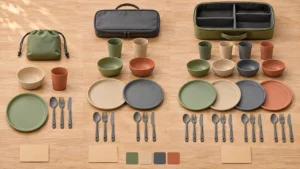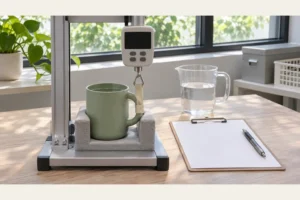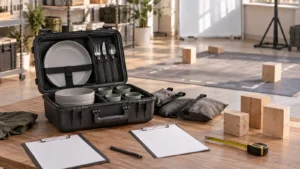
CAMPING CUP HANDLE-LOAD BUYER PROTOCOL
A camping cup handle load test is defensible only when the buyer approves the cup fill state, body support, load point, pull direction, application rate, hold time, repeats and acceptance rule before inspection. Record every result and any visible change. Do not borrow a force value from another cup, material or handle geometry, and do not call an observation a universal pass/fail standard.
Reviewed November 6, 2026 at 16:24:50 CST · GEO D / X + E
What Are the 7 Steps in a Camping Cup Handle Load Test?
| Step | Control to record | Buyer approval question |
|---|---|---|
| 1. Condition | Sample environment, conditioning time and any prior use or cleaning | Were comparison cups prepared identically? |
| 2. Identify | Cup code, revision, sample ID, handle geometry and visible condition | Can the result be traced to the exact finished article? |
| 3. Fill | Empty, approved working fill or approved maximum fill; liquid type and mass | Does the state represent the purchasing question? |
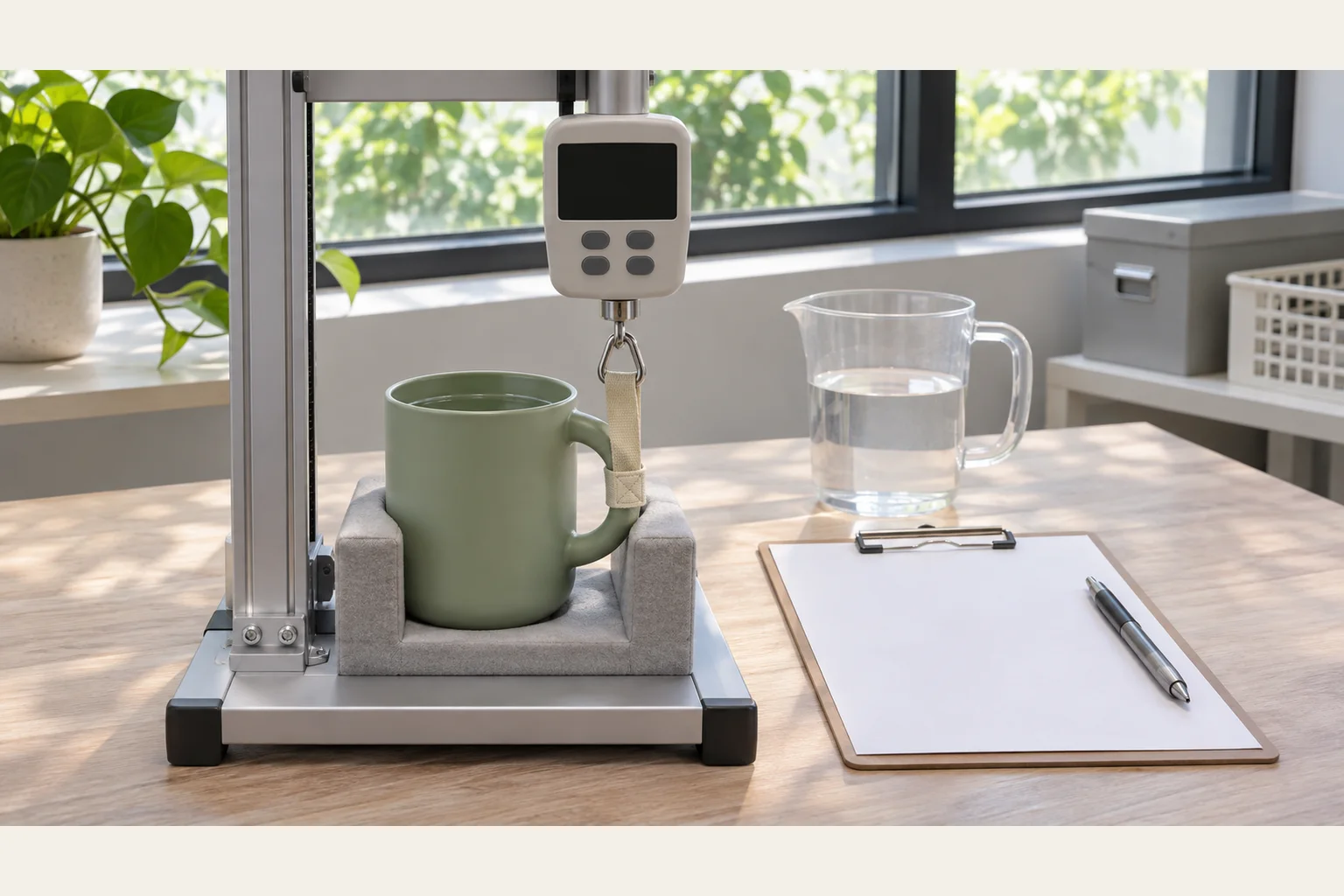
| 4. Support | Body cradle, contact areas and whether rotation is prevented | Does the fixture avoid loading the handle roots unintentionally? |
| 5. Load | Strap width, handle point, direction, rate, target and hold time | Can another inspector reproduce the loading sequence? |
| 6. Repeat | Units, repeats and recovery interval; preserve every raw observation | Is variation visible rather than hidden by an average? |
| 7. Approve | Drawing limit, decision rule, damage definitions, reviewer and date | Was the method approved before pass/fail? |
The method documents a buyer-controlled review; it does not create a load requirement. If the released drawing or inspection plan does not define force, time and damage criteria, report the measured observation and hold the conformity decision.
Which Fill State Should Buyers Specify?
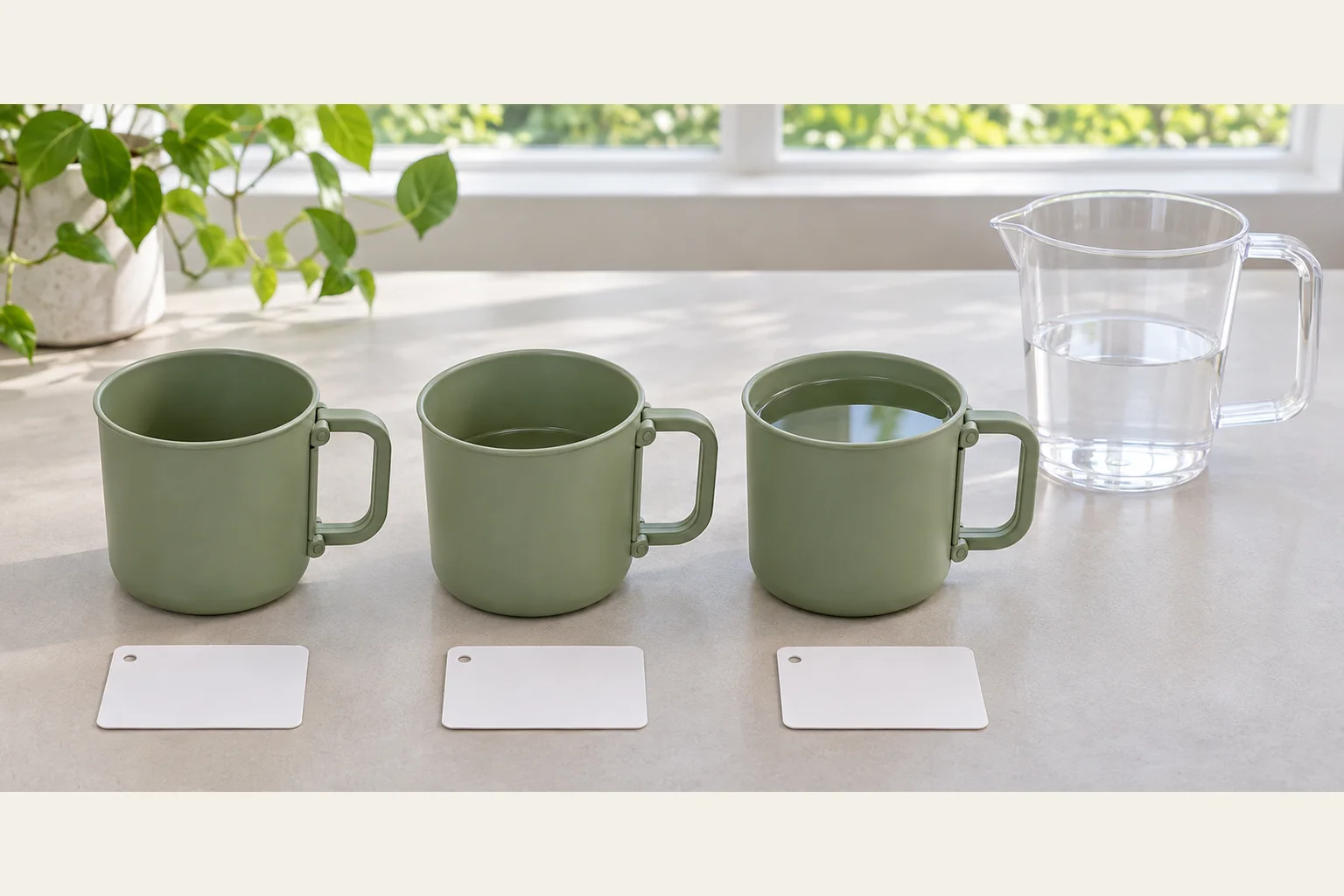
The fill state changes total load and can change how the body is restrained. A camping cup handle strength review should therefore name one state for each decision and record liquid mass, not merely “full.”
| Fill state | Useful procurement question | Risk if substituted |
|---|---|---|
| Empty | Handle and attachment response without contents mass | May underrepresent the intended carried condition |
| Approved working fill | Response at the buyer-defined service level with headspace | Results differ if inspectors choose their own fill line |
| Approved maximum fill | Worst buyer-approved contained mass for the specified use | “To the rim” can create spill and handling variables |
Where Should the Load Be Applied on the Handle?
There is no universal point. The handle midpoint can represent a centered carry, while an upper or lower point may investigate a deliberately off-center condition. Use a soft loop or other approved interface that does not cut the handle and show its width and position on the method drawing.
| Load point | Question answered | Control required |
|---|---|---|
| Handle midpoint | Centered vertical carry under the agreed fill state | Center definition, loop width and vertical alignment |
| Upper third | Buyer-approved off-center condition toward the upper root | Exact distance from the attachment and rotation control |
| Lower third | Buyer-approved off-center condition toward the lower root | Exact distance, direction and fixture clearance |
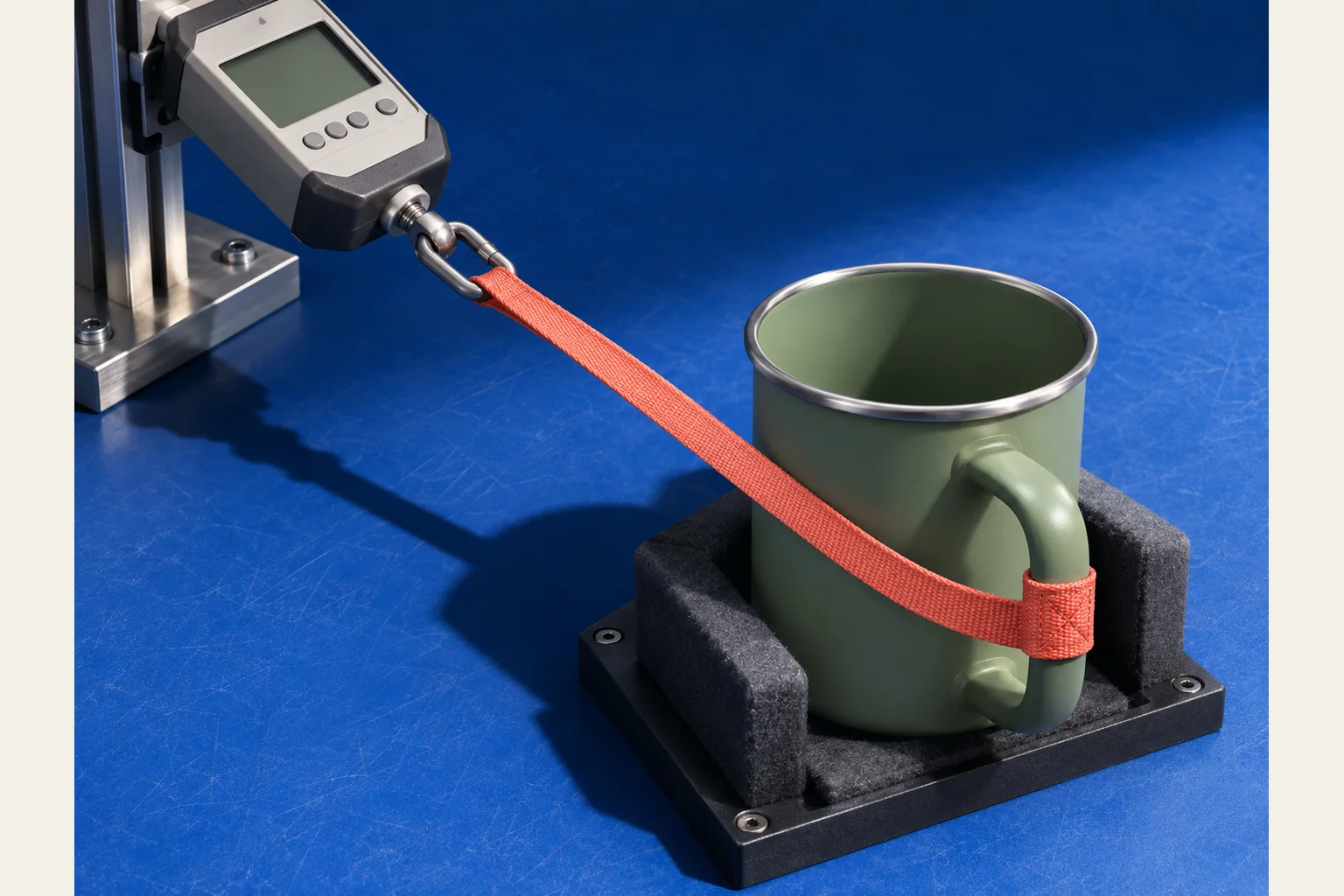
Record force in an approved SI unit and preserve the original value before conversion or rounding. The BIPM SI Brochure defines SI units, while the NIST Engineering Metrology Toolbox explains measurement traceability concepts. Neither source gives a camping-cup acceptance load.
What Must the Handle-Load Worksheet Record?
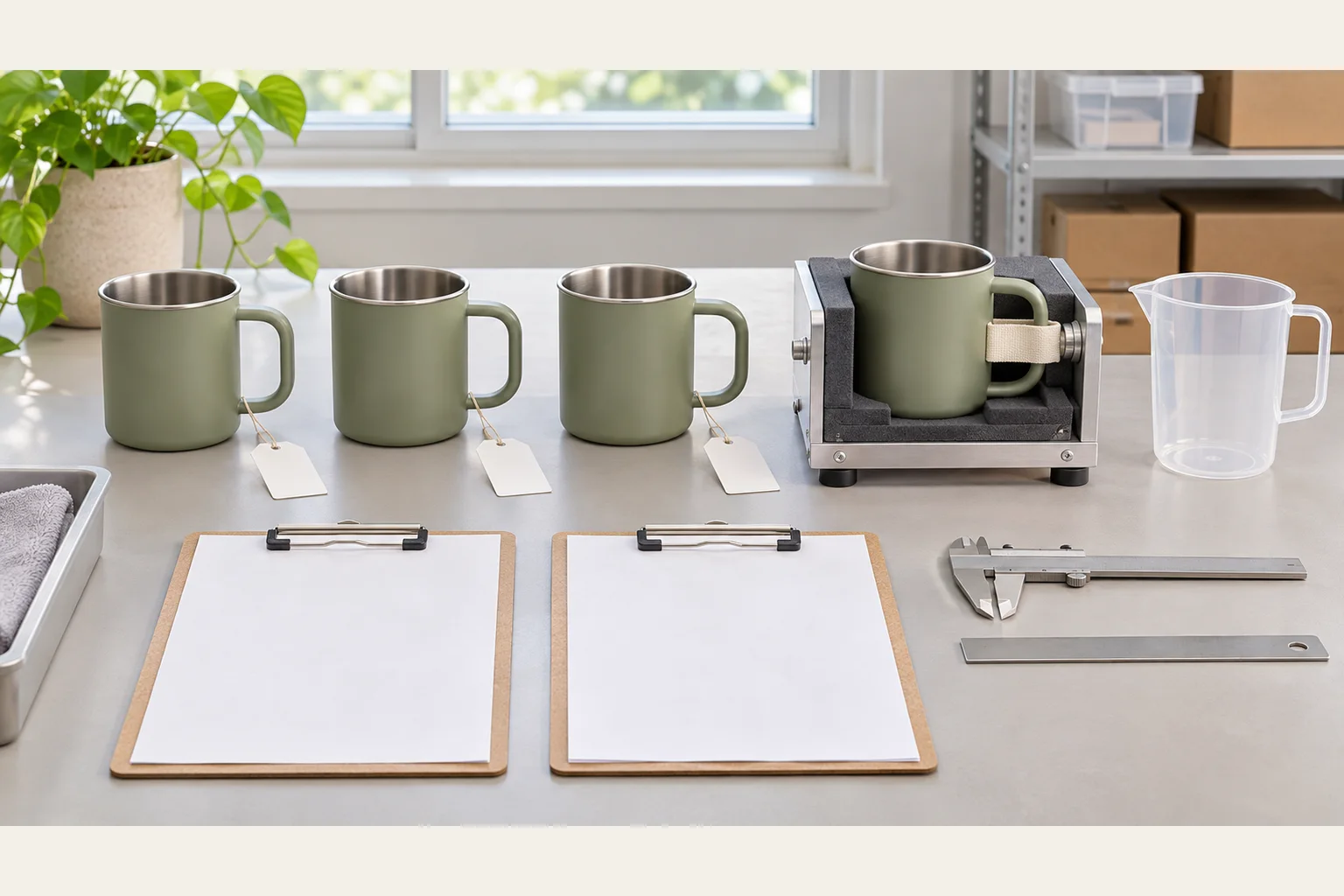
| Worksheet field | Required entry | Do not write |
|---|---|---|
| Article identity | Cup code, revision, sample and handle drawing reference | “Normal cup” |
| Fill state | Liquid, temperature if relevant, fill reference and measured mass | “Full” with no definition |
| Fixture | Body contacts, orientation and restraint drawing or photo reference | “Held firmly” |
| Load application | Point, loop width, direction, rate, target and hold time | Only the target number |
| Instrument | Equipment ID, range/resolution and calibration-status reference where required | “Calibrated” without a record link |
| Raw result | Peak/held value as defined, deformation, cracks, whitening, looseness and recovery | Average only |
| Decision | Released limit, damage definition, pass/fail/deviation and approver | A borrowed limit from another product |
NIST’s official force calibration services describe traceability for force-measuring devices; they do not certify this protocol or any Naike Dinner cup.
How Should the Buyer Approve the Protocol?
Approve a one-page method drawing and worksheet before samples are judged. Link the method revision to the cup drawing, handle geometry, fill state and inspection plan. Review the related tableware measurement-system review, camping-set critical-quality-characteristic matrix and plate and bowl warpage protocol so separate measurands are not merged.
What Does This Review Prove—and What Does It Not Prove?
It can document handle response under the exact approved conditions. It does not prove material identity, food-contact compliance, thermal safety, drop resistance, dishwasher suitability, production capability or conformity of an unmeasured lot. A drinking cup is dinnerware, not cookware. Separate evidence is required for every additional claim.
Buyer Checklist
| Ask the supplier | Review the evidence | Approve only when |
|---|---|---|
| Which fill state and mass are used? | Fill reference, liquid and scale record | The state matches the intended decision |
| Where and how is force applied? | Method drawing, strap width, direction and rate | A second inspector can reproduce the sequence |
| What counts as damage? | Defined crack, whitening, looseness, deformation and recovery criteria | Terms are observable and tied to the same revision |
| How is the lot decision made? | Sample plan, raw results and deviation route | No unapproved averaging or borrowed limit is used |
Frequently Asked Questions
Is the handle midpoint always the correct load point?
No. It is one reproducible option. The buyer must approve the point that matches the purchasing question.
Should the cup body be clamped rigidly?
Only if the approved method defines the contact areas and force. An uncontrolled clamp can change stress at the handle roots.
Can a filled-cup result replace an empty-cup result?
No. They answer different questions unless the buyer explicitly defines an equivalence.
Can one passing sample approve a lot?
No universal rule allows that. Lot definition, sampling and acceptance must come from the buyer-approved inspection plan.
Need a Camping Cup Handle-Load Protocol Review?
Send the cup and handle drawings, fill state, load point, fixture concept, force/time sequence, damage definitions, sample plan and destination use. Naike Dinner can review the information required for a project-specific specification and RFQ without inventing a result or capability.
Request a handle-load protocol review Send the approval worksheet Start a camping cup RFQ