OUTDOOR QUALITY & COMPLIANCE · BUYER DECISION GUIDE
A decorated tableware compliance scope is not fixed by the base item alone. A change to ink, pigment, adhesive, printed area, curing process, supplier or food-contact location can change the substances and exposure conditions that the evidence must cover. Buyers should freeze each decoration system, map its contact route and approve the supporting evidence before listing claims or bulk production.
Decorated tableware compliance scope: the decision rule
Begin with the finished article, not a generic statement that an ink or resin is “food grade.” The relevant question is whether the supplied evidence identifies the final decoration system, substrate, application location and intended conditions of use. A declaration for an undecorated plate does not automatically cover a printed rim. An ink data sheet does not by itself demonstrate the finished article. A pigment masterbatch change can affect composition even when the visible color is close.
Use three gates: identify what changed; decide whether the change can alter migration, transfer, adhesion or foreseeable exposure; then obtain an evidence decision from the responsible technical party. If the supplier cannot link the evidence to the proposed construction, keep the claim pending and request a project-specific review.

Decoration change-risk record
| Change | Why scope may change | Buyer record required | Release decision |
|---|---|---|---|
| Ink chemistry or ink supplier | Different colorants, binders, solvents or additives may be introduced. | Exact ink reference, supplier, application method, cure conditions and evidence linkage. | Reassess; do not inherit the previous approval by color name. |
| Printed area or location | A decoration can move nearer food, lips, hands or abrasion zones. | Controlled artwork showing dimensions, sides and distance from food-contact areas. | Approve only the frozen artwork and placement. |
| Pigment or masterbatch | Color formulation and loading may change while the base polymer remains unchanged. | Color code, masterbatch reference, loading range and finished-article evidence decision. | Review each color family; bracket only with written technical justification. |
| Adhesive label or bonded insert | Adhesive, carrier and insert create new layers and possible edge exposure. | Layer stack, bond area, intended life, cleaning conditions and separation controls. | Keep compatibility and compliance pending until project evidence is agreed. |
| Curing, drying or surface treatment | Process differences can change residuals, adhesion and durability. | Approved process window and production verification method. | Any out-of-window batch requires disposition before shipment. |
| Substrate or surface finish | Adhesion and transfer behavior can change even with the same decoration. | Final substrate grade, texture, pretreatment and interface sample. | Revalidate the system as a construction, not isolated ingredients. |
Map evidence to exposure, not marketing language
For U.S. projects, use the FDA food-contact substance framework and the documented food types and conditions of use to frame the intended exposure. For EU projects, start with the European Commission’s food-contact materials overview and applicable legislation, then have the responsible compliance party identify the measures that apply to the finished construction. These sources define regulatory context; they do not certify a supplier’s proposed decoration.
- Direct food-contact decoration: treat as the highest review priority because the layer is intentionally in contact with food.
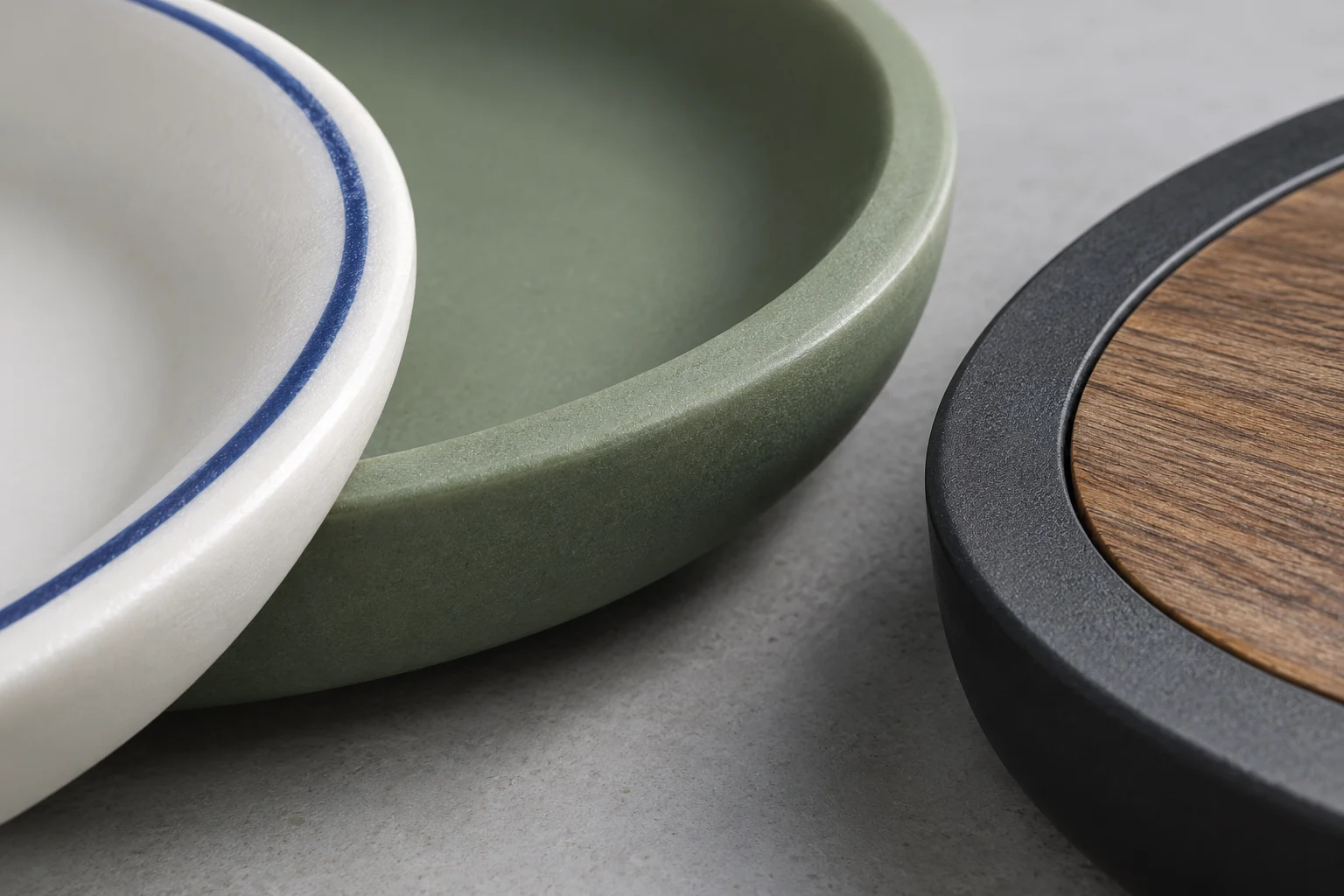
- Lip-contact or rim decoration: record foreseeable oral contact and abrasion rather than calling it “external” without analysis.
- External non-food-contact print: still review hand transfer, cleaning, wear and possible edge migration.
- In-mass pigment: identify the final loading and every color reference included in the purchase.
- Removable label: define whether it is removed before first use and control adhesive residue.
- Permanent bonded insert: assess the whole layer stack, bond line and separation risk.
Primary references: FDA food-contact substances, FDA food types and conditions of use, and the European Commission food-contact materials overview. Buyers should also consult the EU legislation index for the destination and material concerned.
Minimum decoration approval record
| Field | What to freeze | Evidence owner |
|---|---|---|
| Finished article | Component, substrate grade, finish and revision | Supplier plus buyer |
| Decoration system | Ink, pigment, adhesive, carrier, insert and suppliers | Supplier technical contact |
| Artwork and zone | Controlled drawing, side, dimensions and contact classification | Buyer design owner |
| Process | Application, pretreatment, cure/dry window and inspection | Manufacturer |
| Use conditions | Food types, temperature, contact duration, cleaning and reuse | Buyer regulatory owner |
| Evidence | Document IDs, sample identity, test scope, gaps and expiry/review date | Named approver |
| Change control | Changes requiring notification and reapproval | Buyer and supplier |
Do not convert this record into a blanket claim. It is an approval trail for the defined construction. If the artwork, substance, process or intended use changes, reopen the affected rows and document whether existing evidence remains applicable.

Buyer checklist
| Ask | Verify | Record |
|---|---|---|
| What exactly changed? | Compare controlled BOM, artwork and process revisions. | Old/new references and effective date. |
| Where can users contact it? | Food, lip, hand, abrasion and cleaning routes. | Marked drawing and intended-use statement. |
| What evidence covers it? | Identity, sample, method, conditions and conclusion match. | Document ID, owner, gaps and decision. |
| What must trigger reapproval? | Supplier, chemistry, loading, location, process or substrate changes. | Written notification and hold/release rule. |
For related controls, review our mixed-material dishwasher claim guide, dinnerware versus cookware claim boundary, and tableware test-report scope guide. To review a live project, send the proposed decoration stack, share the controlled artwork, and request a scope-gap review.
Procurement FAQ
Does changing only the logo color require review?
Yes. Review does not always mean repeating every test, but it does require an evidence decision. The new color may use a different pigment, ink family or loading. Record the exact formulation reference and obtain written justification for any evidence carried over.
Can an external logo be excluded automatically?
No. Its position may reduce direct food exposure, but lip contact, hand transfer, abrasion, washing and edge contact remain relevant. Classify the actual zone and use conditions before deciding what evidence is needed.
Is an adhesive label simpler than printing?
Not necessarily. A permanent label adds a carrier, adhesive and bond edge. A removable label needs removal instructions and residue control. Define whether the label remains during use and cleaning.
What should be sent with an RFQ?
Send the component list, substrate references, artwork with decoration zones, desired colors, process assumptions, destination markets, intended use and cleaning conditions. Ask the supplier to mark evidence-covered points, gaps and project confirmations rather than giving a generic yes/no answer.
Freeze the decoration system before you approve the claim
Send the final artwork, layer stack, material references, target markets and use conditions. We will structure the open questions for sample, specification and quotation review without assuming unverified compliance or production capability.
Request a decoration scope review