A nested-set tolerance review should map every functional interface, record nominal dimensions and upper/lower limits from controlled drawings, calculate worst-case clearance or interference, and connect each risk to sample evidence and an owner. The release output is an interface stack-up register—not a visual judgment that one prototype happens to nest.
Start with interfaces, not isolated part dimensions
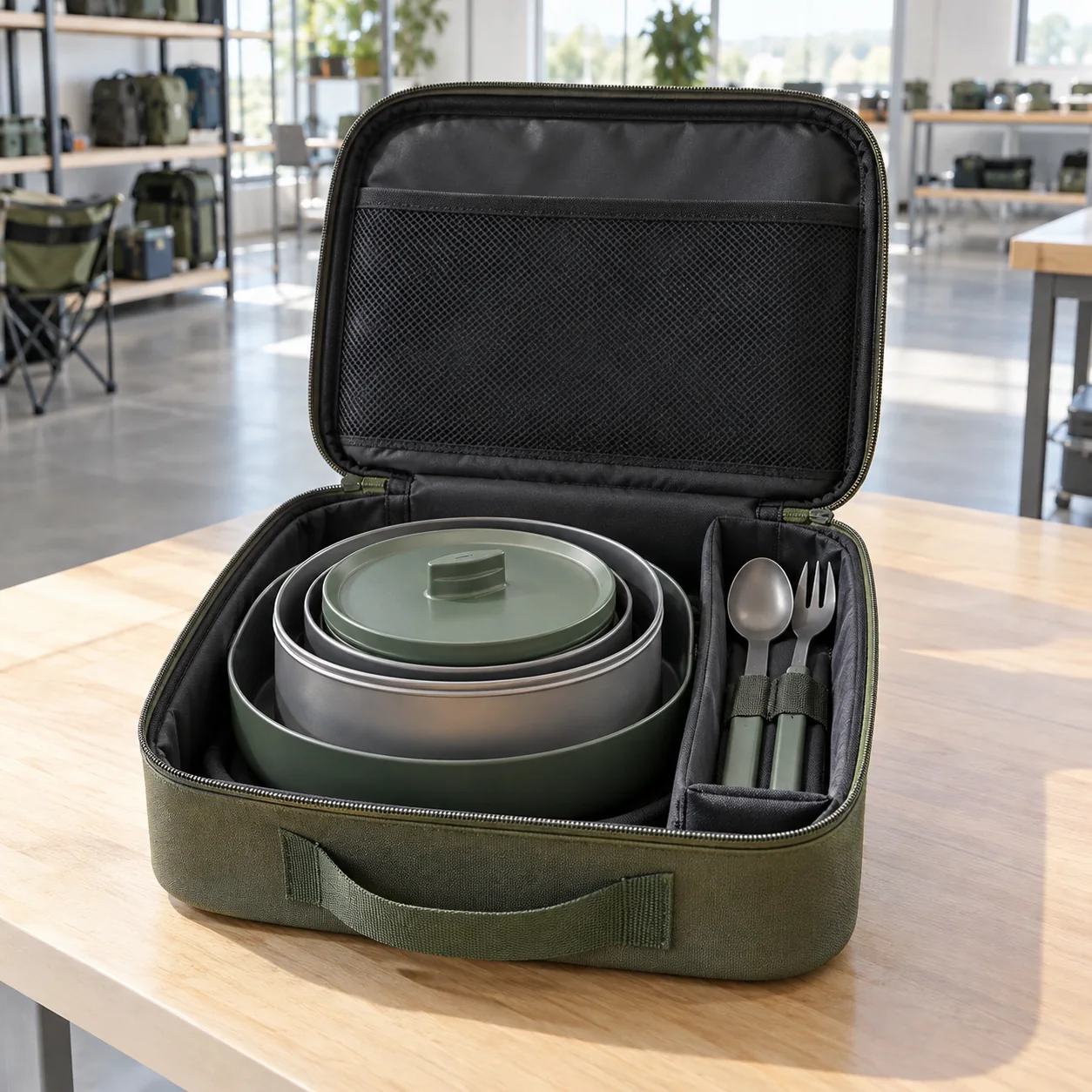
A nested tableware tolerance review is useful when it follows the complete load path. A plate foot may sit in another plate’s well; a bowl foot may locate against a bowl interior; a cup base may enter a recess; the resulting stack may then meet a case base, side wall and lid. Each interface consumes part of the available space. Reviewing component drawings separately can therefore miss an assembled worst case.
Freeze the proposed component matrix and drawing revisions first. Identify which pieces are shared across set sizes, which are new, and which surfaces are intended to locate, clear, flex or remain untouched. A change to a foot ring, rim bead or case liner can affect several downstream interfaces even when the external product name stays the same.
This method supports dinnerware fit review. It does not establish cookware suitability, direct-heat performance, food-contact compliance, impact performance or a production capability claim. Those conclusions require final materials, construction, use conditions and project evidence.

Nested tableware tolerance review register
| Interface | Controlled inputs | Worst-case question | Observable failure | Owner/evidence |
|---|---|---|---|---|
| Plate foot ↔ plate well | Foot OD, well ID, concentricity, draft and finish build | What are minimum radial clearance and maximum lateral movement? | Binding, rocking, rubbing or unstable stack | Drawings, inspection record and nested samples |
| Bowl foot ↔ bowl interior | Foot profile, inner wall profile, rim height and roundness | Can any allowed condition wedge or bottom early? | Stuck bowls, rim load or excess stack height | Section drawing and release sample |
| Cup base ↔ cup/recess | Base diameter, taper, handle envelope and rim geometry | Does the handle or rim become the unintended locator? | Handle clash, tilted cup or trapped contact | Assembly drawing and full-set pack trial |
| Utensil zone ↔ stack | Tool length, sleeve thickness, closure compression | Can utensils enter a dinnerware clearance zone? | Point contact, marking or incomplete closure | Pack drawing and closed-case review |
| Nested stack ↔ case base/lid | Accumulated stack height, liner thickness and case internal height | What clearance remains at both extremes? | Preload, rattle, lid bowing or latch strain | Case drawing and compressed pack sample |
| Stack ↔ case side wall | Stack diameter/width, wall shape and restraint thickness | Is movement controlled without hard interference? | Rubbing, jammed removal or uncontrolled motion | Cross-section and user pack/unpack observation |
Keep units, datums, tolerance type, drawing revision and measurement method visible in the nested tableware tolerance review register. Do not mix nominal dimensions from one revision with samples from another. For metrology language and traceability questions, use the NIST measurement traceability guidance and the NIST/SEMATECH Engineering Statistics Handbook. These sources frame measurement discipline; they do not validate a proposed stack.
Calculate the condition the buyer needs to control
For a simple diametral interface, minimum clearance is the smallest permitted receiving diameter minus the largest permitted inserted diameter. Maximum clearance uses the opposite limits. A vertical stack requires the relevant allowed heights and seating conditions to be combined. More complex interfaces may also depend on draft, roundness, flatness, concentricity, flex and surface build.
Use symbolic or revision-controlled values until engineering releases the numbers. Avoid copying dimensions from a concept render or measuring a single attractive sample and calling it the specification. A nested tableware tolerance review should show which values are released and which remain open. If statistical methods are proposed instead of worst-case limits, document the assumptions, process evidence, acceptance rule and responsible approver.

Run the nested tableware tolerance review on matched samples
| Step | Buyer action | Required record |
|---|---|---|
| 1. Freeze inputs | List every component, drawing, revision, finish and intended orientation. | Approved component matrix |
| 2. Map interfaces | Mark locating, clearance, flexible and prohibited contacts. | Interface diagram and register |
| 3. Review limits | Enter controlled upper/lower limits and identify missing tolerances. | Open-item list with owner |
| 4. Evaluate stack-up | Calculate the decision-relevant worst cases and assumptions. | Traceable calculation sheet |
| 5. Measure samples | Use a documented method and match results to revision IDs. | Measurement record and sample ID |
| 6. Pack and operate | Nest, remove, repack, close and carry the complete set. | Location-specific observations |
| 7. Dispose risks | Accept, revise, request evidence or run a controlled repeat. | Approval record and change owner |
Check fit before and after the project’s intended washing and temperature exposure, but do not assume a material change without data. If food-contact questions are in scope, the FDA food-contact substances overview helps buyers define the evidence question separately from dimensional fit.
Applications, limits and commercial risk
Family sets: review repeated user nesting and easy separation. Retail kits: control presentation, missing-piece visibility and pack consistency. Rental programs: prioritize count checks, mixed-revision prevention and replacement compatibility. Parcel channels: include the retail pack and transport pack in the final envelope review.
Link the register to the nesting-versus-stacking decision, the stackability review and the case-fit method. A tolerance register is not complete if it omits access, retention or cleaning behavior.
The main commercial risks are approving one non-representative sample, leaving ownership of cross-component dimensions unclear, and changing a shared component without rechecking every dependent set. Keep the nested tableware tolerance review linked to the change record. Compatibility to be confirmed by project sample and drawing.
B2B Buyer Checklist
| Check | Buyer question | Why it matters |
|---|---|---|
| Revision control | Do drawings, samples and the component matrix match? | Prevents obsolete geometry from being approved. |
| Interface ownership | Who owns each mating dimension and change? | Stops cross-part gaps from becoming unowned. |
| Limit data | Are both upper and lower limits available? | Nominal-only review hides worst cases. |
| Stack calculation | Are assumptions, units and datums explicit? | Makes the decision reproducible. |
| Full-set sample | Was the complete revision-matched set packed and operated? | Exposes interactions absent from single parts. |
| Change control | Which linked interfaces require reapproval after a change? | Protects shared-component programs. |
| Evidence boundary | Are fit findings separated from material/compliance claims? | Prevents unsupported marketing conclusions. |
Buyer FAQs
Is one good nesting sample enough?
No. It demonstrates that sample’s condition, not the allowed drawing extremes or process distribution.
Should buyers always use worst-case arithmetic?
Use it when guaranteed interchangeability at drawing limits is required. A statistical approach needs documented assumptions, process evidence and approval.
Does a loose fit automatically mean failure?
No. Evaluate access, rattle, surface contact, retention and case interaction against the intended use.
Which dimensions belong in the register?
Only decision-relevant inputs from controlled drawings, plus geometry controls and flexible layers that materially affect the interface.
When should the review be repeated?
Repeat the nested tableware tolerance review after a relevant drawing, material, finish, process, component-source, case or packaging change.
What should accompany an RFQ?
Send the component matrix, revision drawings, target stack order, case envelope, use and washing conditions, markets, evidence expectations and unresolved interfaces.
Request an interface stack-up review
Send revision-controlled drawings, the component matrix, proposed nesting sequence, case envelope and approval concerns. Naike Dinner can review the brief against verified capabilities and identify the samples, measurements and written confirmations needed before release.
Send your tolerance-review brief or use the inquiry form beside this article. Contact Naike Dinner for sample and quotation review.