
Direct answer: A camping set pre shipment inspection should release the lot only after the inspector reconciles the purchase order, approved BOM, drawings and pack-out standard against sampled finished sets. Record component count, identity, appearance, critical fit interfaces, packaging, trace labels and evidence photos. Segregate failures, document disposition authority and never convert an unresolved deviation into an informal pass.
Scope: this is a buyer-side release-sheet framework for reusable multi-component camping dinnerware. It is not an inspection result, certification, laboratory method or claim about an unprovided Naike Dinner product. The buyer must approve lot definition, sampling, tolerances, defect classes, acceptance rules, evidence scope and release authority.
Freeze the camping set pre shipment inspection basis
Before selecting a carton, the inspector needs a controlled reference package: purchase order, approved BOM, current drawings, artwork, color or appearance references, approved master set, packaging specification, labeling file and inspection instruction. Record every revision. If two sources conflict, stop and ask the named buyer authority which source controls; do not select the easiest requirement.
The upstream replacement-part inspection checklist explains how to compare an individual incoming component with its master-set interfaces. A final camping set pre shipment inspection has a broader purpose: it verifies the assembled set, every required component, the pack sequence, sales-unit presentation and shipment evidence before release. The camping dinnerware BOM revision guide and golden-sample control guide provide the linked revision controls.

Reconcile set count at three levels
A complete retail set can still be short when the master carton count is correct. During camping set pre shipment inspection, reconcile three levels: units per set, sales units per inner or master carton, and total cartons in the release lot. Record actual counts, not only “pass.” For mixed configurations, separate every color, pack type, market label and revision that could form a different inspection population.
| Level | Approved source | Inspector records | Hold trigger |
|---|---|---|---|
| Component per set | BOM and pack-out drawing | Actual plates, bowls, cups, utensils, containers, lids, case parts and inserts | Missing, extra, substituted or mixed-revision component |
| Set configuration | PO line and approved sample | Color, component combination, user count and optional module | Configuration does not match ordered line |
| Sales unit | Packaging specification | Set count, accessories, instruction, label and protection | Wrong insert, label, barcode or incomplete sales unit |
| Carton | Carton pack plan | Sales units, orientation, divider, carton mark and seal | Wrong quantity, uncontrolled packing or mixed status |
| Release lot | Shipment list and lot definition | Cartons inspected, lot identifiers and total quantity represented | Untraceable or improperly combined populations |
Verify the system interfaces, not isolated pieces
Visual appearance cannot prove that components work together. In camping set pre shipment inspection, assemble the sampled set in the approved sequence. Check nesting, lid engagement, cup or utensil retention, case or organizer clearance, closure path, access and packed contact points. Record the mating component and sample identity. Compatibility to be confirmed by project sample and drawing.
| Interface | Evidence method | Release record |
|---|---|---|
| Plate-to-bowl nesting | Load the approved stack without forcing | Insertion, removal, rocking, rubbing and stack-height observation |
| Lid-to-container | Use the specified orientation and mating revision | Alignment and engagement observation; no leak claim unless separately evidenced |
| Utensil-to-retainer | Insert and remove each specified utensil | Retention, access, surface contact and unresolved force |
| Cup-to-holder | Load all cup positions and close the carrier | Clearance, migration, removal and neighboring-component contact |
| Full set-to-case | Pack the complete BOM in the approved sequence | Closure, pressure points, protrusion, movement and handle/load path |

16-field camping set pre shipment inspection release sheet
Use the following camping set pre shipment inspection fields as a copyable release record. Attach the project-specific checklist and acceptance limits instead of placing vague “OK” marks in the evidence column. One sheet should identify one controlled inspection population.
| # / field | Required entry | Release decision question |
|---|---|---|
| 1. PO and line | Purchase order, line and buyer item | Is the inspected set the ordered set? |
| 2. Supplier item | Supplier part or project identifier | Can both parties trace the same configuration? |
| 3. Lot definition | Production, batch, carton and shipment boundaries | Does the sample represent a defined population? |
| 4. Quantity | Ordered, completed and presented quantities | Are quantity differences reconciled? |
| 5. Revisions | BOM, drawings, artwork and packaging revisions | Are all controls current and consistent? |
| 6. Sample plan | Method, sample size and selection record | Was selection performed as approved? |
| 7. Component count | Actual count by BOM line in sampled sets | Are required pieces present without substitutions? |
| 8. Identity / appearance | Marks, color method, finish and visible condition | Are observations within approved limits? |
| 9. Dimensions | Actual values, units, instrument and method where required | Do drawing-controlled characteristics conform? |
| 10. Fit interfaces | Mating parts, sample IDs and assembled observations | Does the approved configuration assemble and pack? |
| 11. Claims evidence | Applicable report or declaration references and scope | Are requested claims supported for this finished configuration? |
| 12. Sales-unit pack | Insert, protection, instruction, label and barcode | Does presentation match the approved pack? |
| 13. Carton pack | Count, orientation, divider, mark, seal and condition | Can the approved pack-out be reproduced? |
| 14. Exceptions | Nonconformance IDs, quantities and evidence photos | Are deviations contained and traceable? |
| 15. Disposition | Accept, hold, sort, rework, return or concession | Is the decision authorized and conditional items explicit? |
| 16. Release | Inspector, buyer authority, date, time and signature | Is there a named person accountable for shipment release? |
Capture pack-out evidence that another reviewer can audit
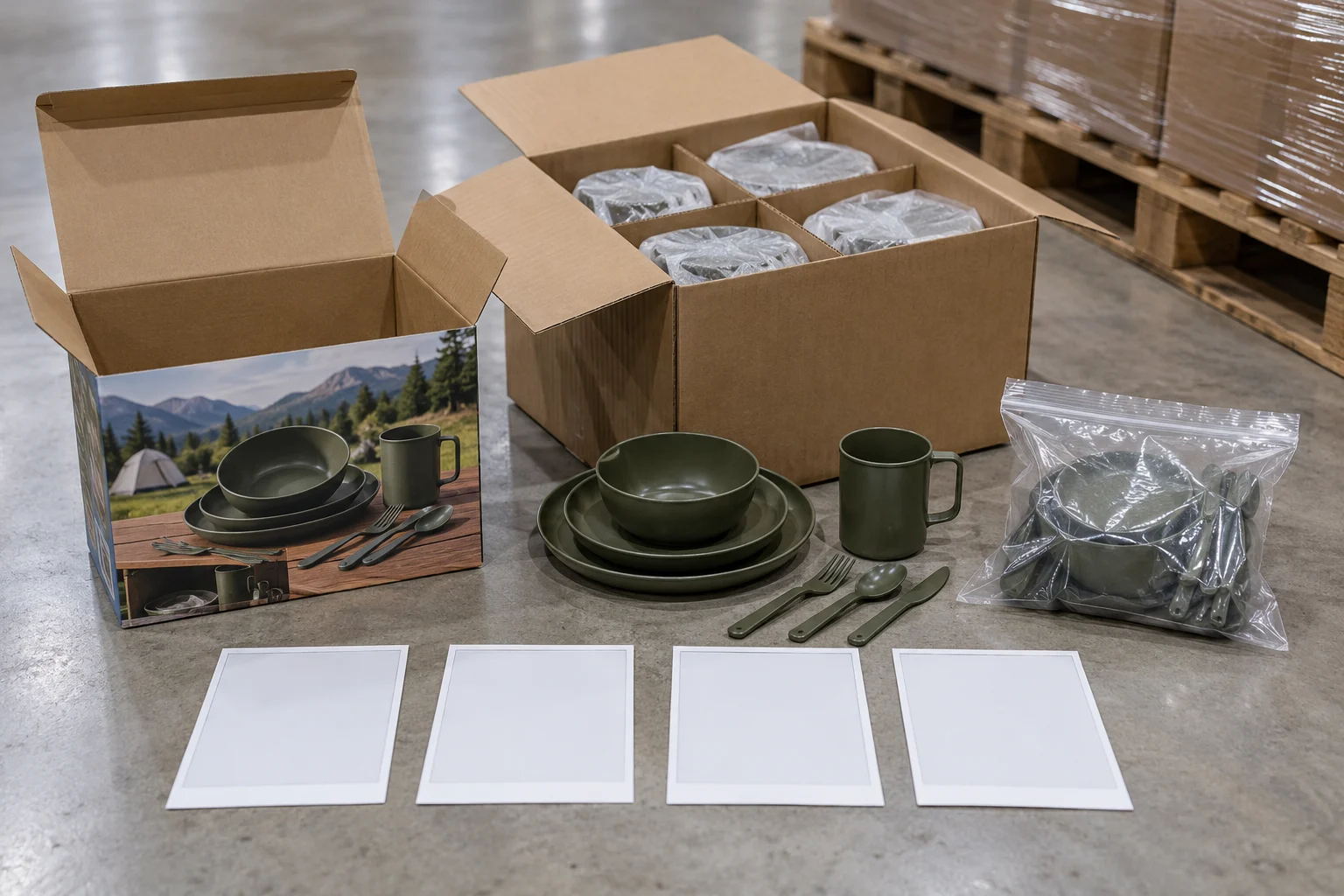
For camping set pre shipment inspection, photograph the closed sales unit, opened sales unit, complete component layout, critical interfaces, inner protection, carton interior, carton marks and seal. Include an identifier or evidence board without obscuring the item. Record which carton and sampled set appear in each image. Avoid staged photos that cannot be linked to the selected population.
Distribution testing is a separate approval activity. The ISTA test procedures overview can help a buyer select a conversation starting point, but only a project-approved procedure, specimen and report can establish a test result. Similarly, an inspection photo of intact packaging is not proof of future transit performance.
Keep material and compliance evidence inside its scope
A camping set pre shipment inspection can confirm that a named evidence package was supplied and that product identifiers match the approved record. It cannot transform a visual check into proof of material identity, fiber content, BPA status, biodegradability, dishwasher suitability, microwave use or food-contact compliance. Review the finished composition, colorants, decorations, adhesives, intended foods, contact time, temperature, cleaning and target market.
For regulatory framing, consult the FDA inventory of effective food-contact notifications, EU Regulation (EC) No 1935/2004 and EU Regulation (EU) No 10/2011. Applicability and evidence remain project-specific. This article concerns dinnerware and packaging; it does not establish cookware or direct-flame suitability.
Separate evidence, cause and disposition
Close the camping set pre shipment inspection by describing the observed condition before naming a suspected cause. Segregate affected quantity, preserve representative failures and record the nonconformance identity. A concession should state the exact deviation, affected lot, residual risk, quantity, conditions and approvers. Rework requires an instruction plus reinspection criteria. Never erase the original result after repair.
| Disposition | Use when | Minimum record |
|---|---|---|
| Release | Approved criteria are met | Inspection sheet, evidence index and authorized release |
| Hold | Evidence, identity or decision is incomplete | Segregated quantity, location, owner and next action |
| Sort / rework | A controlled action may separate or correct units | Instruction, quantity, result and reinspection |
| Concession | Buyer accepts a defined deviation for a defined lot | Deviation, risk, limits, conditions and signatures |
| Return / replace | The lot is not approved for shipment | Quantity, trace, custody and corrective-action request |
Buyer checklist
| Buyer supplies | Supplier confirms | Release record retains |
|---|---|---|
| PO, BOM, drawings, master set, pack-out standard and approved revisions | Lot definition, quantity, locations and all open deviations | Population, sample selection, actual counts and measured observations |
| Sampling, defect classes, limits and decision authority | Inspection access, evidence package and containment readiness | Failures, evidence photos, disposition and reinspection |
| Target market, intended use and claims/evidence requirements | Which evidence applies to the finished set and what remains unverified | Evidence references, scope, approvers and release time |
Procurement FAQ
Can a packing-list count replace opening sampled sets?
No. The packing list is a source to reconcile. The camping set pre shipment inspection must verify selected finished sets and packaging against the approved BOM and pack plan.
Does one assembled sample prove the whole lot fits?
No. The buyer-approved sampling and acceptance plan determines how observations relate to the lot. Preserve sample identities and do not hide mixed revisions or production populations.
Can a supplier release while a deviation is awaiting approval?
Only if the buyer’s controlled process explicitly authorizes that condition. Otherwise retain the lot on hold until a named authority signs the disposition.
Should the inspector test cookware performance?
Not under this dinnerware release sheet unless the project adds a qualified method and specification. Dinnerware fit and appearance do not prove cookware, heating or direct-flame performance.
What should be sent for a quotation or inspection-plan review?
Send the BOM, drawings, master-set record, quantities, target markets, intended use, packaging route, evidence list, sampling instruction and acceptance limits.
Request a camping set release-sheet review
Send the controlled BOM and drawings, target configuration, pack-out plan, lot definition, sampling rule, acceptance criteria and evidence requirements. Naike Dinner can identify missing decisions and interface questions without inventing tolerances, results or certifications.
Send the inspection brief · Request a sample review · Ask for a project quotation