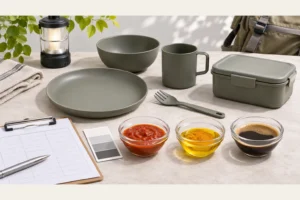
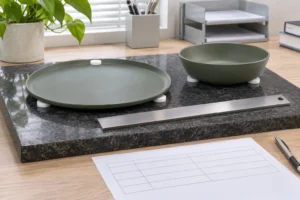
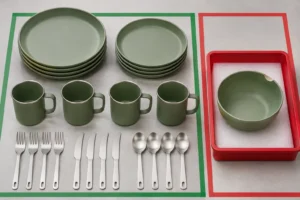
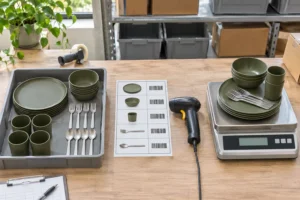
Direct answer: a mixed-material set dishwasher claim should not be unrestricted unless every included component, finish, decoration and interface has evidence for the same declared program and loading conditions. If even one pouch, seal, lid, adhesive or decorated part falls outside that scope, qualify the claim by component or require hand washing for the exception.
Evidence boundary: this is a buyer-side decision method, not a test result for a Naike SKU. Materials, geometry, dishwasher program, detergent, temperature, cycle count and destination-market wording must be confirmed for each project.
Decision path
Why one set-level claim often fails
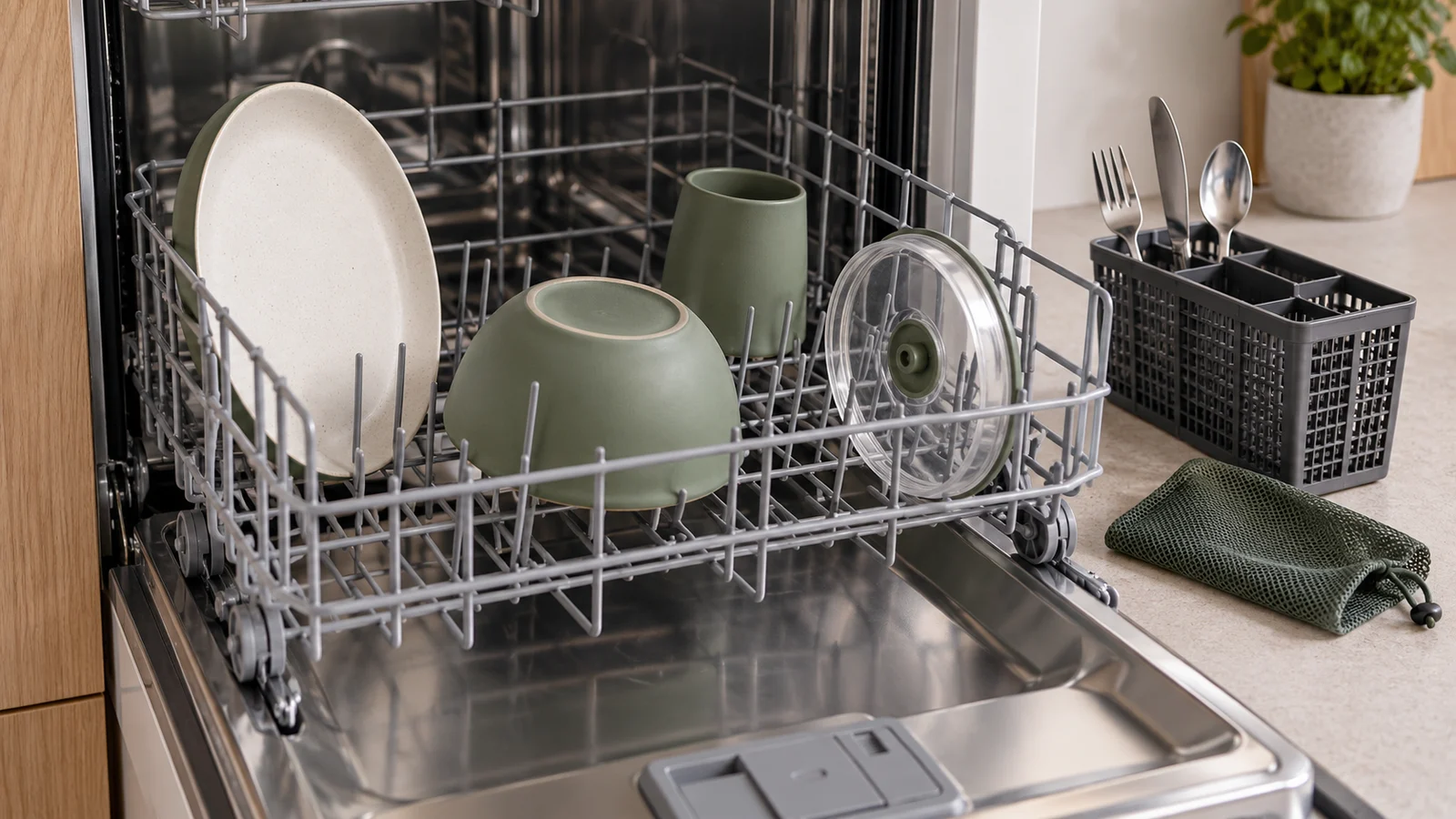
A retail set looks like one item, but a dishwasher exposes every part to heat, water jets, detergent, repeated wetting and drying, and rack contact. A rigid plate may have suitable evidence while a printed cup, flexible lid, bonded insert or textile pouch has a different risk profile. “Dishwasher safe” therefore cannot be inherited from the strongest component.
Start by separating food-contact authorization from durability and care wording. The U.S. FDA food-contact substances program addresses food-contact substance authorization; it does not automatically prove that a finished decorated set survives a buyer-selected dishwasher cycle. FDA also publishes food types and conditions of use. The European Commission food-contact materials overview similarly shows why the buyer must keep applicable evidence tied to the actual article and intended use.

Mixed-material set dishwasher claim matrix
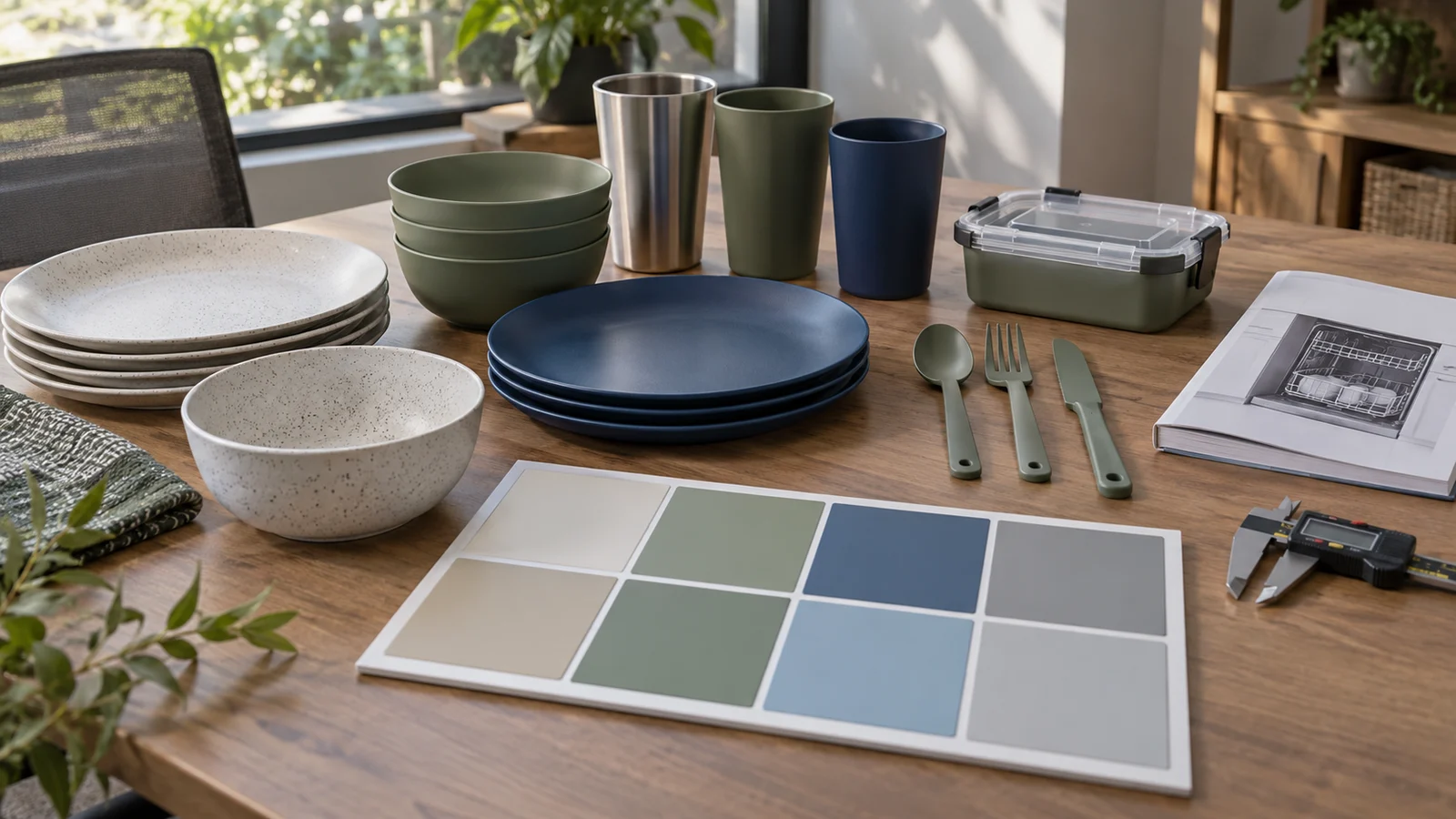
Use one row for every supplied component and every material, finish or decoration variant. “Unknown” is a stop condition, not a provisional pass.
| Component | Evidence to identify | Program variables to match | Decision |
|---|---|---|---|
| Plate and bowl | Final material, color, surface and finished geometry | Rack position, peak temperature, detergent, cycle count | Approve only the matched version |
| Cup | Body plus rim, print, coating or sleeve | Top/bottom rack, inversion, drainage, repeat cycles | Narrow wording if decoration differs |
| Lunch box | Base, lid, hinge, latch and any insert | Open/closed state, part separation, deformation and closure check | Approve by subassembly |
| Flexible lid or seal | Exact formulation, color and thickness | Retention, distortion, odor and cleaning residues | Separate claim if scope differs |
| Cutlery | Metal or polymer body plus handle, coating and joint | Basket loading, contact points, staining and edge condition | Do not inherit from plates |
| Logo/decoration | Ink, pigment, transfer, coating or adhesive as applied | Abrasion, fading, lifting and food-contact position | Revalidate when decoration changes |
| Carry bag/pouch | Textile, lining, zip and care label | Usually outside dishwashing scope | Explicitly exclude unless separately supported |
A practical approval rule
Define the proposed mixed-material set dishwasher claim as the intersection of the supported conditions for all included components:
Approved set claim = the narrowest common program supported by every included part.
Record that mixed-material set dishwasher claim beside the exact component revisions it covers. This prevents the approved wording from being copied to a later color, decoration or substitute component without review.
If the plate supports program A, the cup supports A and B, the cutlery supports B, and the lid has no matched evidence, there is no common set-level program. The honest outcome is component-specific care wording, a revised component choice, or additional verification. Do not average results and do not treat one passed sample as evidence for untested colors, coatings or suppliers.
Example approval record
- Proposed wording: “Dishwasher safe, top rack.”
- Evidence match: plates/bowls—matched; cups—matched only without print; cutlery—program not matched; lid—unknown; pouch—excluded.
- Decision: reject the blanket claim.
- Next action: qualify by component and verify the final printed cup, cutlery and lid under one defined program.
What the verification brief must freeze
- Final bill of materials, supplier/material grade, color, finish, decoration and adhesive system.
- Finished-component drawings and revision numbers, including hinges, thin sections and bonded interfaces.
- Named dishwasher type/program, rack location, water-temperature range, detergent, loading orientation and number of cycles.
- Pre-agreed observations: cracking, warpage, loss of fit, closure, fading, peeling, corrosion, odor, residue, drainage and unsafe edges.
- Acceptance criteria, sample quantity, conditioning, inspection timing and the person authorized to approve wording.
For the intended-use foundation, pair this record with component food, temperature and cleaning conditions. Keep the final revision linked to the finished-set evidence file, and use the report-to-final-color reconciliation method whenever pigment or finish changes.
Write the care statement from the decision
| Matrix result | Permissible direction | Avoid |
|---|---|---|
| All parts share one verified program | State that exact program and loading instruction | Broader “all dishwashers” language |
| Only rigid pieces share a program | Name the eligible pieces; give separate care for lid/pouch | Set-level badge without exceptions |
| Decoration not matched | Hand-wash the decorated version or verify it | Borrowing evidence from undecorated samples |
| No common evidence | Use conservative hand-wash instructions pending review | “Dishwasher safe” based on material reputation |
Buyer checklist
| Ask the supplier | Verify internally | Approve before artwork |
|---|---|---|
| Component BOM, variants and evidence files | Evidence matches final revision and intended program | Exact eligible components and exceptions |
| What changes with color, logo or adhesive | Destination-market and retailer wording rules | Care icons, text and instruction placement |
| Sample and test-brief feasibility | Failure criteria and responsible approver | Signed claim decision and change trigger |
Procurement FAQ
Can the plate report cover the whole camping set?
No. It can support only the article, construction and conditions within its documented scope. Other components and interfaces require their own matched evidence.
Does “food-contact compliant” mean “dishwasher safe”?
No. Food-contact status and repeated dishwasher durability answer different questions. Both may matter, but neither substitutes for the other.
Can a top-rack limitation solve every gap?
No. Top-rack wording is useful only when the evidence and instructions actually support that condition for each named component.
What change should reopen the decision?
Any change to material, supplier, pigment, print, coating, adhesive, thickness, geometry, closure or dishwasher program should trigger a documented scope review.
Who should own the final claim?
The buyer should name one approver who can reconcile the component evidence, care artwork and intended program. The signed record should state the exact mixed-material set dishwasher claim and every exclusion.
Next procurement action
Send the component list, final material/decoration variants, destination markets, proposed care statement and intended dishwasher program. We can map the evidence gaps and sample-review questions without asserting unverified capability. Request a component claim review, send the proposed care artwork, or ask for a project-specific quotation review.
Updated