Camping set critical quality characteristics translate buyer risk into a controlled list of component, assembled-set and packaging features. A CTQ is not every dimension on a drawing. It is a feature whose failure would create an unacceptable safety, use, count, fit, identity, evidence or delivery outcome for the defined project.
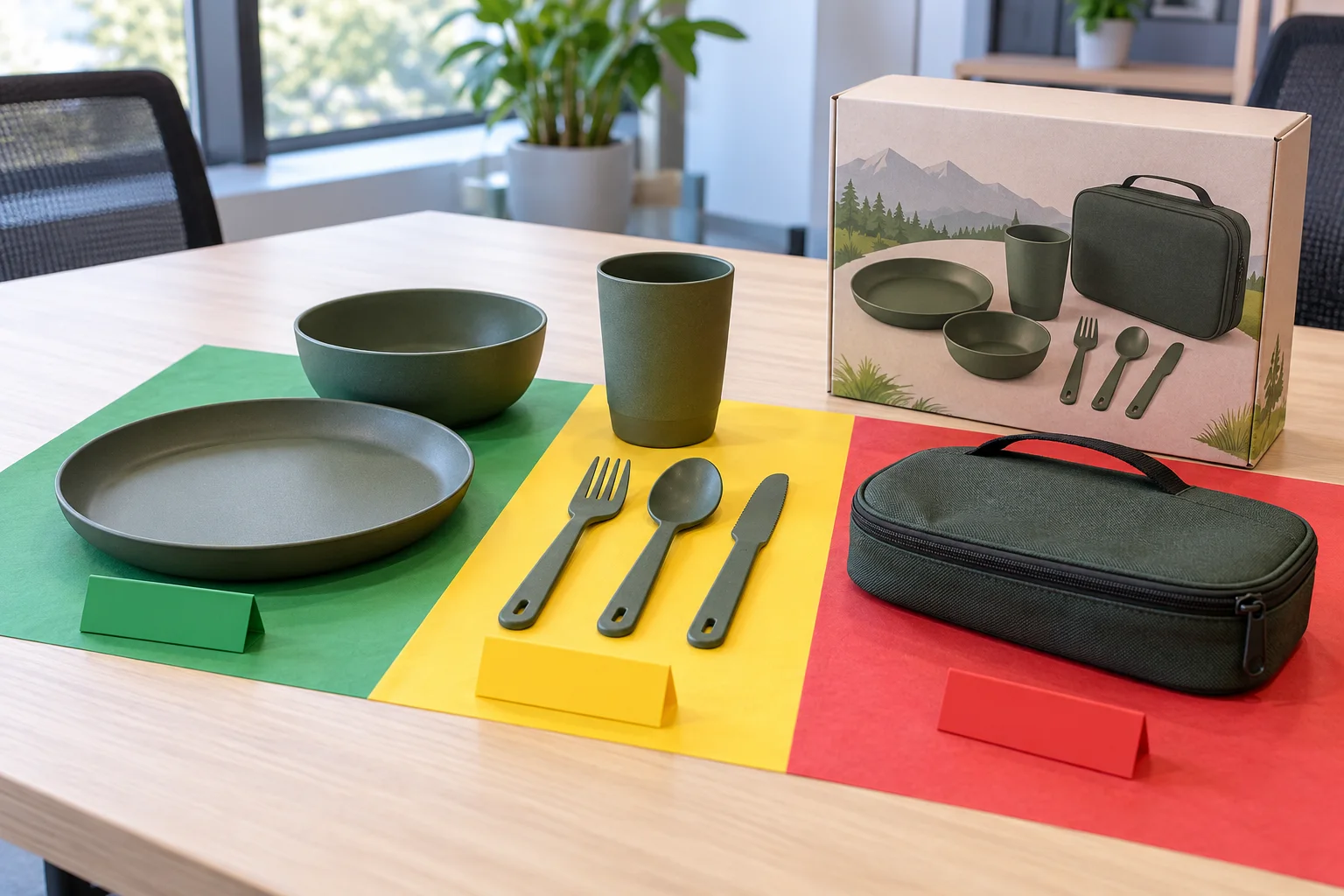
Direct answer: start with the buyer’s intended use and failure risks, then trace each risk to the affected component, complete-set interface and pack-out condition. For every CTQ, define the requirement, measurement or observation method, evidence, owner, sampling point and release action. Keep unverified preferences outside the critical list, and never convert a visual concept into a performance claim.
What Makes a Camping Set Feature Critical to Quality?
A feature becomes CTQ when a defined failure can change a buyer decision or block release. The trigger may be component safety, food-contact identity, fit, count, set stability, artwork accuracy, traceability or protection during transport. A feature is not critical merely because it is easy to measure or visually prominent.
Begin with the consequence
State what fails for the buyer: the set cannot be used as intended, a component is unsafe or missing, an approved claim loses its evidence, the wrong revision is packed, or transport protection no longer works.
Locate the control point
Decide whether the risk belongs to one component, an interface between components, the assembled set, the carry system, retail pack or master carton. The same concern may require more than one control point.
Define objective evidence
Specify the datum, tool, resolution, visual method, approved reference, count method or document trace needed to decide. A bare “good quality” statement cannot be released or audited.
Use the existing component intended-use record before assigning a severity. Connect every controlled feature to the released BOM and drawing revision.
How Should a Camping Dinnerware CTQ Tree Be Structured?
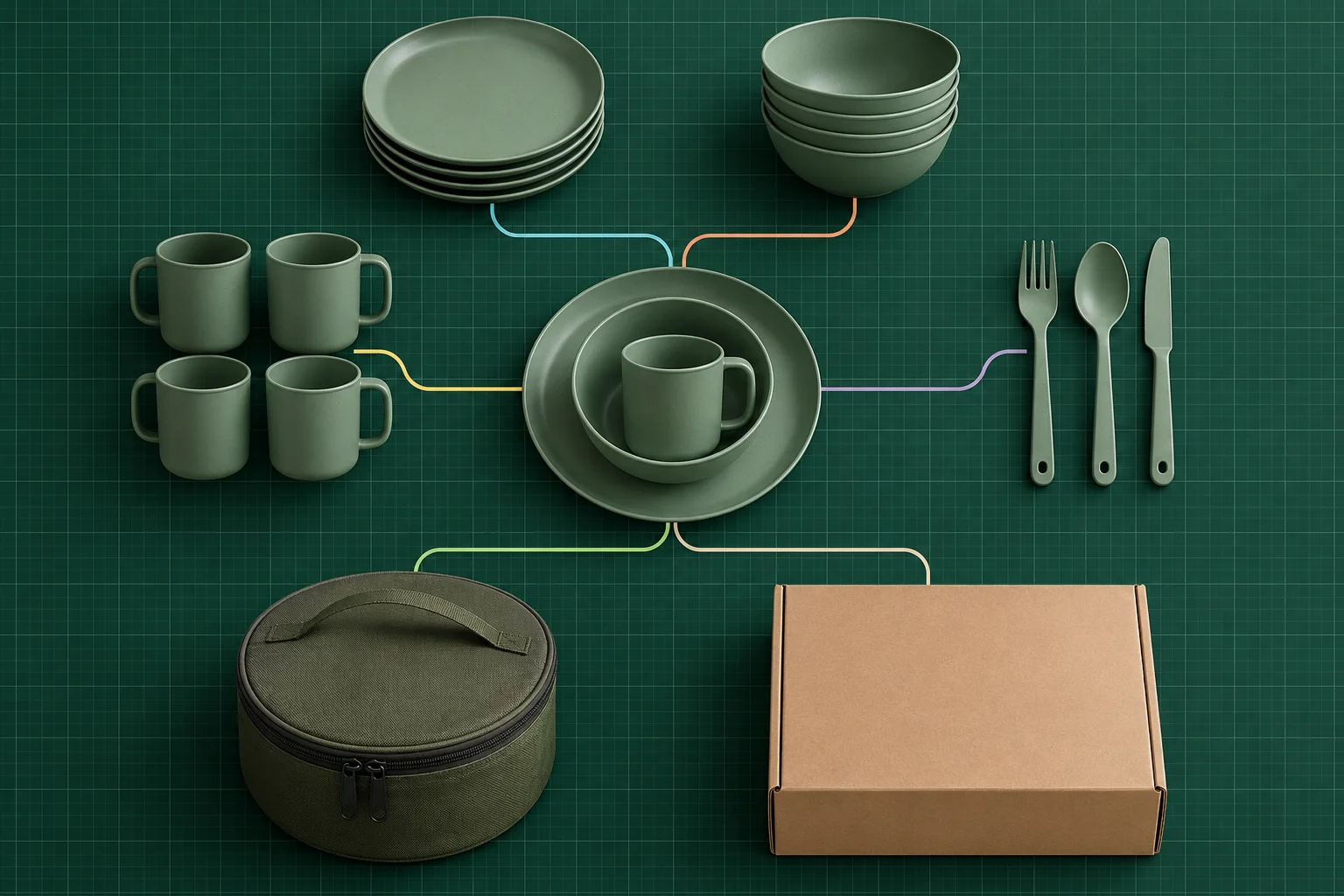
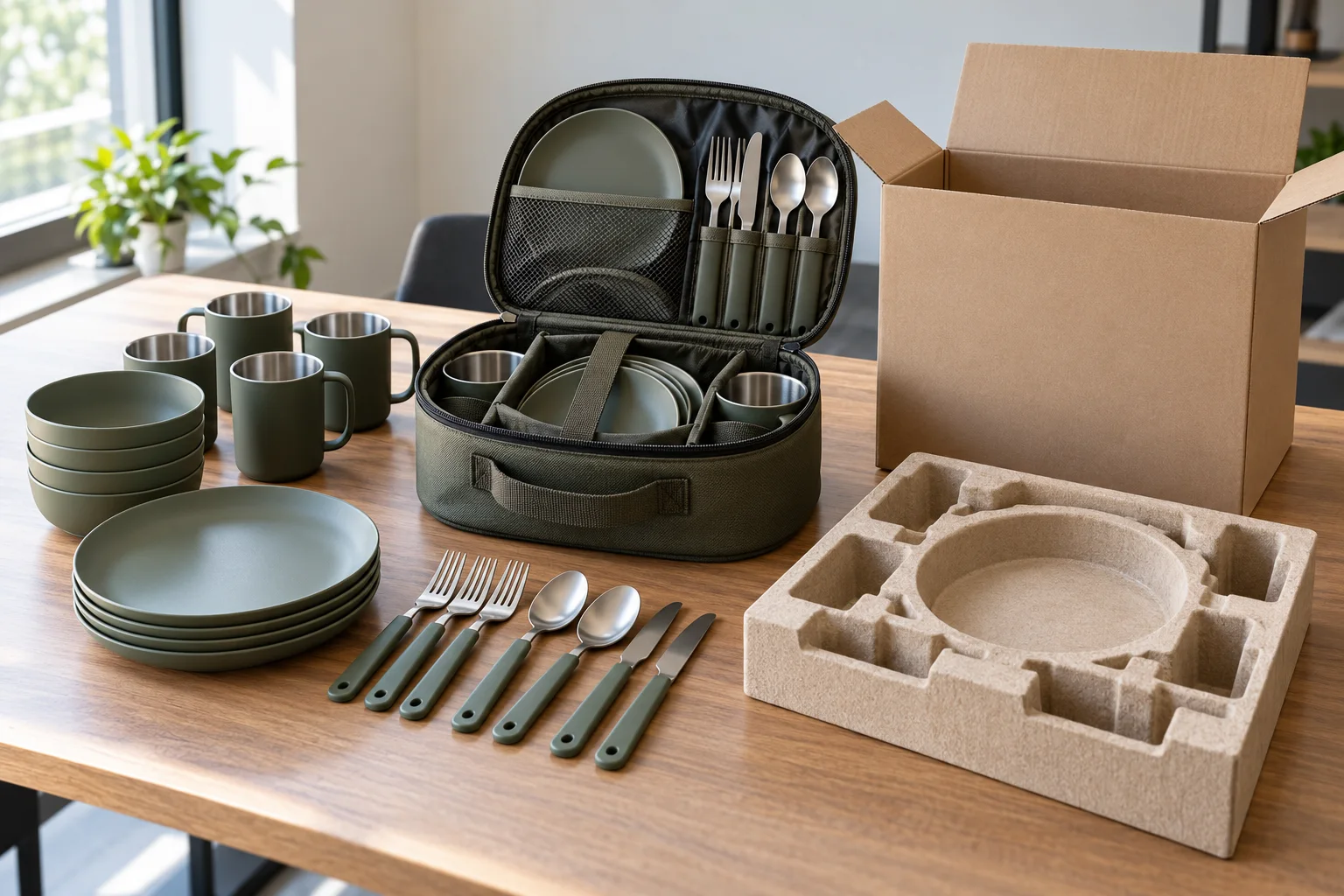
The CTQ tree begins with a buyer outcome, branches into failure risks, then ends in controllable characteristics. It should not begin with a generic checklist copied from another product. For a multi-piece outdoor set, use three linked layers:
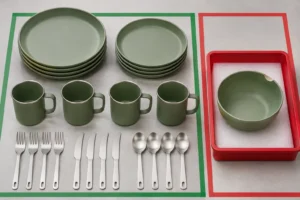
Material identity, edge condition, dimensions, capacity definition, surface, handle or utensil interface, marking and component code.
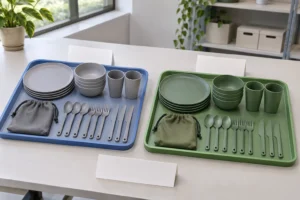
Count, revision match, nesting, stability, lid or divider compatibility, separation, pack order and intended-use alignment.
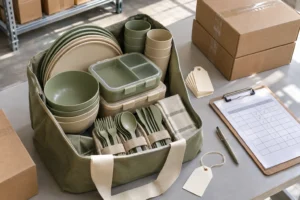
Retention, case closure, artwork revision, label identity, insert protection, carton count and traceability to the released set.
One branch can cross layers. For example, a cup handle concern starts with handle geometry, continues through clearance inside the nested set, and ends with protection against loading from the insert. The owner and evidence may differ at each layer.
Use This Camping Set Critical Quality Characteristics Record
Copy this table into the project specification. Replace every project-dependent placeholder with an approved requirement before sampling or release. Values below are decision fields, not Naike capability or performance claims.
| CTQ branch | Buyer risk if uncontrolled | Requirement to define | Evidence / method | Control point | Release action |
|---|---|---|---|---|---|
| 1. Component and revision identity | Old, substituted or mixed component enters the set | Commercial code, internal code, drawing and BOM revision | Document and lot-code cross-check | Incoming, line clearance and final pack | Hold any unidentified or mismatched component |
| 2. Food-contact material identity | Evidence no longer matches the exact component | Material grade, colorant, construction, intended contact and destination scope | Approved component evidence tied to source and revision | Material release and change control | Hold claim and affected component until resolved |
| 3. Edge and contact-surface condition | Unsafe edge or unacceptable food-contact surface | Location-based workmanship boundary and viewing/touch method | Defined inspection views; measurement where specified | First article and production inspection | Safety risk holds the component and affected sets |
| 4. Plate/bowl geometry | Instability, poor grip, spill risk or pack interference | Datums, diameter, height, rim/base profile, flatness and tolerance | Released drawing and approved measurement method | First article and lot sampling | Verify method; hold out-of-tolerance units |
| 5. Cup or lid interface | Unintended release, interference or unsupported leak claim | Fit boundary, orientation, insertion/removal method and claim scope | Drawing, matched sample and defined functional observation | Component pairing and set assembly | Compatibility to be confirmed by project sample and drawing |
| 6. Utensil shape and edge | Poor use, sharp contact or packing damage | Profile, thickness, edge condition, grip and protected orientation | Drawing, visual/tactile method and pack check | Component and pack-out review | Hold safety issue; separate cosmetic disposition |
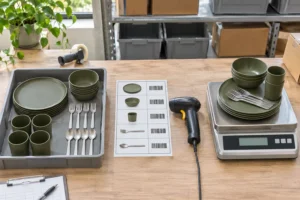
| 7. Complete component count | Buyer receives an incomplete or wrong configuration | Released BOM quantity and permitted substitutions | Count, scan or defined weight method with exception rule | Kitting and final inspection | Hold and reconcile every exception |
| 8. Nesting and separation | Components jam, rattle, abrade or cannot be removed | Stack order, clearances, contact zones and separation method | Matched complete-set sample and cycle record if required | Assembly and packed-set review | Hold interface mismatch; approve bounded deviation only in writing |
| 9. Set stability and carry balance | Set tips, shifts or loads the closure incorrectly | Defined loaded state, orientation, support and handling method | Complete-set observation under approved conditions | Pack-out and carry review | Revise layout or containment before release |
| 10. Artwork and marking revision | Wrong claim, language, code or buyer identity is published | Approved file, placement, color, revision and effective lot | Artwork crosswalk and first-off approval | Decoration, print and packing | Hold affected marked components or documents |
| 11. Carry-case and insert retention | Movement damages components or opens the pack | Part location, restraint, closure, loading direction and inspection view | Complete packed sample under a project-defined review | Pack validation and production audit | Correct containment and repeat full pack review |
| 12. Carton identity and traceability | Wrong set reaches receiving or a complaint cannot be traced | Carton count, revision, lot hierarchy, label and linked set records | Label scan/document check and retained trace | Final release and shipment | Hold unidentified cartons; reconcile before shipment |

How Should Buyers Prioritize CTQs Without Calling Everything Critical?
Use consequence, detectability and control timing to prioritize. A material-identity gap or unsafe edge normally blocks release because later inspection cannot restore missing evidence or remove exposure from already packed units. A color preference inside an approved tolerance may be important without being release-critical. Record the reason rather than assigning an unexplained score.
Release-critical
Failure changes safety, required use, component identity, exact evidence scope, complete count, regulatory claim, artwork authority or traceability. Define an explicit hold rule and authorized disposition.
Function-critical
Failure prevents correct nesting, closure, separation, stability, carry or assembly under the agreed scenario. Require a matched-set method and an owner for interface approval.
Controlled preference
Color, gloss, texture or presentation may matter commercially but should be classified against an approved reference and viewing method instead of being mislabeled as safety critical.
For measurements, NIST explains that measurement uncertainty is part of understanding a result, while metrological traceability applies to the result through a documented chain, not just to the tool name. Where plastic food-contact evidence is relevant to a U.S. project, review the exact resin and use scope against 21 CFR 177.1520; the regulation does not approve an unspecified finished set.
What Is the Seven-Step CTQ Approval Workflow?
- Define use and destination. Record foods, temperatures, cleaning, user, handling, channel and destination evidence scope by component.
- List failure consequences. Describe what the buyer cannot accept without inventing severity from another project.
- Build the three-layer tree. Link component, complete-set and pack branches; identify shared interfaces.
- Write the measurable requirement. Add datum, tolerance, observation method, approved reference or document identity.
- Assign evidence and owner. Name who supplies, checks, approves and maintains each record.
- Place the control. Select incoming, first article, assembly, kitting, final inspection or shipment release; do not rely on final inspection for every risk.
- Connect disposition and continuing control. Define release, deviation, rework, sort or hold and link the result to later-lot sampling.
Keep first-production results in the first article release table, and do not treat them as permanent lot evidence. Before shipment, reconcile the CTQ list with the pre-shipment inspection release sheet.
What Inputs Are Needed to Build the CTQ Tree?
Intended use, destination, user/channel, unacceptable outcomes, claim scope, critical interfaces, release authority and deviation rules.
Released BOM/drawings, component evidence, sample identities, measurement methods, pack-out, artwork and traceability proposal.
CTQ branch, requirement, evidence, owner, control point, sampling boundary, release action and continuing-control link.
Buyer Questions About Camping Set CTQs
Is every drawing dimension a CTQ?
No. Every released dimension may require control, but CTQ status depends on the consequence of failure for the defined project. Keep the full drawing while identifying which dimensions drive critical outcomes.
Can one CTQ apply to several components?
Yes. Count, color, revision identity and evidence scope may cross several components. Record each affected code and the complete-set decision so one passing part does not mask another failing part.
Can a golden sample define all CTQs?
No. It may support visible and tactile comparisons, but measurable requirements, material identity, tolerances, methods and evidence need controlled records.
Should CTQs be printed on the product page?
Only publish buyer-relevant facts supported by approved evidence. Internal control details can remain in the project file. Do not convert a planned test or concept image into a public performance claim.
Does a CTQ list prove compliance?
No. It organizes risks and controls. Compliance depends on exact materials, construction, intended use, destination and applicable finished-article evidence.
Request a Camping Set CTQ Review
Send the intended-use brief, component BOM, drawings, pack-out, claim list, destination, samples and unacceptable outcomes. Naike Dinner can organize them into a component-to-set-to-pack CTQ tree before quotation, sampling or first-production approval.
Send the CTQ project briefRequest a component risk reviewPrepare a B2B quality inquiry
Updated . Evidence scope: buyer decision support. Nothing in this guide verifies a specific product, material, certificate, lot, test result, MOQ, price, capacity, lead time or performance claim.