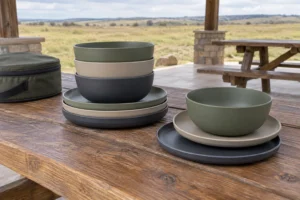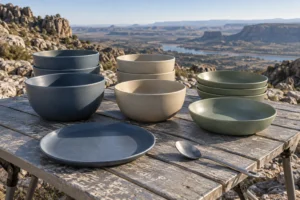
Yes, camping plates can be safe for hot food when the specific plate material, construction and declared conditions of use are supported by appropriate food-contact evidence. Buyers should not treat “camping,” “food grade,” or a material name as proof. Confirm the finished article, maximum food temperature, contact time, food type, repeated-use instructions and market-specific documentation before approval.
That direct answer is intentionally conditional. A plate may be suitable for a warm sandwich but not for oily food served immediately after cooking, and a material family that works in one formulation can perform differently in another. For a B2B buyer, camping plates hot food safety is therefore a specification and evidence question, not a marketing-label question.
Camping Plates Hot Food Safety Starts with Intended Use
The first procurement step is to write the real use condition in operational language. Identify the food, its approximate temperature when it reaches the plate, the expected contact time, whether the plate is washed and reused, and whether it will encounter a microwave, dishwasher, warming cabinet, open flame or direct burner. These details define the relevant risk and the evidence a supplier should provide.
A camping plates hot food safety review should therefore begin with a use matrix rather than a generic heat claim. The matrix gives laboratories, suppliers and buyers a shared definition of what is actually being approved.
The U.S. Food and Drug Administration separates food-contact evaluation by food type and conditions of use. Its food types and conditions-of-use guidance illustrates why a single “heat resistant” statement is insufficient: aqueous, acidic, alcoholic and fatty foods can represent different exposure conditions, while time and temperature change the expected transfer opportunity.
In the European Union, Article 3 of Regulation (EC) No 1935/2004 establishes the general requirement that food-contact materials must not transfer constituents to food in quantities that could endanger health, cause an unacceptable change in food composition or deteriorate organoleptic characteristics. This is a finished-use obligation, not permission to approve a plate from its resin name alone.
For plastic articles, Commission Regulation (EU) No 10/2011 provides specific rules, including Union-listed substances, migration limits and testing provisions. Buyers should obtain documents that connect the tested or assessed article to the ordered formulation, colorant, thickness and intended contact conditions rather than accepting a generic certificate with no product linkage.

Camping plate hot-food decision table
| Decision factor | What the buyer should obtain | Why it matters | Approval boundary |
|---|---|---|---|
| Material identity | Finished-article material declaration, formulation or grade reference where applicable | Different polymers, fillers, coatings and colorants can change the evidence scope | Do not extrapolate from an unrelated resin or product |
| Food temperature | Declared maximum serving or contact temperature tied to a test or assessment | Migration and physical performance can change with temperature | “Hot food” without a temperature range is incomplete |
| Contact duration | Defined short-service or extended-contact condition | A quick meal and hours of storage are different exposure scenarios | Do not use serving evidence to approve hot storage |
| Food type | Coverage for aqueous, acidic, fatty or other relevant foods | Food chemistry affects the appropriate simulant and evaluation | Match the buyer menu, not an abstract food category |
| Repeated use | Cleaning method, cycle assumptions and post-use inspection criteria | Wear, scratching and deformation can alter practical suitability | Replace damaged articles under defined rules |
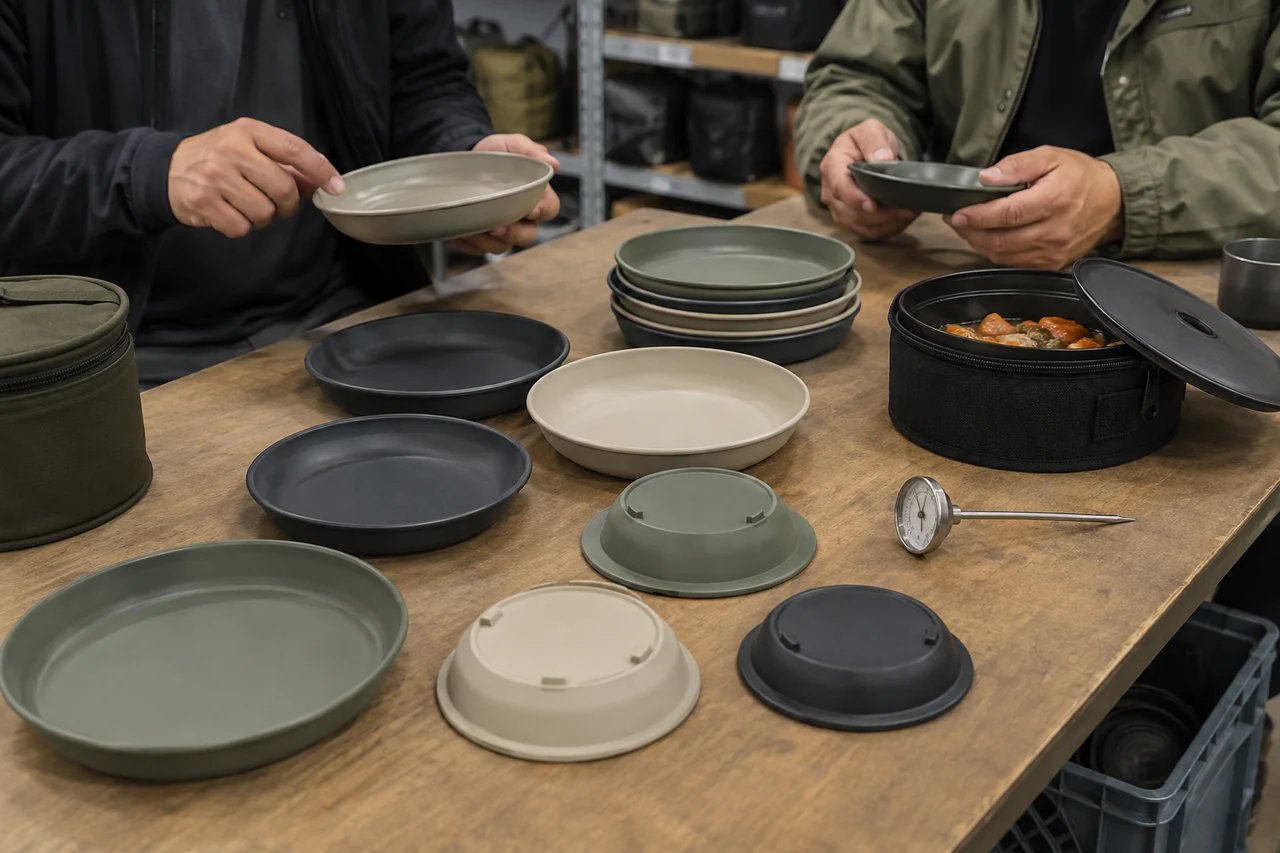
| Structure | Rim, wall, foot and stacking review on project samples | Handling safety depends on geometry as well as chemistry | Validate with the intended portion and service workflow |
| Market documentation | Declaration, test report or compliance file appropriate to the destination | EU and U.S. frameworks are not interchangeable checklists | Confirm scope with qualified compliance counsel or laboratory |
How common material families behave around hot food
A useful comparison separates chemical compliance from user handling. A metal plate can tolerate high material temperatures yet transfer heat rapidly to the user’s hand. A polymer plate can feel cooler at the rim but requires careful confirmation of its formulation and intended temperature range. Enamel adds a coating system that introduces its own chip and edge-inspection considerations.
Stainless steel camping plates
Stainless steel is widely selected where buyers value durability, thin sections and resistance to ordinary impact. However, stainless steel conducts heat more readily than many polymers, so a shallow rim or thin wall may become uncomfortable soon after hot food is served. The correct question is not merely whether the metal survives heat; it is whether the finished geometry supports safe handling in the intended service situation.
Buyers should identify the alloy declaration, manufacturing route, surface finish, seam or weld details if present, and relevant food-contact evidence for the destination market. A metal grade name is not a complete finished-product approval. Check edges, burrs, distortion, nesting friction and whether utensils create unacceptable surface damage during use.
Enamel-coated steel plates
Enamel camping plates combine a metal substrate with a vitreous coating. They can offer a familiar outdoor aesthetic and a hard food-contact surface, but the coating condition matters. Chips, exposed edges, impact damage and inconsistent coverage should be included in the sample inspection plan and in the buyer’s replacement instructions.
Do not generalize from a decorative enamel appearance. Ask for documentation applicable to the finished coated article and the destination market, and define visual limits for pinholes, edge coverage and chips. A product that is chemically appropriate when intact can still create a poor user experience if the coating is fragile in the intended packing system.
PP and other polymer camping plates
Polypropylene is used in many reusable tableware formats, but “PP” is a broad material description rather than an automatic hot-food authorization. Resin grade, additives, fillers, pigments, recycled-content status, wall thickness and processing conditions can all affect the finished article. Buyers need evidence linked to the actual plate and use condition.
For a practical example of how material identity should be scoped, see Naike Dinner’s buyer guide on what food grade means for outdoor tableware. It explains why regulatory status, traceability and intended use need to be read together instead of reduced to a single claim.
Plant-fiber composite plates
A plant-fiber composite normally combines a fiber or particulate fraction with a polymer or other binder. Its hot-food suitability depends on the complete formulation and finished article, not the agricultural feedstock alone. A buyer should identify the matrix, additive system, pigment, fiber proportion when relevant, and the evidence covering the actual temperature and food-contact scenario.
Naike Dinner has published wheat-straw composite products, but that does not mean every plant-fiber formulation shares identical performance. Buyers reviewing such products should request project-specific material and use-condition confirmation. The plate remains dinnerware and must not be presented as cookware or as suitable for a burner, campfire or direct flame without explicit product evidence.
Silicone and flexible components
Silicone may appear as a complete collapsible plate or as a grip, seal or insert. Flexibility can help packing, yet stability under a full hot portion, odor control, seam hygiene and collapse resistance require finished-sample review. The material declaration and compliance file must also match the color and component actually ordered.
When a rigid frame and flexible insert are combined, evaluate each food-contact component and the assembly. A plate that passes a material review can still be unsuitable if it twists during carrying, traps residue in a joint or becomes difficult to clean in a field setting.
Temperature is only one part of the risk
For camping plates hot food safety, temperature must always be read together with food chemistry, duration and the finished plate construction. Treating one maximum-temperature number as universal approval removes the conditions that make the evidence meaningful.
Buyers often ask for a single maximum temperature. That number can be useful only when its meaning is defined: serving temperature, short contact, continuous exposure, dishwasher water, microwave reheating or dimensional stability. A supplier statement should make that boundary explicit and connect it to the supporting evidence.
Hot, fatty food can be a more demanding exposure than warm water. Acidic sauces may require another evaluation condition. Long contact in a closed lunch box differs from serving a meal on an open plate for twenty minutes. The buyer’s menu matrix should therefore sit beside the temperature matrix.
The FDA’s overview for determining the regulatory status of food-contact components is a useful primary reference for understanding how substances and intended uses are evaluated in the United States. It does not replace product-specific legal review, but it demonstrates why a component’s authorized use must be connected to the real application.
Physical handling can fail even when the material file looks strong
A camping plate must be carried from a cooking or serving point to a table, chair or ground mat. The rim must provide enough purchase, the base should remain stable, and the wall should resist excessive flex under the expected portion. These are design controls rather than regulatory claims, but they materially affect user safety and buyer returns.
Metal rims can become hot; shallow plates can spill; flexible plates can bow; glossy undersides can slide; and aggressive nesting ribs can scratch adjacent surfaces. A B2B sample review should reproduce the intended meal mass, temperature and carrying distance. Use adult evaluators, protective procedures and controlled conditions rather than improvised demonstrations.
Four applicable buyer scenarios
Family and recreational camping
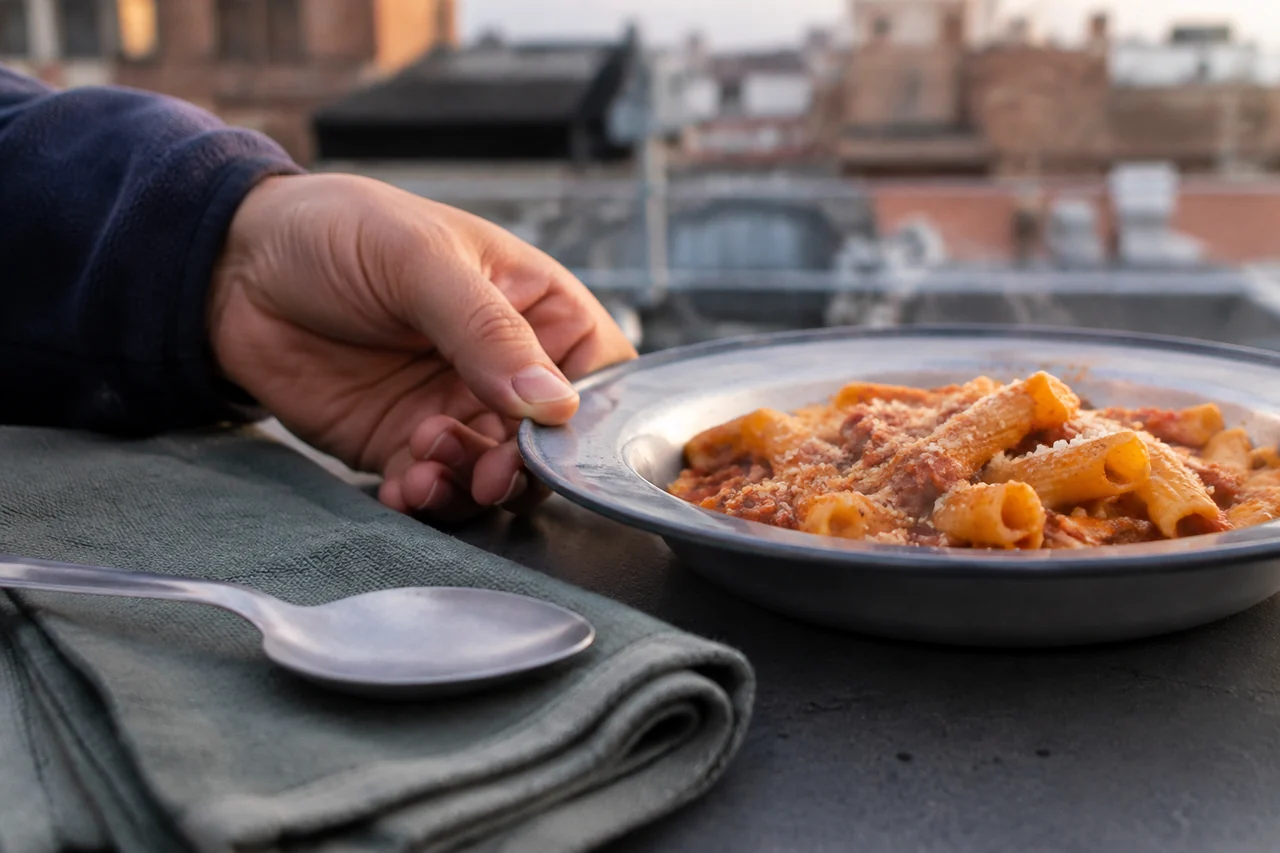
Family sets often prioritize comfortable handling, low noise, stackability and simple cleaning. Hot breakfasts, pasta and grilled foods may be served soon after cooking, but direct flame is not part of the plate use. Buyers should consider hand size, rim grip and whether children will use a separate age-appropriate product rather than assuming one geometry suits everyone.
RV and caravan dining
RV users may combine indoor storage with outdoor service. Plates need secure nesting, quiet transport and resistance to movement on compact tables. If microwave or dishwasher use is part of the program, it must be verified separately; camping suitability alone does not establish either condition.
Outdoor catering and event service
Catering programs can expose plates to repeated washing, faster handling and larger quantities of hot food. The approval file should define cleaning chemistry, cycle assumptions, stacking and retirement criteria. A plate that works for occasional recreation may not have evidence for intensive commercial reuse.
Retail and private-label assortments
Retail buyers need claims that remain accurate on packaging and online listings. Avoid broad phrases such as “heatproof,” “non-toxic” or “safe at any temperature.” Use scoped statements supported by the product file, and ensure the same intended-use limits appear in the supplier specification, artwork and instructions.
Limitations and risks buyers should state clearly
No general article can approve a specific camping plate. Regulations, official guidance and material science establish a framework, but the finished product, its composition and its use conditions determine the evidence needed. Market requirements can change, and competent laboratory or legal review may be necessary for the destination and claim set.
Do not infer microwave safety from hot-food service. Do not infer dishwasher suitability from repeated-use status. Do not infer open-flame suitability from a high temperature statement. A plate is dinnerware; cookware is designed and evidenced for thermal input from a stove, burner or fire.
Physical aging also deserves attention. Scratches, chips, severe warpage, damaged coatings and persistent odors may trigger removal from service even when the original article was compliant. Define inspection and replacement rules in the buyer specification rather than waiting for complaints.
A practical procurement sequence
A controlled camping plates hot food safety decision is easier to audit when each requirement has an owner, evidence reference and approval status. This also prevents a marketing claim from moving ahead while a material or use-condition question remains open.
First, create an intended-use sheet covering food types, temperature at service, contact duration, cleaning, reuse and prohibited uses. Second, ask the supplier to map each declaration and test report to the finished SKU or project sample. Third, review the document dates, issuing party, material/color coverage and test conditions.
Fourth, inspect dimensional stability, odor, staining, rim temperature, grip, balance, nesting and post-wash condition on samples. Fifth, confirm that artwork and sales copy do not exceed the documented scope. Sixth, freeze the approved material, pigment, construction and critical dimensions under change-control rules.
Naike Dinner’s guide to food-contact testing for outdoor tableware provides a complementary explanation of sample identity, test scope and report review. For buyers comparing destination-market expectations, the published EU vs U.S. camping dinnerware requirements article helps separate framework differences without treating one document as universal approval.
Turn evidence into an approval matrix
A practical approval matrix has one row for every ordered plate variant and separate columns for material, color, thickness, decoration, food types, contact temperature, duration, cleaning route and destination. The buyer then cites the declaration, report or technical assessment that supports each condition. Empty cells remain open actions; they are not silently converted into approvals.
This approach is especially important when a range shares one commercial name. Two colors may use different pigment packages, a printed version may introduce inks, and a deeper plate may have a different wall thickness or molding history. Grouping can be legitimate, but the reason for grouping should be recorded by a competent party and remain traceable to the actual production specification.
Separate regulatory evidence from performance evidence
Food-contact documentation addresses chemical and legal suitability within its stated scope. It does not automatically prove that a plate will resist staining, remain flat, stack quietly or feel comfortable at the rim. Conversely, a successful kitchen trial cannot replace regulatory evidence. Keep these two evidence streams separate and require both where the buyer brief needs them.
Performance protocols should define the starting sample, conditioning, food or simulant, temperature measurement point, loading, contact time, cleaning method and acceptance criteria. Record observations without upgrading them into universal claims. A result from one plate geometry and color should not be applied to another configuration unless the project rationale supports that extension.
Use a golden sample and controlled change notices
After documentary and physical approval, retain a signed or otherwise controlled golden sample with photographs and critical specification references. The supplier should notify the buyer before changing resin source, grade, additive package, pigment, recycled-content status, tooling, surface treatment, decoration or manufacturing location when those changes could affect the approval basis.
A change notice should describe what changes, why it changes, which documents remain applicable, what new verification is proposed and whether inventory will mix old and new versions. This discipline reduces the risk that a commercially identical plate arrives with a materially different evidence profile.
Hot-food communication for packaging and instructions
Consumer-facing instructions should translate technical boundaries into plain language. State the permitted serving use and cleaning route, then state relevant exclusions. If direct flame, stovetop, oven, microwave or dishwasher use is not supported, the artwork should not imply those uses through icons, photography or broad “all heat” language.
For international assortments, verify that translated warnings retain the same meaning. Placement and legibility matter: a limitation hidden in a distributor file will not help the end user. Retail listings, cartons, inserts and product-page copy should be checked against the same approved claim register before launch.
Marketing images also need control. A scene showing a plate beside a campfire can accidentally suggest that the plate belongs on the fire even if the copy says otherwise. Use serving and dining scenes that clearly separate cookware from dinnerware, and show hot food being carried or eaten under realistic conditions.
B2B Buyer Checklist
Use the following camping plates hot food safety checklist as a project-screening tool, then adapt it to the final material, product design, intended meals and destination market.
| Check | Question | Why It Matters |
|---|---|---|
| Use definition | What food, temperature, contact time and reuse cycle will the plate encounter? | Evidence is meaningful only against a defined condition. |
| Finished identity | Does the document name or trace to the ordered article, formulation and color? | Generic material reports may not cover the finished plate. |
| Market scope | Which destination requirements and claims does the file address? | EU and U.S. routes use different legal structures. |
| Hot handling | Can users grip and carry the intended portion without excessive heat or flex? | Physical usability is separate from chemical compliance. |
| Surface condition | Are edges, coatings, seams and surfaces acceptable before and after use? | Damage can create hygiene, comfort and durability problems. |
| Cleaning | Is the claimed washing method covered and reproduced in sample review? | Repeated cleaning can change appearance and dimensions. |
| Claim control | Do packaging and web claims stay within the evidence boundary? | Overbroad claims create compliance and return risk. |
| Change control | Must material, pigment, mold or process changes receive written approval? | Uncontrolled changes can invalidate the reviewed evidence. |
Buyer FAQs about camping plates and hot food
1. Is every stainless steel camping plate safe for hot food?
No. Stainless steel is a material family, while approval concerns the alloy, finished article, surface condition and intended market. Handling also matters because thin metal can transfer heat to the rim quickly. Request article-linked documentation and test the finished geometry with the intended serving condition.
2. Does a “BPA-free” claim prove a polymer plate is safe for hot meals?
No. A BPA-free statement addresses only a narrow claim and does not establish the regulatory status of every constituent, the finished article’s migration performance or suitability for a particular temperature and food. Review the complete material and compliance scope.
3. Can a hot-food camping plate be used in a microwave?
Only when microwave use is specifically declared and supported for that finished article. Hot food may simply have been transferred from cookware to the plate. Microwave energy, heating patterns and duration represent a separate use condition.
4. Are plant-fiber composite plates automatically heat resistant?
No. The fiber name does not define the binder, additives, colorants or finished construction. Buyers should obtain the complete material identity and evidence for the specified serving temperature, contact duration, food type and cleaning cycle.
5. What should a hot-food sample test include?
Use the intended portion, temperature and contact duration under controlled procedures. Evaluate odor, staining, deformation, leakage, rim comfort, balance, surface change, nesting and post-cleaning condition. This practical review supplements rather than replaces formal compliance evidence.
6. How should a buyer write temperature claims?
Use a precise, evidence-backed condition such as a declared short-contact serving range when verified. Avoid “heatproof” or unlimited wording. Keep exclusions for direct flame, burner, oven, microwave or dishwasher clear unless each use is separately supported.
7. Can one test report cover several colors or designs?
Possibly, but only when the report, technical rationale and applicable rules support grouping. Pigments, additives, thickness and surface treatments may change the scope. Ask the supplier or qualified laboratory to document why each ordered variant is covered.
8. What should be frozen before production approval?
Freeze the material and color reference, critical geometry, surface finish, approved sample, intended-use statement, document set, artwork claims and change-control procedure. Any proposed substitution should return to review before shipment.
Request a hot-food plate specification review
Send Naike Dinner your destination market, material options, menu profile, serving temperature, contact time, cleaning method, target geometry and required evidence. We can review the project brief against verified company scope, identify questions that need supplier or laboratory confirmation, and prepare a documented quotation without inventing performance, MOQ, price or lead-time claims.
Request a camping plate project review or ask for a sample and evidence checklist.