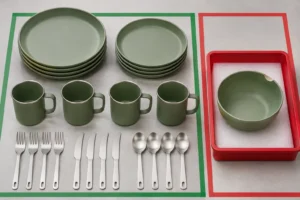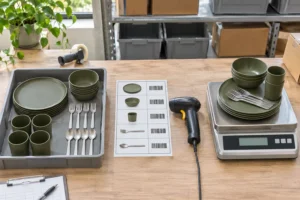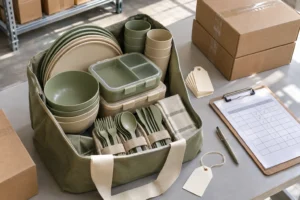

A camping set lot code system should identify the finished kit while preserving the component lots consumed into it. Buyers need one hierarchy that connects plates, bowls, cups, cutlery, lunch boxes and carrier parts to the kitting event, finished-set lot, carton range and shipment record.
Direct answer: assign stable component codes first, capture each source or receipt lot, create one controlled kitting-event code, then issue a finished-set lot that links every consumed component lot. Connect that set lot to inner packs, master cartons and shipment units. If a component, quantity or carton link cannot be retrieved, hold only the bounded affected population.
Camping Set Lot Code System: Four-Level Buyer Decision
A usable camping set lot code system connects component identity, kitting consumption, finished-set release and carton distribution without turning an unverified assumption into a code. Approve the hierarchy only after a two-way retrieval drill can move from one finished set to its component lots and from one component lot to every affected carton.
What Lot-Code Hierarchy Should Buyers Approve?
The buyer should approve a hierarchy with four distinct identities: component lot, kitting event, finished-set lot and logistics unit. A code should not carry more meaning than the underlying record can support. The printed mark is only a retrieval key; the controlled record supplies the details.
| Level | What it identifies | Minimum linkage | Release risk |
|---|---|---|---|
| Component lot | One controlled population of a plate, bowl, cup, utensil, lunch box, carrier or packaging component | Component code, source/receipt lot, revision, quantity and disposition | Different lots become indistinguishable |
| Kitting event | The assembly or packing event that combined components | Date/time window, line or cell, operator/team record and component lots consumed | Sets cannot be reconstructed |
| Finished-set lot | The population of complete kits released under one configuration | Released BOM revision, kitting event, quantity, inspection disposition and carton range | One code may conceal mixed configurations |
| Logistics unit | Inner pack, master carton, pallet or shipment unit | Set-lot quantities and destination/shipment reference | Affected cartons cannot be isolated |
GS1 Application Identifier (10) defines a batch or lot number data field as a variable-length string of up to 20 characters. The GS1 General Specifications and GS1 Global Traceability Standard are useful data-structure references. They do not prove that GS1 coding is required for a particular dinnerware project.

Which Fields Belong in the Lot-Code Record?
Keep the visible code short enough for reliable marking and scanning. Put changing detail in the linked record instead of embedding unverified claims in the code itself. The following template is a buyer-controlled record, not a universal mandatory format.
| Record field | Buyer-entered value | Decision rule |
|---|---|---|
| Finished-set article and revision | Set code + released BOM/specification revision | One lot cannot span unapproved configuration changes |
| Finished-set lot | Unique project convention | Never silently reuse a retired lot |
| Kitting event | Event ID, date/time window and location/cell | Must retrieve consumption records |
| Component consumption | Component code, component lot and quantity used | Every BOM line reconciles |
| Inspection disposition | Accepted, held, sorted, reworked or rejected with authority | Only accepted scope enters released sets |
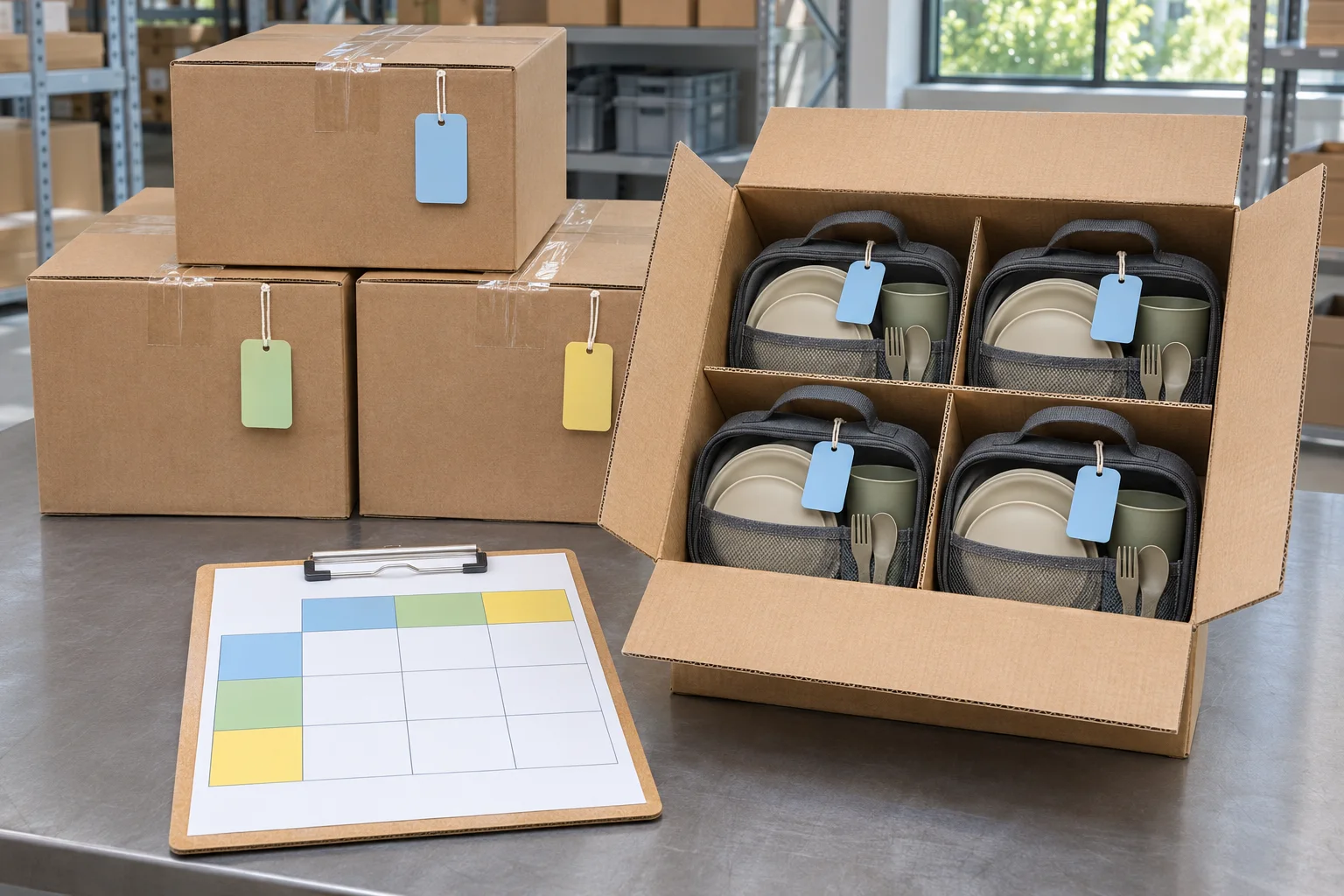
| Inner/master carton | Carton ID or controlled range + set lot + quantity | Carton contents can be retrieved without opening |
| Shipment linkage | Shipment, destination, quantity and carton range | Affected destinations can be bounded |
| Record owner | Role, system/location, retention rule and retrieval test | Evidence remains available for the agreed period |
Start with the component identities in the source-to-component traceability map, keep the same released characteristics in the critical-to-quality record, and prevent revisions from drifting by using the specification-drift control method.
How Should Component Lots Link to Cartons?
Create one row for every finished-set lot and carton range. When the kitting line changes a component lot, start a new consumption segment even if the finished-set lot remains open. When an unapproved BOM, artwork or pack-out revision changes, close the finished-set lot and issue a new one.
| Finished-set lot | Component-lot bundle | Kitting event | Carton linkage | Release |
|---|---|---|---|---|
| Buyer enters | Plate lot; bowl lot; cup lot; cutlery lot; lunch-box lot; carrier/packaging lots | Event ID and quantity completed | Inner IDs, master-carton range and quantity per carton | Disposition, owner, date and evidence links |
| Boundary | List only verified consumed lots | Split when a source lot or revision changes | Do not infer unopened contents from a generic label | Hold missing or contradictory links |
Use the first-production-unit review to confirm that the marking location, legibility and pack-out match the released reference. Use the pre-shipment release sheet to verify the exact carton range before shipment.
How Do Buyers Calculate the Affected Set and Carton Scope?
Buyer calculation: maximum affected sets for one suspect component lot = the smaller of (accepted suspect component quantity − verified remaining stock − verified scrap/returns) and the total sets recorded as consuming that lot. Then map those sets to carton records. This is a bounding calculation; it does not replace physical reconciliation.
Example inputs
Buyer enters 1,200 accepted cups, 160 verified in controlled stock, 20 verified scrap and 1 cup required per set.
Calculated ceiling
1,200 − 160 − 20 = 1,020 cups potentially consumed, so no more than 1,020 one-cup sets can be affected before checking the kitting record.
Carton boundary
If 12 sets are packed per carton, divide the verified affected set range by 12 and include any partial boundary cartons. Use actual carton records, not rounding alone.
Quantities in this illustration explain the method only; they are not Naike Dinner production, MOQ, capacity or case-history data.
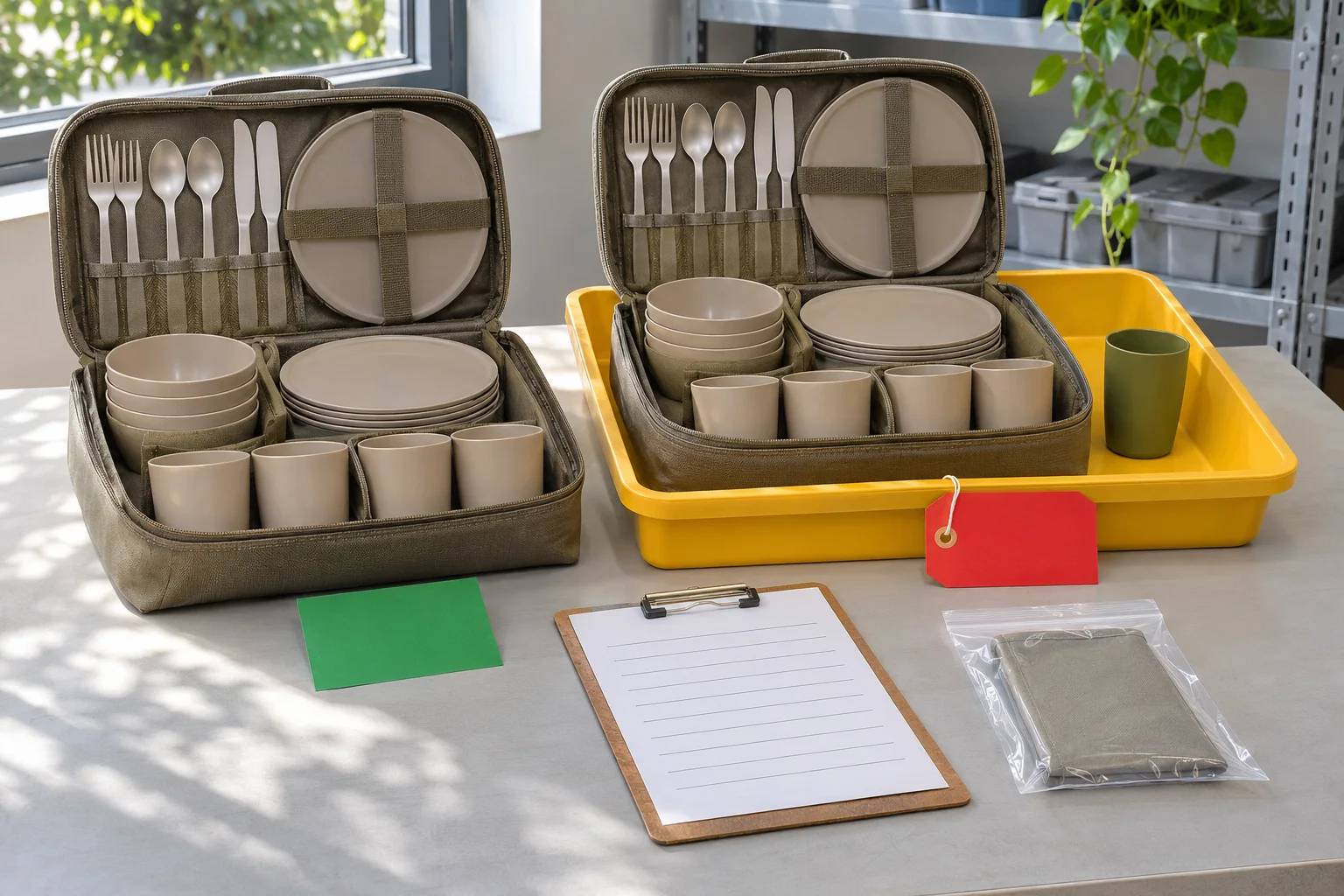
Buyer Checklist for Lot-Code Approval
Markets, set/BOM revision, required coding standard, code location, carton hierarchy, retention period and deviation authority.
Code convention, component-lot records, kitting consumption, carton linkage, sample marks, readability checks and exceptions.
Signed hierarchy, approved sample, completed linkage record, reconciliation, retrieval-test result, open risks, owner and re-review trigger.
Run one retrieval drill before release: select a finished-set lot, retrieve all component lots and cartons, then select one component lot and retrieve every finished set and destination. Record elapsed time, missing links and the authorized decision.
Buyer Questions About Camping Set Lot Codes
Is a date code the same as a lot code?
Not necessarily. A date may be one field, but the lot record must define the controlled population and retrieve its component and carton links.
Should every plate and bowl carry its own mark?
The buyer must define required marking granularity by risk, destination rules, item size and retrieval needs. Do not assume one carton mark is sufficient.
Can one finished-set lot contain two component lots?
Yes only if the kitting record preserves the exact consumption segments and the buyer accepts the retrieval boundary. A revision or unapproved substitution may require a new set lot.
Does a barcode prove traceability?
No. It is a data carrier. Traceability depends on accurate controlled records, reconciliation and retrieval.
What if a printed mark is unreadable?
Hold the affected scope, retain its original identity, investigate the marking process and relabel only under documented authority.
Does this guide confirm Naike Dinner’s lot-code capability?
No. It is a buyer decision tool. Exact marking methods, systems, materials, code durability, quantities, capacity, MOQ and lead time require project evidence.
Request a Camping Set Lot-Code Review
Send the BOM, component codes, source/receipt lots, kitting flow, carton hierarchy, destination markets and proposed code convention. Naike Dinner can organize the available evidence into a buyer-reviewable lot-code hierarchy and carton linkage record before sampling, quotation or release.
Send the lot-code briefRequest a carton-linkage reviewPrepare a B2B quality inquiry
Updated . Evidence scope: buyer decision support. Nothing in this guide verifies a specific supplier, site, product, code system, lot, compliance result, capacity, MOQ, price, lead time or case history.