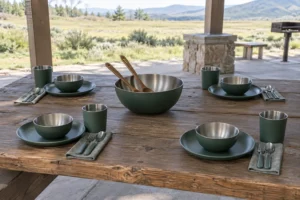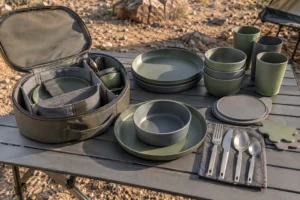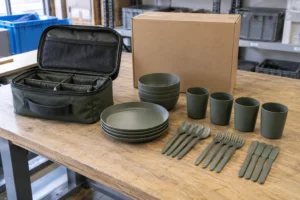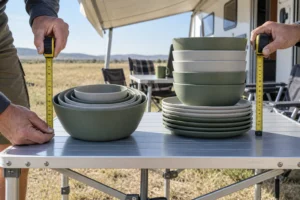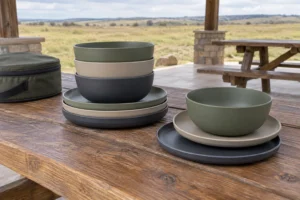
Food grade outdoor tableware means the finished article is suitable for its intended food-contact conditions and supported by market-relevant evidence. It does not mean every item made from the same named material is automatically safe. Buyers must verify composition, colorants, coatings, temperature, food type, contact time, repeated use and the exact product covered by declarations or tests.
Why “food grade” needs a defined scope
Outdoor-tableware buyers often see “food grade” beside stainless steel, titanium, polypropylene, silicone or plant-fiber composites. The phrase sounds like a permanent material property, yet food-contact suitability depends on more than a broad material name. A resin grade, pigment, adhesive, surface treatment, print, gasket or coating can change the evidence required for the finished article.
The intended use also changes the question. A cup for cold water, a lunch box for oily food and a plate used with hot meals do not necessarily share the same contact conditions. Repeated-use articles need care instructions and a reasonable service scenario, while a product exposed to heat, abrasion or aggressive detergents may require a different evaluation from a decorative sample kept at room temperature.
For procurement, “food grade” should therefore open a verification sequence. The buyer identifies the market, product identity, food types, temperature, duration and cleaning method; the supplier maps materials and evidence to those conditions; the finished sample is checked against the same specification. If any step is missing, the claim remains incomplete.
Food-grade outdoor tableware decision table
A food grade outdoor tableware decision should connect the finished article to its intended use and evidence scope. The following table turns that principle into a buyer review sequence.
| Decision area | Buyer question | Evidence to request | Common mistake |
|---|---|---|---|
| Product identity | Does the document identify the supplied item and revision? | Drawing, SKU record, bill of materials and sample reference | Using a generic material sheet as finished-product proof |
| Material system | Are base material, pigments, coatings, seals and prints included? | Component-level composition and declarations | Checking only the plate body |
| Food type | Will the item contact aqueous, acidic, fatty or dry foods? | Intended-use statement and relevant test scope | Assuming one food simulant covers every meal |
| Temperature | What food and cleaning temperatures are intended? | Condition-specific specification and evidence | Turning a room-temperature result into a hot-food claim |
| Contact time | Is contact brief, meal-length or storage? | Time and repeat-use conditions in the evidence file | Applying a short-contact result to lunch-box storage |
| Destination market | Which legal framework and customer requirements apply? | EU, U.S. or other market evidence map | Calling one document “global certification” |
| Change control | What happens if resin, color, coating or supplier changes? | Revision and re-evaluation procedure | Keeping old evidence after construction changes |
This table is a purchasing framework, not a substitute for legal review or product-specific testing. The applicable evidence depends on the exact article and its destination market. A buyer should record unanswered points as open project requirements rather than filling them with assumptions.
What U.S. food-contact rules ask buyers to understand
The U.S. Food and Drug Administration explains that food-contact substances are evaluated for their intended conditions of use. Its official Food Contact Substances resource describes the regulatory routes and emphasizes the relationship between a substance and its intended food-contact use. That framework is more precise than a label saying only “FDA approved.”
General provisions in 21 CFR 174.5 address good manufacturing practice for indirect food additives. Buyers should not quote the regulation as a certificate for a particular plate. Instead, they can use it to ask how the supplied materials, manufacturing controls and intended conditions are documented.
A U.S. project file should connect the finished item to the relevant regulatory basis, supplier information and conditions of use. Colorants, coatings, adhesives and other components may have separate considerations. If a test report is used, verify the sample description, test method, laboratory, dates, results and whether the conditions match the buyer’s real use case.
What European Union buyers should verify
Regulation (EC) No 1935/2004 establishes the general framework for materials and articles intended to contact food in the European Union. It includes the principle that materials should not transfer constituents to food in quantities that could endanger health, cause an unacceptable change in food composition or deteriorate organoleptic characteristics under normal or foreseeable conditions.
The European Commission’s official food-contact materials overview explains the framework and links to harmonized and material-specific measures. Buyers should identify whether the article falls under a specific measure, a national requirement or additional customer standards. A declaration for one component cannot automatically be extended to a mixed-material set.
Traceability is part of practical compliance control. The project record should identify the product revision, material suppliers, production lot and evidence version that correspond to the approved sample. When a pigment, coating, seal or decoration changes, the buyer should decide whether the existing declaration remains applicable or whether review and testing must be repeated.
Material name is only the first line of the specification
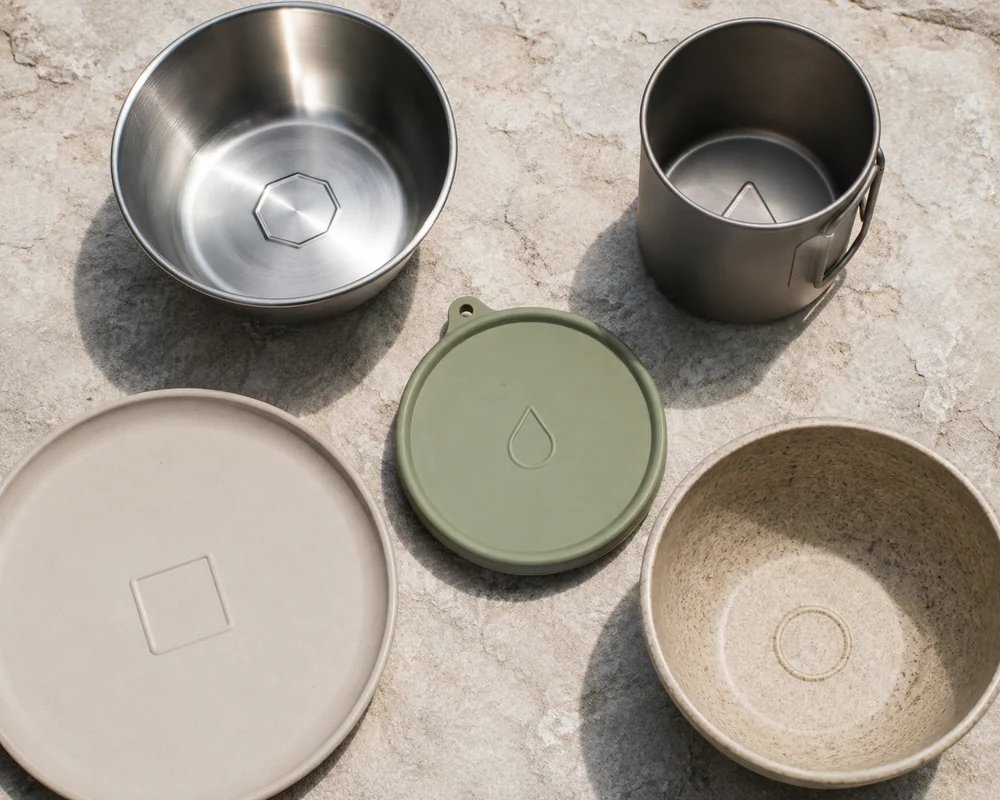
When a supplier describes food grade outdoor tableware, the material name is only the starting point. The finished construction and every relevant component still require verification.
“Stainless steel” does not identify grade, surface, joining, passivation, coating or decoration. “Titanium” does not identify grade, thickness or forming. “PP” does not identify resin grade, additive package or colorant. “Silicone” does not identify formulation or cure, and “plant fiber” does not disclose the polymer matrix holding the fiber together.
A robust specification breaks the article into food-contact and non-food-contact components. It identifies the body, lid, seal, handle, coating, ink, adhesive and any removable accessories. This bill-of-materials view prevents a supplier from presenting strong evidence for the main body while leaving the decorated rim, gasket or lunch-box latch outside the review.
For multi-piece camping sets, repeat the exercise for every component family. Plates, bowls, cups, cutlery, lunch boxes and storage accessories may use different materials and processes. The set can still be marketed as coordinated, but the evidence file should remain component-specific and should never imply that a textile bag or non-food-contact divider has the same regulatory status as a food-contact article.
Hot food changes the intended-use question
Temperature can influence migration, deformation, surface wear and user handling. A product intended for hot soup needs a defined temperature and contact time, not a vague statement that it is “heat resistant.” Buyers should also distinguish serving hot food from reheating, cooking, oven use, microwave use or placement over a burner.
Outdoor dinnerware is not cookware unless the exact product has been designed and verified for direct heat. A metal plate may tolerate warm food without being suitable for a stove or campfire. A molded composite bowl may be reusable dinnerware without any direct-flame claim. The use instruction should state the boundary in language a consumer can understand.
The published guide Can Camping Dinnerware Go in the Dishwasher? shows why cleaning claims also need conditions. Dishwasher cycle, detergent, rack position and repeated exposure can differ from food service. A food-contact declaration alone does not prove dishwasher durability or appearance retention.
Food type and contact duration matter
Aqueous, acidic, alcoholic and fatty foods can interact differently with material systems. Lunch boxes may hold food for hours, while cutlery has intermittent contact and a plate may be used for one meal. The intended-use statement should describe realistic foods and duration so evidence can be matched to the actual product claim.
Buyers should avoid testing language that is broader than the product brief. If the product is intended for cold snacks, do not ask a report to support boiling food merely because a higher number looks better in marketing. Conversely, if the set will be used for oily cooked meals, a narrow cold-water scope may not address the intended scenario.
Storage introduces additional interfaces. A lunch-box lid, seal, hinge and compartment wall may all affect food contact or cleanability. Confirm whether the article is intended for transport, refrigeration, freezing or reheating, and keep each claim separate. Unknown performance should be marked “to be confirmed for the project.”
Repeated use requires more than a first-day sample
Reusable outdoor tableware experiences stacking, abrasion, washing, drying, sunlight, temperature changes and contact with other components. A visually perfect preproduction sample cannot demonstrate long-term performance by itself. The buyer should define representative conditioning and inspection criteria that reflect the intended channel and consumer behavior.
Repeated-use review can include color change, warpage, odor, cracking, coating wear, print adhesion, edge condition and dimensional fit. The test plan must be product-specific and should not be presented as a universal standard unless the issuing body and current scope support that statement. Results belong to the tested sample and conditions, not to every product with a similar appearance.
Inspection criteria should distinguish cosmetic variation from safety-relevant change. A minor shade difference may be commercially important without changing food contact, while a damaged coating or cracked seal may affect the use boundary. Buyers need agreed acceptance language before production, not after a shipment disagreement.
How to read a food-contact report without overclaiming
Start with sample identity. The report should describe the item, material, color and relevant construction clearly enough to connect it to the approved product. A report for “plastic plate” is weak if the purchase order covers several pigments, printed surfaces and a lid with a different resin.
Next, review the issuing laboratory, dates, methods, simulants, temperature, time and result units. Confirm that the report is complete and that pages, sample photos and conclusions belong together. Do not accept cropped screenshots as evidence. If a standard or regulation is cited, verify the current official scope rather than relying on a distributor summary.
Finally, compare the report with the bill of materials and intended-use statement. Record gaps and ask whether a declaration, supplier authorization or additional test closes each one. The existing Food Contact Testing for Outdoor Tableware Buyers article provides a related project-review framework.

Declarations, certificates and test reports are not interchangeable
A declaration communicates responsibility and identifies the basis on which conformity is claimed. A test report records methods, conditions and results for a submitted sample. A certificate may have a defined scheme and scope. Buyers should ask what each document actually covers instead of treating every PDF with a logo as equivalent proof.
The phrase “FDA certificate” is especially prone to misuse because different regulatory pathways and documents may apply. Request the exact basis and product linkage. In EU projects, ask whether the declaration references the correct framework and material-specific measures. For metals, coatings, silicone and composites, requirements can differ by market and construction.
Document control matters after approval. Save the reviewed version, link it to the item revision and define an expiry or review trigger when appropriate. A supplier change, new pigment, revised coating, new factory or altered process can require reassessment even when the visible product name remains unchanged.
Applicable outdoor-tableware scenarios
Family camping and park picnics
These sets may contact varied foods, be washed by hand and be used by adults and children. Buyers should prioritize stable geometry, reachable surfaces, clear care instructions and realistic hot-food boundaries. A colorful set still needs pigment and finished-item evidence tied to the supplied colors.
RV and caravan programs
Mobile storage adds abrasion, rattle and nesting interfaces. The food-contact file does not replace pack-out review, and a storage divider does not automatically have the same status as a plate. Use the published RV camping tableware selection guide to connect compliance with storage and replacement decisions.
Outdoor retail and private label
Retail packaging must state included pieces and care limitations accurately. The buyer should align online copy, carton claims and instructions with the same evidence file. Avoid broad words such as non-toxic, unbreakable or universally safe unless the claim has a defensible, product-specific meaning.
Camps, rental fleets and catering
High turnover increases washing, stacking and replacement. Operators need component codes and retirement criteria for damaged items. Procurement files should show which replacement version remains compatible with the approved set and whether a material or color revision changes the supporting evidence.
Limitations and risk controls
No image can prove food-contact compliance. Generated application scenes can help discuss use, but they cannot establish material identity, product availability, migration results or factory capability. Every illustrated product remains a concept unless linked to a verified live record and confirmed for the project.
No single document automatically proves every market, food type, temperature and duration. A buyer should resist “global food grade” language and ask for the destination-market map. If the supplier cannot connect the evidence to the exact product revision, the safe procurement status is “not yet verified.”
Do not infer direct-flame, microwave, oven, freezer or dishwasher performance from food-contact status. These are separate use and durability claims. Likewise, do not invent MOQ, price, lead time, test result or certificate. Commercial terms and evidence needs can be quoted only after the component and customization scope is understood.
Children’s products may trigger additional destination-market considerations beyond general food contact. Sharp points, small parts, breakage behavior, labeling and intended age should be reviewed where relevant. A family-oriented image is not proof that a product meets every children’s-product requirement.
B2B buyer checklist
| Check | Question | Why It Matters |
|---|---|---|
| Identity | Does every record identify the exact product, color and revision? | Prevents evidence from being transferred to a different article. |
| Composition | Are body, coating, print, seal, adhesive and accessories mapped? | Finds components hidden by a generic material name. |
| Conditions | Are food type, temperature, time and repeat use defined? | Keeps claims within the supported use scope. |
| Market | Which U.S., EU or other requirements apply? | Avoids unsupported “global certification” language. |
| Reports | Are reports complete, traceable and relevant to the sample? | Rejects screenshots and unrelated laboratory work. |
| Instructions | Do care and misuse limits match the evidence? | Reduces consumer misuse and contradictory claims. |
| Changes | Who approves a resin, pigment, coating or supplier change? | Protects the identity of the approved construction. |
| Golden sample | Is the approved finished set retained and revision-controlled? | Gives inspection a physical and documentary reference. |
Procurement workflow for a defensible food-grade claim
For a defensible food grade outdoor tableware claim, purchasing, compliance and product teams should approve the same intended-use brief. This prevents sales copy from becoming broader than the evidence file.
Begin with a one-page intended-use brief. State destination markets, users, food types, maximum intended temperature, contact duration, cleaning method, reuse expectations and excluded uses. Then build a component matrix for every plate, bowl, cup, lid, lunch box, utensil and food-contact accessory.
Ask the supplier to mark each component as verified existing, proposed substitution or new development. Link evidence to the exact material and product record. Review gaps before approving marketing language. If a piece is not covered, change the claim, change the component or obtain appropriate project-specific evidence.
Approve a physical sample together with drawings, colors, decoration, packaging and instructions. Record the report versions used for the decision and retain a golden sample. The camping tableware brand-selection guide can help connect this evidence step with assortment, storage and channel choices.
Before production, define incoming and final-inspection checks that protect the approved identity. Confirm material codes, color references, markings and component quantities. A test report cannot compensate for uncontrolled substitutions, and an inspection photo cannot replace destination-market evidence.

Keep the evidence file usable after launch
A compliant launch package can become unreliable if nobody owns it after the first order. Assign a document owner, define where declarations, reports, drawings, artwork and approved samples are stored, and record which version supports each sales claim. Distributors and customer-service teams should receive the same care limitations that appear in the technical file so marketplace listings do not gradually expand beyond the approved scope.
Set practical review triggers rather than relying only on calendar dates. A new colorant, resin supplier, surface treatment, production site, print process, lid design or food-use claim should prompt a documented comparison with the approved construction. The outcome may be no change, a revised declaration or additional testing, but the decision should be recorded by a qualified reviewer instead of assumed by sales or purchasing staff.
Complaints and returns can also reveal evidence gaps. Odor, staining, cracking, warpage or coating wear does not automatically prove a food-contact failure, yet each signal should be connected to the relevant batch, care instructions and product revision. A disciplined feedback loop helps buyers separate misuse, durability issues and possible compliance questions without making unsupported public conclusions.
Buyer FAQs
1. Does “food grade” mean a product is certified?
No. The phrase alone does not identify a certification scheme, regulation or tested condition. Ask for the specific regulatory basis, declaration, report and product linkage relevant to the destination market.
2. Is a material data sheet enough?
Usually not for a complete finished article. It can support material identity, but buyers must also review pigments, coatings, seals, prints, manufacturing changes and intended use.
3. Does FDA compliant mean FDA approved?
Do not use the terms interchangeably. Request the exact regulatory basis and conditions of use, then confirm how the supplied article is connected to that basis.
4. Can one report cover every color?
Only when the report, declaration and technical rationale legitimately cover those formulations. Buyers should not assume a natural or white sample represents every pigment system.
5. Is food-grade dinnerware safe over a campfire?
No such conclusion follows. Dinnerware is not cookware, and direct-flame use requires separate product-specific design and evidence. Keep the item away from flame unless that use is explicitly verified.
6. Does food grade prove dishwasher safety?
No. Food-contact suitability and dishwasher durability are separate questions. Confirm cycle, detergent, rack position, repeated exposure and appearance criteria for the finished item.
7. What should a buyer send for evidence review?
Send product drawings, component list, materials, colors, logo method, destination markets, food types, temperatures, duration, cleaning method and intended claims. Unknown data should remain open rather than guessed.
8. Can Naike Dinner confirm every material shown in concept images?
No. Images support discussion only. Availability, construction, capability, dimensions and evidence must be confirmed from live company records and the specific project review.
Turn “Food Grade” Into a Verifiable Product File
Share the exact product family, component list, materials, colors, intended foods, temperature, contact time, cleaning method and destination markets. Naike Dinner can separate verified records from open evidence and development questions before samples, claims or quotations are finalized.
Request a food-contact evidence review