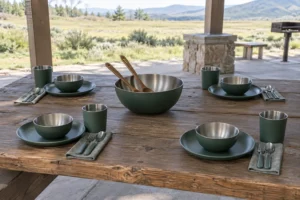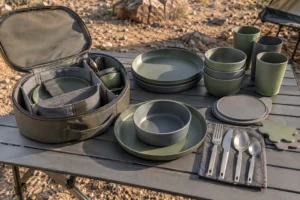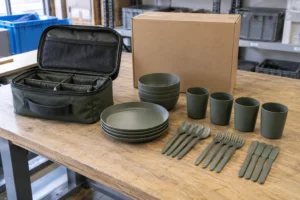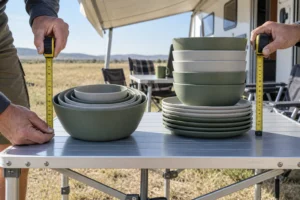
EU vs US camping dinnerware requirements are not interchangeable. Both systems expect food-contact articles to be safe for their intended use, but the legal routes, supporting records and supplier-specific scope differ. Buyers should define the complete material formulation, food types, time and temperature conditions, repeated-use pattern and target market before deciding which declarations and migration evidence are adequate.
EU vs US Camping Dinnerware Requirements at a Glance
A camping plate is not compliant merely because its base resin appears on a list or because a supplier calls it “food grade.” The finished article includes resin, fillers, pigments, coatings, adhesives, printing inks and any component that may reasonably contact food or transfer constituents during foreseeable use. Its compliance file must connect those components to the actual plate, bowl, cup, lunch box or cutlery design being purchased.
In the United States, the Food and Drug Administration regulates food-contact substances through several authorization routes. FDA explains that a component reasonably expected to migrate must be covered by an applicable regulation, an effective Food Contact Notification, a Threshold of Regulation exemption, a prior sanction or another valid basis, and that authorization conditions matter. In the European Union, Regulation (EC) No 1935/2004 provides the framework principle, while material-specific measures such as Regulation (EU) No 10/2011 add rules for plastics.
The practical buyer lesson is that a US letter referencing 21 CFR does not automatically establish EU conformity, and an EU Declaration of Compliance does not automatically demonstrate that every US component has an applicable authorization. A dual-market project needs one bill of materials but two documented regulatory mappings, both tied to the same production-intent sample and intended-use statement.
| Buyer question | United States route | European Union route | Procurement implication |
|---|---|---|---|
| What is the legal starting point? | FD&C Act framework plus applicable 21 CFR provisions, FCNs, TOR exemptions or other valid authorizations | Regulation (EC) No 1935/2004 plus material-specific measures where they exist | Do not ask for one generic “FDA/EU certificate” |
| Does an authorization cover every supplier? | An FCN is effective for the listed manufacturer, substance and conditions of use | The business operator must support the marketed article and supply-chain declaration scope | Check supplier identity and formulation traceability |
| How are plastics assessed? | Confirm each relevant component and its permitted use conditions | Regulation (EU) No 10/2011 provides Union-list, restriction, migration and declaration rules for covered plastics | Use market-specific compliance mapping |
| Are food and temperature conditions relevant? | Yes; FDA authorizations are tied to food types and conditions of use | Yes; migration testing and compliance depend on foreseeable contact conditions | Define hot, fatty, acidic, repeated and storage uses before testing |
| Is a raw-material statement enough? | No; the finished article and all reasonably migrating components must be supported | No; the finished article, composition, migration and declaration chain matter | Approve a production-intent sample and complete bill of materials |
| What should remain in the technical file? | Authorization references, supplier statements, formulation identity, test rationale and intended use | Declaration of Compliance where required, supporting documents, traceability and test rationale | Control versions and link evidence to SKU, color and decoration |
The Shared Principle: Safety Under Intended Conditions
Both jurisdictions focus on safe use rather than a marketing adjective. The FDA describes a food-contact substance as one used as a component of materials that contact food without being intended to have a technical effect in the food. Its official component-status guidance tells manufacturers to assess identity, specifications and limitations for each applicable authorization.
The EU framework applies to articles intended to contact food, already contacting food for that purpose, or reasonably expected to contact food or transfer constituents under normal or foreseeable use. Regulation 1935/2004 requires sufficient inertness so transfer does not endanger health, cause an unacceptable change in food composition or deteriorate sensory characteristics. That principle reaches beyond a resin name and makes the finished-use scenario essential.
Outdoor use adds variables that generic kitchen language can hide. A bowl may hold hot soup, a plate may carry acidic tomato sauce and oily grilled food, a cup may be repeatedly filled with hot drinks, and a lunch box may store refrigerated food before warming. The buyer must state these conditions rather than letting a laboratory or supplier assume the easiest test program.

How the US Authorization Map Works
The US route starts with every substance that may reasonably migrate from the food-contact article. FDA’s public explanation lists regulations in Title 21, GRAS status where applicable, prior sanctions, Threshold of Regulation exemptions and effective Food Contact Notifications as possible bases. The correct route depends on substance identity, manufacturer where relevant, specifications and intended conditions.
A common procurement error is to cite a polymer regulation and ignore additives. Colorants, processing aids, stabilizers, fillers, surface treatments, adhesives and print systems may have separate restrictions. The finished article supplier should be able to trace these inputs through the formulation or obtain adequate supporting statements from upstream suppliers.
FDA’s 21 CFR food-contact inventory is an index, not a blanket approval. FDA states that specific regulations must be consulted for allowed intended uses and conditions. Buyers therefore need the exact citation and a reasoned explanation of why the purchased camping dinnerware falls within its identity, specifications and limitations.
Food types and conditions of use
FDA publishes reference tables for food types and use conditions. The food categories distinguish aqueous, acidic, fatty, dairy, beverage, bakery and dry-food contacts, while the conditions range from high-temperature sterilization and hot filling to room-temperature, refrigerated, frozen and cooking uses. The official food types and conditions of use tables help buyers translate a product brief into a supportable use envelope.
Do not claim every condition because a product might theoretically encounter it. A reusable camping plate intended for serving food is different from cookware used on a stove, and a lunch box intended for cold storage is different from a container approved for reheating. The commercial specification should state the narrow, truthful envelope that the evidence actually covers.
Supplier-specific Food Contact Notifications
FDA notes that an FCN is effective for the manufacturer identified in the notification, the substance and the specified conditions of use. A buyer cannot simply find a similar substance in the database and assume it covers material sourced from another manufacturer. Traceability to the authorized source is therefore a procurement control, not an administrative extra.
When a supplier relies on an FCN, request the notification number, manufacturer identity and a statement connecting the supplied grade to the effective notification. Then check that the product’s food types and temperatures fit the permitted conditions. This is especially important when a brand changes compounders, pigments or factories after sampling.
How the EU Framework and Plastics Measure Work
Regulation (EC) No 1935/2004 is the broad legal framework for food-contact materials and articles in the EU. It addresses safety, labeling where applicable, traceability and supporting measures. A buyer should treat it as the starting architecture rather than as a standalone test method.
For plastic materials and articles within scope, Regulation (EU) No 10/2011 establishes specific composition, restriction, migration, testing and documentation requirements. It includes the Union list for authorized substances, specific migration limits, overall migration requirements and rules for declarations and supporting documents. Because the regulation has been amended, buyers must confirm that the compliance assessment uses the applicable consolidated rules at the time of placing the product on the market.
A composite outdoor article can require careful scope analysis. A plant-fiber and PP product is not supported merely by testing another unfilled PP item, and a coated metal article is not transformed into a plastics-only case because a polymer coating contacts food. The buyer must identify which rules, national provisions or recognized technical guidance apply to each layer or material.
Migration is tied to the test scenario
EU plastics testing uses food simulants and time-temperature conditions selected to represent foreseeable contact. Overall migration addresses the total non-volatile substances released under specified conditions, while specific migration limits address named substances. The test plan should explain why its simulants, duration, temperature and repeated-use sequence represent the intended camping use.
Repeated-use articles need more than a single convenient exposure if the applicable rule expects successive migration testing. Color variants, decorations or recycled-content changes can also affect the worst-case rationale. A laboratory report is most useful when it identifies the sample, material, color, surface, test conditions, results and rule version clearly enough to trace back to the purchase specification.
Declaration and supporting-document chain
For materials covered by specific EU measures, the Declaration of Compliance is a controlled supply-chain document, not a decorative certificate. It should identify the issuing operator, the materials or articles, the date, relevant legislation, adequate information about restricted substances and specifications for use where applicable. Supporting documents must substantiate the declaration and be available to competent authorities.
Importers should check whether the declaration accurately matches the finished item, including SKU family, material, colorant and decoration. A declaration copied from a resin supplier may be useful upstream evidence, but it is not automatically a finished-product declaration. Version control matters when formulations, suppliers or manufacturing sites change.

Eight Buyer Checks for a Dual-Market Project
1. Freeze the product identity
Assign a clear SKU or project code to every plate, bowl, cup, lunch box and cutlery component. Record material family, formulation reference, color, coating, decoration and supplier. If the set combines multiple materials, maintain a component-level bill of materials rather than one description for the carton.
2. Define foreseeable food contact
List food types, maximum contact temperature, duration, repeated-use pattern, washing method, storage conditions and whether reheating is intended. Separate serving dinnerware from cookware. Never extend a food-contact statement to direct flame, burner or campfire use unless product-specific evidence explicitly supports it.
3. Map the US basis component by component
Record the precise 21 CFR citation, effective FCN, TOR exemption, prior sanction or other valid basis for each relevant substance. Confirm manufacturer-specific limitations where applicable. A vague phrase such as “meets FDA” is not an authorization map and should not close the buyer’s review.
4. Map the EU rules by material and layer
Start with Regulation 1935/2004, then identify material-specific rules. For plastics, determine how Regulation 10/2011 applies to the finished structure. For metals, coatings, silicones or composites, document the applicable EU, national or recognized technical basis instead of forcing every material into a plastics declaration.
5. Approve the worst-case test rationale
The most demanding color, surface-area-to-volume ratio, food type, temperature and duration may drive sample selection. The laboratory or compliance specialist should explain grouping decisions. Buyers should not assume a neutral-color bowl covers every dark pigment, print or coating without a documented rationale.
6. Match reports to the production-intent sample
Compare report photographs, sample descriptions, material codes and dates with the approved drawing and golden sample. Ask how production lots will be kept within the tested formulation. The companion guide on food-contact testing for outdoor tableware provides a practical file-review sequence.
7. Control changes after approval
Require notification before changing resin grade, compounder, filler, pigment, coating, ink, adhesive, factory or process condition that could affect compliance. Define when a change triggers document review, risk assessment or retesting. A current technical file is more valuable than an old report attached to a new formulation.
8. Keep market claims narrower than evidence
Marketing should not convert a limited declaration into “safe for everything.” State only the verified food-contact and use conditions. For a broader explanation of terminology, use what food grade means for outdoor tableware and keep consumer-facing instructions consistent with the approved evidence file.
Applicable Camping Dinnerware Scenarios
Family car-camping sets often combine plates, bowls, cups, utensils and storage pieces, so the compliance map must cover several shapes and sometimes several materials. A retailer may sell the set in both the EU and US with different labeling, importer information and document retention procedures. The physical components can be shared only when the evidence supports both destination markets.
Scout, education and rental-fleet programs introduce repeated washing, component replacement and heavy rotation. The buyer should confirm whether replacement parts retain the approved formulation and whether the set’s intended-use instructions remain with the fleet. A replacement cup made from a new compound is a change even if its color and dimensions look similar.
Promotional or gift sets may add printing, sleeves and mixed-source cutlery late in development. Those additions can alter the food-contact surface or the traceability file. Artwork approval should therefore follow, not precede, confirmation of the decoration system and its applicable compliance support.

Limitations and Procurement Risks
This comparison is buyer guidance, not a legal opinion or a substitute for destination-market counsel. EU rules may interact with member-state requirements, and US compliance can depend on the exact authorization route and supplier identity. Product-specific evidence must be evaluated against the current formulation and intended use.
A pass result from one laboratory does not prove that every future production lot is identical. Testing samples only the submitted article and specified conditions. Supplier qualification, incoming-material control, change management and traceability are needed to keep later production aligned with the approved file.
Do not treat “BPA-free,” “LFGB tested,” “FDA approved,” “food safe” or similar isolated phrases as a complete dual-market decision. Some phrases may be inaccurate for the legal route, and none replace scope review. Ask for the underlying record, its issuing body, sample identity, date, method and limitations.
Naike Dinner’s live site verifies selected PP and wheat-straw composite outdoor-product records, but it does not establish every material capability or every pictured concept as available. When a project uses a new material, color, coating or assembly, the capability and evidence package must be confirmed for that project before quotation or claim approval.
B2B Buyer Checklist
| Check | Question | Why It Matters |
|---|---|---|
| Market scope | Will the identical SKU be sold in the EU, US or both? | Determines the regulatory maps and importer responsibilities |
| Bill of materials | Are resin, filler, pigment, coating, ink, adhesive and accessories identified? | Prevents gaps hidden by a generic material name |
| Intended use | Which foods, temperatures, durations, washes and storage conditions apply? | Defines authorization and test boundaries |
| US basis | What exact regulation, FCN, TOR or other basis covers each relevant component? | Confirms identity and conditions rather than marketing language |
| EU basis | Which framework and material-specific rules apply to each layer? | Builds the correct declaration and migration rationale |
| Sample identity | Does the report match the production-intent SKU, color and decoration? | Connects evidence to the purchased article |
| Change control | Which supplier or formulation changes require approval or retesting? | Protects compliance after launch |
| Claim control | Do packaging and web claims stay inside verified conditions? | Reduces misleading-claim and recall risk |
Procurement Workflow for EU and US Approval
Start with a written buyer brief rather than a request for certificates. Define the product family, component matrix, destination markets, target users, foods, temperatures, storage and cleaning. Share drawings and specify which surfaces contact food, including printed or coated areas.
Next, request a compliance matrix showing the US basis and EU basis for every material and component. Ask the supplier to distinguish documents already verified from items that remain to be confirmed. If you are developing a new combination, use the camping tableware brand-selection guide to align materials, storage and channel needs before freezing the specification.
Then approve a production-intent sample and worst-case testing rationale. Review the resulting reports and declarations against the drawing, bill of materials and intended-use statement. Log every gap, owner and resolution; do not close a gap with an unrelated certificate or a report for a visually similar product.
Finally, establish version control and change notification in the purchase specification. Retain the signed sample, controlled documents and approved artwork. Before placing an order, request a documented project review that separates verified current capability from new development questions.
Buyer FAQ
1. Is an FDA registration or certificate required for every camping plate?
Food-contact compliance is not demonstrated by a generic facility registration or decorative certificate. The buyer needs the applicable legal basis for the substances and conditions of use, plus evidence connecting those substances to the finished article. Ask for exact references and supplier-specific scope.
2. Does an EU Declaration of Compliance prove US compliance?
No. An EU declaration addresses EU requirements and its stated scope. A US review must separately confirm the applicable authorization route for each relevant component and the intended conditions of use. The same laboratory data may sometimes inform both reviews, but the legal conclusions are separate.
3. Can one migration report cover several colors?
Only when the grouping and worst-case rationale are technically justified and documented. Different pigments or additives can change the composition. Buyers should ask why the selected color represents the others and whether the declaration and supplier formulation records support that conclusion.
4. Are stainless steel or enamel products covered by EU plastics rules?
Not simply because they are food-contact articles. Regulation 1935/2004 still provides the framework, but the material-specific assessment differs. A polymer coating or plastic accessory may introduce additional requirements, so evaluate the complete structure layer by layer.
5. Does dishwasher testing replace food-contact testing?
No. Dishwasher durability checks appearance and performance under a cleaning cycle, while food-contact compliance addresses substance transfer and applicable legal conditions. Repeated washing can affect a use scenario, but the two questions require distinct evidence and should not be conflated.
6. What happens if a resin or pigment supplier changes?
The buyer should trigger a documented change review. Confirm whether the new grade has the same identity, authorization basis, specifications and migration profile, and whether the existing declaration or report remains valid. Retesting may be required depending on the risk and scope.
7. Can Naike Dinner confirm both markets before a quote?
Naike Dinner can review a buyer brief, verified live product records and the requested evidence scope, but project-specific capability and documentation must be confirmed rather than assumed. Send the markets, component list, materials, colors, use conditions and artwork through the Contact Us page.
8. What should a buyer send for the fastest review?
Provide destination markets, product drawings or reference components, complete set configuration, food types, temperature and duration, repeated-use and cleaning expectations, material preferences, color and logo plans, packaging concept and required document list. Unknown values can be marked for project confirmation.
Build a Dual-Market Evidence Plan Before Tooling
Do not wait until final inspection to discover that a US authorization does not match an EU declaration or that the tested sample differs from the production brief. Request a specification and evidence review with your component matrix, intended use, destination markets and current documents. Naike Dinner will separate verified records from project items that still require confirmation.