Product specification drift control keeps one approved fact set aligned across the product webpage, sales sheet, carton artwork, instruction leaflet and inspection release. For a B2B buyer, the goal is not to make every channel look identical. It is to make every measurable value, component count, material statement, use instruction and revision traceable to the same controlled source.
Direct answer: assign one controlled specification as the source, compare every website, carton and instruction field against it, record each mismatch by owner and revision, and stop release when a safety, material, dimension, count or intended-use statement conflicts. Publish only after the reconciliation record identifies the approved value, evidence, effective date and channels updated.
Why Does Specification Drift Create a Buyer Risk?
A buyer may receive a correct sample while the carton still carries an old count, the website rounds a dimension differently, or the instruction leaflet describes a use condition that was never approved. The problem is not cosmetic: the channels can drive quotation, artwork, labeling, warehouse checks, customer expectations and complaint handling. Product specification drift control makes the disagreement visible before an order or public claim relies on it.
One product, several release paths
Website content may be edited by marketing, carton files by packaging, instructions by compliance or engineering, and sales sheets by account teams. Without a shared revision key, each file can be individually polished but collectively inconsistent.
Not every difference is an error
A carton may show packed dimensions while a webpage shows product dimensions. That can be valid only when the field names, measurement basis, units and revision make the distinction explicit. Ambiguous differences remain on hold.
Use This Cross-Channel Specification Reconciliation Record
Copy the table into the project release file. Enter the controlled source first, then transcribe what is actually visible in each channel. Do not silently correct a value while auditing; record the mismatch, decide which source governs and preserve the approval trail.
| Field to reconcile | Controlled source and revision | Website value | Carton value | Instruction value | Mismatch / evidence gap | Owner | Release / hold decision |
|---|---|---|---|---|---|---|---|
| Public product name and code | Released commercial specification; product code; revision | Page H1, SKU and structured data | Front, side and barcode panels | Cover and model reference | Aliases, missing suffix or wrong configuration | Commercial specification owner | Release only when the marketed configuration is unambiguous |
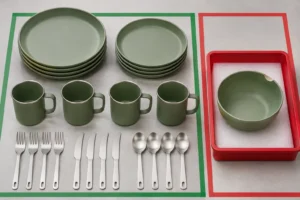
| Included component count | Released BOM and pack-out count sheet | Summary, table, image captions and FAQ | Piece count and component list | Parts diagram and cleaning list | Optional item presented as standard; image/count conflict | BOM owner | Hold any channel that overstates the approved pack |
| Dimensions and method | Released drawing, datum, tolerance and measured-sample record | Product or packed dimensions, clearly labeled | Unit, order of dimensions and pack level | Only dimensions needed for safe use or assembly | Unit conversion, rounding, datum or pack-level conflict | Drawing / quality owner | Release with the measurement basis and approved rounding rule |
| Capacity definition | Approved fill-line or brimful method, temperature and tolerance | Nominal capacity with method if material | Same defined capacity or intentionally omitted | Use fill line where relevant | Nominal, usable and brimful values mixed | Test-method owner | Hold until the capacity term and method match |
| Net and packed weight | Approved scale record, sample identity and tolerance | State whether net set or packed weight | Net/gross designation and pack quantity | Usually omitted unless needed | Sample, accessory, carton or unit basis differs | Packaging / quality owner | Release only with a defined weight basis |
| Material statement | Component-level material specification and supplier record | Exact supported wording; no unsupported umbrella claim | Required material or recycling statement by project | Material-dependent care limits | One component’s material applied to the full set | Material / compliance owner | Hold broadened or unsupported material claims |
| Intended use and cleaning | Approved use-condition matrix and verified instructions | Summary, FAQ and claim qualifications | Warnings or symbols required by the project | Complete preparation, use, cleaning and storage steps | Dinnerware described as cookware; unsupported heat or dishwasher claim | Quality / compliance owner | Release only within the approved use scope |
| Claim wording | Claim approval matrix and linked evidence | Heading, body, ALT text, metadata and FAQ | Front/back claims and icons | Explanatory wording and limitations | Qualification removed or stronger synonym introduced | Claim owner | Use the exact approved sentence or return for review |
| Artwork and labels | Approved artwork master and destination-market brief | Download preview if provided | All printed panels, barcode and importer fields | Symbols, language and document identifier | Superseded artwork or wrong market version | Artwork owner | Hold printing until the approved file hash/revision matches |
| Revision and effective date | Change notice, release ID and effective order/batch | Page change record and canonical URL | Artwork revision or production code | Document revision and issue date | Mixed old/new files without transition rule | Change-control owner | Release with a documented cutover and old-stock decision |

How Should Dimensions, Units and Capacity Be Reconciled?
Start with the physical definition, not the displayed number. A plate diameter needs a named datum; a set size needs a stated orientation and order; a cup capacity needs a defined fill method; and a packed dimension needs a stated pack level. Then apply one conversion and rounding rule. The NIST unit conversion guidance is a primary reference for conversion practice. GS1’s Trade Item Implementation Guideline provides measurement and master-data principles for trade items. Neither source supplies a Naike Dinner product dimension; the project drawing and measured sample must do that.
Product or pack level, datum, orientation, fill line, included accessories and sample condition.
Unit, decimal places, rounding rule, tolerance language and field label used in every channel.
Released drawing, calibrated measurement record, sample ID, reviewer and effective revision.
Use the existing normalized quotation comparison to keep suppliers on the same field definitions, and connect the final values to the drawing and BOM revision record.

Which Mismatches Require an Immediate Hold?
Hold a channel when the difference can change product identity, included quantity, material understanding, intended use, warning, destination-market information, physical fit or buyer acceptance. A spelling style or approved shortened description may be editorial. A different component count, conflicting capacity, unsupported cleaning claim or mixed artwork revision is not.
Release after documented correction
Correct a transcription error only after confirming the controlled source, updating every affected channel, recording the owner and revision, and rerunning the comparison. Keep the before/after record.
Escalate when the source conflicts
If the drawing, BOM, sample or evidence file disagree, the website is not the place to decide. Return the field to the responsible owner and leave public wording neutral until the product record is resolved.
What Is the Seven-Step Product Specification Drift Control Workflow?
- Freeze the channel list. Include website, structured data, downloadable sheet, carton, label, instructions, marketplace copy and inspection form where applicable.
- Name the controlled source. Record the drawing, BOM, material file, claim matrix and use-condition record with revision.
- Extract the visible facts. Capture the wording exactly as displayed; do not normalize it yet.
- Classify each difference. Mark correct equivalent, editorial difference, evidence gap, obsolete revision or direct conflict.
- Assign one owner and due decision. Avoid collective ownership without an accountable approver.
- Update every affected channel. A corrected website does not close an open carton or instruction mismatch.
- Approve the release record. Store channel URL/file, revision, effective date, reviewer and release/hold status.
For evidence used in public wording, connect this process to the tableware claim approval matrix. Before shipment, verify the released values again in the pre-shipment inspection release sheet.

Does Reconciliation Replace Regulatory or Technical Review?
No. Reconciliation proves that channels match the approved source; it does not prove that the source itself is legally sufficient or technically correct. For EU food-contact projects, Regulation (EC) No 1935/2004 establishes the general framework for materials intended to contact food. The project still needs exact material, article, intended-use and destination evidence. Product specification drift control must preserve those qualifications rather than turn them into broad claims.
What Should a Buyer Send for a Reconciliation Review?
Destination markets, sales channels, required languages, approved assortment, intended use and release deadline.
Current BOM/drawings, material records, measurement methods, sample ID, website draft, carton artwork and instructions.
Field-by-field comparison, mismatch owner, corrected value, evidence link, effective date and release/hold decision.
Buyer Questions About Product Specification Drift
Can equivalent metric and imperial values differ slightly?
Yes, when one documented conversion and rounding rule explains the displayed values. Record the governing source unit, precision and allowed rounding so the difference cannot be mistaken for a second specification.
Should a website show tolerances?
Show tolerances when the buyer decision or fit depends on them. Otherwise keep the tolerance in the controlled specification and avoid implying that a rounded nominal value is an exact guarantee.
What if old printed cartons remain in stock?
Define a cutover decision: use, relabel, segregate or scrap. Record the affected quantity and production/order range. Do not let the website silently represent a new revision while old packaging creates a conflicting claim.
Can photography be part of the reconciliation?
Yes. Check that product photos, component layouts, captions and ALT text show the released configuration. The product-photo evidence checklist helps identify visual count or revision conflicts.
Who signs the final release?
The named release owner signs after field owners close their mismatches. The record should show who approved the product data, who approved claim scope and who released each channel.
Request a Cross-Channel Specification Review
Send the current webpage draft, controlled BOM and drawings, carton artwork, instructions, destination markets and known change history. Naike Dinner can organize the differences into a buyer-ready reconciliation record before quotation, artwork release or shipment approval.
Send the website and artwork setRequest a specification reviewPrepare a B2B project brief
Updated . Evidence scope: buyer decision support. Nothing in this guide verifies a specific product, material, certificate, commercial term, delivery schedule or performance result.