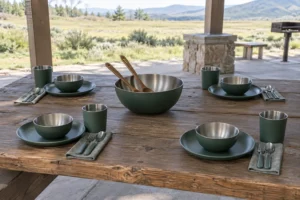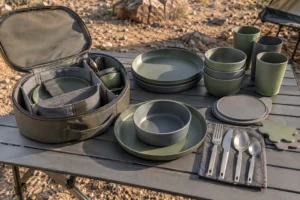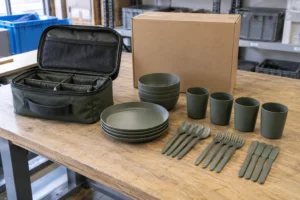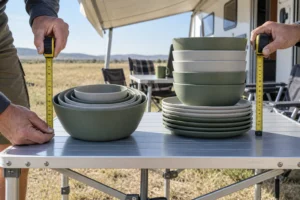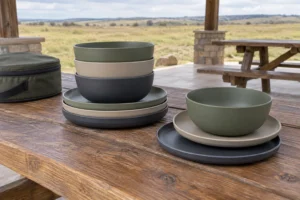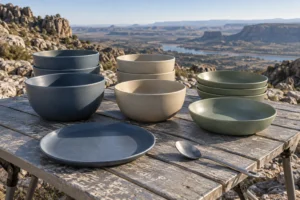
Melamine can be suitable for reusable camping dinnerware when the finished plate, bowl or cup is verified for the intended food-contact conditions and kept away from microwave, burner, campfire and other direct heating. It is rigid, lightweight and color-friendly, but suitability depends on resin formulation, molding quality, food acidity, temperature, contact time, cleaning, damage limits and destination-market evidence.
Melamine camping dinnerware safety: the decision in one table
A buyer should not decide from weight, color or the word “melamine” alone. The correct unit of assessment is the exact finished article under normal and foreseeable use. That means connecting resin system, pigment, decoration, molding process, geometry and production site to foods, temperatures, contact time, cleaning and the destination market.
Melamine dinnerware is often chosen because it can feel rigid, stack efficiently and carry consistent colors without the metallic character of steel. Those commercial benefits remain valid only inside a controlled use envelope. The table below separates an acceptable sourcing question from a weak marketing shortcut.
| Decision factor | Suitable basis | Risk or limitation | Evidence to review |
|---|---|---|---|
| Product identity | Declared melamine-formaldehyde resin construction tied to model and lot | “Food-grade plastic” without formulation or traceability | Bill of materials, resin declaration, drawing and lot records |
| Food contact | Finished-article migration evidence matching foods, temperature and time | Raw-resin certificate presented as finished-product proof | Representative report, sample identity, method and conditions |
| Heating | Food is cooked elsewhere and served within documented conditions | Microwave, burner, campfire, oven or other direct heating | Instructions, claim review and product-specific assessment |
| Acidic foods | Use covered by relevant test conditions and care guidance | Hot acidic food held longer or hotter than the evidence supports | Simulant/food selection, time, temperature and repeated-use scope |
| Physical condition | Smooth, intact, cleanable surface and rim | Cracks, deep scoring, flaking decoration, sharp damage or heavy wear | Inspection criteria, limit samples and replacement policy |
| Outdoor use | Stable plate, comfortable rim, controlled packing and drying | Crushing, abrasive nesting, wet storage and heat-source confusion | Production-intent sample trials and packing review |
| Market access | Destination-specific regulatory and import documentation | One generic “FDA/EU certificate” used worldwide | Legal mapping, declaration, report and importer records |
What melamine dinnerware is—and is not
Melamine-formaldehyde resin is a thermoset material. During manufacture, the molding compound is shaped and cured into a rigid article. A properly cured plate is not the same thing as free melamine powder, and the presence of melamine in a regulated manufacturing route does not authorize adding melamine directly to food.
The FDA’s melamine tableware questions and answers explains that a small residual amount can remain after resin formation and may migrate slowly into food. FDA also distinguishes authorized food-contact uses from adding melamine to food. This is why finished-article conditions matter more than an alarming or reassuring material slogan.
Melamine is not ordinary polypropylene, Tritan, ceramic or bamboo-fiber composite. It is also not enamel, even though both can have hard, colorful surfaces. Buyers should make the material identity explicit across the quotation, drawing, declaration, report, packaging, online listing and instructions so an attractive appearance does not obscure the actual construction.
Why camping brands consider it
For car camping, RV, picnic and family assortments, melamine can offer a rigid eating surface, broad color choices and lower breakage risk than conventional ceramic in ordinary handling. It can stack neatly and support coordinated plates, bowls and cups. Finished weight and impact behavior still depend on diameter, wall section, rim design, filler system and molding quality.
Those advantages do not make it suitable for every outdoor program. Backpackers may prefer a lighter construction, institutional fleets may prioritize a material with simpler retirement criteria, and brands serving very hot foods may choose a different platform. The broader camping dinnerware material comparison helps place melamine beside metal, PP, silicone and plant-fiber composites without declaring one universal winner.
FDA guidance sets a clear heating boundary
FDA reports that measured migration from melamine-formaldehyde tableware was generally low in the conditions it discussed, while acidic food at exaggerated high-temperature, long-duration conditions increased migration in some samples. The agency specifically advises that food and drinks should not be heated on melamine-based dinnerware in microwave ovens. Food can be heated in suitable cookware and then served on melamine tableware.
This distinction is especially important outdoors. A camper may see a rigid plate and assume it can sit near a stove, warming tray or fire. A buyer should therefore state “serving dinnerware, not cookware” in the product specification and align the package, listing and instructions with that boundary.
The FDA’s Inventory of Food Contact Substances entry for melamine directs users to the applicable Title 21 provisions and their intended-use limitations. An inventory listing is not a blanket approval for any finished plate. US importers must connect the complete formulation and use to the relevant regulatory basis and retain competent documentation.
EU requirements focus on migration and traceability
The current consolidated EU Plastics Regulation (EU) No 10/2011 provides a Union list, restrictions, specifications and migration-test framework for plastic materials and articles intended to contact food. Buyers should use the current consolidated text and competent advice because amendments can change requirements, transitional provisions and testing logic.
Melamine and formaldehyde are separate substances in the regulatory assessment. The evidence file should not test one and silently claim both are controlled. Check the current restrictions and ensure the laboratory plan covers the correct constituents, foods or simulants, repeated-use sequence, time and temperature for the finished article.
The general EU food-contact framework Regulation (EC) No 1935/2004 requires that materials under normal or foreseeable conditions do not transfer constituents in quantities that endanger health, cause unacceptable changes in food composition or deteriorate sensory characteristics. It also establishes traceability principles. A valid-looking report cannot support production if the factory later changes the resin, pigment, decoration, mold or process without review.
Special import controls can apply
Commission Regulation (EU) No 284/2011 lays down specific conditions for polyamide and melamine plastic kitchenware originating in or consigned from China and Hong Kong. For melamine kitchenware, it requires an importer declaration and an accompanying laboratory report addressing formaldehyde release within the specified limit. Importers must verify the current procedure, consignment scope and competent-authority expectations rather than treating a historical test PDF as complete clearance.
This import measure is a concrete procurement control, not a marketing badge. The declaration identifies the consignment and relevant business operators. A buyer planning EU distribution should coordinate documents before shipment, confirm that the tested model represents the goods and avoid last-minute substitution of color, decoration or manufacturing site.
Resin, curing and molding quality change the result
Two products called melamine can perform differently. Resin formulation, fillers, pigments, decorations, moisture control, mold temperature, pressure, curing cycle and post-mold handling can influence surface quality and residual constituents. Procurement must therefore control the manufacturing route instead of accepting only a trade name.
Request a bill of materials or confidential material declaration adequate for compliance review. Tie input suppliers and formulation codes to the approved sample, then define change notification. A compound supplier’s declaration is valuable but does not replace migration testing and workmanship checks on the molded finished article.
Surface defects can indicate process or handling problems. Inspect pinholes, blisters, flow marks, embedded contamination, uneven gloss, exposed fibers or filler, decoration defects, rim cracks and sharp flash. Cosmetic variation should be governed by approved limit samples; cracks, flaking or sharp edges need separate functional rejection criteria.
Food acidity, temperature and time work together
Migration is not governed by one variable in isolation. Acidic food, elevated temperature and longer contact can create a more demanding condition than a short contact with cool, neutral food. A procurement brief should therefore list representative foods and the maximum intended serving conditions before the laboratory chooses simulants and test parameters.
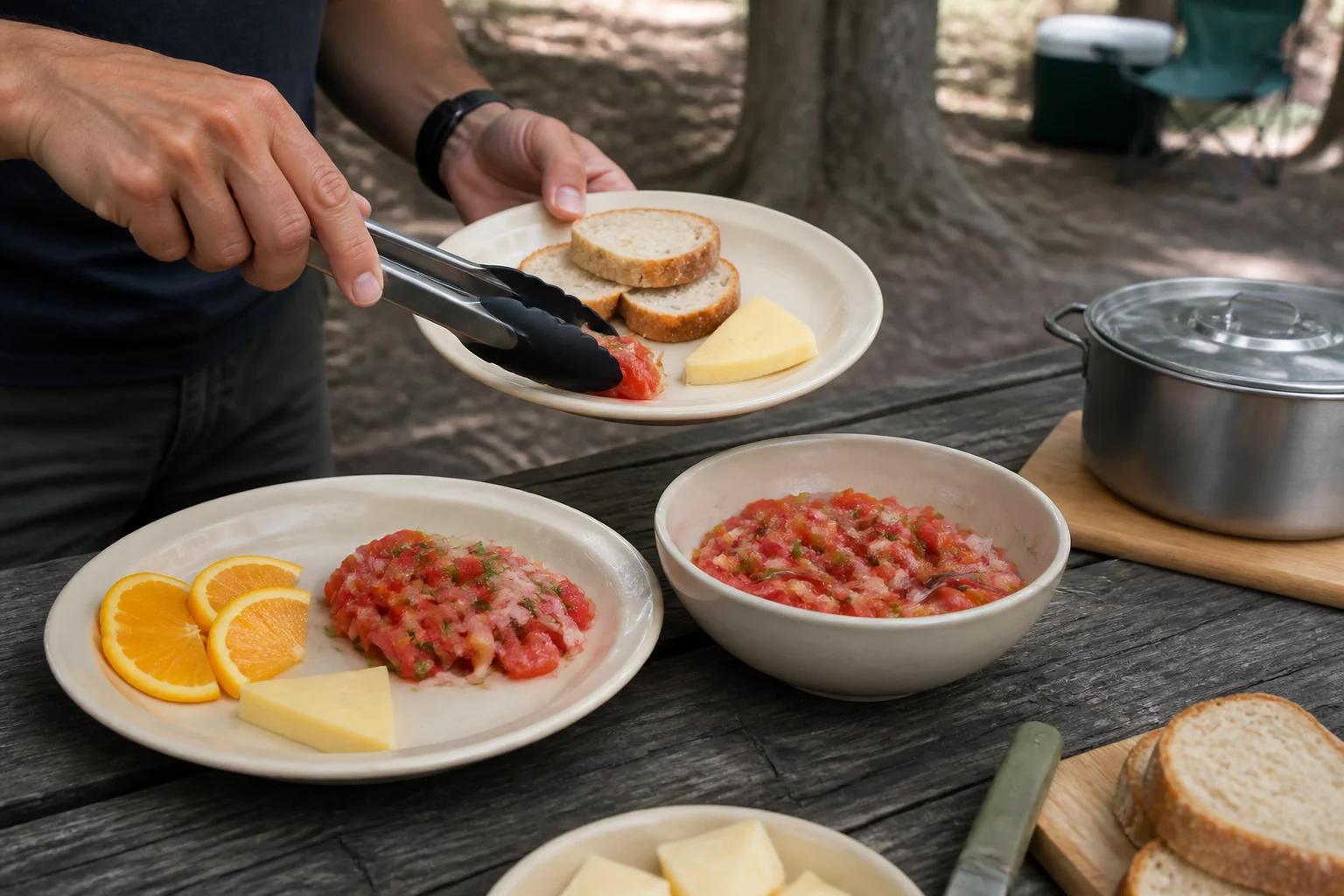
Tomato dishes, citrus, vinegar dressings and fruit are realistic camping foods. Their presence does not automatically make a compliant melamine plate unsafe. It means the buyer should avoid a universal “safe for all foods at any temperature” claim and verify that the exact use is covered by the evidence and instructions.
Do not confuse receiving hot food with heating the plate. A serving-temperature claim needs product-specific assessment, yet it still does not authorize microwave use or direct exposure to a stove or flame. If the brand expects long holding times, repeated hot servings or unusually acidic meals, those scenarios belong in the test plan.
Outdoor scenarios where melamine may fit
Family car camping
Family car-camping sets can value rigidity, full-size plates, color coding and easy stacking more than minimum pack weight. Melamine may suit this scenario when adults understand the heating restriction and damaged pieces are replaced. Use trials should check rim comfort, base stability, cutlery marks, nested transport and cleaning at a real campground station.
RV and caravan assortments
RV users may want a coordinated table setting that resists ordinary vibration better than ceramic. However, repeated cabinet movement can cause abrasion and rattling, while a nearby microwave increases misuse risk. Packaging and instructions should make the microwave boundary conspicuous, and storage design should prevent hard plate-to-plate movement.
Picnic, glamping and outdoor retail
Color and surface decoration can support lifestyle merchandising. Buyers should control pigment, decoration placement, print or overlay process and batch appearance. Do not assume that a report for a plain white plate automatically represents every dark pigment, printed design or decorative surface.
Scout camps and rental fleets
Group programs require fast inspection and consistent replacement rules. Melamine can work if staff can identify cracks, deep wear, unstable deformation and flaking decoration, but a material with simpler heat handling may be preferable where users cannot be trained. The decision should include replacement stock, collection routines and written use rules.
Backpacking and flame-oriented kits
Melamine is usually a weak fit when the product is expected to double as cookware, sit next to open flame or deliver the lowest possible pack mass. A metal cookware vessel may serve a separate role, but it should not be confused with the eating plate. Compare finished mass and actual use rather than relying on the broad word “camping.”
Damage, wear and retirement criteria
Thermoset dinnerware can scratch, chip or crack even if it does not behave like brittle ceramic. Deep scoring may make cleaning harder, and cracks can harbor soil or propagate under further impact. A smooth intact surface is not guaranteed for the entire service life, so the buyer needs a retirement policy.
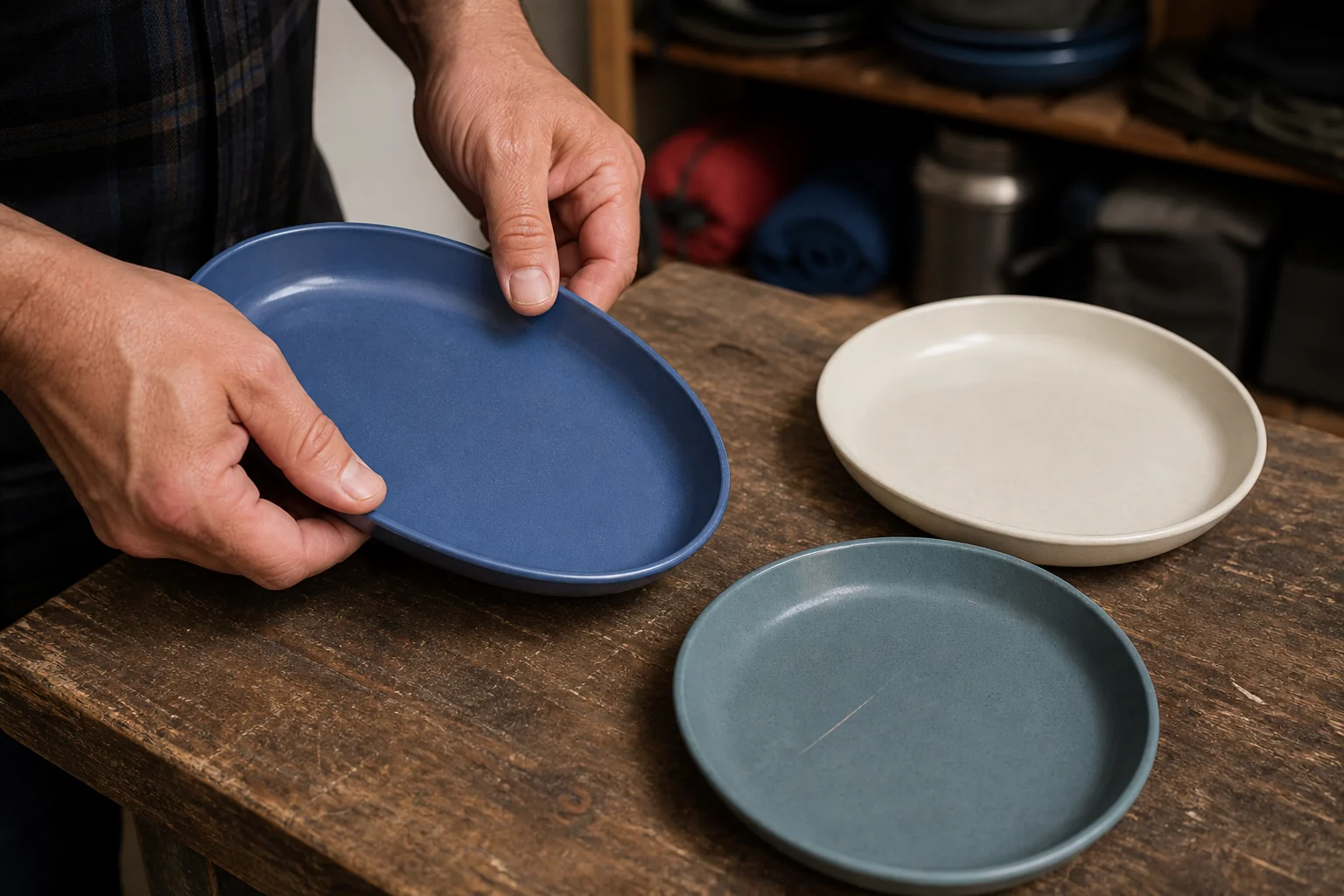
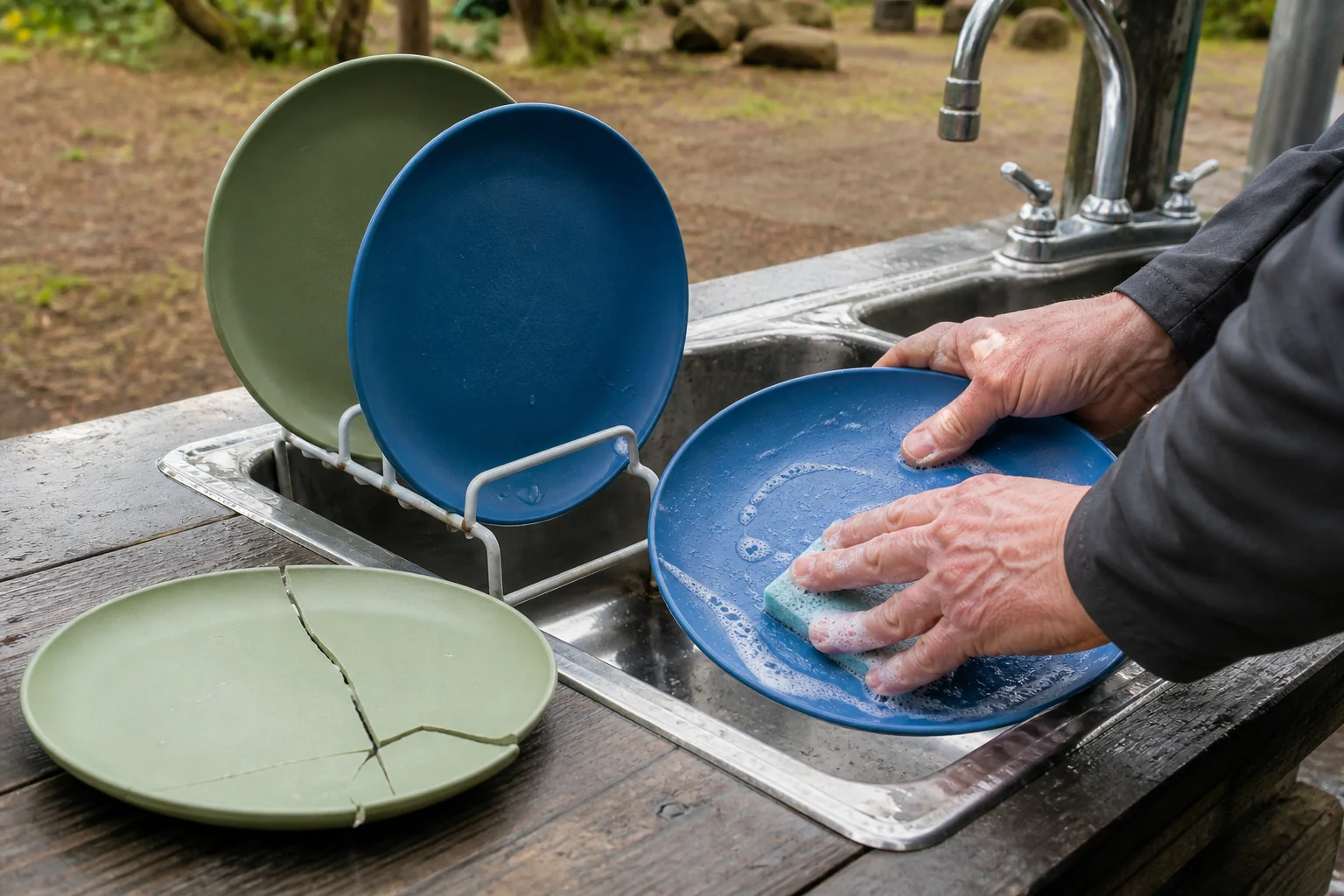
Define unacceptable conditions: sharp rim damage, through-cracks, branching cracks, loose or flaking decoration, severe abrasion, embedded staining that cannot be cleaned, heat deformation and any damage outside approved limit samples. The inspection image is illustrative and does not define a universal pass/fail threshold. Those thresholds must come from the specification and product risk assessment.
Do not repair a cracked food-contact plate with adhesive. Repair chemistry, gaps and uneven surfaces can introduce new hygiene and compliance questions. Remove the item from service and follow the brand’s disposal or replacement procedure.
Cleaning, dishwasher claims and storage
A “dishwasher safe” statement is a separate performance claim. Melamine items may tolerate some dishwasher conditions, but cycle temperature, detergent alkalinity, rack contact, drying and repeated exposure can influence appearance and wear. Validate the production-intent article under a defined method before putting the claim on packaging.
At camp, use a soft sponge and a compatible detergent, rinse thoroughly and dry before nesting. Aggressive abrasives can create visible wear, while wet storage can trap odors and soil between pieces. Care guidance should reflect the actual formulation, finish and decoration rather than a generic plastic instruction copied from another material.
Inspect plates after cleaning under good light. A clean surface makes small cracks and deep scratches easier to see. Fleet operators can sort questionable pieces into a separate container for review instead of returning them immediately to circulation.
Limitations and sourcing risks
The first risk is material substitution. Some products marketed as “melamine” may use a different resin blend, surface layer or filler than the approved sample. Buyers should request identity controls, traceability and prior approval for changes in compound supplier, formulation, pigment, decoration and factory.
The second risk is a mismatched report. Compare model, dimensions, mass, color, decoration, food-contact surface, resin reference, manufacturer, method, simulants, temperature, time, repeated-use cycles, sample photos and report validity. A report for another brand or a raw material does not automatically support the quoted dinnerware.
The third risk is unsupported heat language. “Heat resistant” can be interpreted as microwave, oven, fire or hotplate compatibility even when the seller meant only warm-food serving. Replace broad wording with an explicit intended-use range and clear exclusions supported by the product assessment.
The fourth risk is capability inference. This guide does not verify that Naike Dinner molds melamine, holds a specific test report or offers a universal MOQ and lead time. Use the camping tableware manufacturer checklist to verify factory identity, process, quality controls, evidence, capacity and commercial conditions before making an offer.
Review a real melamine dinnerware proposal
Send the destination market, model drawings, resin and decoration proposal, foods, serving temperature, contact time, cleaning method, user group, packing and claim list. We can identify missing specifications and confirm what capabilities and records must be verified before a documented quotation or sample plan.
Request an evidence-gap reviewA six-gate sourcing process for melamine camping plates
Gate 1: classify every SKU and prohibited use
List each plate, bowl, cup and serving piece with its intended function. State that food is cooked or reheated in suitable cookware and transferred to the dinnerware. Exclude microwave, oven, burner and open flame unless a different product-specific assessment expressly supports a claim.
Gate 2: freeze composition and appearance
Record the molding compound, supplier reference, pigment, decoration, surface finish, mold, cavity and production site under appropriate confidentiality. Lock useful dimensions, wall section, rim geometry, base stability and stack clearance. Require written approval before a commercial or technical substitution.
Gate 3: define foreseeable contact
Describe foods, acidity, serving temperature, maximum contact time, repeat use, washing and storage. Include the most demanding credible scenario rather than the easiest demonstration. If a use is excluded, ensure the listing and instructions communicate the same exclusion.
Gate 4: build the destination evidence file
Map applicable FDA or EU rules and any special import procedure with a competent professional. Select representative production-intent samples and laboratory conditions. Retain full reports, declarations, sample photos, traceability and the rationale that connects tested articles to every marketed color or decoration.
Gate 5: approve usability and workmanship
Run equal, documented sample trials for stacking, transport, washing, serving, cutlery contact and inspection. These trials are not accredited migration tests, but they expose unstable bases, uncomfortable rims, deep marking, trapped water and packing damage. Retain approved samples and visual defect limits.
Gate 6: control production and post-market handling
Set incoming material verification, molding parameters, decoration checks, final inspection, lot traceability, change notification and complaint review. Define how damaged items are removed and replaced. A brand that cannot maintain those controls should reconsider whether melamine is the right platform.
Melamine camping dinnerware buyer checklist
| Check | Question | Why It Matters |
|---|---|---|
| Classification | Is every item clearly serving dinnerware rather than cookware? | Prevents microwave, flame and burner misuse. |
| Resin identity | Which melamine-formaldehyde molding compound is tied to the sample and lot? | Connects formulation, evidence and repeat orders. |
| Color and decoration | Are pigment, print, overlay and food-contact locations controlled? | Changes may affect representativeness and migration scope. |
| Contact conditions | Which foods, temperatures, times and repeat-use cycles are claimed? | Defines the laboratory and instruction envelope. |
| Microwave warning | Do packaging and online listings clearly prohibit microwave heating? | Aligns use guidance with FDA advice. |
| EU import scope | Does Regulation (EU) No 284/2011 apply to the consignment? | May require a declaration and laboratory report before import. |
| Report match | Do reports identify the model, manufacturer, color, method and conditions? | Prevents unrelated evidence from supporting the SKU. |
| Workmanship | Are flash, cracks, blisters, contamination and decoration limits defined? | Supports a smooth, cleanable finished article. |
| Care claim | Has any dishwasher statement been verified on production-intent samples? | Avoids transferring a claim from another formulation. |
| Retirement rule | When are scratched, cracked or heat-damaged pieces removed? | Creates consistent field handling. |
| Capability | Are factory, process, MOQ, capacity and lead time verified for this project? | Separates education from a real commercial offer. |
Prepare a decision-ready RFQ
Include market, annual forecast, set configuration, dimensions, compound proposal, colors, decoration, foods, serving conditions, wash method, packaging, testing and damage limits. Ask the supplier to separate verified facts from open items and price only the documented construction.
Start a documented RFQBuyer FAQs about melamine camping dinnerware
1. Is melamine safe for serving hot camping meals?
It can be suitable within product-specific documented serving conditions, but “hot” is too vague for a universal answer. Specify food, temperature and contact time, then verify the finished article. Serving cooked food does not authorize reheating the plate in a microwave or placing it near flame.
2. Can melamine camping plates go in a microwave?
FDA advises that foods and drinks should not be heated on melamine-based dinnerware in microwave ovens. Heat food in cookware that is explicitly suitable for the microwave, then transfer it to the serving plate. Packaging and product pages should make this boundary clear.
3. Are acidic foods such as tomato and citrus prohibited?
Not automatically. Acidity, temperature and time combine to determine the relevant exposure. The finished-product evidence should cover the intended foods and conditions. Avoid prolonged or unusually hot acidic contact outside the verified use envelope.
4. Is melamine unbreakable for camping?
No. It can resist ordinary handling better than some ceramic ware, but it can crack, chip or develop deep wear under impact, crushing or misuse. Use protective packing and retire pieces with damage beyond the approved limit.
5. Does a raw-resin certificate prove the plate is compliant?
No. It can support material identity, but the finished article also includes molding history, pigments, fillers, decorations and geometry. Buyers need destination-specific assessment and representative finished-product evidence matched to intended use.
6. Can every melamine color use the same test report?
Only when the responsible compliance party has a documented representativeness rationale. Pigments, overlays and decorations may vary. Freeze the color system, identify worst-case or representative samples properly and review changes before production.
7. When should a camping program replace a melamine plate?
Replace items with sharp damage, through-cracks, branching cracks, flaking decoration, severe abrasion, heat deformation or other conditions outside the approved inspection standard. Do not glue a cracked food-contact surface back together.
8. How should a buyer compare melamine with wheat-straw composite?
Compare the exact formulations, mass, rigidity, wear, heat limits, cleaning, food-contact evidence, environmental claims and supplier controls. The existing wheat-straw plates versus melamine plates guide offers a broader commercial comparison; this article focuses specifically on melamine safety and camping use boundaries.
Make suitability a documented conclusion
Melamine can be a practical camping dinnerware material for controlled serving use, especially in color-led family, RV, picnic and glamping sets. It is not a microwave or flame material, and an attractive sample is not compliance proof. Suitability comes from a stable formulation, finished-product evidence, realistic use conditions, clear instructions, production control and a working retirement policy.
Naike Dinner must verify real capability before discussing any melamine offer. To evaluate a defined project, send the destination, user group, drawings, material proposal, foods, serving temperature, cleaning, forecast, packaging and evidence expectations. Ask for a melamine-use evidence review before approving the product brief or releasing an order.