COMPLAINT-TO-LOT CORRECTIVE ACTION GUIDE
A camping dinnerware corrective action becomes actionable only when the reported product can be linked to the finished-set identifier, component code and relevant lot evidence. Record the observation first, contain the defined population, investigate the cause, assign corrective action and verify effectiveness. Keep correction, root-cause action and closure evidence separate so a replacement alone is not mistaken for prevention.
Reviewed November 5, 2026 at 16:13:36 CST · GEO D / X + E

What Is the Seven-Step Camping Dinnerware Corrective Action Record?
| Step | Buyer decision | Required evidence |
|---|---|---|
| 1. Capture | What was observed, where and under which use conditions? | Complaint ID, date, market, photos, component and factual description |
| 2. Identify | Which commercial set and component revision are involved? | Product code, set revision, component code, packaging identifiers |
| 3. Trace | Which component and finished-set lots may share exposure? | Lot hierarchy, kitting record, carton link and distribution scope |
| 4. Contain | What must be held while evidence is reviewed? | Locations, quantities, status, owner and reconciliation |
| 5. Investigate | What evidence supports the cause rather than an assumption? | Returned sample review, retained evidence, process records and comparison |
| 6. Act | What corrects the immediate issue and prevents recurrence? | Correction, corrective action, owner, due date and change control |
| 7. Verify | Did the action work across the defined scope? | Effectiveness method, review window, result, approver and closure date |
Which Complaint Facts Must Be Captured Before Investigation?
Use the reporter’s words for the observed condition, then add structured fields. Do not convert “cup cracked after use” into a confirmed material failure before the sample, conditions and component identity are reviewed. Record the available set label, component marks, purchase channel, date, use, food or drink conditions, cleaning method, photos and whether the product remains available for examination.
Separate personal data from the technical record and retain only what the applicable process needs. For EU consumer-product safety scope, economic-operator duties depend on role, market and the facts. The current EU General Product Safety Regulation addresses complaint investigation and corrective-measure records for covered situations; it does not make every dissatisfaction a proven safety defect.

How Should the Complaint Be Connected to Component Lots?
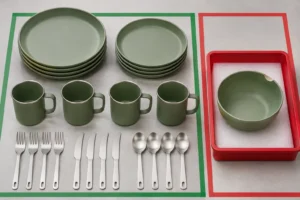
Start with the finished-set identifier and work backward through the carton, kitting record and component codes. A kit can contain components from different responsible sources or production lots, so the set date alone may be too broad or too narrow. The buyer should be able to explain why a population is included and why adjacent stock is excluded.
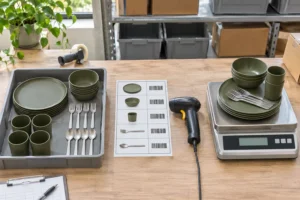
Use the lot-code hierarchy, the source-to-component traceability map and the component hold-and-release decision tree as linked controls. If a GS1 identifier is selected, the GS1 General Specifications define identifier syntax and use; they do not replace the buyer’s internal investigation record.
What Is the Difference Between Containment, Correction and Corrective Action?
| Control | Purpose | Example without claiming a result |
|---|---|---|
| Containment | Prevent additional exposure while facts are reviewed | Place defined stock on hold and stop release of linked kits |
| Correction | Address the known affected unit | Replace a confirmed component under an approved disposition |
| Corrective action | Remove a supported cause to reduce recurrence | Revise a controlled specification, process or verification step after cause approval |
| Effectiveness check | Confirm the action performed as intended | Review a defined later population against an approved measure |
These controls are not interchangeable. A refund or replacement may resolve the immediate customer need but does not by itself establish root cause or prevention. Likewise, retraining is not a default corrective action unless evidence links the issue to the controlled work method and the effectiveness check can test the change.

What Fields Belong in the Buyer CAPA Record?
| Record field | Minimum entry | Approval question |
|---|---|---|
| Complaint and risk triage | Observed condition, use context, injury/safety signal if any, escalation owner | Was the required regulatory or customer escalation considered? |
| Product identity | Set code/revision, component code/revision, available lot and carton identifiers | Can the affected configuration be reproduced from records? |
| Population and containment | Locations, quantities, reconciliation and hold status | Does the population include every reasonably connected unit? |
| Investigation | Evidence reviewed, comparisons, tested hypotheses and cause conclusion | Is the cause supported, unconfirmed or excluded? |
| Actions | Correction and corrective action listed separately with owners and dates | Does each action address its stated purpose? |
| Effectiveness | Metric, sample/population, timing, acceptance rule and result | Can another reviewer reproduce the closure decision? |
| Closure | Approver, date, residual risks, linked changes and communication | Are open actions visible rather than silently carried forward? |
Which External Rules Set the Evidence Boundary?
Destination, product construction, economic-operator role and complaint facts determine the applicable obligations. For food-contact articles in the EU, Regulation (EC) No 1935/2004 includes traceability provisions. Product safety duties may also arise under the GPSR. Neither source proves that a particular dinnerware component complies, caused the complaint or requires a specific CAPA outcome. Obtain market-specific advice when safety, recall or notification questions arise.
Buyer Checklist
| Ask the supplier | Review the evidence | Approve only when |
|---|---|---|
| Which component and lot are connected? | Set, component, kitting and carton identifiers | The traceability path is documented and gaps are declared |
| How was the affected population defined? | Quantity reconciliation and boundary rationale | All locations and statuses are visible |
| What is the supported cause? | Evidence, comparisons and excluded hypotheses | The conclusion distinguishes fact from assumption |
| How will recurrence be checked? | Effectiveness measure, period and acceptance rule | The closure test is defined before CAPA approval |

Frequently Asked Questions
Does every complaint require a full CAPA?
No universal rule makes every complaint a CAPA. Use the approved triage process, risk, recurrence and applicable obligations to decide the investigation and action level.
Can a photo identify the affected lot?
Only if the photo captures a controlled identifier that maps to reliable records. Appearance or color alone is not a lot code.
Should the entire set be recalled when one component is involved?
That decision depends on risk, distribution, traceability and legal scope. Do not infer recall from this article; escalate through the applicable safety process.
When can corrective action close?
After required actions are implemented and the approved effectiveness check supports closure, with residual risks and open changes recorded.
Need a Complaint-to-Lot Record Review?
Send the complaint description, set and component identifiers, available lot/carton records, affected quantities, evidence, containment status and proposed actions. Naike Dinner can review the information needed for a project-specific specification or quotation discussion without assuming an unverified cause or capability.
Request a complaint-to-lot review Send the corrective-action record Start a dinnerware RFQ