A camping dinnerware golden sample should control the approved identity, component count, geometry, fit, nesting, appearance, decoration and pack-out of the complete modular set. It should also show which characteristics are reference-only and which require measured limits. Never let one retained sample silently replace drawings, BOM revisions, specifications, test evidence or destination-market requirements.
A golden sample is a controlled reference, not the whole specification
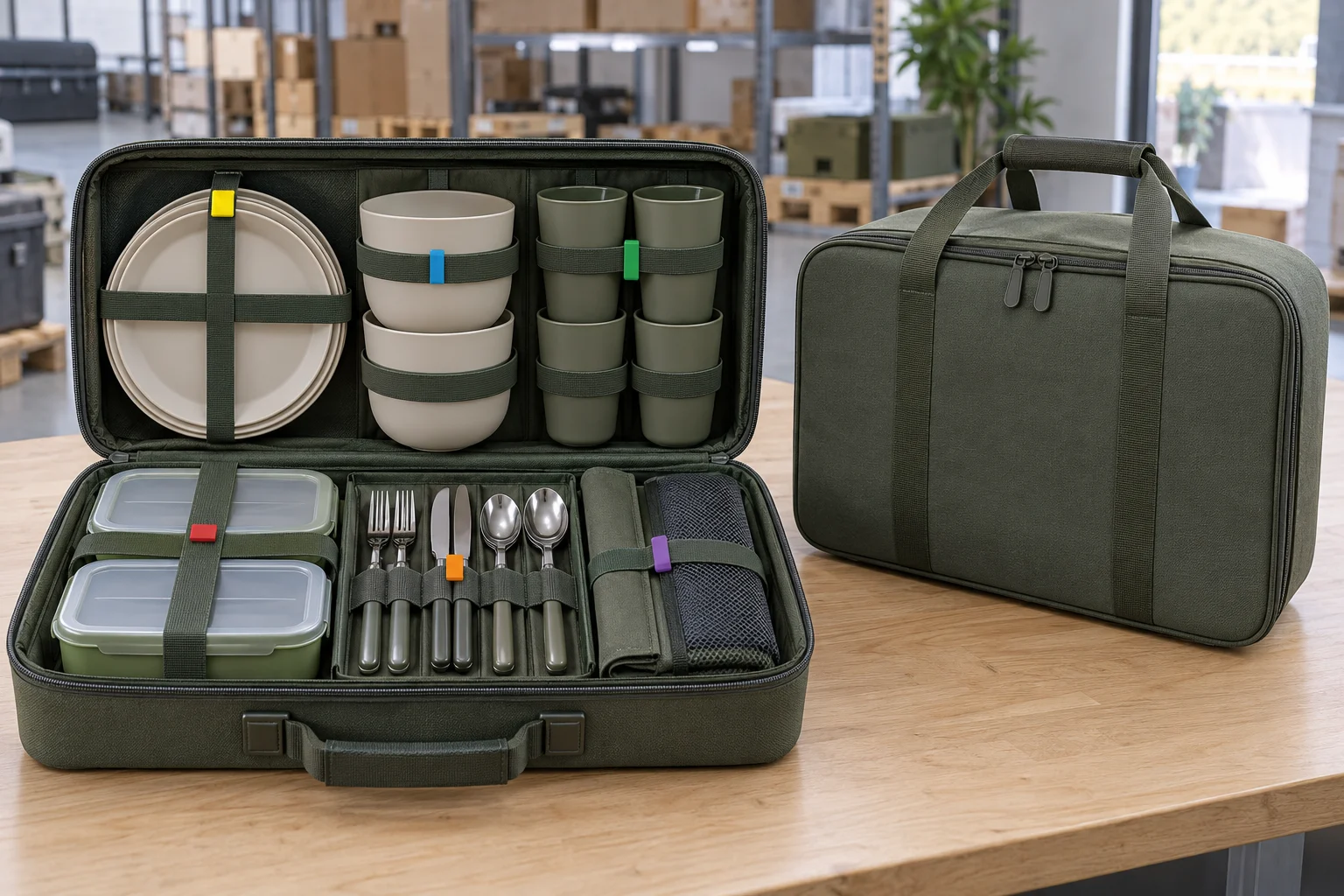
A modular set contains relationships that disappear when components are reviewed one by one. Plate thickness affects the stack height. A bowl tab can interfere with a mug handle. A lunch-box hinge can touch the case wall. A color that looks acceptable alone may appear inconsistent beside the textile case. The retained reference therefore needs to represent the approved complete configuration, not a convenient assortment of unrelated samples.
The buyer must also state what the sample can control. It can show an approved visible appearance, assembly relationship and pack-out sequence. It cannot by itself define an invisible resin grade, exact material formulation, tolerance, legal compliance, wash durability, impact performance or production capability. Those characteristics require controlled documents and, where relevant, scoped evidence.
Camping dinnerware golden sample acceptance index
| Control area | What the sample may show | Required linked record | Status |
|---|---|---|---|
| Identity | Approved complete set and configuration | Program code, BOM revision and sample ID | Match / open |
| Component count | Presence and arrangement of every piece | Count matrix and replacement rules | Pass / fail |
| Geometry | Visible shape and mating relationships | Controlled drawings and measured limits | Reference / measured |
| Nesting and fit | Assembly order, contacts and release | Fit checklist and approved packing sequence | Pass / revise |
| Appearance | Color family, gloss, texture and workmanship | Viewing condition and permitted variation | Approved / open |
| Decoration | Placement, scale, orientation and visual result | Artwork file, process and substrate revision | Approved / blocked |
| Carry case | Construction, opening, restraint and loaded balance | Case drawing and loaded inspection record | Pass / revise |
| Retail pack | Insert, presentation and current product depiction | Packaging artwork and pack-out release | Approved / open |
| Evidence boundary | No invisible characteristic is inferred | Claim-to-evidence and intended-use register | Linked / missing |
| Retention | Physical reference remains identifiable | Owner, location, seal, date and review trigger | Active / superseded |
This index is the buyer-facing output. Copy it into the sampling file and give each row an owner. If the team cannot identify the linked BOM, drawing, specification, artwork or evidence record, the physical sample is not ready to control production.
Separate visual references from measurable requirements
| Characteristic | Physical reference role | Do not rely on the sample alone |
|---|---|---|
| Color and gloss | Approved visual relationship under stated lighting | Quantified acceptance method where needed |
| Dimensions | Shows the assembled relationship | Drawing dimensions and tolerances |
| Material identity | Shows final-looking component | Material declaration and controlled formulation |
| Food-contact status | No visual proof | Finished-component and use-condition evidence |
| Retention strength | Shows the approved architecture | Defined inspection or verification method |
| Cleaning durability | Can be the before/after reference | Cleaning cycle, method and acceptance criteria |
| Packaging protection | Shows one approved loaded condition | Transport plan and failure acceptance |
Measurement traceability should be documented where measured acceptance matters. NIST traceability guidance explains the relationship between a result and documented calibration chains, but it does not certify this product. For food-contact boundaries, the U.S. FDA food-contact substances overview and the EU Framework Regulation (EC) No 1935/2004 provide primary regulatory context. Neither source makes a retained sample sufficient evidence for a final article.

Approve the complete configuration in a repeatable sequence
- Freeze the review baseline. Record the buyer program, component matrix, BOM, drawing set, materials, finishes, artwork and packaging revisions.
- Inspect every loose component. Confirm identity, count, visible workmanship, orientation and any approved appearance relationship.
- Build each module. Check nesting, removal, mating edges, grips, closures and interfaces without forcing parts.
- Load the final case. Follow the intended pack-out order and check restraints, zipper or closure paths, component contacts and loaded balance.
- Compare the retail pack. Reconcile component count, images, artwork, insert and any visible claim with the approved configuration.
- Record exceptions. A deliberate difference needs a written reason; an unexplained difference blocks release.
- Seal and identify the reference. Assign a unique ID, date, owner, storage location and supersession rule.
- Issue the acceptance index. List exactly what the sample controls and what remains governed by documents or evidence.
Connect the record to the existing drawing comparison log, multi-substrate color approval record and cross-asset artwork release checklist. The golden sample should point to those approvals rather than duplicate or obscure them.
Define storage, review and change triggers
A camping dinnerware golden sample can drift even when nobody intentionally changes it. Components may be borrowed, seals can break, color can age, packaging can be crushed, and the approved configuration can become obsolete. Store the reference in a clean, identified container with access control appropriate to the program. Keep photographs and a signed index, but do not treat photographs as a replacement for the physical sample.
| Trigger | Impact review | Buyer decision |
|---|---|---|
| Component geometry or supplier changes | Fit, nesting, case, insert, count and artwork | Partial or full new golden sample |
| Material, color or finish changes | Appearance, use conditions and evidence | New component proof and linked review |
| Decoration process or artwork changes | Placement, color, wear and packaging depiction | New decorated proof |
| Case or restraint changes | Loading sequence, contact, balance and closure | New complete loaded review |
| Retail configuration changes | BOM, count, insert, carton and claims | New pack-out reference |
| Reference damage or missing parts | Control integrity | Quarantine and replace through approval |

Golden Sample Buyer Checklist
| Check | Buyer question | Required output |
|---|---|---|
| Identity | Is the sample tied to one program and revision? | Unique sample index |
| Completeness | Does it contain the exact approved configuration? | Signed count matrix |
| Scope | Which attributes does the sample control? | Control-scope column |
| Limits | Which attributes need measured specifications? | Linked drawing/specification |
| Fit | Was the complete loaded set reviewed? | Pack-out sign-off |
| Appearance | Were viewing conditions and variations defined? | Appearance approval record |
| Evidence | Are claims linked to the final component and use? | Evidence index |
| Change | What forces reapproval? | Change-trigger list |
Buyer FAQs
Should there be one golden sample or several?
Keep one controlled complete-set reference and, where necessary, additional sealed component or packaging references. The index must explain the purpose and priority of each.
Can a golden sample define dimensions?
It can demonstrate fit, but controlled drawings and measured limits should define dimensional acceptance.
Does a golden sample prove compliance?
No. Regulatory and performance evidence must match the final component, material, decoration, intended use and destination market.
What if the approved sample has a minor defect?
Record whether the condition is accepted, cosmetic-only or specifically excluded. An unexplained defect can become an accidental production standard.
Can photographs replace the retained sample?
Photographs help document condition and arrangement but cannot fully preserve color, texture, fit, weight or physical interfaces.
When should the reference be superseded?
Supersede it after an approved change affects a controlled attribute, or when damage or loss makes the reference unreliable.
Request a golden-sample acceptance review
Send the controlled BOM, drawings, component matrix, materials and finishes, artwork, pack-out instruction, destination markets and evidence expectations. Naike Dinner can identify the samples and written records needed before the complete set is released.
Send your golden-sample brief or use the inquiry form beside this article. Contact Naike Dinner for a written review.