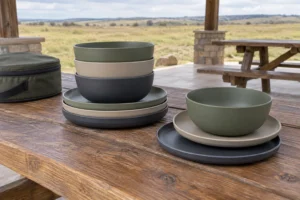
Silicone camping bowls can be safe and practical when the exact finished article is made from a controlled food-contact formulation, fully cured, tested for its intended foods, temperatures and repeated use, and kept within documented limits. Material names alone are not proof. Buyers should verify composition, odor, migration evidence, folding durability, cleaning, traceability and market-specific documentation before approval.
Silicone camping bowl safety: the decision in one table
For a B2B buyer, the useful question is not whether “silicone” is safe in the abstract. The decision concerns a named finished bowl, produced from a known formulation at a controlled site, under a defined cure process, for specified food types, contact times, temperatures, cleaning cycles and destination markets. Color, softness, price and a generic food-grade statement cannot answer that question.
A collapsible bowl also has mechanical interfaces that a rigid bowl does not: fold rings, corners, reinforced rims and sometimes plastic frames or lids. Each component and interface needs review. The following table converts a broad safety question into evidence that procurement, quality and compliance teams can actually verify.
| Decision factor | Acceptable basis | Limitation or risk | Evidence to review |
|---|---|---|---|
| Material identity | Declared silicone elastomer formulation linked to the finished SKU | “Premium silicone” or “food grade” without formulation control | Bill of materials, supplier declaration and change-control record |
| Cure and post-cure | Documented process appropriate to the formulation and article geometry | Residual odor, volatile constituents or inconsistent thick sections | Process specification, lot traceability and finished-sample review |
| Food contact | Finished-item testing matched to intended foods, time and temperature | Raw-material paper used as universal proof | Report identity, methods, simulants, conditions and conclusions |
| Temperature | Product-specific use limits supported by evidence and instructions | Generic silicone temperature ranges copied from a resin brochure | Finished-item assessment and validated claim wording |
| Collapsing function | Stable deployed shape and repeatable folding without damage | Unexpected collapse, torn fold rings or rim separation | Production-intent cycle method and post-cycle inspection |
| Cleaning | Geometry drains, dries and remains inspectable after defined cycles | Trapped soil, persistent odor, abrasion or wet nested storage | Cleaning protocol, cycle evidence and care instructions |
| Market access | Destination-specific legal mapping and traceable evidence | One logo or certificate presented as global approval | Compliance file, declarations and importer review |
What food-contact silicone is—and what the name does not prove
Silicone elastomers are polymeric materials built around silicon-oxygen backbones with organic groups. Silicone camping bowls therefore need the same disciplined identity control as any other repeated-use food-contact article. Finished articles may include polymers, crosslinking systems, catalysts, fillers, pigments and processing aids. Different formulations can share a similar soft-touch appearance while having different cure behavior, extractables, odor, tear strength and regulatory status.
The German Federal Institute for Risk Assessment publishes Recommendation XV on silicones, which describes compositional and extractable-matter considerations for silicone materials used with food. A BfR recommendation is a scientific recommendation rather than a product certificate or a substitute for applicable law. It is useful when the exact formulation and intended use are mapped to its scope and the finished product is appropriately evaluated.
The broader BfR food-contact recommendation database also makes clear that recommendations are not legal norms. Buyers should not turn the phrase “meets BfR” into a vague marketing badge. They should identify the applicable recommendation, version, test conditions, sample and supporting documentation.
Platinum-cured and peroxide-cured are process descriptions, not automatic verdicts
Suppliers may describe silicone as platinum-cured or peroxide-cured. Those terms identify aspects of a crosslinking route, but neither phrase alone proves that a finished colored bowl meets a destination market’s requirements. Formulation, catalyst residues, post-cure, article thickness, pigment system and process control still matter.
Buyers should ask the manufacturer to state the cure system and the controls used for the quoted SKU. The answer should connect to the approved material code and production process, not remain a sales adjective. If a formulation, pigment, mold or cure cycle changes, the compliance impact should be reviewed before production continues.
EU requirements begin with the finished article and intended use
Regulation (EC) No 1935/2004 establishes the general EU safety framework for food-contact materials. Under normal or foreseeable conditions, materials must not transfer constituents in quantities that could endanger health, create an unacceptable change in food composition or impair organoleptic characteristics. The regulation also supports traceability throughout relevant business stages.
There is no single harmonized EU measure for silicone that functions exactly like Regulation (EU) No 10/2011 for plastics. National measures, recognized recommendations and risk assessment can therefore become important, depending on the market and article. Importers should obtain competent regulatory advice for the actual destination rather than assume a report issued for another jurisdiction is sufficient.
Organoleptic performance deserves attention because a bowl can technically pass selected migration checks yet still create an unacceptable smell or taste in use. A buyer should include odor and taste evaluation in the product specification and sample approval. Strong perfume-like masking is not a substitute for investigating a persistent material odor.
US review requires the exact rubber article and conditions of use
For the United States, 21 CFR 177.2600 on rubber articles intended for repeated use is a key primary source to review for applicable rubber food-contact articles. The provision includes compositional and extractive requirements and distinguishes conditions involving aqueous and fatty foods. A citation to the section is not blanket approval for every silicone item.
The supplier and importer must determine whether the exact ingredients, manufacturing route and intended use fall within an applicable authorization. They should retain adequate evidence for the finished bowl and representative production. A raw-material data sheet can support the file, but it does not demonstrate that pigments, additives, molding, post-cure and assembly have produced a compliant finished article.
Claims such as “FDA approved silicone” are often imprecise. FDA generally regulates substances and conditions of use rather than issuing a retail-style approval badge for a colored camping bowl. Procurement documents should name the relevant regulatory basis, intended conditions and supporting evidence instead of relying on a logo.
Cure, post-cure and article thickness influence odor and extractables
During molding, silicone is crosslinked into an elastomer. The time, temperature, pressure and post-cure process can affect remaining volatile or extractable constituents. Thick bases and reinforced rims may respond differently from thin collapsible walls, so a process proven for one geometry should not automatically be extended to another.
A practical incoming review begins with sealed-sample odor, surface condition, color consistency and traceability. Samples should be conditioned and evaluated according to an agreed method rather than casually smelled immediately after opening hot packaging. Persistent or unusual odor requires investigation; it should not be accepted merely because the bowl is inexpensive or colorful.
Production control should identify the compound lot, pigment batch, molding line, cure parameters and inspection results. If a buyer approves a clean, low-odor sample but production uses a different compound or abbreviated post-cure, the approval has lost its meaning. Change notification and retained samples make the evidence file operational.
Temperature claims must belong to finished silicone camping bowls
Silicone materials are often marketed with very broad temperature ranges. Those figures may describe a base polymer or test coupon, not a thin-walled collapsible bowl with pigment, printed decoration, bonded frame or lid. The safe working range for a finished SKU must reflect the weakest relevant component and the intended contact condition.
Serving warm food is different from heating food inside the bowl. Pouring a defined hot meal into a supported bowl is also different from placing the bowl on a burner or near a flame. Direct heat can create local temperatures far above the average food temperature and may damage rims, frames, decorations or nearby plastic parts.
For silicone camping bowls, the specification should state whether the bowl is for cold meals, room-temperature service, warm serving or another documented condition. Microwave, freezer, dishwasher and boiling-water claims each need separate evidence. Silence should not be interpreted as permission.
Collapsible geometry creates specific mechanical risks
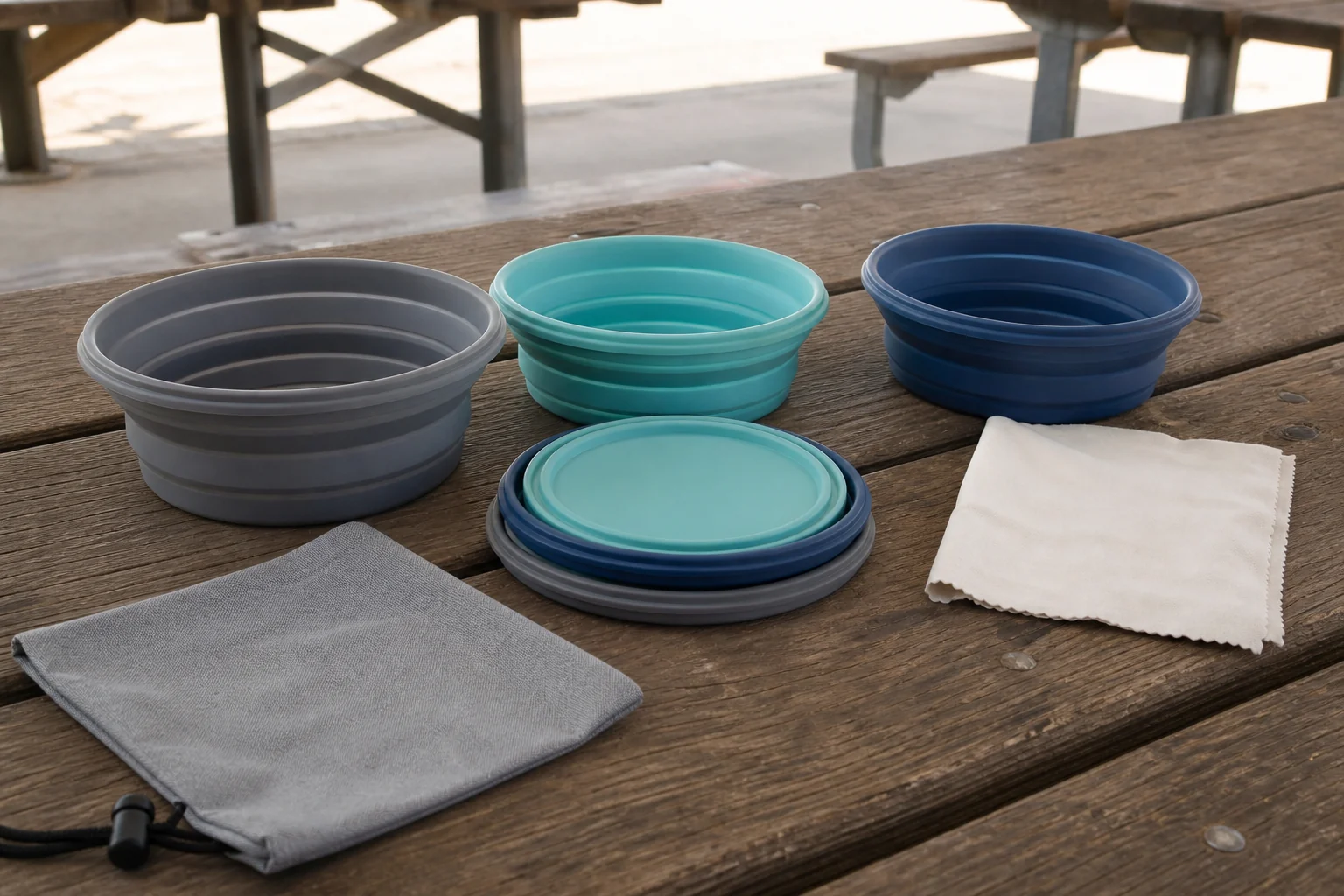
A collapsible bowl saves pack volume by using flexible fold rings. That benefit introduces possible failure modes: unintended collapse while loaded, tearing at repeated creases, stress whitening in non-silicone frames, separation between materials and instability on uneven surfaces. Capacity alone cannot describe these risks.
Buyers should define a cycle test using production-intent samples, a representative fill mass and realistic deployment technique. Inspect the bowl before and after cycling for tears, pinholes, distortion, delamination and changes in stability. Cycle numbers should be chosen from the actual program rather than copied from another product, and no unsupported durability number should appear in marketing.
Rim stiffness matters when a bowl is lifted with hot or liquid food. A very soft rim may deform under a one-handed grip, while an overly rigid frame can add pack bulk or create a joint that traps soil. Use trials should include carrying, stirring, eating, pouring, packing and cleaning by representative users.
Applicable outdoor scenarios for silicone camping bowls
Backpacking and compact travel
Silicone camping bowls can reduce occupied volume after a meal and fit into restricted pack systems. They are most useful when the packed shape remains controlled and the bowl can dry before nesting. Buyers should compare complete packed dimensions and mass with rigid alternatives instead of assuming every folding product saves meaningful space.
Family car camping
Families may value quiet handling, bright user identification and low breakage risk. A wider stable base and reinforced rim may matter more than minimum mass. The bowl should be tested with the intended meal types and adult supervision assumptions, especially if children will use it.
RV, caravan and picnic programs
Flexible bowls can store in shallow drawers and avoid the clatter of metal. However, closed RV cabinets make wet nested storage a realistic risk. The program should include drainage, drying and storage guidance, and the lid or frame compatibility must be confirmed with the full set.
Rental, catering and group use
High-throughput programs need simple cleaning, rapid visual inspection and clear retirement rules. Deep folds may slow inspection or trap residue. A rigid bowl may be preferable if staff cannot deploy, dry and check the collapsible design consistently.
Cookware-centered kits
A silicone serving bowl should remain separate from a metal cooking vessel unless verified evidence explicitly supports another role. Avoid layouts or photographs that imply flame compatibility. The outdoor tableware hub helps buyers separate eating and drinking pieces from cookware functions.
Cleaning, drying and odor management
Silicone surfaces can attract dust or retain oily films if cleaning is incomplete. Fold valleys, textured logos and joints with rigid frames deserve particular attention. A defined care method should specify detergent, water temperature, tools, rinsing and drying rather than using the vague phrase “easy to clean.”
Dishwasher suitability is a performance claim, not an inherent property of all silicone. Rack placement, detergent, cycle temperature, drying and repeated exposure can affect appearance, odor, printing and multi-material joints. Validate the complete article under a defined cycle program before applying the claim.
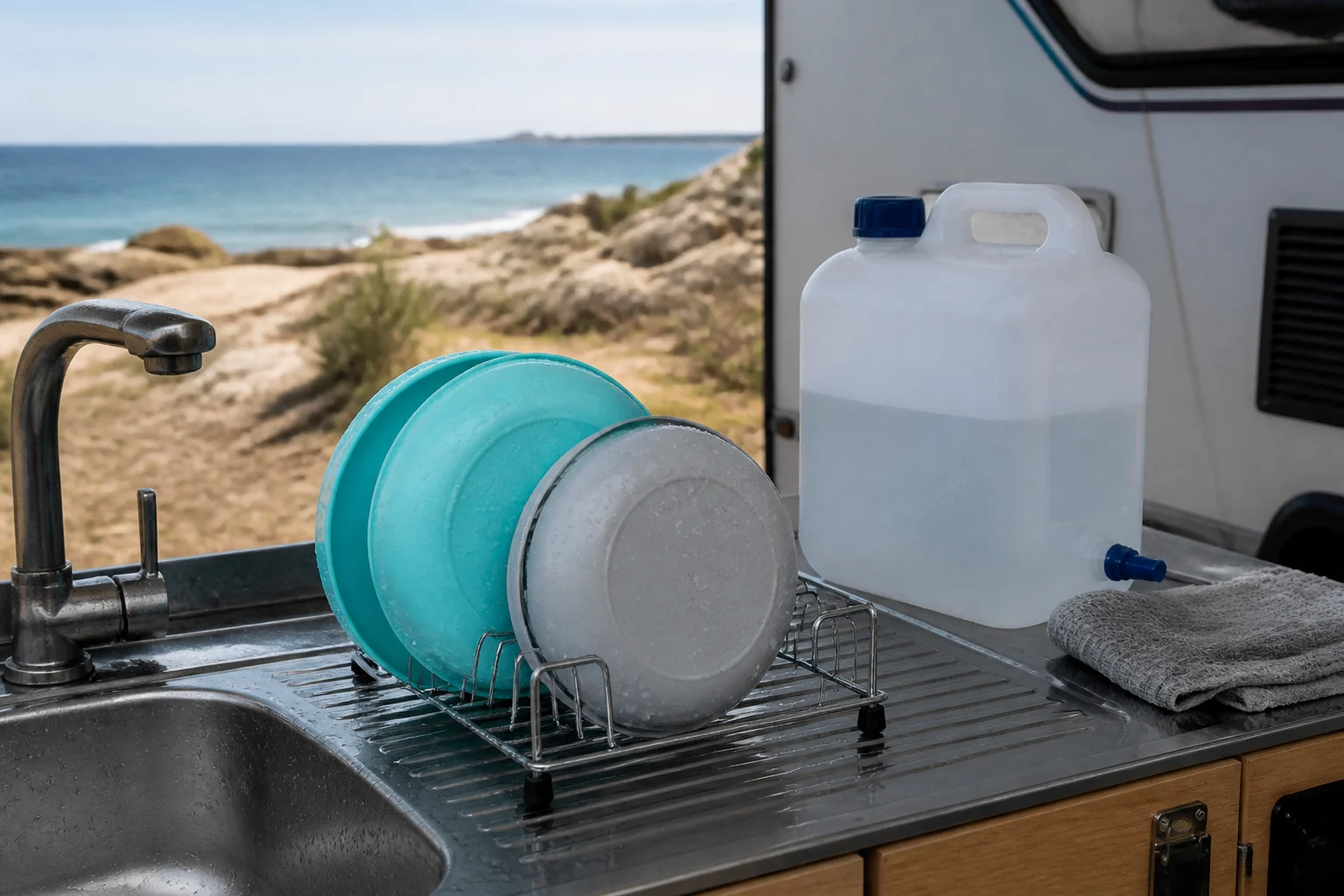
After camping, bowls should be fully deployed for cleaning and drying. Packing them collapsed while wet can trap moisture and food residues. A persistent odor after correct cleaning may signal absorbed food aromas, incomplete cure or contamination; the cause should be investigated before the product remains in service.
Limitations and risks a buyer should state clearly
The main risk is overgeneralization. “Silicone” does not disclose formulation, cure, temperature scope or finished-item evidence. A marketing team may copy heat resistance from an ingredient brochure, while the actual bowl includes pigments and a plastic rim with different limitations.
Another risk is using concept imagery as proof. An image of soup in a bowl does not verify serving temperature, migration, stability or capacity. Naike Dinner and its buyers should keep illustrative scenes clearly separate from test reports, controlled samples and production specifications.
Mechanical damage also needs a retirement rule. Tears, punctures, delamination, a distorted base, a cracked rigid frame, sticky or degraded surfaces and inaccessible contamination are reasons for review or removal. Do not repair a food-contact bowl with unassessed adhesive.
Finally, destination requirements can differ. A report may cite a relevant method yet omit the intended food, temperature or repeated-use sequence. The importer must confirm current legal expectations and ensure that the tested sample represents production.
Silicone versus common camping bowl materials
| Material direction | Typical buyer advantage | Key limitation | Best evidence question |
|---|---|---|---|
| Silicone elastomer | Flexible, quiet and potentially collapsible | Cure, odor, fold durability and temperature overclaim | Does finished-item evidence match formulation and use? |
| Polypropylene | Lightweight, rigid and economical | Heat and scratch limits depend on grade and design | Is the exact resin and finished SKU documented? |
| Stainless steel | Rigid, durable and easy to identify | Conducts heat, can dent and does not collapse | What grade, finish and corrosion evidence apply? |
| Titanium | Low mass with high corrosion resistance | Higher cost and thin-wall heat transfer | Is grade and finished construction verified? |
| Plant-fiber composite | Distinct appearance and brand story | Matrix polymer and claims require precise disclosure | What is the complete formulation and use limit? |
No material wins every program. The family car-camping dinnerware guide shows how user count, washing, storage and meal type change the decision. For coordinated sets, review the published camping dinnerware set category and confirm actual supplier capability before specifying silicone.
Procurement advice for silicone camping bowls: build an evidence chain
For silicone camping bowls, start with an intended-use brief: destination countries, user group, foods, maximum contact temperature and time, repeated-use expectations, cleaning, folding, storage, decoration and packaging. Ask the supplier to identify unresolved items rather than filling gaps with assumptions. The brief becomes the basis for quotation, sample review and evidence planning.
Next, establish material identity and change control. Record compound and pigment references, cure route, post-cure parameters, component materials and manufacturing site. The compliance file should link those inputs to the tested finished article, approved sample and production lots.
Then approve function and communication. Test stability, grip, folding, drainage, cleaning and pack-out. Align the product listing, packaging and instructions with verified limits, especially heating and direct-flame restrictions. If a capability or test is not confirmed, request a project review instead of claiming it.
Sampling should represent the quoted construction rather than an idealized showroom piece. Record color, cavity, compound lot and assembly status for every evaluation sample, and retain one approved reference under suitable conditions. When production begins, compare incoming lots with the approved reference and the controlled drawing, then investigate meaningful differences in odor, feel, surface, folding force or geometry before accepting shipment.
Packaging is part of the use system. A tightly sealed bag can concentrate normal packaging odors, while abrasive inserts can mark soft surfaces and unsupported cartons can deform collapsible walls. The pack-out review should confirm ventilation assumptions, protection, labels, component count, care instructions and storage configuration. If the bowl is shipped collapsed, confirm that it returns to the intended deployed shape after realistic storage and transit conditioning.
Finally, define responsibilities. The brand owner controls claims and intended use; the supplier controls declared materials and processes; the laboratory evaluates the submitted sample under stated conditions; and the importer confirms market access. None of those parties can replace the others with a single generic certificate. A short responsibility matrix prevents evidence gaps from being discovered only after artwork, production or shipment.
B2B Buyer Checklist
| Check | Question | Why It Matters |
|---|---|---|
| SKU identity | Do report, drawing, quotation and sample identify the same bowl? | Prevents evidence from being transferred to a different construction. |
| Formulation | Are silicone compound, pigment and every rigid component declared? | Appearance cannot reveal ingredients or regulatory status. |
| Cure control | Are cure and post-cure parameters controlled by production lot? | Process variation can affect odor and extractables. |
| Use conditions | Which foods, temperatures, times and cleaning cycles are supported? | Safety evidence is conditional, not universal. |
| Finished-item evidence | Does testing cover the colored, assembled production-intent bowl? | Raw-material documents do not capture molding and assembly. |
| Fold durability | Is a documented cycle method followed by damage and stability checks? | Collapsible geometry creates unique mechanical risks. |
| Claims | Are microwave, dishwasher, freezer and heat statements separately supported? | One property cannot authorize unrelated uses. |
| Traceability | Can lots, material batches, process records and retained samples be connected? | Enables investigation and controlled change. |
| Supplier capability | Has the named supplier verified it can make the requested silicone SKU? | Educational content must not be mistaken for availability. |
Buyer FAQs about silicone camping bowls
1. Are all food-grade silicone bowls safe for hot camping meals?
No. “Food grade” is not a complete specification. The exact formulation, finished article, food type, temperature, contact time and repeated-use conditions must be supported. A broad material temperature statement is not enough.
2. Does platinum-cured silicone automatically mean safer?
No automatic conclusion follows from the cure-system label alone. Platinum curing may be part of a controlled formulation, but ingredients, process, post-cure, pigments, geometry and finished-item evidence still determine suitability.
3. Can a collapsible silicone bowl go in a microwave?
Only if the exact assembled product has product-specific evidence and instructions supporting that use. A rigid rim, decoration or lid may have different limits. Without verification, do not make or assume the claim.
4. Why does a new silicone bowl smell?
Odor can come from packaging, process residues, contamination or absorbed environmental aromas. Condition and evaluate samples with an agreed method. Persistent or food-transferring odor requires investigation and may be unacceptable.
5. How should buyers test the folding mechanism?
Use production-intent samples, a defined deployment cycle and realistic load. Inspect folds, rim, base and joints before and after cycling, then reassess stability, leakage, cleaning and odor. Do not invent a universal cycle count.
6. Is silicone better than stainless steel for camping bowls?
Silicone can offer quiet handling and compact folding, while stainless steel offers rigidity and simpler material identification. The better choice depends on packing, heat handling, cleaning, durability, weight, evidence and user behavior.
7. Does Naike Dinner supply silicone camping bowls?
This article does not verify that capability. Buyers should send the requested geometry, intended use, market and evidence requirements for a documented capability review. Do not infer supply from educational coverage.
Request a Silicone Camping Bowl Specification Review
Send your target market, food and temperature conditions, bowl format, collapse mechanism, colors, branding, packaging and evidence expectations. Naike Dinner can review the brief against verified capability and identify the material, sample, testing and supplier-document questions that must be resolved before quotation or approval.
Request a documented project review or use the inquiry form. For a second procurement discussion, contact Naike Dinner with your intended-use matrix and target launch market.