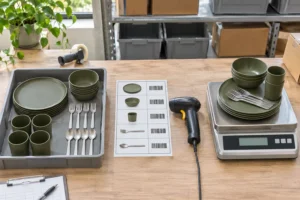
Direct answer: To compare camping dinnerware quotations, first normalize both offers to the same component names, quantities, material assumptions, decoration, case, packaging, evidence scope and Incoterm. Compare line items and exclusions before totals. Any field that cannot be reconciled stays open; do not treat a lower total as equivalent until the same deliverables and commercial basis are confirmed.
Scope: this is a buyer-entered comparison worksheet, not a supplier quotation, price forecast or statement of Naike Dinner’s MOQ, lead time, capacity or product availability. Enter only supplier-confirmed figures and identify currency, tax, freight, tooling, sample, artwork and evidence assumptions separately.
Use this method to compare camping dinnerware quotations only after both suppliers answer against the same buyer brief.
Freeze one comparison basis before reading the totals
Two offers can both say “four-person camping set” while describing different purchases. One may include four plates, bowls, cups and cutlery sets; another may add lunch containers, a fitted case and a retail carton. Even equal component counts may hide different materials, dimensions, decoration methods, packaging levels or test-document scope. A valid comparison begins with the buyer’s target BOM and one unit definition.
Record whether “one set” means one retail pack, one carry case, one user kit or one master-carton assortment. Then lock the target quantity per component. Use the custom camping dinnerware brief to define the intended set and the existing-component versus new-mold matrix to separate reuse from development. A quote should not silently change that baseline.
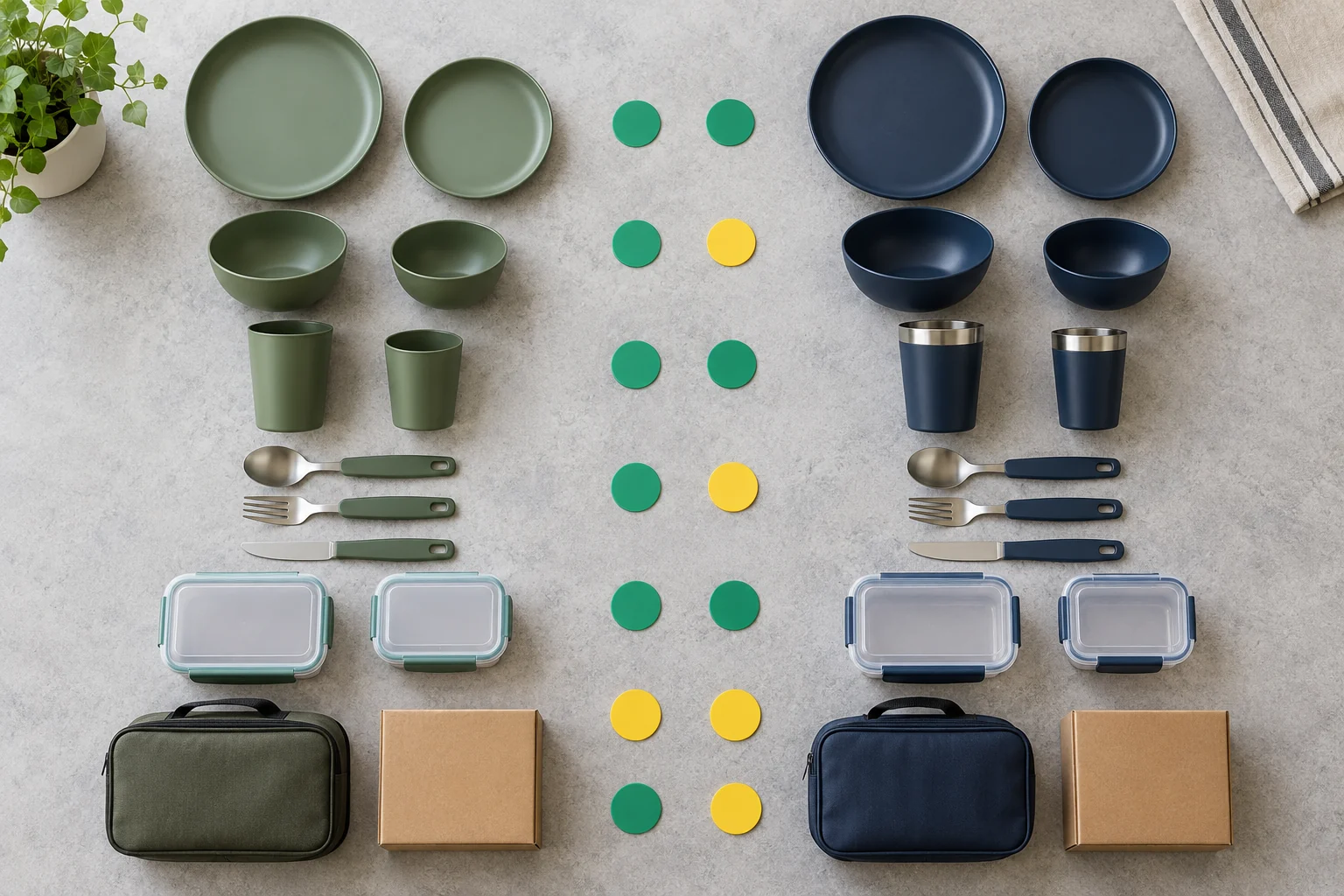
Copyable table to compare camping dinnerware quotations
Create one row for every purchased item and every separately chargeable activity. Do not combine “tableware + bag + box” in one row if the offers split them differently. Use “included,” “excluded,” “optional,” or “open” only when the supplier has stated that status. Unknown values remain open.
When buyers compare camping dinnerware quotations in this format, each unmatched line remains visible instead of disappearing inside a headline total.
| Normalized line | Buyer requirement | Quote A | Quote B | Decision / open issue |
|---|---|---|---|---|
| Plate | Quantity per set; drawing or reference; material; finish; color | Part ID, quantity, unit price, status | Part ID, quantity, unit price, status | Confirm equivalent geometry and scope |
| Bowl | Quantity; envelope; nesting interface; material; finish | Enter supplier-confirmed values | Enter supplier-confirmed values | Check stack and case effect |
| Cup | Quantity; handle or no handle; lid if required; volume target | Enter values and exclusions | Enter values and exclusions | Do not assume lid or performance claim |
| Cutlery | Fork, spoon, knife or other pieces per user; holder or sleeve | Count and quoted basis | Count and quoted basis | Reconcile piece count, material and finish |
| Food container | Quantity; divider; lid; intended use; pack position | Included / optional / excluded | Included / optional / excluded | Confirm component and lid as separate lines if needed |
| Carry case | Construction, internal retention, handle, closure and color | Case scope and price | Case scope and price | Confirm whether insert is included |
| Decoration | Logo locations, process, colors, artwork versions | Setup and repeat charges | Setup and repeat charges | Link to exact components and approval method |
| Retail packaging | Insert, carton, print, label, manual and pack quantity | Included elements and charge | Included elements and charge | Separate artwork and structural development |
| Outer packaging | Units per carton, carton specification and protection | Pack basis and assumptions | Pack basis and assumptions | Normalize units and pack-out |
| Samples / tooling | Sample stage, molds, fixtures, ownership and revision | One-time and recurring amounts | One-time and recurring amounts | Keep non-recurring charges outside unit subtotal |
| Evidence / documents | Target market, finished component, color, decoration and use conditions | Included records and exclusions | Included records and exclusions | Never price-match unmatched evidence scope |
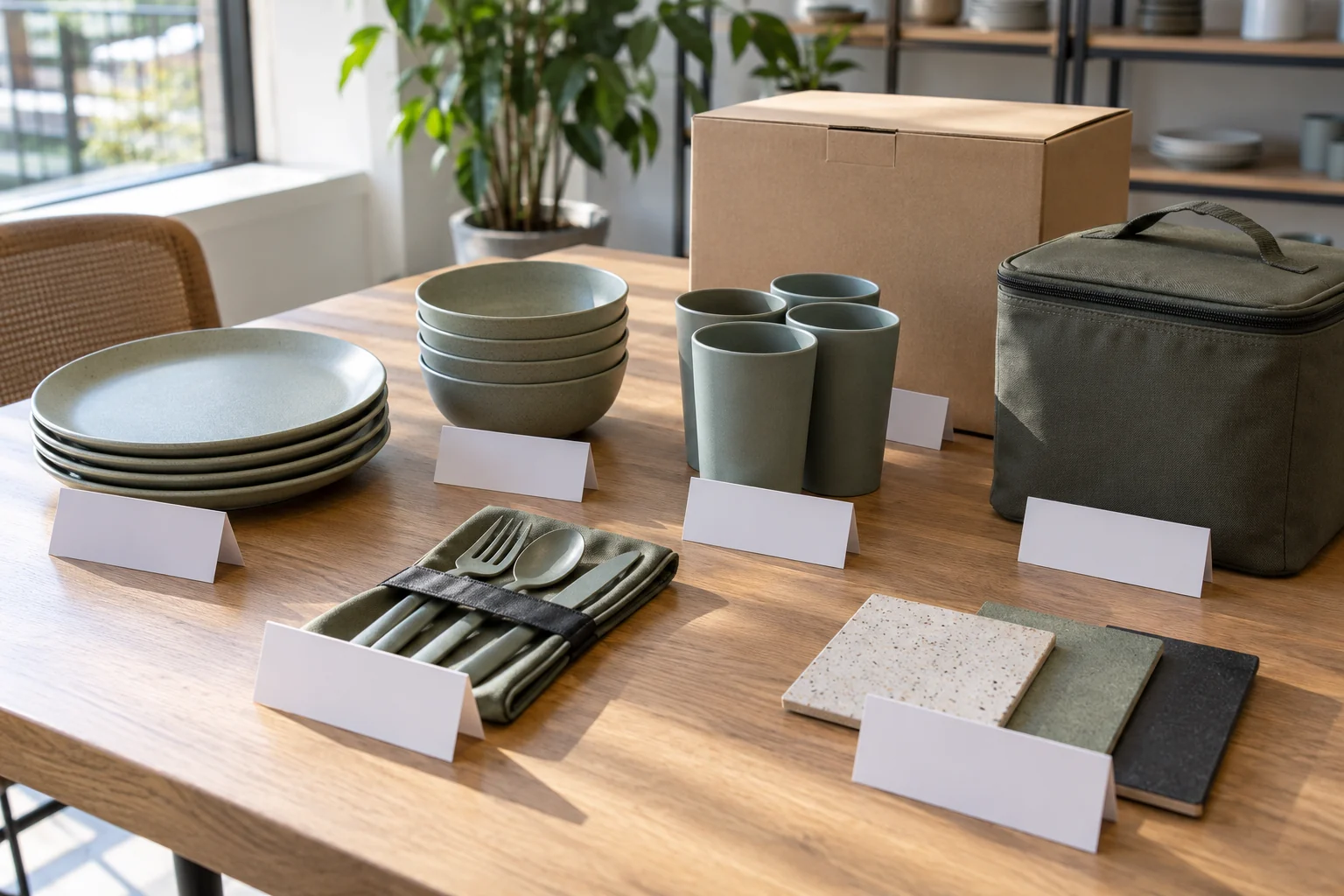
Separate product scope from packaging and development scope
A supplier may quote a low unit price for loose components and show a carry case only as a visual reference. Another may include fitted retention, printed packaging and packing labor. Those offers are not yet comparable. Write an explicit inclusion code beside each line: I for included, E for excluded, O for optional and TBC where written confirmation is still needed.
This scope split is essential when you compare camping dinnerware quotations with different component mixes.
The retail insert design guide helps identify insert and retention work that can otherwise disappear inside a packaging line. The camping tableware pack-volume guide helps keep set price separate from buyer-entered logistics calculations. Neither should be used to invent packaging dimensions or transport cost.
| Scope group | Questions to reconcile | Evidence to retain |
|---|---|---|
| Components | Same count, revision, material assumption, finish and color? | BOM, drawing/reference ID and supplier line |
| Case and retention | Outer case only, or insert, loops, tray and packing labor included? | Case specification and pack-out drawing |
| Decoration | Setup, application, sample approval and repeat charge separated? | Artwork map, process and charge basis |
| Retail pack | Structural sample, printing, labels, manual and assembly included? | Dieline revision and pack BOM |
| Development | Existing parts, modifications, new mold, fixtures or engineering work? | Development responsibility and ownership record |
| Evidence | Which finished components, variants and use conditions are covered? | Document list with issuer, date and exact scope |
Normalize currency, Incoterm, quantity and validity
Commercial terms change what a quoted number contains. Record the currency, price basis, quantity break, unit definition, payment terms, quotation validity, production assumption and named Incoterm location. The International Chamber of Commerce Incoterms rules overview explains the allocation of tasks, costs and risks between seller and buyer; an Incoterm does not by itself define product quality, payment timing or title transfer.
Apply the same currency and commercial basis before you compare camping dinnerware quotations.
For import planning, classification and customs valuation require separate buyer review. The World Customs Organization overview of the Harmonized System explains the international nomenclature framework, while the World Trade Organization customs valuation overview describes the valuation agreement. These sources do not determine a product’s final classification, duty, tax or landed cost from an image or marketing title.
| Commercial field | Quote A | Quote B | Normalization action |
|---|---|---|---|
| Currency and exchange-date rule | Buyer entry | Buyer entry | Convert using one documented rate/date only for analysis |
| Price unit | Per piece / set / pack / carton | Per piece / set / pack / carton | Convert to the same buyer-defined set |
| Quantity tier | Quoted quantity and tolerance | Quoted quantity and tolerance | Compare the same order quantity |
| Incoterm and named place | Term, version and place | Term, version and place | Identify cost/risk items outside each offer |
| Tax / duty / freight | Included, excluded or open | Included, excluded or open | Do not mix supplier quote with buyer estimates |
| Payment and validity | Milestones and expiry | Milestones and expiry | Flag cash-flow and expiry differences |
| Lead-time basis | Stated trigger and scope | Stated trigger and scope | Do not invent or average; request clarification |
Use a buyer-entered normalized subtotal
For each recurring line, calculate normalized extended amount = quantity per set × supplier-confirmed unit amount. Sum only lines with matched scope. Add separate rows for case, packaging and recurring decoration. Keep samples, tooling and other one-time charges in a non-recurring subtotal. If currency conversion is needed, preserve the original amount, conversion source, rate and date.
The normalized subtotal is a decision aid for buyers who compare camping dinnerware quotations; it is not a supplier-issued price.
Example structure only: if Quote A includes an item and Quote B marks it optional, the comparison table should not insert a guessed amount for B. Mark the normalized total “incomplete” until the optional price and its exact specification are confirmed. The correct result is sometimes “not comparable yet,” not a forced winner.
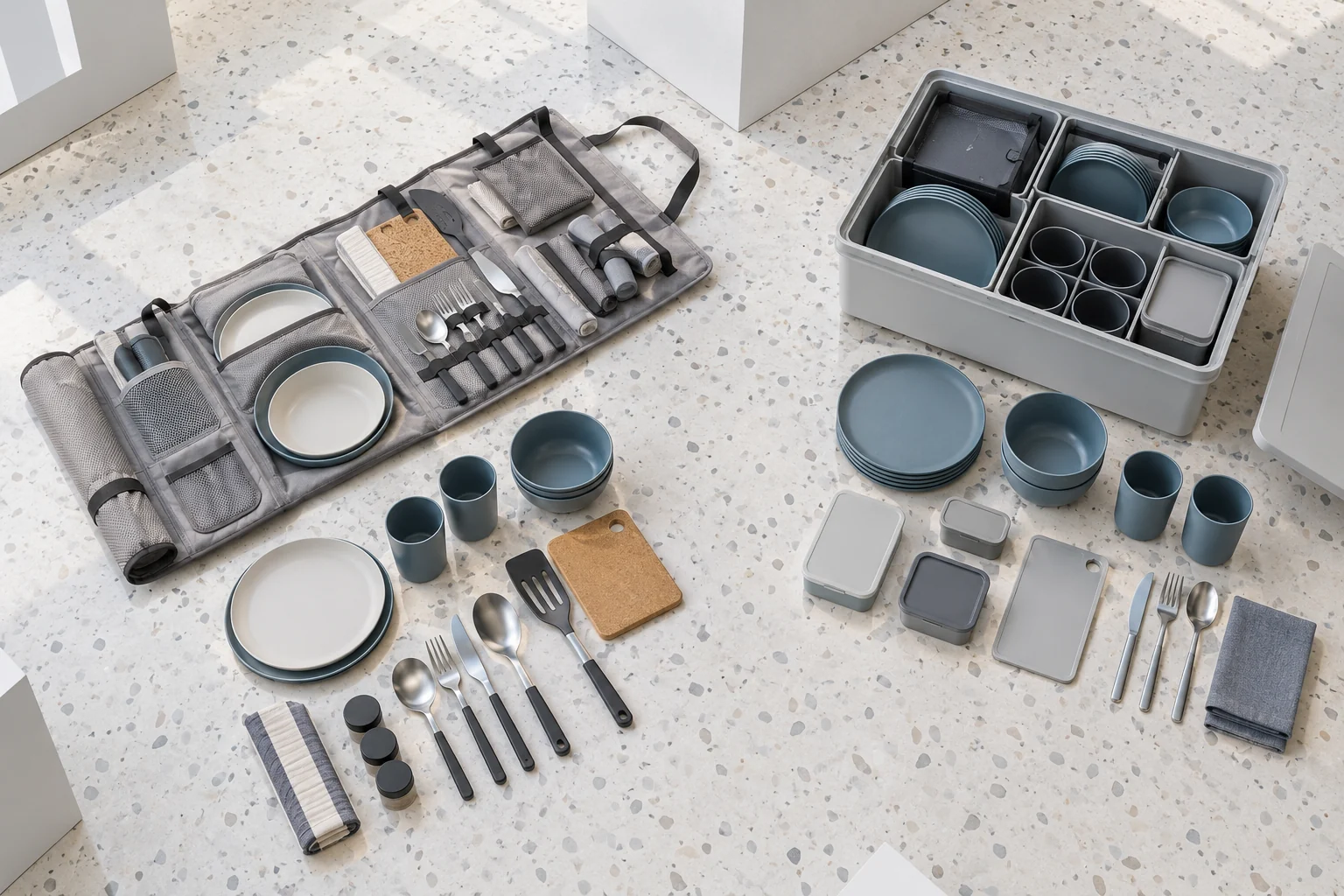
Close the comparison with an approval record
Do not finish the approval record until the team can compare camping dinnerware quotations without unresolved differences being treated as equal.
| Approval field | Required entry | Stop condition |
|---|---|---|
| Target BOM revision | Buyer-approved set and component revisions | Offers reference different or obsolete requirements |
| Scope completeness | Included, excluded, optional and open lines | A material line remains hidden in a bundle |
| Commercial basis | Currency, unit, tier, Incoterm/place, validity and payment | Totals use different bases |
| Development boundary | Existing, modified and new-tool items plus ownership | Tooling or sample responsibility is unclear |
| Evidence boundary | Required documents and exact finished-component scope | Compliance or performance is assumed from generic wording |
| Selection rationale | Chosen offer, exceptions, owner and approval date | Decision relies only on headline total |
Buyer checklist
| Verify | Request | Approve only when |
|---|---|---|
| Same unit and BOM | Line-item component matrix | Every required component maps to each offer |
| Same customization scope | Decoration, artwork and setup split | One-time and recurring charges are separated |
| Same packaging scope | Case, insert, retail pack and carton lines | Included/excluded status and pack quantity are written |
| Same commercial basis | Currency, tier, Incoterm/place, payment and validity | Normalized subtotal uses comparable inputs |
| Same evidence expectation | Document list tied to component/revision/use | No generic certificate assumption remains |
Quotation comparison FAQ
Should the lowest total win?
No. First determine whether the component mix, customization, packaging, development and commercial basis are equivalent. A lower incomplete offer is not automatically better.
Can I divide the total by the number of pieces?
Only as a clearly labeled rough observation. It can hide different component complexity, case construction, packaging and one-time costs. Use line items for the decision.
Where should tooling and samples appear?
Keep them in a separate non-recurring subtotal with ownership, revision and approval scope. Do not spread them into unit price unless both parties deliberately agree to that method.
Can a supplier confirm exact cost from a concept image?
No. A quotable request needs a controlled BOM, dimensions or references, materials, intended use, customization, packaging, quantity and evidence requirements.
Request a line-item quotation review
Send the two supplier component matrices or your target BOM, required quantity, customization, packaging, market and commercial basis. Naike Dinner can identify unmatched scope and open project fields without inventing prices or specifications.
Send the comparison brief · Request a component review · Discuss the packaging scope
Reviewed for publication: .