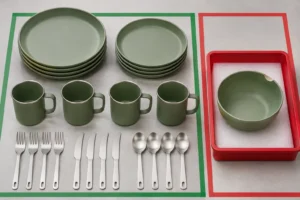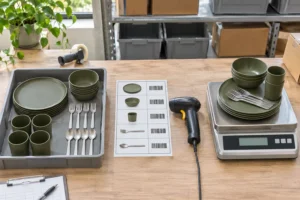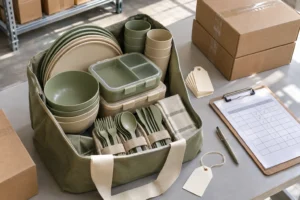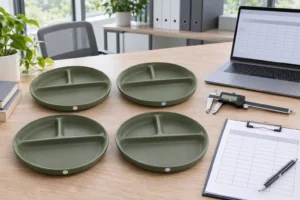
Camping dinnerware supply traceability starts with the component, not only the finished set carton. A buyer should be able to move from one released set to its plate, bowl, cup, cutlery, lunch-box and carry-case records, then identify the responsible source, component lot, specification revision, receipt, kitting event and finished-set lot without guessing.
Direct answer: assign one controlled component code to every set item, record the responsible legal source and source lot against each receipt, preserve those links through inspection and kitting, and connect the consumed component lots to the finished-set lot. If any link, revision or quantity reconciliation is missing, hold the affected scope instead of approving the whole kit.
What Traceability Decision Must the Buyer Make?
The purchasing decision is not simply whether a supplier list exists. The buyer must decide whether the proposed records can isolate an affected component, source, revision, receipt and finished-set population without placing unrelated sets on hold. That requires component-level identity before assembly and a kitting record after assembly.
Release the map
Every required component has a controlled code, responsible source, lot field, revision, receipt and finished-set linkage.
Hold the map
A component is pooled, relabelled or substituted without preserving its source, lot, revision or quantity history.
Limit the scope
The evidence supports only named components, lots and destinations. Do not extend one valid record to unverified sources or future runs.
The GS1 Global Traceability Standard provides a framework for interoperable traceability systems. Its compliance criteria support checking whether traceability processes and records are complete. For EU food-contact materials and articles, Article 17 of Regulation (EC) No 1935/2004 addresses traceability and identification through relevant documentation or information. The project must still determine its applicable legal scope.
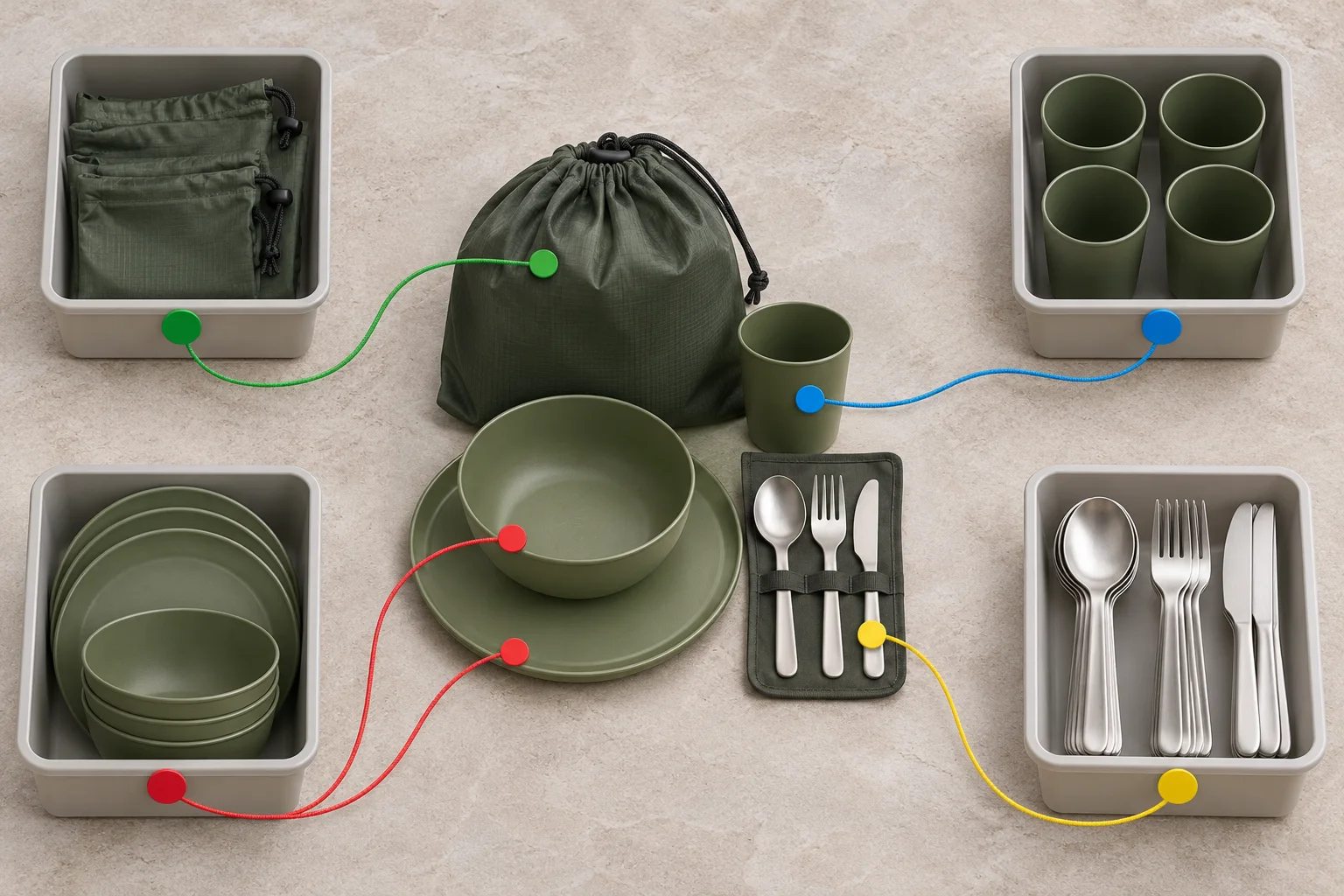
Use This Source-to-Component Traceability Map
Copy one row for every controlled component and approved source route. The map should link the commercial article code to the internal component specification rather than using informal names such as “green bowl” or “standard spoon.”
| Traceability field | Required entry | Buyer decision or diagnostic | Action if missing |
|---|---|---|---|
| Finished-set article | Set code, market name and released revision | Defines the kit being traced | Hold mapping |
| Component identity | Component code, description, drawing/specification revision and required quantity | Separates each physical item | Do not use description alone |
| Responsible source | Legal entity, approved site when relevant, role and approval status | Shows who supplied or controlled the component | Resolve entity ambiguity |
| Source lot or batch | Source identifier and production/dispatch reference when available | Defines the incoming population | Quarantine unidentified receipt |
| Receipt record | Purchase order, delivery, received quantity, date and receiving reference | Connects source lot to physical stock | Reconcile before use |
| Incoming disposition | Accepted, held, sorted, returned or conditionally released with authority | Prevents rejected stock entering the kit | Block consumption |
| Kitting consumption | Line/batch, date, component lot, quantity issued, used, returned and scrapped | Links components to the assembly event | Investigate imbalance |
| Finished-set lot | Set lot, pack date, line/cell and carton range | Defines the released population | Do not ship unlinked sets |
| Change or substitution | Approved deviation, replacement source, effective lot and expiry/closure | Shows where configuration changed | Hold mixed configuration |
| Record owner and retention | System owner, access, location, retention rule and retrieval test | Confirms evidence can be produced | Assign before release |
Who Counts as the Responsible Source?
Record the legal entity and its role, not only a salesperson, marketplace listing or informal factory nickname. One organization may sell the component while another site molds, coats, prints, packs or warehouses it. The map should show only relationships supported by project evidence and should distinguish commercial source, manufacturing or processing site, and logistics location when those roles matter.
Connect each component to the controlled field set in the component-list specification. Use the drawing and BOM revision record so marketing names cannot break internal identity. Any source-specific claim should also follow the claim approval matrix.
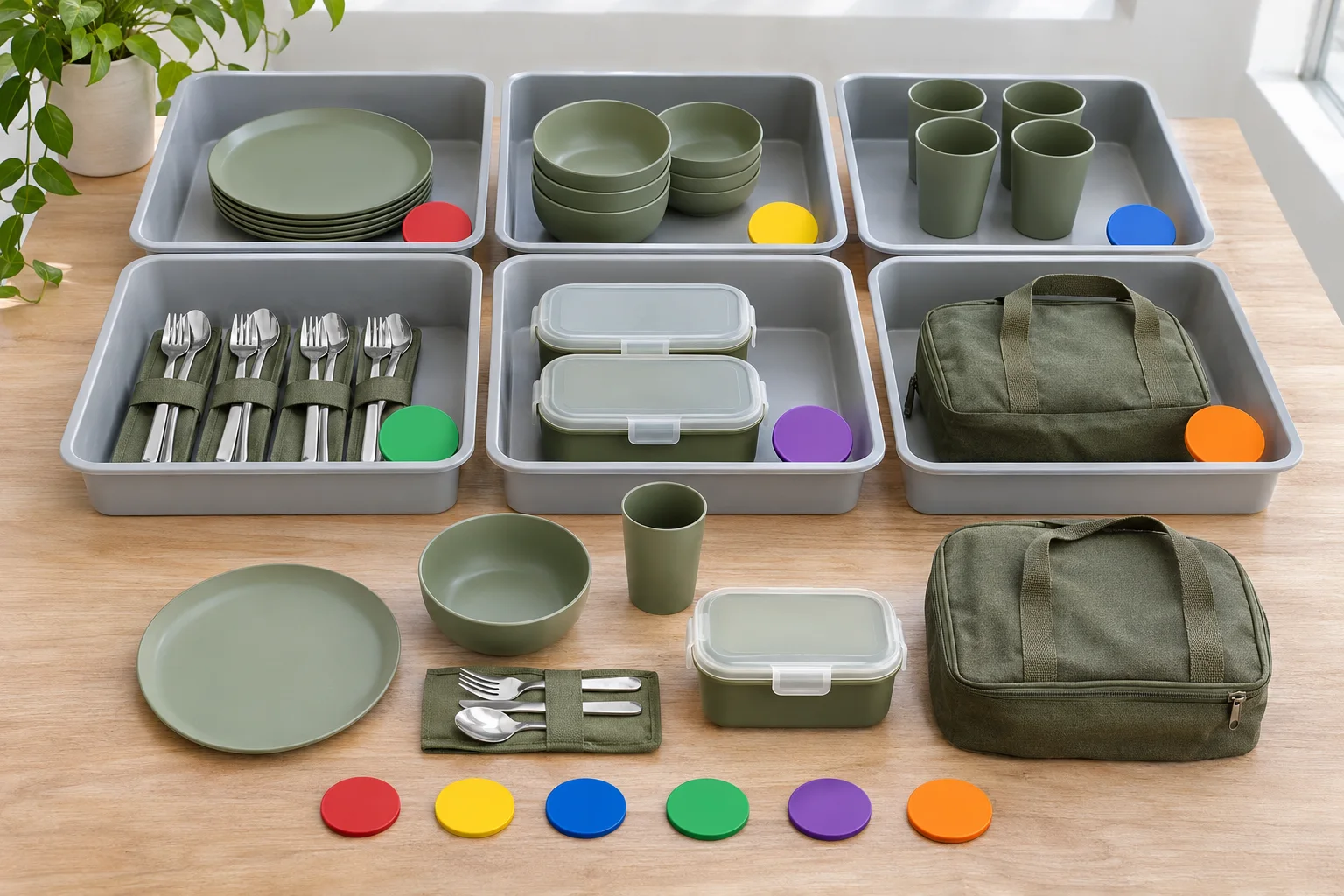
How Should Buyers Link Receipts to Finished Kits?
Use a quantity reconciliation for each component lot. Start with accepted quantity, add authorized returns from a previous kitting event when applicable, then subtract issued-to-kit quantity, verified scrap, return-to-stock quantity and remaining controlled stock. The record should explain any difference rather than forcing the numbers to balance.
Buyer-entered calculation: expected closing quantity = accepted opening quantity + approved additions − quantity consumed in released sets − verified scrap − approved return or transfer. This is a control equation, not proof that the physical count is correct. Reconcile it with stock and kitting evidence.
| Event | Record that preserves identity | Release question |
|---|---|---|
| Receipt | Component code, source lot, delivery reference and received quantity | Was identity fixed before pooling? |
| Incoming review | Sample/result link and disposition for the exact receipt | Was only accepted stock released? |
| Storage | Location, status, split/merge history and relabel authority | Can mixed lots still be separated? |
| Kitting | Component lots consumed by finished-set lot and quantities | Can an affected set population be isolated? |
| Carton release | Finished-set lot linked to carton range and shipment | Can the shipment scope be retrieved? |
Link the final configuration to the released evidence from the first-article-versus-golden-sample review. Traceability identifies what went where; it does not replace inspection or prove conformance.
What Should Happen When a Traceability Link Fails?
Segregate the unidentified component, receipt, work-in-process, finished set and carton range that could share the missing link.
Check whether the loss occurred at source receipt, relabelling, storage split, substitution, issue-to-line, return-to-stock or carton release.
Only a documented owner may accept reconstructed evidence or a bounded deviation, with scope, reason, expiry and next trigger.
Do not solve a missing source lot by assigning a new identifier that implies knowledge the record does not contain. A new internal hold number can control the material, but it should not erase the unknown origin.

Buyer Checklist for Camping Dinnerware Supply Traceability
Set and component codes, released revisions, source-approval rules, required lot granularity, destination scope, retention period and deviation authority.
Responsible-source map, receipt and disposition records, component-lot inventory, kitting consumption, substitutions, finished-set lots and carton links.
Completed map, reconciliation, retrieval-test result, open exceptions, bounded release decision, owner, revision, date and re-review trigger.
Buyer Questions About Multi-Component Set Traceability
Is one finished-set lot code enough?
No. It identifies the set population only if the component lots consumed into that population remain linked.
Can several sources use the same component code?
Yes only when the controlled system also records the responsible source, approved revision and lot. The component code alone must not conceal a source change.
Should every fabric, zipper and packaging item be mapped?
Use a risk-based component hierarchy approved for the project. Food-contact, fit, safety, claim-critical and service-critical items normally need clear identity; the buyer defines the final scope.
Does traceability prove compliance?
No. It shows identity and movement. Material suitability, declarations, tests, specifications and finished-article conformity need separate evidence.
Can records be reconstructed after kitting?
Only when objective records can support the reconstruction and an authorized decision defines the bounded scope. Assumptions should remain visible as gaps.
Does this article prove Naike Dinner’s source network?
No. It is a buyer decision tool. Exact sources, sites, systems, lot structures, capabilities and retention periods are project-specific evidence.
Request a Source-to-Component Traceability Review
Send the set BOM, component codes, approved source list, receipt fields, lot conventions, kitting flow and finished-set release rule. Naike Dinner can organize the available project evidence into a source-to-component traceability map before sampling, quotation or release.
Send the traceability briefRequest a component-lot reviewPrepare a B2B quality inquiry
Updated . Evidence scope: buyer decision support. Nothing in this guide verifies a specific supplier, site, material, component, lot, compliance result, system capability, MOQ, price, capacity, lead time or case history.