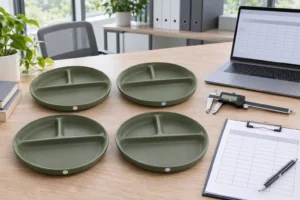
Camping dinnerware first article inspection is a controlled comparison between initial production units and the still-authoritative golden sample. The first article can release a defined production revision, but it must not silently become the new appearance, material or workmanship reference. Buyers need both identities, both roles and every approved deviation preserved in one record.
Direct answer: keep the golden sample sealed, identified and authoritative; inspect the first production unit against the released drawing, BOM, measurement method and golden-sample characteristics; record every result and deviation; then release, conditionally release or hold the production revision. Never relabel the first article as the golden sample unless a separate controlled re-approval replaces the reference.
Why Must the Golden Sample and First Article Stay Separate?
The golden sample defines already approved visible and tactile characteristics for the project revision: component identity, color target, surface appearance, assembly relationships and any agreed workmanship boundaries. A first production unit answers a different question: can the actual production setup deliver the released specification without an unexplained departure from that reference?
Golden sample role
Reference the sample ID, approval date, protected condition, linked drawing/BOM revision and any signed limitations. The sample does not replace measurable specifications, and its approval does not prove future lots automatically comply.
First article role
Record production date, lot or setup identity, tooling/cavity where relevant, component sources, measured results and comparison observations. It is evidence about an initial production condition, not permanent authority for every later lot.
Use the existing golden sample control guide to define the protected reference, and connect production changes to the BOM revision control record.
Use This Camping Dinnerware First Article Inspection Table
Copy the table into the project quality file. Fill the approved requirement before entering the observed first-article result. Where a characteristic is visual, define the lighting, viewing distance and comparison method. Where it is measurable, identify the tool, resolution, method and tolerance.
| Release characteristic | Controlled requirement | Golden sample reference | First production evidence | Difference / risk | Decision and owner | Next-lot control |
|---|---|---|---|---|---|---|
| Product and revision identity | Released commercial code, drawing and BOM revision | Sample ID and linked approval record | Lot/setup record, unit ID and production date | Wrong revision, mixed component or missing trace | Hold until identity is complete | Verify revision at line clearance and pack-out |
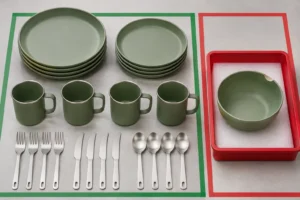
| Complete component count | Released BOM and pack-out list | Approved configuration visible and recorded | Count every plate, bowl, cup, lid and utensil | Missing, duplicate or substituted component | Hold; BOM owner resolves | Kitting verification method and exception log |
| Dimensions and capacity | Drawing datum, tolerance and approved measurement method | Reference only where the sample was measured | Actual readings, tool ID, resolution and unit | Out-of-tolerance result or method mismatch | Hold or approved deviation by named authority | Defined sampling frequency for later lots |
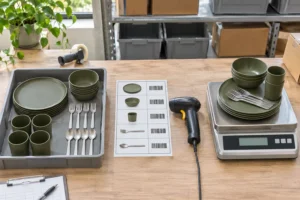
| Net set and packed weight | Defined weight basis, included parts and tolerance | Reference measured under stated condition | Scale reading, tare, sample condition and unit | Different pack level or accessory basis | Re-measure on aligned basis before decision | Periodic weight reconciliation |
| Material identity | Component-level material specification and approved evidence | Appearance is not material proof | Component/source records tied to the production unit | Unsupported substitution or incomplete evidence | Hold material claim and affected components | Incoming identity and change notification control |
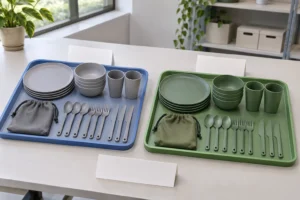
| Color and surface | Approved color target, finish and viewing method | Protected comparison surface and approved limits | Controlled side-by-side observation; instrument data if required | Lighting effect, gloss shift, contamination or real color drift | Accept, conditionally accept or hold with reason | Master color reference and lot check method |
| Parting lines, gates and edges | Drawing/workmanship criteria and safety boundaries | Approved visible condition, not an unlimited tolerance | Views of every component and identified location | Sharp edge, excess flash, sink, gate or deformation | Hold safety risk; classify cosmetic issue separately | Location-based defect standard and inspection view |
| Nesting and component fit | Released stack order, clearance and compatibility requirement | Approved relationship between components | Complete assembly/separation observation on this revision | Interference, instability, unintended release or abrasion | Hold functional mismatch; document approved variance | Fit check with defined sample size |
| Logo, marking and artwork | Approved file, position, color and revision | Reference appearance if included in approval | Production application view and file trace | Wrong mark, placement, language or old artwork | Hold affected printed or marked parts | Artwork release and first-off print check |
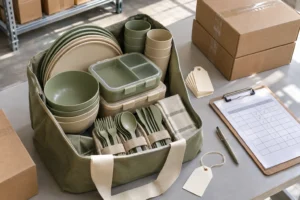
| Packaging and instructions | Released component restraints, carton and document set | Only if packaging formed part of sample approval | Actual first pack-out with every insert | Movement, count, label or instruction mismatch | Correct and repeat full pack-out review | Pack audit tied to production revision |

When Should Buyers Release, Approve a Deviation or Hold?
Release
Release only when product identity is complete, required measurements meet the released criteria, visual comparisons fall inside the approved boundary, and no unresolved material, safety, count, fit, artwork or packaging conflict remains. Name the production revision and effective lot.
Conditional release
Use only for a documented, bounded deviation with an owner, affected quantity, buyer acceptance, containment action and closure date. A conditional release is not permission to update the golden sample automatically.
Hold
Hold when the wrong revision appears, traceability is missing, a critical characteristic fails, material identity is unresolved, fit is unsafe or inconsistent, component count is wrong, or an observation cannot be compared under the defined method.
Replace the reference separately
If a new production outcome is intentionally preferred, start a controlled golden-sample replacement: define why, confirm every affected document, obtain the required approvals, retire or archive the old sample and record the effective revision.

Does One First Article Prove the Full Production Lot?
No. One or several initial units can confirm that a defined production setup produced reviewable parts, but they cannot describe all variation across time, cavities, operators, material lots or later pack-out. If acceptance sampling is used, define the lot and sampling plan independently. The NIST/SEMATECH acceptance-sampling handbook explains that a random sample supports a decision about a defined lot; it does not supply this project’s acceptance criteria or replace first-article approval.
For measured characteristics, NIST’s measurement uncertainty guidance explains that a measurement result carries incomplete knowledge that should be expressed and controlled. NIST’s separate metrological traceability guidance emphasizes that traceability belongs to a measurement result supported by a documented chain, not merely to an instrument label.
Did initial production match the released requirements and protected reference under the defined review?
What does a defined sample indicate about a defined production lot under an agreed plan?
What approved visible/tactile reference remains authoritative for the controlled project revision?
What Is the Eight-Step First Article Approval Workflow?
- Confirm authority. Name the released drawing, BOM, claim record and still-valid golden sample before production comparison starts.
- Identify the first article. Record unit, date, lot, setup, tooling/cavity where relevant and component-source trace.
- Protect the golden sample. Inspect its seal and condition; never consume or modify it during the comparison.
- Verify identity and completeness. Confirm product code, revision and every component before measuring.
- Measure with the approved method. Record datum, tool, resolution, unit, result and tolerance rather than a bare pass mark.
- Compare visual and functional characteristics. Control lighting and method; keep observations separate from unsupported performance claims.
- Classify every difference. Release, approved deviation, rework/recheck or hold, with owner and affected quantity.
- Define continuing controls. Link the decision to later-lot sampling, line clearance, kitting checks, artwork release and pre-shipment review.
Before public wording is released, reconcile the decision with the tableware claim approval matrix. Before shipment, use the pre-shipment inspection release sheet rather than treating the first article as permanent proof.

What Should a Buyer Send for First Article Review?
Approved configuration, critical characteristics, destination market, intended use, release authority and deviation rules.
Released BOM/drawings, golden sample ID, first-unit trace, measurement methods, component evidence, artwork and pack-out.
Field-by-field result, comparison observation, deviation/hold decision, owner, effective lot and continuing-control plan.
Buyer Questions About First Article Inspection
Can the first article become the new golden sample?
Only through a separate controlled re-approval. Record the reason, compare the change, update every affected document, obtain buyer authority, archive the prior reference and define the effective revision.
Should the golden sample be measured again?
Only when the project method requires it and the action will not damage the protected sample. A drawing and approved measurement record should remain the source for measurable requirements; the physical sample alone is not a substitute for tolerances.
What if appearance matches but a dimension fails?
Hold the affected characteristic. Visual similarity does not override a released measurable requirement. Confirm the method and tool, repeat only under the defined rule, then assign a formal disposition.
What if a component is sourced separately?
Keep component identity and source trace in the first-article record. The complete set decision must show which component revisions were assembled and whether later substitutions require re-approval.
Does first article inspection certify food-contact compliance?
No. It may verify that the intended component/material records are linked to the unit, but finished-article compliance depends on exact material, construction, intended use, destination and applicable evidence.
Request a First Article Release Review
Send the released BOM and drawings, golden sample ID, first-production trace, measurement methods, critical characteristics, artwork, packaging and deviation authority. Naike Dinner can organize the comparison into a buyer-ready release table before continuing production or shipment approval.
Send the first-article packageRequest golden-sample comparisonPrepare a B2B quality brief
Updated . Evidence scope: buyer decision support. Nothing in this guide verifies a specific product, material, certificate, production lot, commercial term, delivery schedule or performance result.