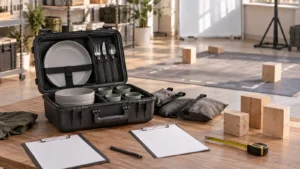
Direct answer: Camping set replacement part inspection should compare the incoming component with the approved master set, current drawing and BOM—not with memory or an old sample. Record identity, fit interfaces, finish, nested clearance, case or insert fit, cleaning boundary and packaging condition. Quarantine mismatches, identify the affected revision, and release only against a signed disposition.
Scope: this is a buyer-side receiving and approval worksheet for reusable camping dinnerware components. It is not a laboratory method, supplier capability claim, incoming result or proof that any Naike Dinner SKU meets an unprovided tolerance. Dimensions, acceptance limits, sampling level and evidence requirements must be approved for the project.
Freeze the master-set baseline before opening the shipment
A replacement bowl, cup, plate, lid, utensil or case insert can look correct and still fail at an interface. Start camping set replacement part inspection by linking the incoming lot to the current purchase order, component part number, drawing revision, approved BOM and master-set identity. If the team cannot prove which master set controls the comparison, place the parts on hold. Do not average two masters or select the one that makes a mismatch disappear.
The NIST explanation of metrological traceability is a useful primary reference for understanding why a measurement result needs an unbroken documented chain to stated references. For procurement, that means recording the instrument, method, unit, operator and applicable drawing characteristic instead of writing only “size OK.” The earlier golden sample control guide, BOM revision control guide and component change-control workflow provide the upstream controls this receiving check depends on.

Camping set replacement part inspection identity gate
| Check | Evidence to capture | Hold trigger |
|---|---|---|
| Part identity | PO, supplier part number, buyer part number, component name and quantity | Missing, conflicting or reused identity |
| Revision link | Drawing revision, BOM revision, artwork or color reference where applicable | Part cannot be linked to the current release |
| Master set | Master-set ID, approval date, condition and custody | Uncontrolled, damaged or obsolete comparator |
| Lot trace | Lot, carton or batch identifier supplied with the shipment | Mixed or untraceable incoming population |
| Measurement readiness | Instrument ID, calibration status, method and environment needed by the drawing | Required measurement cannot be supported |
| Evidence scope | Target market, intended use and evidence package named in the project file | Claim or compliance assumption exceeds the approved scope |
Copyable camping set replacement part inspection checklist
Use one line per characteristic or interface in the camping set replacement part inspection record. Replace the example fields with drawing-controlled requirements. “Same as sample” is not a tolerance. When a numeric requirement is unknown, mark it for buyer approval rather than inventing a value.
| Characteristic | Compare / method | Record | Disposition trigger |
|---|---|---|---|
| Overall identity | Part number, revision, component family, cavity or mark if specified | Actual identifiers and photo | Any mismatch or missing trace |
| Critical diameter / width / depth | Current drawing and approved measurement method | Actual value, unit, instrument and sample ID | Outside approved limit or method unavailable |
| Rim and foot geometry | Master-set contact surfaces and drawing datum | Rocking, gap, interference and observation photo | Unstable seating, contact or unresolved gap |
| Nesting clearance | Insert replacement into the controlled stack without forcing | Insertion, removal, trapped air, sticking and stack height | Force, jam, surface contact or closure change |
| Lid / container interface | Approved mating component and orientation | Engagement, alignment and release observation | Partial engagement, distortion or unapproved substitution |
| Cutlery / clip interface | Specified utensil with case clip or retention feature | Retention and removal observation | Loose retention, excessive force or surface damage |
| Finish and edge | Approved light, viewing distance and limit sample if defined | Location, type and extent of observation | Sharp edge, crack, contamination or defect beyond limit |
| Color / appearance | Controlled master or approved color method | Method, lighting and result | Visual-only decision where a controlled method is required |
| Case / insert fit | Pack the full master set in the approved sequence | Clearance, closure, movement and pressure points | Closure load, protrusion, migration or food-contact rubbing |
| Cleaning boundary | Approved use and cleaning instruction for the finished component | Evidence reviewed and unresolved conditions | Unsupported dishwasher, microwave or temperature assumption |
| Packaging condition | Approved inner protection, count, label and carton arrangement | Count, separation, visible damage and trace label | Mixed revision, contamination or inadequate protection |
| Decision | Acceptance criteria and responsible authority | Accept, segregate, concession, rework, return or investigate | No owner, approval or linked evidence |
Inspect the assembled system, not only the loose part
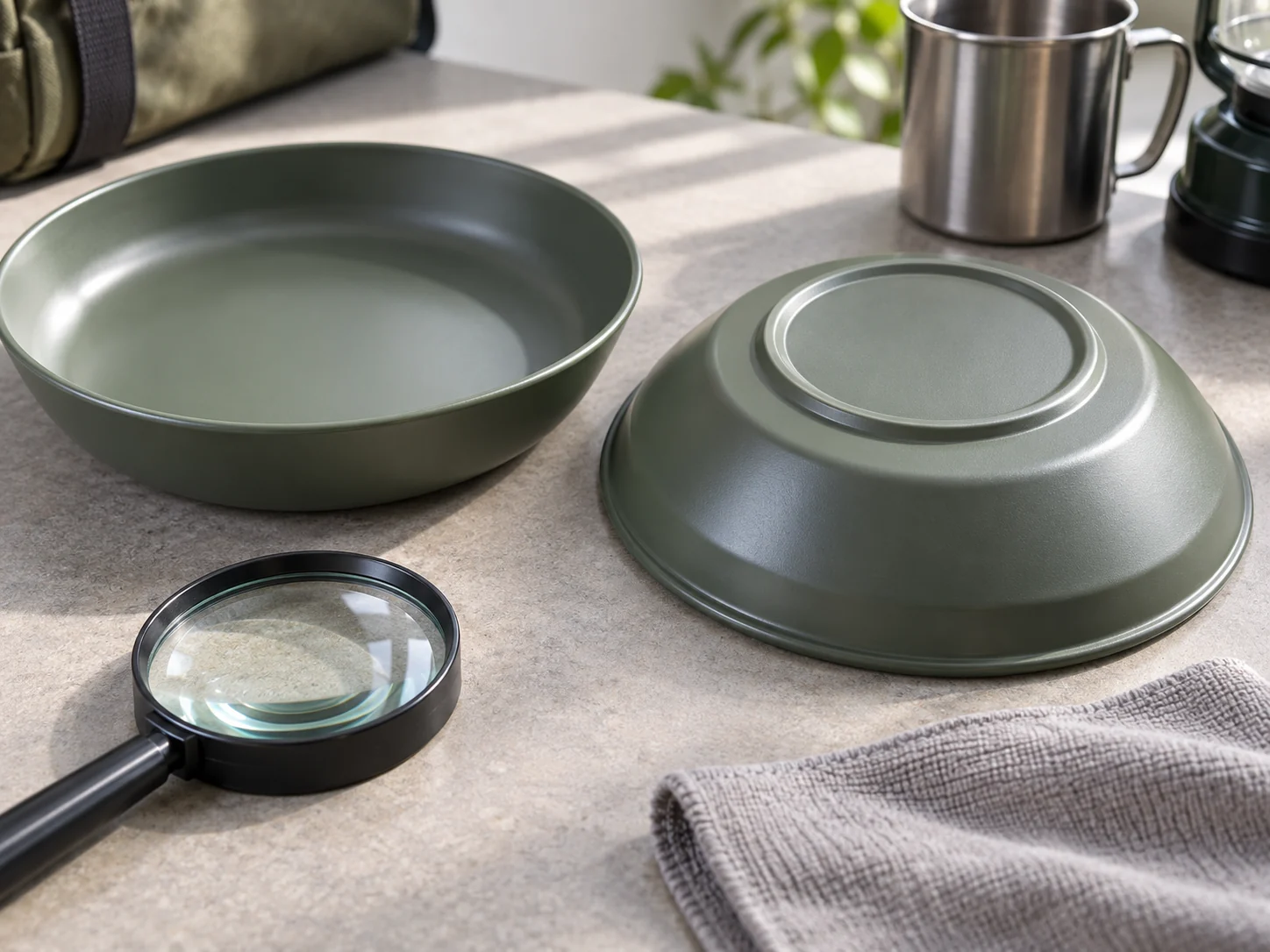
Camping set replacement part inspection must cover the system of contact surfaces. A plate can be dimensionally acceptable alone but raise the nested stack, rub the bowl above it or prevent the case from closing. A cup can fit its dock but interfere with an adjacent fork. A replacement insert can hold every component while transferring load to a food-contact rim. Run the interface review in the approved packing sequence and record every contact partner.
| Replacement part | Interfaces to verify | Useful output |
|---|---|---|
| Plate or bowl | Part below, part above, foot ring, rim, case wall and stack height | Contact map plus insertion and removal notes |
| Cup | Dock, neighbor cup, lid if any, case closure and utensil zone | Clearance and migration observation |
| Lid | Mating container, sealing or snap feature, stack and storage orientation | Engagement map; performance claim only if separately evidenced |
| Cutlery | Hand-contact edge, clip, sleeve, adjacent food-contact surface and closure | Retention, release and packed-contact record |
| Case insert | Every component, zipper or latch path, handle load path and outer case | Full-pack photo set and closure observation |
Compatibility to be confirmed by project sample and drawing. This sentence is not a substitute for inspection; it identifies the evidence boundary before approval.
Select samples without hiding mixed lots
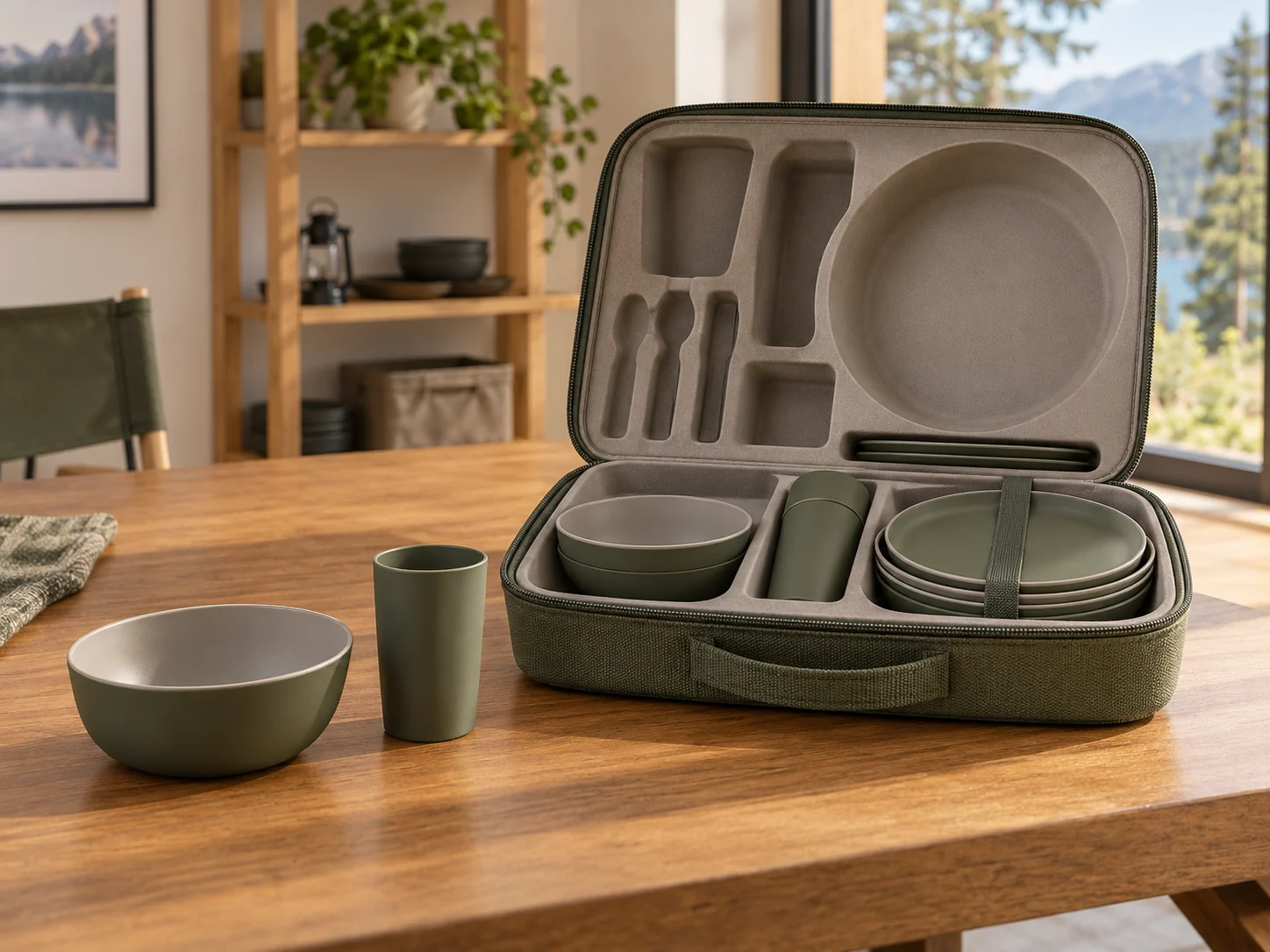
Define the lot before selecting units. Separate shipments, supplier lots, molds, cavities, colors or revisions when they may represent different populations. The camping-set fit sampling plan explains how to connect multi-component combinations to a sampling rationale. The sample size and acceptance rule remain project decisions; this checklist does not create them.
If a mismatch appears, preserve the failed combination and its packaging. Do not swap in another master component until the original evidence is photographed and identified. Expand the review only under a documented plan. A replacement part that fits one master may still be incompatible with another approved set revision.
Close camping set replacement part inspection with a controlled record
| Field | Required entry | Why it matters |
|---|---|---|
| Nonconformance ID | Unique record linked to lot, PO, part and revision | Prevents informal decisions from losing traceability |
| Observed condition | Fact, location, method, sample ID and photo | Separates evidence from suspected cause |
| Affected interfaces | Master component, case, insert, lid, stack or packaging | Defines the system risk |
| Containment | Quantity segregated, location and label | Stops mixed status from reaching assembly or shipment |
| Decision | Accept, concession, sort, rework, return, replace or investigate | Makes the action explicit |
| Authority | Buyer and supplier approver, date and conditions | Shows who accepted residual risk |
| Follow-up | Drawing/BOM change, corrective action, resample or no change | Closes the loop without silently changing the standard |
Keep food-contact and material statements inside their evidence scope
Visual similarity does not establish polymer identity, recycled content, BPA status, biodegradability, dishwasher suitability, microwave suitability or food-contact compliance. Review the finished composition, colorants, decorations, intended food, temperature, duration, cleaning and target market. The FDA inventory of effective food-contact substance notifications and the European Commission food-contact materials overview are primary starting points, not blanket approvals for an incoming component.
This workflow concerns dinnerware and storage-system interfaces. It does not establish cookware suitability or direct-flame performance.
Buyer checklist
| Buyer supplies | Supplier confirms | Approval record retains |
|---|---|---|
| Current PO, drawing, BOM, master-set ID and acceptance limits | Incoming part, lot, revision, quantity and open deviations | Identity trace, measurements, photos and interface observations |
| Target market, intended use, cleaning and evidence requirements | Which claims and compatibility points remain unverified | Evidence scope, unresolved items and responsible owner |
| Sampling rationale and authority for concessions | Containment quantity and proposed corrective action | Disposition, signatures, date and follow-up verification |
Procurement FAQ
Can the approved master set replace the drawing?
No. Camping set replacement part inspection uses the master for appearance and system-interface comparison, while the current drawing and BOM control defined characteristics. Record which source controls each decision.
Should a replacement component match the master color exactly?
Only against the agreed method and tolerance. Lighting, texture, material and surface geometry can change visual judgment, so record the approved comparison condition.
Can we approve a part that fits after force is applied?
Do not assume so. Record the force or interference and obtain a controlled engineering and buyer decision. Forced assembly may hide stack, wear or closure risks.
Does a passed loose-part check prove pack compatibility?
No. Camping set replacement part inspection must also cover the full set, case or insert, closure and packing sequence because they create additional interfaces.
Can one accepted lot approve future revisions?
No. Approval applies to the identified part, revision, lot and evidence scope unless the project procedure explicitly states otherwise.
Request a replacement-component review
Send the current BOM and drawing, master-set identity, replacement part and lot details, target market, use conditions, sampling rule and acceptance limits. Naike Dinner can identify open interface and evidence questions without inventing tolerances or test results.
Send the inspection brief · Request a sample review · Ask for a project quotation