OUTDOOR SET GUIDES · BUYER DECISION GUIDE
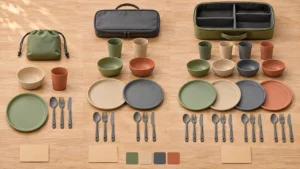
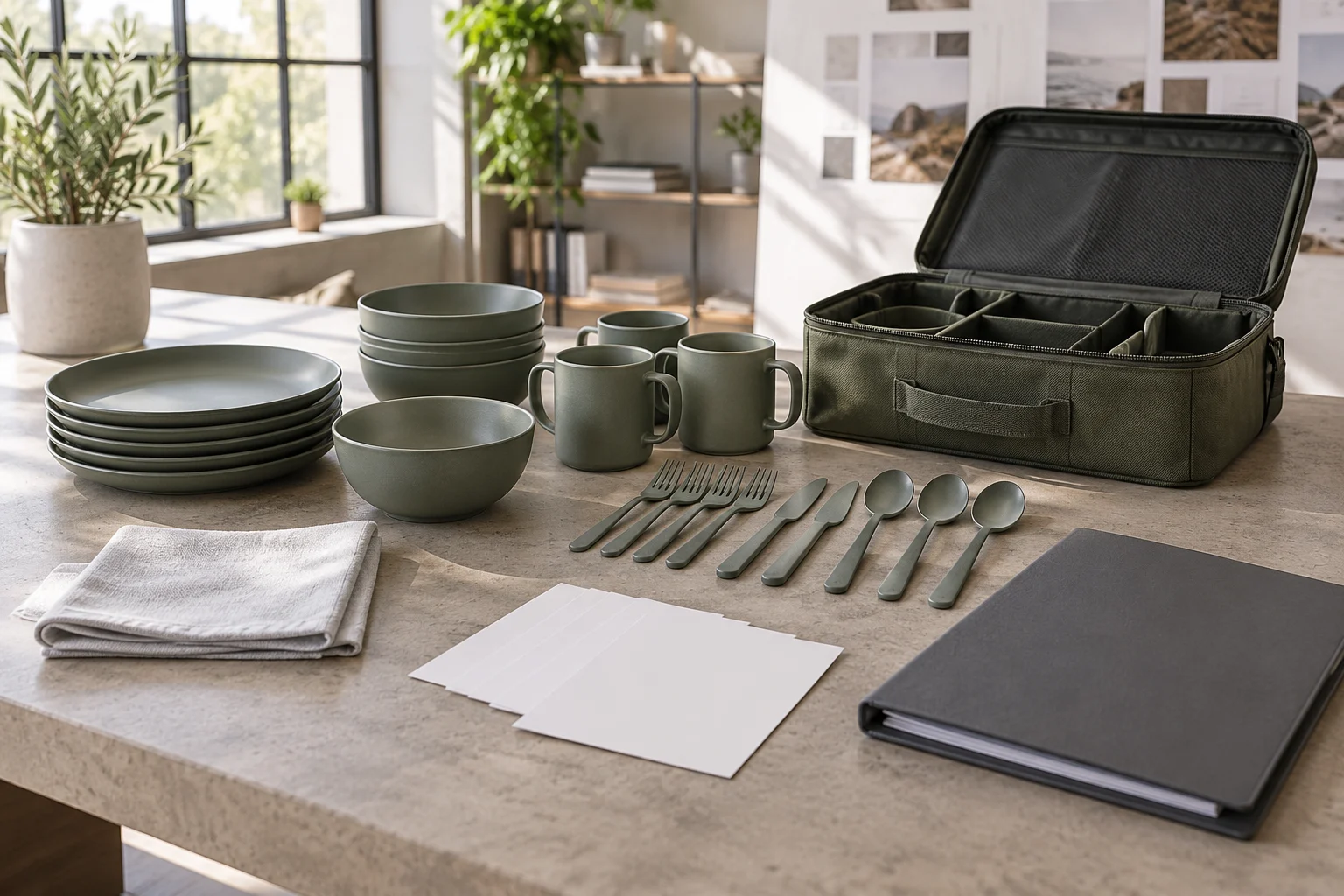
Camping dinnerware cleaning instructions should control the entire packed system, not only plates and bowls. Name the approved cleaning method for each component, require complete draining and air-drying, open every lid and textile compartment, define a visible dry-before-pack check, and tell users what to do when water remains in seams, recesses, utensil channels or the carry case.
Camping dinnerware cleaning instructions in seven steps
- Empty and separate. Remove food, separate every plate, bowl, cup, utensil, lid, divider and removable insert. Open the carry bag and all pockets.
- Follow component limits. Use only the cleaning method confirmed for that exact material, decoration, closure and accessory. A set-level dishwasher statement is not a substitute for component evidence.
- Wash accessible surfaces. Clean food-contact faces, rims, bases, nesting rings, cutlery channels, lid grooves and container corners without assuming a tool can reach hidden recesses.
- Rinse and inspect. Remove visible residue and inspect joints, textured areas and decoration zones. Reclean rather than packing a questionable part.
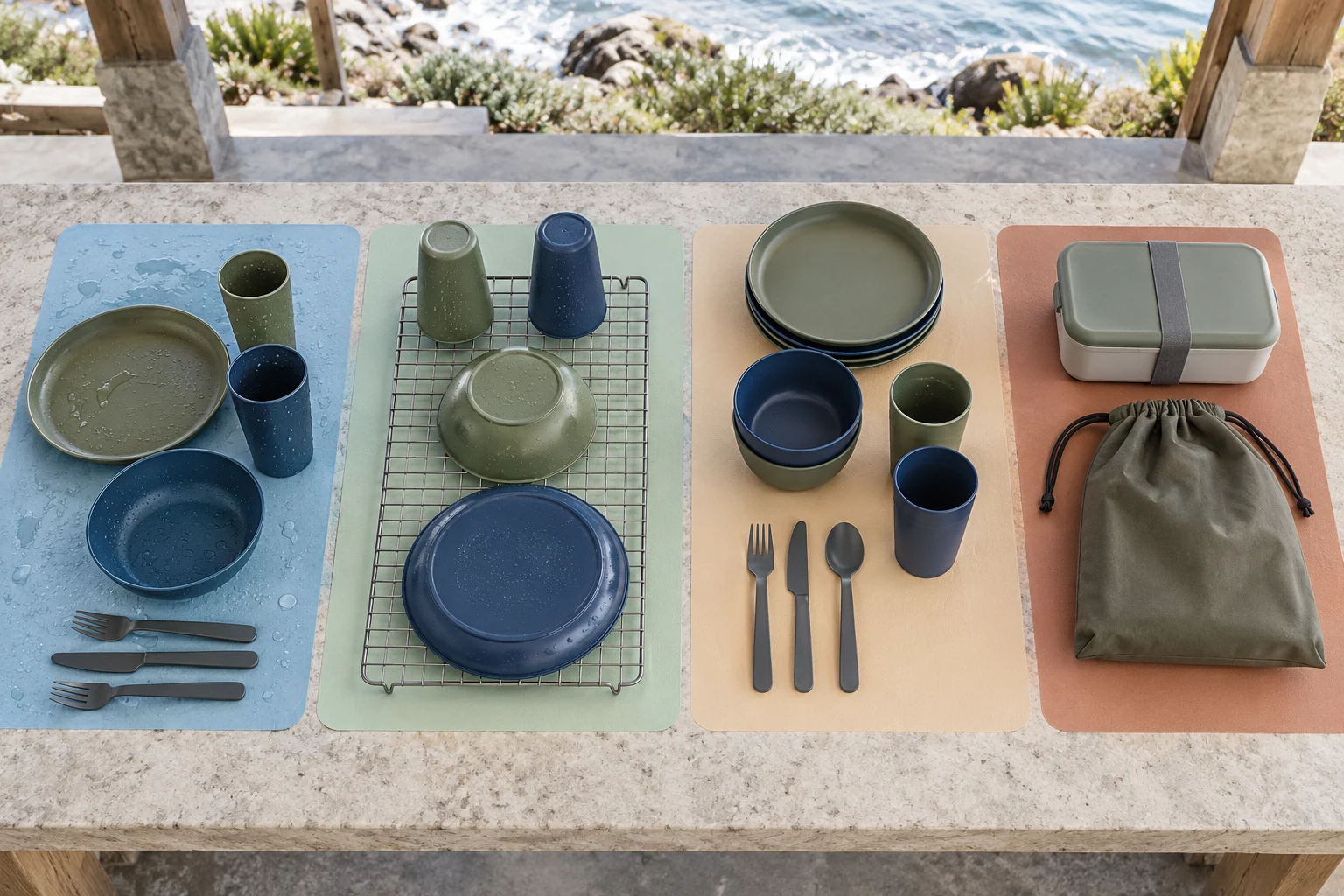
- Drain by geometry. Tilt bowls, invert cups with an air gap, separate utensils and keep lids off. Do not create water traps by tight nesting.
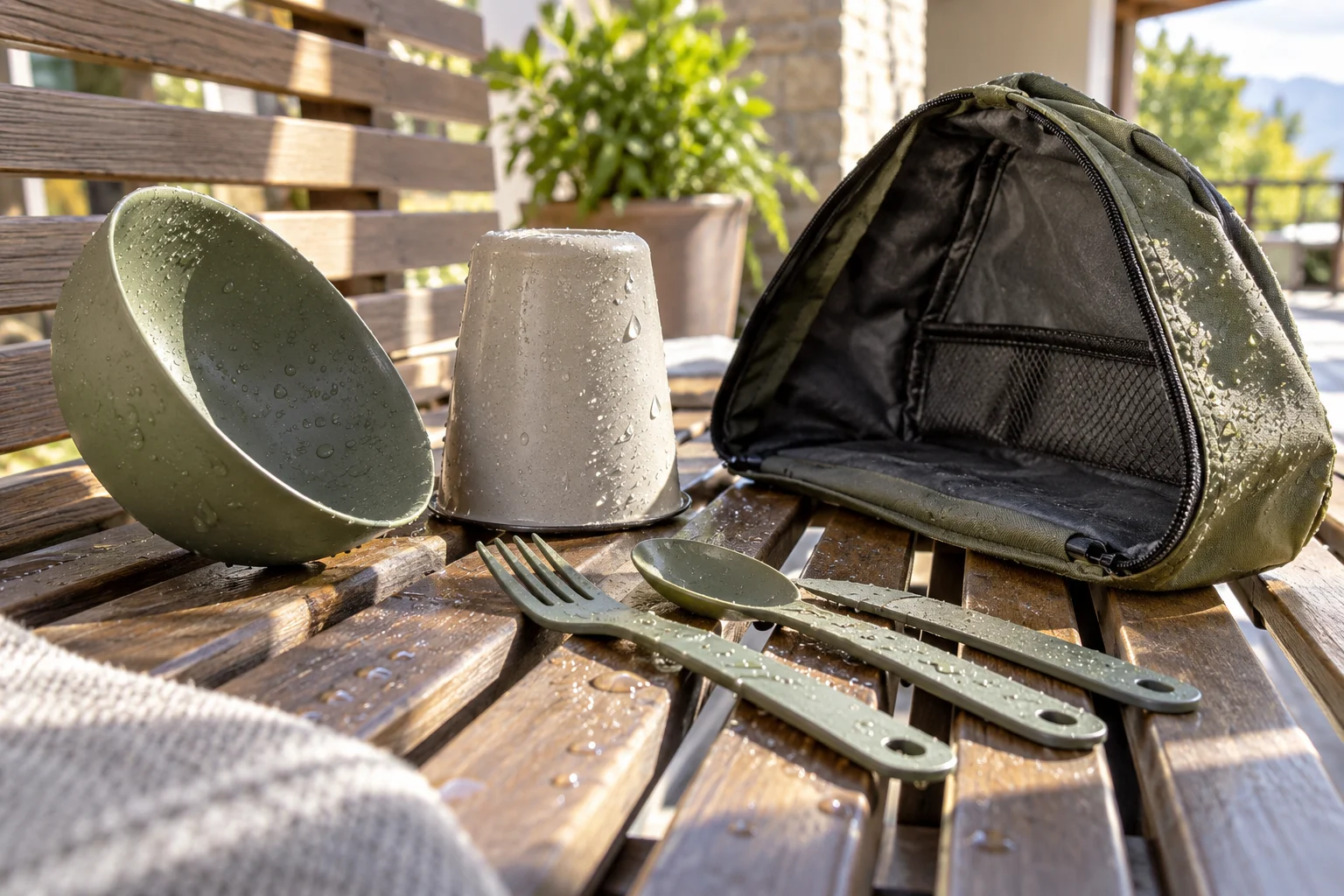
- Air-dry the case. Hold textile or rigid storage fully open; expose seams, pockets, dividers and foam or padding interfaces. Wiping is not proof that internal layers are dry.
- Release only when dry. Touch-check or visually check defined trap points, then repack in the approved order. If moisture remains, continue drying and keep the case open.
Cleaning and drying register by component
| Component | Instruction must define | Water-trap risk | Pack-release check |
|---|---|---|---|
| Plates and shallow trays | Cleaning method, scratch controls and edge inspection | Foot rings, stacked faces and textured bases | Both faces and base ring visibly dry |
| Bowls | Food-residue removal and approved cleaning method | Deep base radius and tight nested contact | Tilted dry; no droplets in base or rim |
| Cups | Rim, inside wall and base cleaning | Inverted cup sealed against a flat surface | Inverted with air gap; interior fully dry |
| Utensils | Separation, tine/edge cleaning and handling | Bundled handles and retention channels | Separated dry before entering channels |
| Lid, gasket or divider | Whether removal is allowed and reassembly order | Grooves, seal seats, clips and overlaps | Every removable interface dry and correctly seated |
| Lunch box | Corner access, closure position and odor check | Hinge, latch, partition and seal channel | Open, dry and free of retained debris |
| Carry case or bag | Surface cleaning, drying orientation and storage state | Seams, pockets, padding, zipper tape and base panel | Fully open and dry before components return |
Use this register to turn camping dinnerware cleaning instructions into component-level controls. Record unverified methods as pending. “Wipe clean,” “dishwasher safe” and “air dry” are incomplete when they do not identify which parts, what preparation is required, or how a user recognizes a dry condition. For a mixed-material set, link this register to the final BOM and component evidence file.
Write instructions around foreseeable misuse
- Do not tell users to nest wet bowls to save space.
- Do not close a wet lunch box or zip a damp textile bag.
- Do not assume an upside-down cup can dry when its rim seals against the surface.
- Do not group sharp utensils where they can damage soft components or the storage lining.
- Do not reuse a cleaning claim from a previous material, finish or decoration without review.
- Do state what to do if odor, visible residue, damage or persistent moisture is found.
Primary context should come from the final product evidence and destination-market instructions. For food-contact framing, consult the FDA food-contact substances overview, the FDA conditions-of-use framework, and the European Commission food-contact materials overview. These sources do not approve a particular cleaning claim; they help define the intended-use context that evidence must address.
Dry-before-pack approval record
| Record field | Buyer decision | Approval evidence |
|---|---|---|
| Final component revision | Instruction matches the released BOM, material and finish | Drawing/BOM revision and sample identity |
| Cleaning route | Manual or other method defined per component | Applicable evidence and limitations |
| Drain orientation | Every water-trap point has an open path | Photo or diagram of approved position |
| Dry-release criterion | Observable pass/fail condition is stated | Inspection points and responsible reviewer |
| Repack order | Dry parts do not reintroduce moisture or damage | Pack-out sequence and case condition |
| Change trigger | New material, shape, lining, closure or decoration reopens review | Change-control rule |
Buyer checklist
| Ask | Verify | Record |
|---|---|---|
| Can every part be separated as instructed? | Use the final sample and pack-out | Exceptions and tool needs |
| Where can water remain? | Inspect grooves, rings, pockets and overlaps | Drying orientation for each trap |
| How is “dry” judged? | Use observable, repeatable criteria | Release points and reviewer |
| What changes reopen approval? | Compare BOM, shape, finish and storage revisions | Notification and hold rule |
Related controls: mixed-material dishwasher claim matrix, component use-condition register, and complete-set evidence file. For a project review, send the final component list, share the cleaning assumptions, and request a dry-before-pack review.
Procurement FAQ
Can one drying instruction cover every component?
Only when the camping dinnerware cleaning instructions explicitly address each material, geometry and storage interface. A set may need different positions or preparation steps for rigid dinnerware, removable seals, a lunch box and a textile case.
Is wiping enough before packing?
Not automatically. Wiping can remove visible surface water while moisture remains in seams, grooves, padding or stacked interfaces. Define an air-dry step and observable release check.
Should cups be placed upside down?
They should drain without sealing the rim against a flat surface. An approved rack, tilt or spacer should preserve an air path.
What belongs in the RFQ?
Include the final component list, materials, decorations, intended cleaning methods, carry-case construction, expected use environment and destination markets. Ask the supplier to mark every unverified instruction as pending.
Approve the dry-before-pack process with the set
Send the component matrix, cleaning assumptions, water-trap photos and pack-out. We will structure the camping dinnerware cleaning instructions for sample, specification and quotation review without inventing a cleaning or performance claim.
Request a cleaning-instruction review