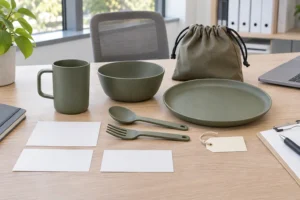
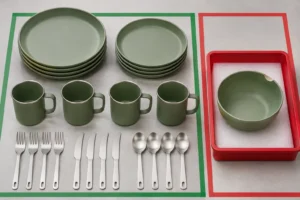
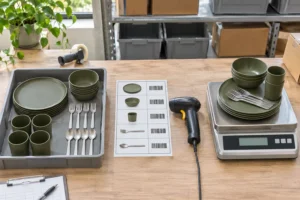
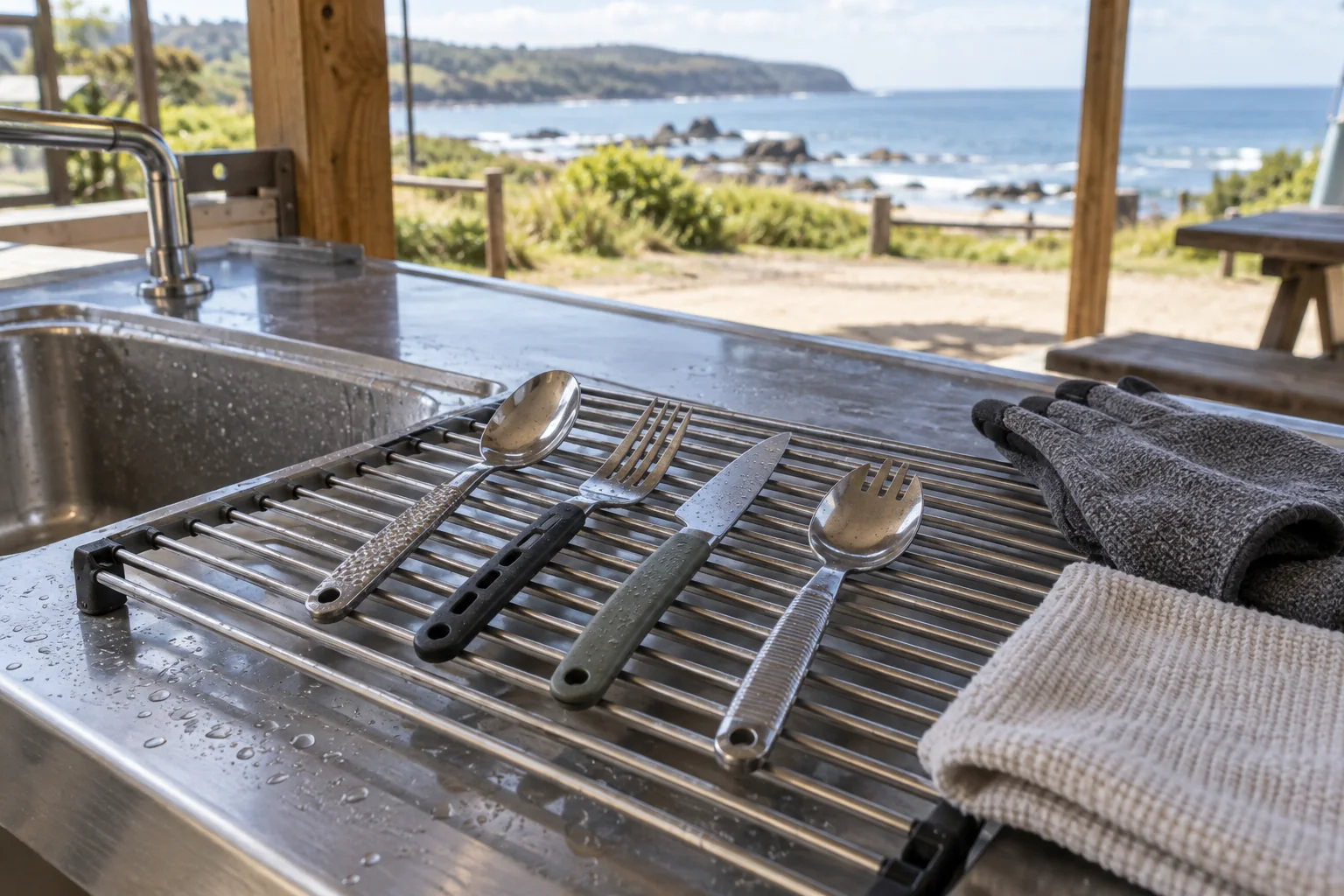
Review camping cutlery grip design with the intended utensil, representative food actions, a wet bare hand and the glove type buyers expect users to wear. Record control, rotation, pressure points, reach, cleaning and retention separately. Do not approve a handle from texture photographs alone: compare revision-matched samples and state exactly which conditions the decision covers.
Define the handling decision before choosing a texture
A grip review should answer whether a user can control the utensil during the actions written into the product brief. It is not a contest to find the most aggressive texture. A handle that resists rotation in a wet hand may create pressure through a glove, trap soil, snag a sleeve or consume too much space in the case.
Freeze the utensil type, handle revision, intended users, glove construction, meal actions and cleaning method before comparison. Spoon, fork and table knife loads differ, so one result should not automatically be transferred to the other pieces. This is a buyer observation protocol, not a universal performance claim.
The review concerns dinnerware utensils. It does not establish cookware or direct-heat suitability, food-contact compliance, corrosion resistance or a quantified ergonomic rating. Those decisions need their own specifications and evidence.
A useful camping cutlery grip design record connects every observation to a component revision and use condition. Keep that phrase as a controlled subject, not a performance promise.
Separate observable mechanisms from unsupported claims
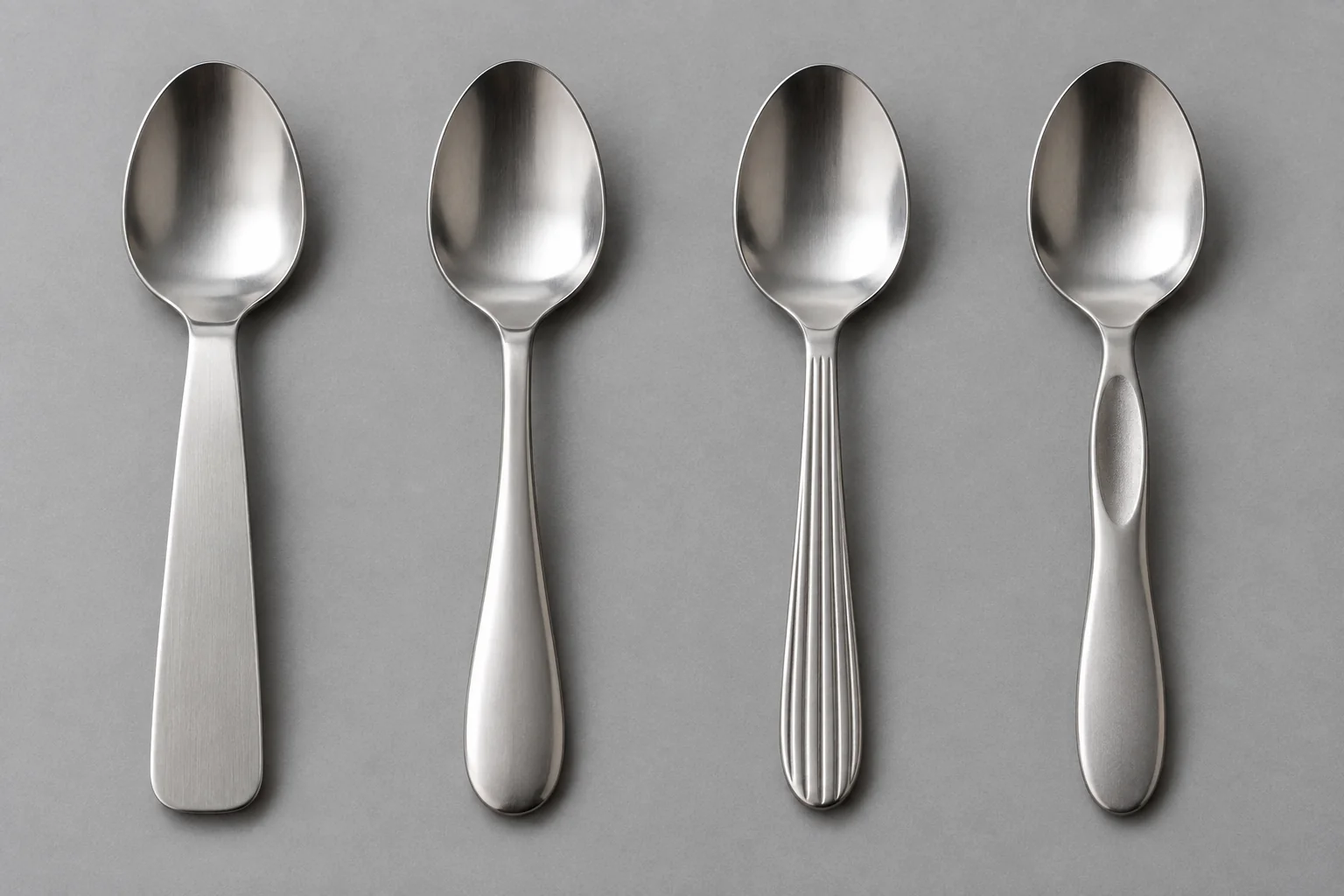
Handle width, thickness, edge radius, cross-section, balance, surface finish and local texture can all change control. Water, oil, soap residue, glove stiffness and hand size change the interaction again. Buyers can observe movement and discomfort under a defined method, but should not call a sample “non-slip” without a controlled claim method and acceptance criteria.
The NIOSH ergonomics overview explains why tasks, tools and users should be considered together. For food-contact scope, connect the final material and intended use to the U.S. FDA food-contact substances overview and the EU food-contact framework regulation. These sources do not certify a cutlery handle; they define evidence boundaries around the project decision.
Camping cutlery grip design comparison matrix
| Handle feature | Potential benefit to observe | Risk to check | Required record |
|---|---|---|---|
| Wide flat section | May give a clear orientation cue | Edge pressure or case-width penalty | Rotation, pressure location and packed width |
| Rounded section | May feel neutral across varied grips | Rotation when wet or inside a loose glove | Clocking change during scoop and cut actions |
| Shallow ribs | May add a tactile reference | Soil retention, glove snag or cleaning effort | Control plus wash-and-dry observation |
| Thumb pad | May guide one intended grip | Discomfort for reverse or left-handed use | Both hands and alternative grip positions |
| Handle opening | May support hanging or case retention | Local edge pressure and reduced end strength | Finger contact, sleeve interface and inspection |
Wet-hand and glove handling trial protocol
| Step | Method | What to record |
|---|---|---|
| 1. Identify samples | Record utensil, drawing revision, finish and sample code. | Traceable comparison set |
| 2. Establish dry baseline | Place, scoop, stir, pierce and perform a soft-food cut as applicable. | Grip changes, pressure points and rotation |
| 3. Wet bare-hand condition | Use clean water and a consistent drain-off period; avoid invented friction numbers. | Loss of orientation, regrip frequency and unsafe movement |
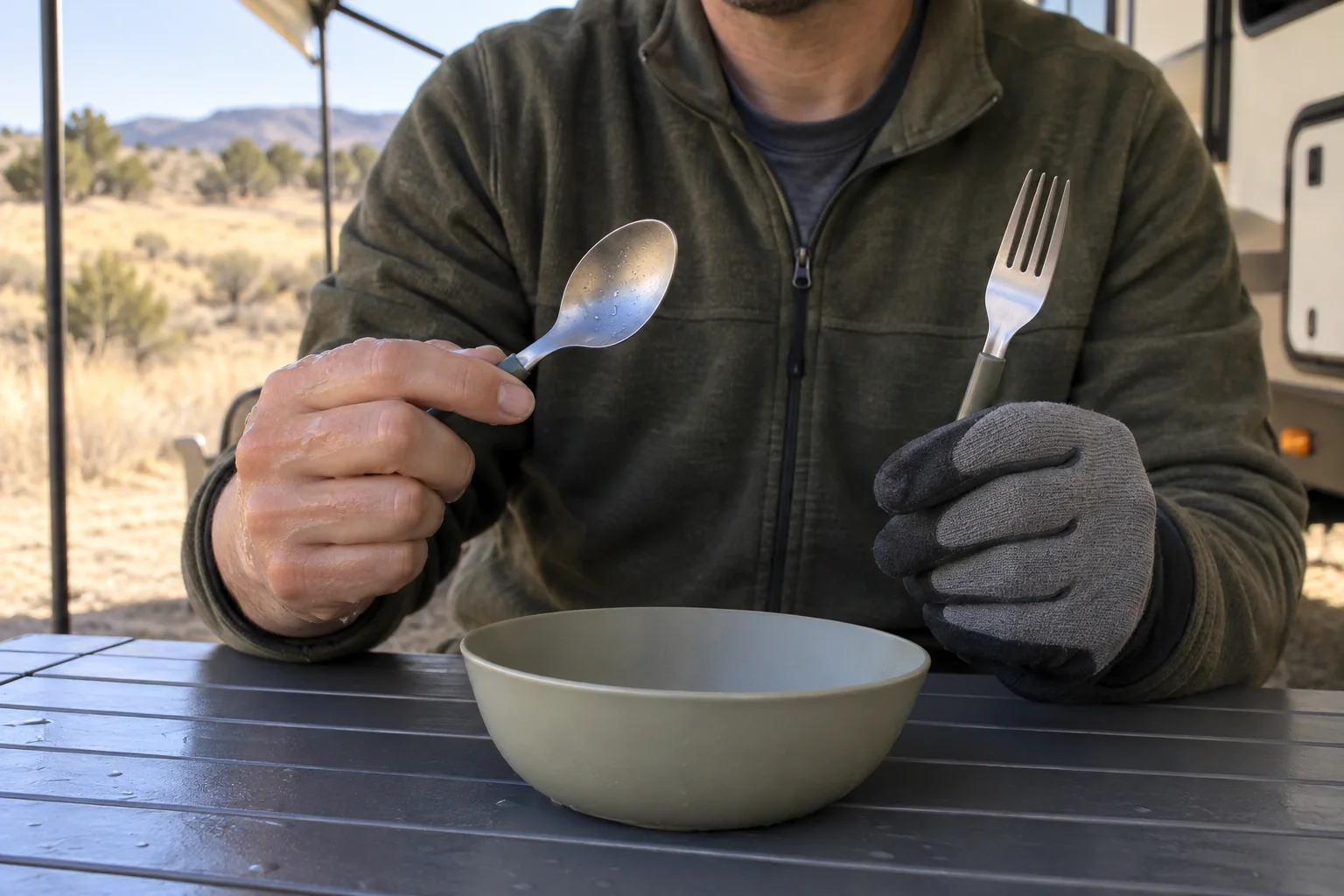
| 4. Representative glove | Use the glove class named in the brief, including its real size and thickness. | Reach, control, snagging and tactile feedback |
| 5. Left/right review | Repeat critical actions with intended handedness coverage. | Asymmetry or thumb-feature conflict |
| 6. Clean and dry | Wash according to the planned method and inspect textures and openings. | Trapped residue, drainage and drying access |
| 7. Pack retention | Return utensils to the case, sleeve or tray. | Insertion force, rattle, exposed edges and removal order |
| 8. Disposition | Accept, revise or retest with named owner and evidence request. | Auditable next action |
Use the same tester sequence, utensils and actions for each revision. If exact force, torque or dimensional capability matters, define a competent controlled test rather than treating a field observation as laboratory data.
When camping cutlery grip design changes, repeat the full sequence rather than carrying forward the previous approval. A revised edge radius, texture or insert can change both handling and cleaning.
Match the trial to the product and channel
Family camping sets: include different adult hand sizes, left-handed use and simple meal actions. Avoid using children in unsupervised sharp-utensil trials. Cold-weather kits: select the actual glove thickness; a thin liner and insulated glove are different conditions. Rental and group sets: cleaning access and rapid inventory may matter more than a highly contoured grip. Compact retail sets: cross-check every handle change against nesting, utensil sleeves and the overall pack envelope.
Link the decision to the core-set component review, carry-case opening decision and replacement SKU decision. A handle that feels better but breaks the retention layout is not yet an approved system solution.
Limitations, misuse boundaries and commercial risk
Do not convert a small internal handling review into “ergonomic,” “anti-slip” or “safe for all users” marketing. The result applies only to the samples, users, glove conditions, moisture state and actions recorded. Surface wear, detergent residue, temperature and production variation may change later observations.
The final camping cutlery grip design decision should cite the completed trial sheet, sample codes, unresolved evidence and the person authorized to approve or request another revision.
Deep ribs and soft inserts may create additional cleaning, bonding, aging and material-documentation questions. Mixed-material construction should be reviewed for the intended food-contact area, cleaning process and target market. Compatibility to be confirmed by project sample and drawing.
B2B Buyer Checklist
| Check | Question | Why It Matters |
|---|---|---|
| Revision | Are all utensils and drawings revision-matched? | Prevents evidence transfer between prototypes. |
| User scope | Which hand sizes, handedness and gloves are represented? | Defines the decision boundary. |
| Actions | Which placement, scoop, pierce and soft-cut actions are required? | Connects grip to real use. |
| Wet condition | How is moisture applied and drained consistently? | Makes sample comparisons repeatable. |
| Cleaning | Can ribs, openings and inserts be washed and dried? | Prevents grip texture from creating hygiene problems. |
| Packing | Does the handle still fit the approved sleeve, tray and case? | Protects the system pack-out. |
| Claims | Is wording limited to the observed conditions? | Reduces unsupported marketing risk. |
Buyer FAQs
1. Is a rougher handle always better when wet?
No. Texture can help orientation but may increase pressure, soil retention or glove snag. Compare controlled samples.
2. Which glove should be used?
Use the glove construction and size named in the intended-use brief. Do not substitute a thin glove for an insulated one and generalize the result.
3. Should every utensil share one handle?
A common design can simplify the set, but spoon, fork and knife actions differ. Confirm each piece and the shared storage interface.
4. Can a silicone insert be specified?
It can be evaluated, but bonding, cleaning, wear, material evidence and production feasibility need project review.
5. Does this trial prove ergonomic safety?
No. It is a scoped buyer comparison, not a universal ergonomic or safety certification.
6. What belongs in an RFQ?
Send utensil drawings or references, user and glove conditions, meal actions, target markets, material preferences, retention method, cleaning plan, sample quantity and evidence expectations.
Request a cutlery handle sample review
Provide the handling protocol, utensil matrix, glove condition, pack interface and claim boundary. Naike Dinner can review the brief against verified capabilities and identify which drawings, samples and written confirmations remain necessary. No material, performance, compatibility, MOQ, price or lead time is confirmed until project review.
Send the cutlery grip brief or use the inquiry form beside this article. Contact Naike Dinner for a written sample and quotation review.