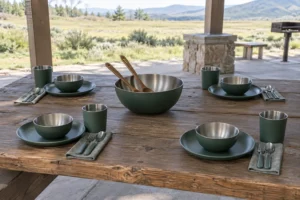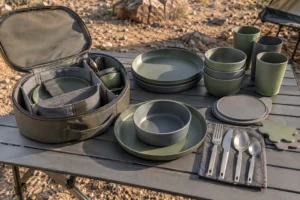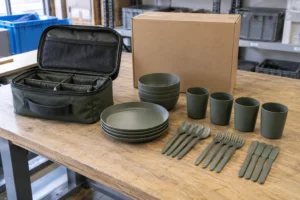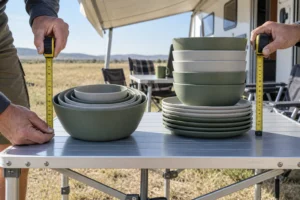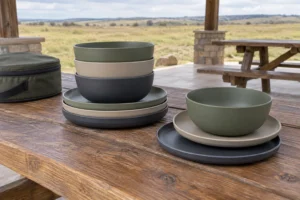
Direct answer: A family camping set should give every declared user a complete eating and drinking allocation, then add only the shared pieces needed by the meal plan. For four users, start with four plates, four bowls, four cups and the chosen personal utensils. Add serving, storage and packing pieces only after assigning each one a task, owner and counting rule.
A defensible family camping set piece count begins with people and meal actions, not a target number printed on a carton. Buyers need to distinguish items that every user needs from items that the group can safely share. That separation controls usability, pack volume, replacement stock, artwork, inspection and quotation comparison.
This guide produces a user-to-component allocation table for a four-person family program. It does not prescribe a Naike Dinner stock configuration or confirm that a pictured combination is available. The examples are buyer guidance that must be converted into a project BOM, sample plan and written specification.
Start with complete individual allocations
An individual allocation is the minimum repeatable group that lets one person complete the intended meal without waiting for another person’s item. A plate, bowl, cup and utensil choice may form that group, but the correct list depends on whether the menu includes soup, breakfast cereal, grilled food, snacks or beverages. User age, dexterity and cleaning practice can also change the decision.
Do not create a “four-person” claim from four cups alone. Every claimed user should have access to the required food vessels and eating tools at the same time. If the set expects alternating use, washing between courses or adults sharing with children, that operating condition belongs in the brief rather than being hidden in marketing copy.
The article on defining camping dinnerware set components explains how to classify objects by function. The comparison of 20-piece and 24-piece camping sets shows why a headline count cannot replace a line-level schedule. Use both records before requesting quotations.

Family camping set piece count: a practical allocation table
The following matrix uses four simultaneous users and three representative meal moments: breakfast, a shared main meal and a snack. It is a decision worksheet, not a product specification. Replace each example with the foods, user ages, channel promise and carry method for the actual program.
| Component role | Reference quantity | Allocation owner | Buyer decision | Approval evidence |
|---|---|---|---|---|
| Main plate | 4 | One per user | Required meal area, rim and grip direction | Representative meal trial and drawing |
| Bowl | 4 | One per user | Liquid-food need, depth and nesting relationship | Fill/use review and nested sample |
| Cup | 4 | One per user | Handle choice, beverage use and storage orientation | Handling review and packed-set check |
| Fork and spoon | 4 of each when both tasks are required | One pair per user | Menu need, age group and retention method | Meal-task simulation |
| Knife | 0 or 4 | One per user when justified | Whether target foods actually require cutting | Food/task record and safety review |
| Shared serving bowl | 0 or 1 | Group; named carrier or storage zone | Shared-food volume and serving workflow | Table-layout and pack-out review |
| Serving utensil | 0, 1 or a defined pair | Group | Food type and cross-use risk | Meal workflow and cleaning plan |
| Food container | Project-defined | Group or named user | Storage task, lid parts and evidence scope | Written use condition and sample |
| Carry case and retention | One system | Named carrier | Whether packing elements count commercially | Pack sequence, BOM and packed sample |
The quantity column deliberately uses conditional language for knives, serving pieces and storage items. A useful allocation is not necessarily the largest allocation. It is the smallest complete system that performs the declared meals without creating a shared bottleneck or an unused accessory.
Individual pieces answer simultaneous-use questions
Ask what all users may need at the same moment. Four people may drink while eating, so four cups normally belong in the individual group. Four bowls can be justified when soup or cereal is served simultaneously, while one bowl used only for shared salad belongs in the group allocation.
Utensils need the same logic. If every diner needs a fork and spoon, provide four of each rather than expecting rotation. If only one serving spoon touches the common bowl, one may be enough, provided the set defines where it is stored and how it is distinguished from eating spoons.
A child-oriented family program may use different shapes, but it still needs complete allocation logic. Do not infer child suitability from color, size or an image. Age-related use, supervision, material, geometry and destination requirements require project-specific evaluation and evidence.
Shared pieces need a named task and an owner
Shared pieces can add real value when the family eats from a common dish, portions food, stores leftovers or carries a central meal container. They become count inflation when their task is unclear or duplicates a function already handled by personal pieces. Require the supplier quotation to state why each shared item exists.
Ownership is operational, not legal. During use, somebody must carry, place, clean and repack the shared object. A large serving bowl that does not fit the case or a serving spoon with no retention point creates more friction than value, even if it looks impressive in a product photograph.
Mark critical shared pieces separately. Losing one shared serving spoon may affect all four users, while losing one personal spoon affects one setting. Replacement planning, spare quantities and rental inventory should reflect that difference instead of treating every component as equally interchangeable.
Use a meal-task method before choosing quantities
Map breakfast
Breakfast often reveals whether every user needs both a bowl and cup. Record whether the intended food is cereal, porridge, bread, fruit or a cooked dish, and whether hot beverages are part of the promise. The exercise identifies functions; it does not validate temperature or food-contact performance.
Map the main shared meal
List the vessels used to serve and eat the main meal. If food is portioned directly from cookware, keep cookware outside the dinnerware count and do not imply that a plate or bowl can contact a burner or flame. If a separate serving vessel is needed, document its volume direction, nesting position and cleaning sequence for the project.
Map snacks and leftovers
A snack may use only a plate or cup, while leftovers can introduce a container, lid and seal. Decide whether the container is part of the dining set, part of food storage, or an optional accessory. Count commercial pieces and controlled physical parts separately so lids and seals are not lost in inspection.
Map washing and reuse
Family sets are often reused across several meals before returning home. Define access to water, expected hand washing or machine washing, drying time and the need to isolate wet items. Never state dishwasher suitability across a mixed set unless every relevant component has product-specific support.

Compare allocation patterns, not marketing totals
| Pattern | Individual allocation | Shared allocation | Best-fit situation | Main risk |
|---|---|---|---|---|
| Lean place-setting program | Plate, bowl, cup, fork and spoon per user | None in headline set | Simple retail bundle with external cooking/serving gear | Missing serving function may be discovered late |
| Full personal setting | Plate, bowl, cup, fork, spoon and knife per user | None | Menus requiring personal cutting tools | Knives add count without value when meals do not need them |
| Family service program | Complete lean setting per user | Serving bowl, utensil and selected storage | Car camping and communal meals | Shared objects enlarge the case and create single-point loss |
| Hybrid child/adult program | Different declared shapes by user group | Defined family service pieces | Family channel with age-specific requirements | Complexity in evidence, artwork and replacements |
The lean pattern can be excellent when the channel promises only eating and drinking pieces. The family service pattern can be better when communal meals are central. Neither should be presented as universally superior, and neither count proves quality, safety or compatibility.
Pack volume can reverse an attractive allocation
Shared objects are often larger than individual objects, so one added bowl may change the case more than four slim utensils. Evaluate the complete nested envelope after selecting the allocation. Packed dimensions, clearances, dividers and retention must be confirmed by project sample and drawing.
Do not assume identical nominal shapes will nest. Rim angle, foot ring, handle projection, lid flange and surface contact can prevent stable stacking. A component matrix becomes procurement-ready only when it includes the intended nesting order and a reference to the approved packed sample.
Carry balance also matters. A shared bowl or food container placed on one side can shift the load and press against other pieces. The buyer should review upright carry, flat storage and repacking after use without claiming a formal impact or rattle result unless a defined test supports it.
Evidence follows every food-contact component
Piece allocation and regulatory evidence solve different questions. In the European Union, Regulation (EC) No 1935/2004 establishes the general framework for materials intended to contact food. For plastics, Commission Regulation (EU) No 10/2011 contains material-specific rules and testing concepts.
For United States projects, the FDA explains the framework for food-contact substances. These sources do not approve a family piece count or prove that a generic material name is compliant. Buyers must match declarations, tests and intended-use conditions to the final material, color, decoration and component configuration.
When shared and personal pieces use different materials, build an evidence line for each material/component group. A carry case is not evaluated like a food-contact bowl, and a textile sleeve does not make the dinnerware suitable for heat. Keep dinnerware, food storage, packing components and cookware clearly separated.
Commercial risks created by a weak allocation
Partial user claims
A set advertised for four people can disappoint when one function is supplied in only two units. Avoid ambiguous phrases such as “serves four” unless the component schedule supports simultaneous use for the declared meal. Product imagery, instructions and the BOM should describe the same capacity.
Shared-piece bottlenecks
One shared object may delay serving, washing or packing. Test the sequence with representative users and food tasks. Record whether the bottleneck is acceptable or whether the allocation needs another serving utensil, container or drying position.
Count inflation
Lids, straps and pouches may be legitimate controlled parts, but they should not disguise an incomplete place setting. State the commercial piece total, physical-part total and user allocation separately. This makes retail comparisons and inspection plans more transparent.
Uncontrolled variants
A supplier substitution can change nesting, color coordination, evidence scope or replacement fit. Freeze the approved component codes, drawings and revision level before artwork or packaging approval. If compatibility is not verified, use the explicit statement: Compatibility to be confirmed by project sample and drawing.
Normalize quotations with an allocation schedule
Send every bidder the same matrix. Require one line per component family, quantity per set, material description, color/decoration status, packaging role and evidence reference. Ask bidders to identify assumptions instead of filling unknown fields with invented values.
Compare costs only after quantities and boundaries align. A quotation that includes a shared container, insert and carry case is not comparable with one that lists only personal tableware. Likewise, a lower price may reflect fewer controlled parts or different evidence responsibilities rather than better value.
Request a sample configuration before approving retail claims. Lay out all individual settings, then the shared group, and photograph the approved arrangement for internal control. The photograph supports recognition, while the signed BOM and drawings remain the controlling records.
Run three allocation reviews before approval
Review one: functional completeness
Give the draft matrix to somebody who did not create it and ask that reviewer to complete each planned meal on paper. The reviewer should assign a vessel and utensil to every person and identify who handles each shared item. Any meal step without an assigned component is a specification gap; any object without a meal step is a candidate for removal or optional status.
This desk review is inexpensive and should happen before detailed drawings. It often reveals that a large shared vessel duplicates a lunch box, that knives are unnecessary for the menu, or that one serving tool cannot perform two simultaneous tasks. Record the decision, including why an apparently useful accessory was excluded.
Review two: physical table and pack sequence
Use representative samples to arrange four complete personal settings and the shared group on the smallest realistic campsite table. Observe reach, crowding, cup stability and whether shared pieces can be passed without disturbing other items. Then repack every dry component in the intended order and record which item establishes the case height, width and closure clearance.
The exercise is a design review, not proof of durability, compliance or production readiness. Representative pieces may differ from the final geometry. Convert every observation into a requirement for the project sample: nesting order, retention zone, orientation, clearance or a question that the drawing must answer.
Review three: cleaning and missing-piece recovery
Model a meal in which one bowl remains wet, one personal utensil is missing and the shared serving spoon needs cleaning. Decide whether wet storage is allowed, whether a separate compartment is needed and whether a spare can restore the set. The exercise helps rental, tour and family brands plan practical replacement stock instead of supplying random extras.
A recovery plan should name exact component codes. “One spare spoon” is not enough when eating and serving spoons use different shapes or materials. Link the replacement matrix to the same revision-controlled BOM used for the original set so a later purchase does not introduce a part that fails to nest or match.
Translate the allocation into packaging and artwork
Front-of-pack imagery should show the exact shipped individual and shared quantities. If four bowls and one larger serving bowl are included, the image and component list should make the size and role difference understandable without implying unverified capacity. Avoid decorative food or props that conceal omitted pieces or resemble included accessories.
The instruction sheet should explain the intended nested order, ownership of shared items and any separation between dinnerware, storage and cookware. It should not turn buyer guidance into unsupported product claims. Temperature, dishwasher, microwave, stain, odor, breakage or direct-flame statements require evidence matched to the final component.
Color coding can support inventory and family allocation, but it creates additional control questions. Decide whether every user receives one color, whether shared pieces use a neutral color, and how color is identified on drawings and approval samples. A color name alone is not an acceptance limit; use an agreed project method and retain an approved reference.
Use the matrix during inspection and replenishment
Incoming inspection should count physical components by code and reconcile them to the commercial set total. Inspectors need to know whether a utensil bundle contains two or three separate objects, whether a container lid is a controlled part and which insert belongs to the case. This prevents a carton from passing because the headline count is correct while a critical shared part is missing.
For replenishment, track individual and shared loss separately. Frequently lost personal utensils may justify a service pack, while a unique shared container may need a different spare policy. The decision belongs in the commercial plan before launch because a replacement that cannot be ordered can shorten the useful life of the complete program.
When a component changes, repeat the allocation, pack and evidence review. A new bowl can alter user function, nesting height, case pressure and material documentation at the same time. Revision approval should state what changed, what was rechecked and which earlier records remain valid.

B2B Buyer Checklist
| Check | Question | Why It Matters |
|---|---|---|
| Declared users | How many people must eat and drink simultaneously? | Prevents a partial setting from being marketed as full capacity. |
| Meal tasks | Which foods require plates, bowls, cups, cutting, scooping or serving? | Connects every object to a real use. |
| Individual allocation | Does every user receive the complete required group? | Avoids waiting and hidden omissions. |
| Shared allocation | Who carries, uses, cleans and repacks each shared piece? | Exposes bottlenecks and single-point loss. |
| Counting rule | Are lids, bags, sleeves and utensil bundles counted consistently? | Makes competing totals comparable. |
| Pack-out | Does the final allocation fit the approved case orientation? | Controls volume, retention and component contact. |
| Evidence scope | Are records matched to every final food-contact material and use? | A generic material statement does not cover a finished set. |
| Revision control | Are component codes, drawings and sample status frozen? | Prevents substitutions after approval. |
| Replacement plan | Which personal and shared pieces need spares? | Shared-piece loss may disable the group workflow. |
Sequential buyer FAQs
1. Is there a universal number of pieces for a four-person family set?
No. The count follows the declared meals, user group, serving method and packing system. A complete five-object personal allocation produces 20 individual pieces; adding knives or justified shared pieces changes the total without changing user capacity.
2. Should every family member receive a knife?
Only when the expected foods and user group justify it. Do not add four knives merely to reach a larger retail number. Record the cutting task and review age-related use before fixing the utensil schedule.
3. Can one serving bowl count as one piece?
It can be one commercial piece if the counting rule says so, but bases, lids, seals or inserts may be separate controlled parts. Keep both totals in the BOM and inspection plan.
4. Are carry cases part of the dinnerware count?
That is a merchandising choice that must be disclosed consistently. Procurement should maintain a separate packing BOM even when the case contributes to the advertised count.
5. How should mixed adult and child settings be counted?
List each user allocation separately and avoid implying suitability from appearance alone. Confirm geometry, materials, supervision statements and destination evidence for the actual project.
6. What if a shared item does not fit the final case?
Revise the allocation or case architecture before approval. Do not assume dimensions or compatibility; confirm the complete nested program through sample and drawing.
7. Does a higher piece count require more evidence?
It may expand the evidence file when additional materials, colors, decorations or food-contact uses are introduced. Count alone is not decisive; the final component/material/use matrix is.
8. What should be sent for a documented quotation?
Send user count, meal tasks, individual and shared matrix, material direction, color and artwork brief, intended markets, pack target, evidence request and sample approval sequence. Mark every unknown as “To be confirmed for the project.”
Approve the allocation before requesting a final set
Build one controlled table showing each user, each shared task and every packing component. Then reconcile it with the physical sample, nested order, destination evidence and replacement plan. This produces a quotable family program instead of an arbitrary collection of pieces.
For a specification review or written quotation, send Naike Dinner your allocation matrix and intended-use brief. Include the meals, user ages, markets, material direction, color/Logo expectations, case concept and evidence questions. If the matrix is not ready, request a component-allocation review before artwork or tooling decisions.