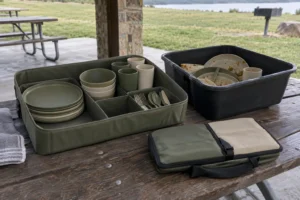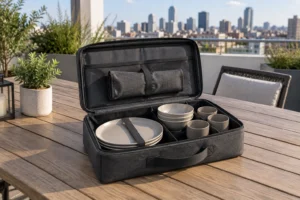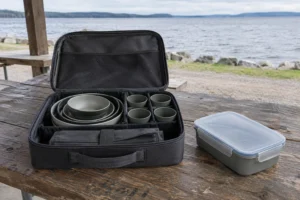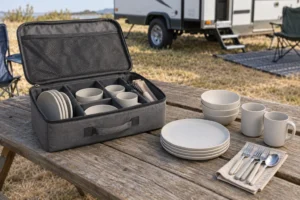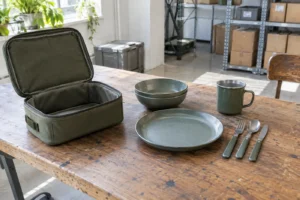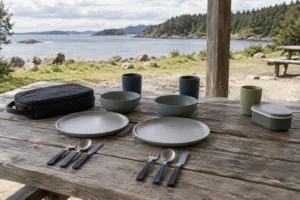
A lunch box camping dinnerware set should use a shared case only when the finished container, lid, utensils and eating pieces can be loaded, removed, cleaned and transported without a conflict. Choose a separate module when food storage needs independent temperature control, frequent access, isolation from used dishes or a different sales channel. Decide from a component drawing and physical sample, not the appeal of a single-bag photograph.
This guide produces a shared-case versus separate-container matrix that a buyer can copy into a product brief. The images illustrate candidate arrangements; none proves that a pictured container fits a pictured bag, meets a food-contact rule, keeps food cold or represents a Naike Dinner production SKU. The first decision is what the lunch box is supposed to do, not which photograph makes a neater retail listing.
Define the lunch box camping dinnerware set boundary
In this discussion, dinnerware means the plates, bowls, cups and eating utensils used to serve and eat a meal. The lunch box is a separate food-storage article with its own lid, potential seal, cleaning route and intended food conditions; it is not cookware. A carry case organizes and transports the components, but its fabric, foam or zipper cannot be assumed to be a thermal cooler or a food-contact surface.
Write a revision-linked component list before choosing the carrier. Record the lunch container body and lid separately, whether a divider is fixed or removable, the number and profile of eating pieces, the cutlery holder, the case opening, optional retail sleeve and any cooling accessory. The modular-set interface guide distinguishes a core dining module from add-ons; this matrix answers the narrower question of whether one food-storage add-on belongs inside the dining case.
The practical starting point is a use-condition statement. Is the container intended to carry dry snacks, a packed ready-to-eat meal or perishable food needing temperature control? FDA outdoor food-handling guidance advises cold perishable food be kept at 40°F or below in a cooler with cold sources, and separates food and beverage cooler access as a practical handling consideration. A plain dinnerware bag in an image is not such a cooler; describe the real food workflow before making any storage claim.
Shared case or separate module: a buyer comparison matrix
Use the following rows as questions, not as scored test results. Enter the actual candidate’s drawing revision and sample observations in a working copy; a blank result means hold the decision. An attractive shared bag can reduce visible package count but increase cleaning, fit and exception complexity, whereas a separate container can add one more handling step while keeping the food-storage route independent.
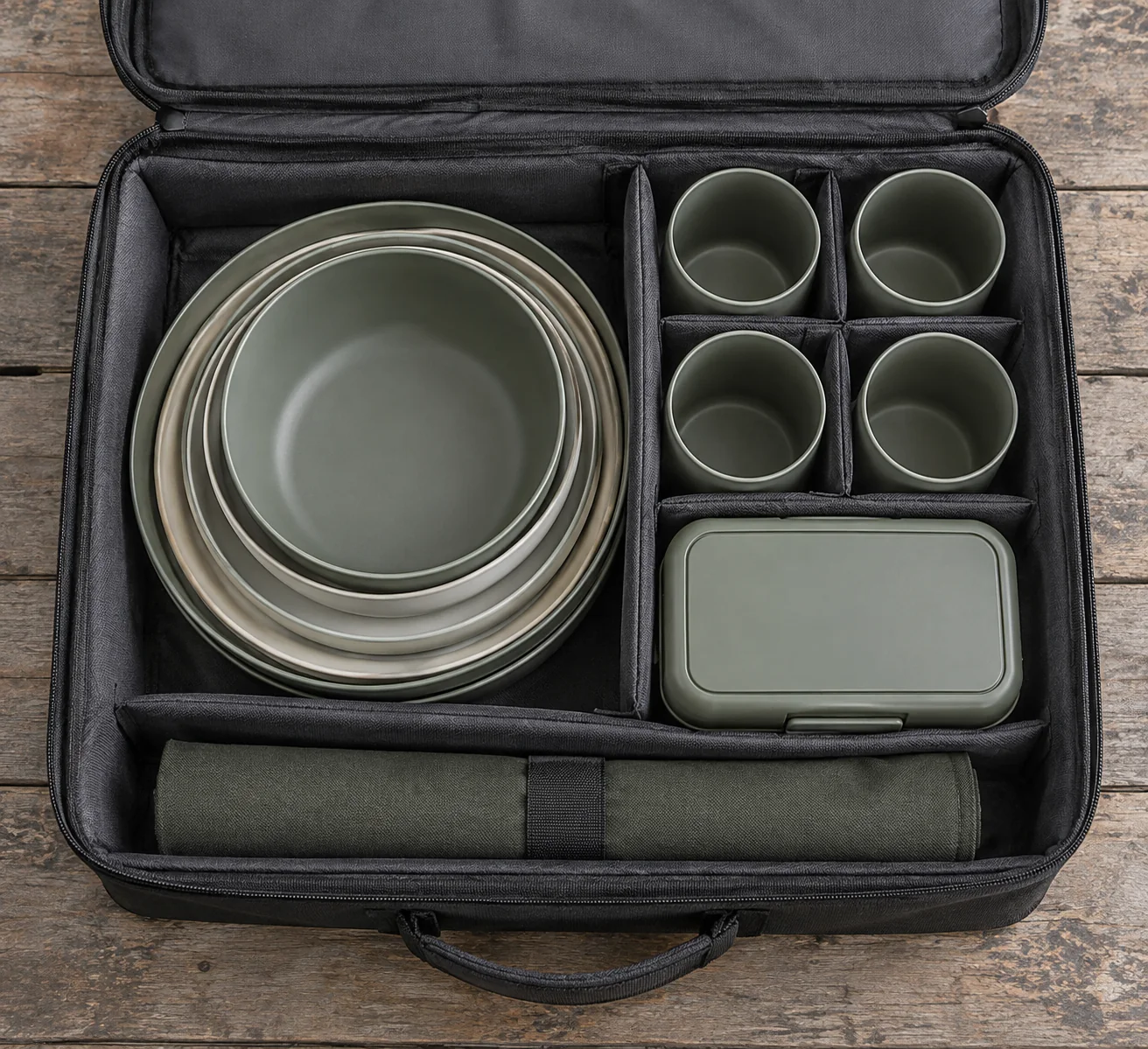
| Decision criterion | Shared dinnerware case: approve only if | Separate food-container module: prefer when | Buyer record |
|---|---|---|---|
| Purpose and food condition | Food is carried under a separately defined safe handling plan; the fabric case is not described as refrigeration. | A cooler, cold pack, independent access or another controlled food route is required. | Food/use statement and permitted claim for each article. |
| Physical envelope | Closed container, lid clips and handle clear every divider and zipper through loading and removal. | Case dimensions or removal path cannot be approved without forcing components. | Revision-matched drawings and loaded sample photographs. |
| Contact and protection | Container and eating surfaces do not damage one another in the nominated pack-out; barriers can be cleaned or replaced. | A lid edge, utensil point, plate rim or wet surface creates unresolved contact risk. | Contact map and before/after inspection. |
| Clean versus used return | The case has a documented route for a used container and used dishes without contaminating clean pieces. | Container frequently returns with food residue or needs separate washing and drying. | Outward and return-flow diagram. |
| Access at the table | The user can remove the lunch box without unloading the entire dinnerware stack or destabilizing the case. | Food is accessed repeatedly or at a different time/place from the dining pieces. | Observed access sequence with actual samples. |
| Assortment and replacement | The lunch box is a stable included component across the intended set variants. | Some channels omit it, quote it separately or replace its lid/body independently. | Core/add-on matrix and part identifiers. |
| Retail and parcel pack | One combined unit has a validated outer pack and a truthful included-parts statement. | Different routes or a separate saleable module need distinct packaging and labels. | Channel-specific pack drawings and distribution plan. |
A mixed result is common. If a case passes the geometric review but the food-storage route remains unresolved, do not call the whole package approved: keep the lunch box as an optional, separately assessed module. If a separate module is preferred for a cold-food channel but not for a dry-food gift set, create two controlled variants instead of implying that one illustration validates both.
Run a physical comparison before approving one bag
Ask the team to prepare a sample of the final component revisions and the proposed carrier. Use the component-to-case drawing checklist to capture actual opening width, part orientation, lid-clip clearance, lift-out direction and loaded closing path. A nominal external dimension is not enough: a soft wall, zipper curve or case divider can reduce usable clearance.
First photograph the empty case and closed lunch container side by side. Next load the dining components and one container according to a written sequence; note every part that must be moved to retrieve the box. Close the case without forcing the zipper, reopen it, then inspect the container lid, plate rims, cup edges, divider seams and cutlery protection. Repeat with the proposed outer retail or shipment pack if the channel uses one.
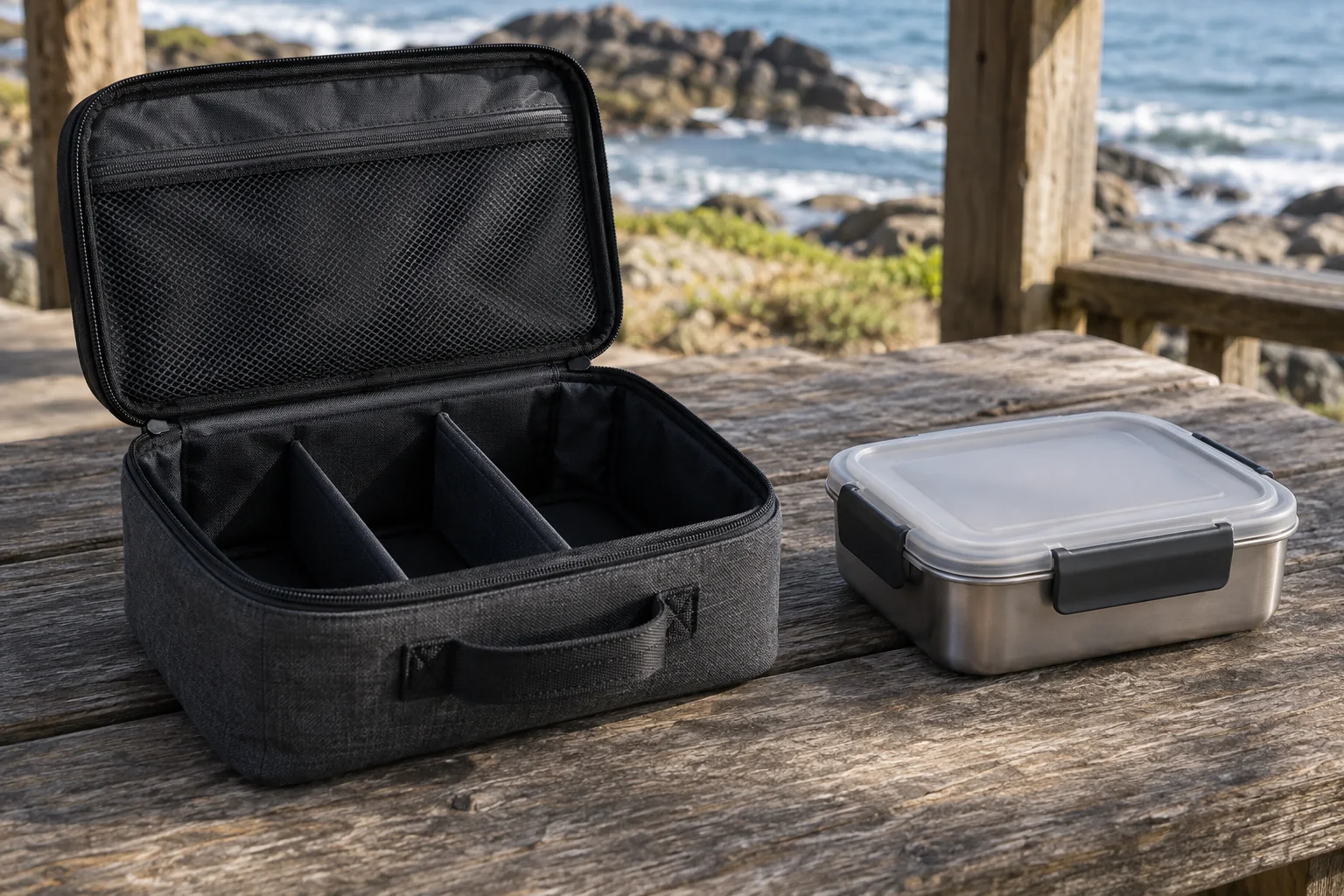
Document three outcomes separately: geometry, use workflow and evidence. “The box can be placed inside” is a geometry observation, not proof that a lid stays closed, that used components can return hygienically, or that a perishable meal is temperature-controlled. A practical approval record should say pass, hold or revise for each criterion and identify the sample, drawing and reviewer; never copy a pass result from this illustration.
For a retail or e-commerce shipment, validate the actual packaged-product combination and route rather than treating a carry case as protective transit packaging. ISTA’s test-procedure overview</a distinguishes screening, partial simulation and general simulation methods with differing distribution scopes. It does not prescribe one test for every camping kit or imply that this candidate has passed one.
When a separate food-container route is better
A distinct container module is useful when the lunch box is optional, when it is sold as a replacement, or when it must go into a cooler while clean tableware stays dry elsewhere. FSANZ camping food-safety guidance treats temperature control, water, handwashing and contamination protection as separate planning concerns in camps. It does not validate any specific dinnerware carrier, but it shows why a visual “all-in-one” claim cannot substitute for a real food-handling plan.
The separate route also helps a program with changing meal formats. A family car-camping set may include a lidded box for packed lunches, while a campground catering kit might use washable service pieces and separately controlled food transport. In both cases the same dining base can remain stable, provided the case, SKU, artwork and customer instruction do not silently imply that the optional box is always inside.
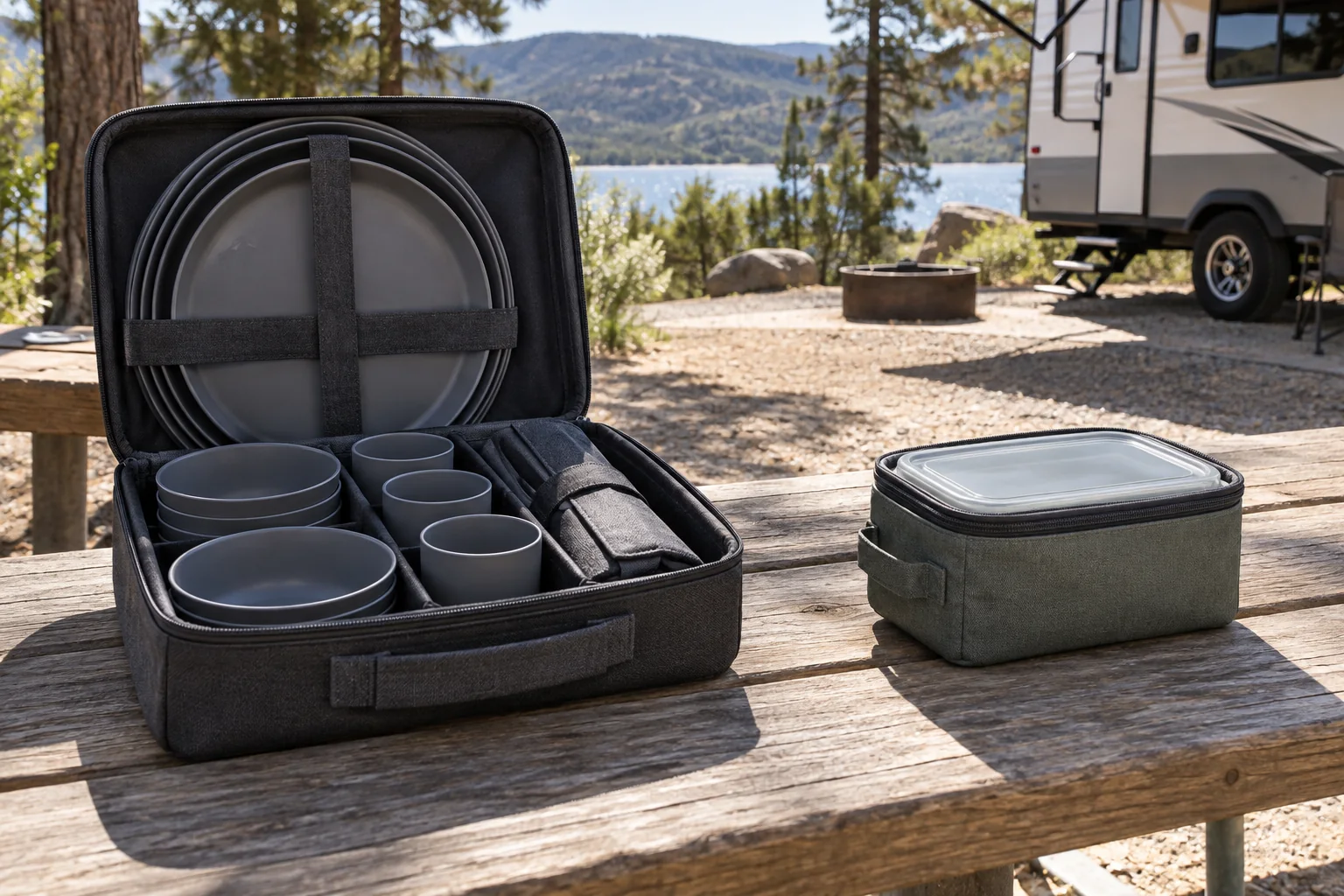
Separation is not free of work. Specify how both modules are counted, how the two parts are paired at dispatch, what the buyer receives in a sample, and where the included-parts statement appears. The numbered pack-out instruction offers a repeatable release framework; its steps must be adapted to whichever shared or separate configuration this decision approves.
Limits: food contact, cooling, leakage and claims
The container’s food-contact materials and intended use must be assessed as finished articles, including the lid, seal, divider, colorant and decoration where applicable. The European Commission’s food-contact legislation overview frames EU obligations, while the FDA’s food types and conditions-of-use guidance helps scope US documentation. Neither page is a certificate for a pictured container or evidence that any particular material and finish has been approved.
Do not translate “lidded” into “leakproof,” “insulated,” “microwave-safe” or “dishwasher-safe” without product-specific verification. A food box may be closed but not liquid-tight; a padded dinnerware case may protect against incidental scuffs but not prevent food spoilage. Temperature control concerns apply to actual food and handling, not to empty product samples photographed on an outdoor table.
Clean and used return is a second boundary. A case that is attractive during outbound packing may be difficult to wipe and dry after a food container leaks or dishes are returned damp. Ask how a user isolates a wet lid and how removable liners or barriers are cleaned, replaced and dried. If the workflow cannot be specified plainly, a separate washable or cooler-compatible food route is usually the safer design hypothesis for further sample work, not a performance claim.
Turn the comparison into a quotable development brief
For the shared-case variant, send a controlled component matrix, closed lunch-container drawing, bag opening and divider drawings, desired loading order and target retail or shipment route. Request a written reply that distinguishes verified existing parts from new-development candidates and identifies which fit, lid, cleaning and packaging questions need samples. Ask for a side-by-side sample review before approving the combined case dimensions or imagery.
For the separate variant, specify whether the food box is a base component, optional add-on or separately orderable article. Give the two module identifiers, pairing rule, packaging and artwork needs, and expected user handling instructions. The core-versus-option assortment worksheet can then keep the dining base stable while the container inclusion changes by channel.
| Check | Question | Why It Matters |
|---|---|---|
| Use condition | What food, temperature, contact time and cleaning route is actually intended? | Separates container evidence and food handling from a visual bundle claim. |
| Component revision | Are the box, lid, divider, case and eating pieces identified by the same sample record? | Prevents an obsolete fit approval from being applied to a new shape. |
| Access | Can the user take the box out without emptying dinnerware? | Exposes an inconvenient shared-case architecture early. |
| Return hygiene | Where do used dishes and a damp food box go after the meal? | Tests whether the outbound layout remains practical on return. |
| Packaging | Does the real retail/parcel unit protect and count both modules? | A carry bag alone is not a verified transit package. |
| Commercial scope | Is the lunch box included, optional or separately replaceable? | Keeps the BOM, quotation, artwork and listing aligned. |
Buyer FAQs
1. Does a lunch box always belong inside a camping dinnerware case?
No. Put it inside only if a real sample confirms a usable opening, protected contact surfaces and a workable food-use and return route. A separate module may be better when the box is optional or requires independent temperature control.
2. Can the carry case be described as a cooler?
Not from its appearance or padding. Insulation and temperature performance would require a product-specific design and evidence. Perishable food needs a suitable cold-storage plan regardless of whether empty dinnerware travels in the same marketing bundle.
3. Does a closed lid prove the lunch box will not leak onto plates?
No. Identify the closure design, intended contents and actual test conditions before making a leak-resistant claim. For a shared case, also inspect where any accidental liquid would travel and how the liner is cleaned.
4. Can an optional food box still appear in the product photographs?
Yes, if the caption and included-parts statement say clearly that it is an optional concept rather than a standard supplied item. A buyer should approve variant-specific images and artwork so a retail customer is not promised an omitted component.
5. Which measurement determines whether a box fits?
There is no single decisive number. Compare the closed box’s full envelope including clips and handle to the case’s actual usable opening, loading angle, dividers and closure path, then inspect the loaded sample without forcing it.
6. What should the buyer request first?
Send the intended food/use conditions, component drawings and counts, case opening and channel. Request a shared-case and separate-module sample review with a documented hold/revise/release decision rather than an unqualified promise of fit.
Request a shared-versus-separate sample review
Send your existing lunch-box and dinnerware drawings, case envelope, proposed component matrix, target markets and intended food-handling route through the Naike Dinner inquiry page. Ask which parts and processes are verified, which require development, and what sample evidence is needed before either architecture can be quoted accurately. Do not infer availability, tooling capability, MOQ, price or lead time from the illustrations.
For a direct comparison, request two written configuration responses against the same buyer brief: one shared case, one separate food-container module. The resulting decision record should identify the approved variant, component revisions, evidence gaps and next sample owner.