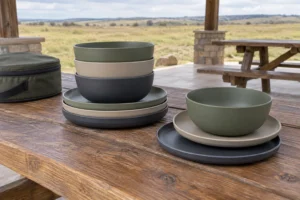
Direct answer: A 20-piece camping dinnerware set normally suits a tightly defined four-person place-setting program, while a 24-piece set adds either a missing utensil per user or four shared and packing components. The better choice depends on the declared counting rule, meal plan, channel and pack target—not the larger number printed on the package.
The phrase 20-piece vs 24-piece camping dinnerware set sounds precise, but the number alone does not identify what a buyer receives. One supplier may count every fork, spoon and knife separately; another may count a three-piece cutlery bundle as one unit; a third may include lids, a carry bag or organizer in the headline count. Procurement teams therefore need a controlled component schedule before they can compare price, packed volume, user capacity or evidence.
This guide produces a practical piece-count comparison for a four-user program. It explains two defensible 20-piece and 24-piece architectures, shows how to normalize competing quotations, and identifies the checks that prevent a higher count from becoming unnecessary cost or a lower count from creating a poor meal experience.
Define “one piece” before comparing the two sets
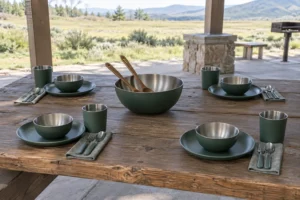
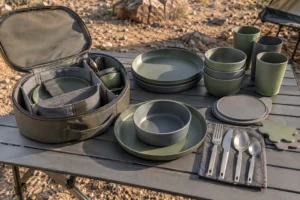
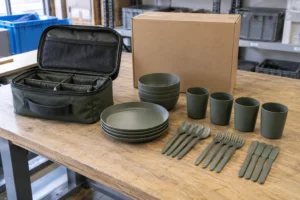
A commercial piece count is a merchandising statement, not automatically a bill of materials. If each plate, bowl, cup, fork and spoon counts as one piece, four identical place settings produce 20 pieces. Adding one knife for each user produces 24 pieces, but that is only one possible interpretation.
An alternative 24-piece architecture keeps the 20 individual pieces and adds four functional shared items: for example, a serving bowl, serving spoon, divided food box and organizer. A third seller may count four lids as the extra four pieces. These offers have the same headline count but solve different tasks, so a quotation comparison without a counting convention is unreliable.
Write the convention at the top of the RFQ. State whether lids, bags, sleeves, straps and removable inserts count; whether a utensil bundle is one sales unit or three physical parts; and whether replacement pieces are included. Also require a line-level quantity for every physical object, because quality teams inspect objects rather than marketing totals.
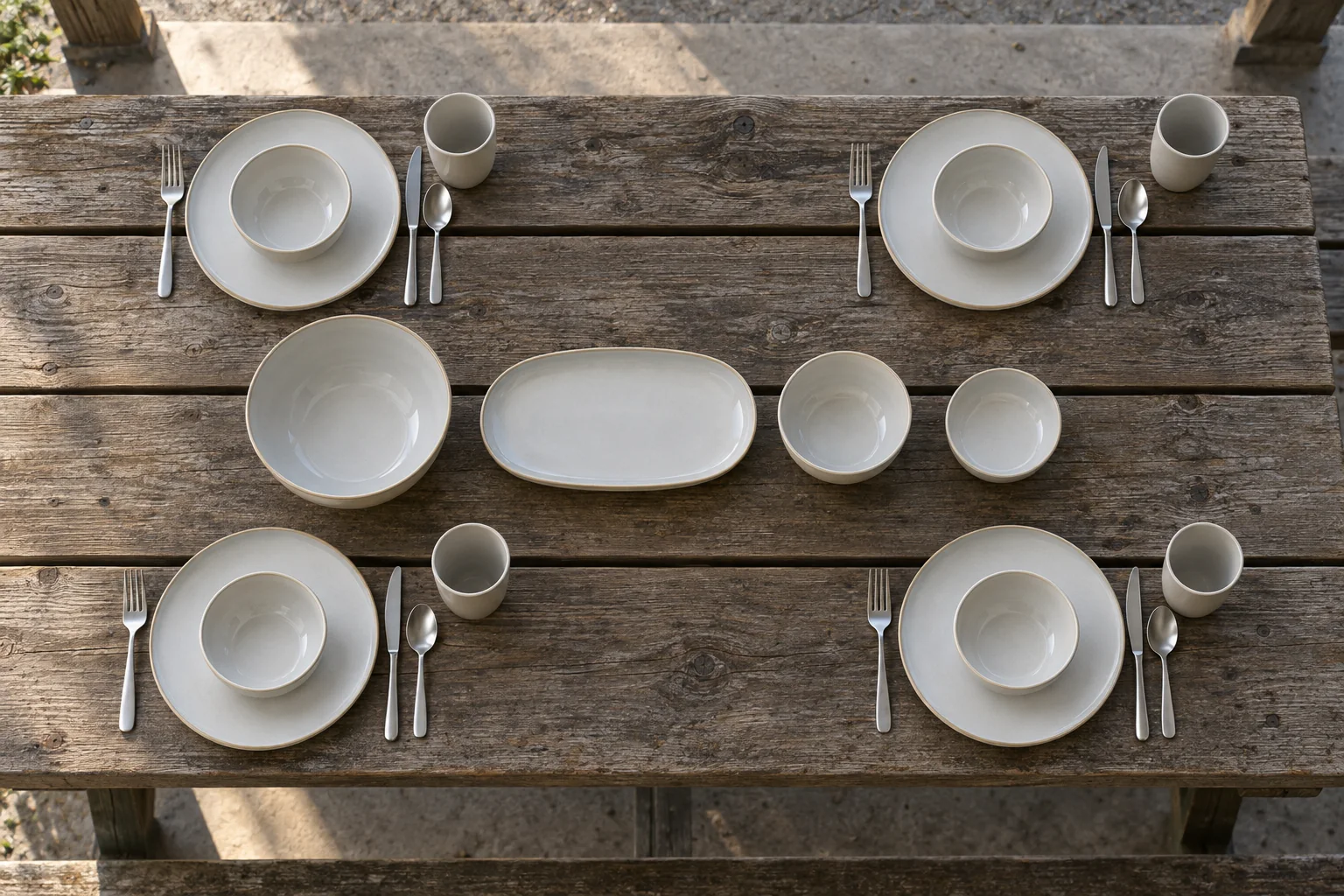
A buyer-ready 20-piece vs 24-piece camping dinnerware set comparison
The matrix below uses four users and a two-course meal as the working scenario. It is not a universal Naike Dinner specification and it does not prove product availability. Buyers should replace the example choices with their intended foods, age group, cleaning method, sales channel and packing limits.
| Decision | 20-piece baseline | 24-piece option A | 24-piece option B |
|---|---|---|---|
| Individual components | 4 plates + 4 bowls + 4 cups + 4 forks + 4 spoons | Baseline plus 4 individual knives | Same 20-piece baseline |
| Shared components | None included in headline count | None included in headline count | 4 defined shared/storage items |
| Best fit | Simple foods that do not need a separate knife or serving kit | Meals where every user needs a knife | Family or car-camping meals with shared service and storage tasks |
| Primary risk | Users may need an omitted tool or shared vessel | Four knives add count even if meal testing shows little use | Shared items may be vague, oversized or counted inconsistently |
| Approval evidence | Meal simulation and signed component schedule | Food/task review plus utensil handling check | Shared-meal workflow and packed-set trial |
| Quotation instruction | Price each of the five component families separately | Show incremental knife and retention cost separately | Identify every shared item, lid and storage interface separately |
Option A is easy to explain at retail because every person receives six objects. Option B can create more operational value, but the front-of-pack description must make the shared items clear. If a lid is counted separately, buyers should also request the base-and-lid relationship in the engineering BOM so a missing lid does not leave an unusable container.
For a procurement comparison, add two totals: “commercial pieces” and “physical controlled parts.” A lunch box with a base, lid, seal and closure may be one commercial piece yet contain several inspection-relevant parts. Separating the totals prevents disagreements during incoming inspection, replacement planning and claims review.
Do not assume that 24 pieces means more user capacity
Four additional objects do not necessarily serve another person. A fifth complete place setting would require the same functional group as the other users, and a partial fifth setting can create a misleading capacity claim. The user count should be derived from complete individual allocations, not from dividing the headline number by an arbitrary figure.
A 24-piece set may still be strictly four-person. Four knives, four lids or four nesting separators increase the count without increasing place-setting capacity. Conversely, a 20-piece set can support four users well when the intended menu is soup, cereal, pasta, salad or other food that needs only the declared utensils.
Use the published guide on defining camping dinnerware set components to assign each object to an individual, shared, storage or packing role. Then compare the result with the broader mess kit versus dinnerware set decision, because a compact personal mess kit and a group dining set use piece counts for different purposes.
Calculate the count from meals and users
Step 1: list the actual meal tasks
Record what the target user must do: hold a main dish, contain liquid food, drink, cut, scoop, spear, serve or store leftovers. Do not begin with shapes. A bowl and plate may both hold food, but their rim height, base stability and packing behavior can make them unsuitable substitutes for the same menu.
Test at least the highest-risk meal in the intended program. If the set is sold for family car camping, review a shared meal with sauce, a breakfast and a snack rather than photographing an empty place setting. The objective is not to certify performance from an informal trial; it is to identify which functions need formal specification and evidence.
Step 2: multiply individual needs by verified user count
Each person should receive a complete functional allocation. If four users each require a plate, bowl, cup, fork and spoon, the individual subtotal is 20. When knives are necessary, the subtotal becomes 24 before adding any shared, storage or packing items.
Children’s programs, rental fleets and guided groups can require different allocations. A children’s set might omit a knife but need a divided plate or handled cup; a rental operator may prefer identical pieces that are easy to count; a premium retail set may include shared serving items. The quantity must follow the operating scenario rather than a fixed merchandising convention.
Step 3: add shared items only when they have an owner and task
A shared serving bowl can be useful for four people, but it should not be added merely to reach 24. Identify who carries it, what food it serves, whether it nests, how it is cleaned, and where it sits in the case. The same rule applies to serving utensils, lunch boxes, condiment containers and organizers.
Shared items also affect replacement logic. When four users depend on one serving spoon or one food container, losing that item changes the whole program. The quotation and after-sales plan should therefore distinguish critical shared components from optional accessories.
Step 4: audit the carry and packaging system separately
The bag is important but should not hide a weak tableware allocation. A case, divider or utensil sleeve may count commercially if the description says so, yet the buyer should retain a separate packaging BOM. This makes it possible to compare a 20-piece tableware set plus one case with a “21-piece set” that counts the case.
Packed dimensions, component orientation and retention points must be confirmed by project sample and drawing. A four-piece increase may force a deeper case, different insert or larger retail carton. That change can matter more commercially than the nominal cost of the extra objects.
How the two counts behave in real scenarios
Compact four-person retail set
A 20-piece baseline works when the retail promise is a simple four-person eating and drinking set and the expected foods do not require knives. It gives the buyer five repeatable component families, supports straightforward color coordination and can reduce the number of unique replacement SKUs. The buyer still needs to specify the carry solution and any shared service separately.
This architecture is less suitable when the channel expects a visibly “complete” Western place setting. Retail content must not imply that a knife is present if it is absent, and imagery should match the shipped configuration. A product comparison based only on a lifestyle photograph can obscure that gap.
Four-person full place-setting set
A 24-piece individual architecture is logical when knife use is part of the tested meal plan. It creates four equal six-piece place settings and makes user allocation easy to communicate. Procurement should still check utensil length, handle comfort, edge purpose, retention and destination-specific expectations.
Adding knives solely to raise the count is not a purchasing benefit. The team should observe whether the target foods need them and whether intended users can handle them appropriately. Product-specific suitability, material and use conditions require written evidence; an image cannot establish safety or compliance.
Family car-camping set with shared pieces
For family meals, a 20-piece individual baseline plus four shared items can be more useful than four knives. The extra pieces might support serving, leftovers and organization, but the exact selection should come from the buyer’s meal workflow. A shared item that cannot nest or that duplicates an existing container can increase pack volume without improving use.

Rental, event and guided-tour programs
Operational buyers may prefer the 20-piece architecture because five component families are faster to count and replenish. Alternatively, a 24-piece configuration can include four color-coded or retention-related parts that improve accountability. The operator should record inventory time, loss frequency and cleaning workflow before approving the increment.
Do not count a replacement part as part of the guest-facing service unless the commercial description makes that distinction. Spare pieces belong in the replenishment plan. Mixing service count and spare inventory creates confusion when staff inspect a returned kit.
Material and compliance evidence applies to every included item
A higher piece count expands the evidence scope. Buyers must connect the final component list to the materials, colors, decorations and food-contact conditions used in the actual set. The European Union’s Framework Regulation (EC) No 1935/2004 establishes general requirements for materials intended to contact food, while the scope of a specific supporting document must still match the final article and intended use.
For plastics in EU programs, Regulation (EU) No 10/2011 provides the relevant Union measure for plastic materials and articles. In the United States, buyers can use the FDA’s primary overview of packaging and food-contact substances to understand the regulatory pathway, then request product-specific supporting records rather than treating a generic material name as proof.
Evidence must be mapped item by item. A plate, cup, utensil, lunch-box base, lid, seal and printed decoration may not share the same formulation or contact conditions. A declaration or report covering one sample does not automatically cover four additional components simply because they are packed together.
Neither the 20-piece nor 24-piece label proves dishwasher resistance, microwave suitability, heat limits, stain resistance, leak resistance or direct-flame use. These are separate claims requiring defined use conditions and appropriate product-specific substantiation. Dinnerware should not be described as cookware or placed on a burner unless verified evidence expressly supports that use.
Commercial risks hidden by the bigger number
Uncontrolled substitutions
A supplier may quote 24 pieces and later substitute a different cup, utensil or lid to meet packing or cost pressure. Prevent this by assigning each component a controlled identifier, approved drawing or sample reference, color target, material declaration and substitution rule. “Similar item accepted” is not adequate when nesting, evidence or artwork depends on the exact form.
Pack-volume expansion
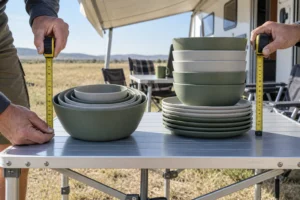
Four slim knives may fit beside existing utensils, whereas four shared vessels can alter the stack height and case footprint. Request both component-level dimensions and the verified packed arrangement after the combination is fixed. Do not add nominal component volumes as if they stack perfectly; nesting clearance, walls, lids and retention materials occupy real space.
Misleading value comparison
A lower unit price for 24 pieces can still represent poorer value if several additions are low-utility fillers. Normalize quotations to the approved functional matrix and calculate the difference by component family. That reveals whether the premium buys a necessary tool, meaningful shared service or only a marketing count.
Artwork and instruction mismatch
Cartons, inserts, online listings and instructions must show the final component schedule. If artwork is frozen before sample approval, changing from 20 to 24 pieces can leave inaccurate diagrams or missing use limitations. Require an artwork reconciliation step against the golden sample and final BOM.
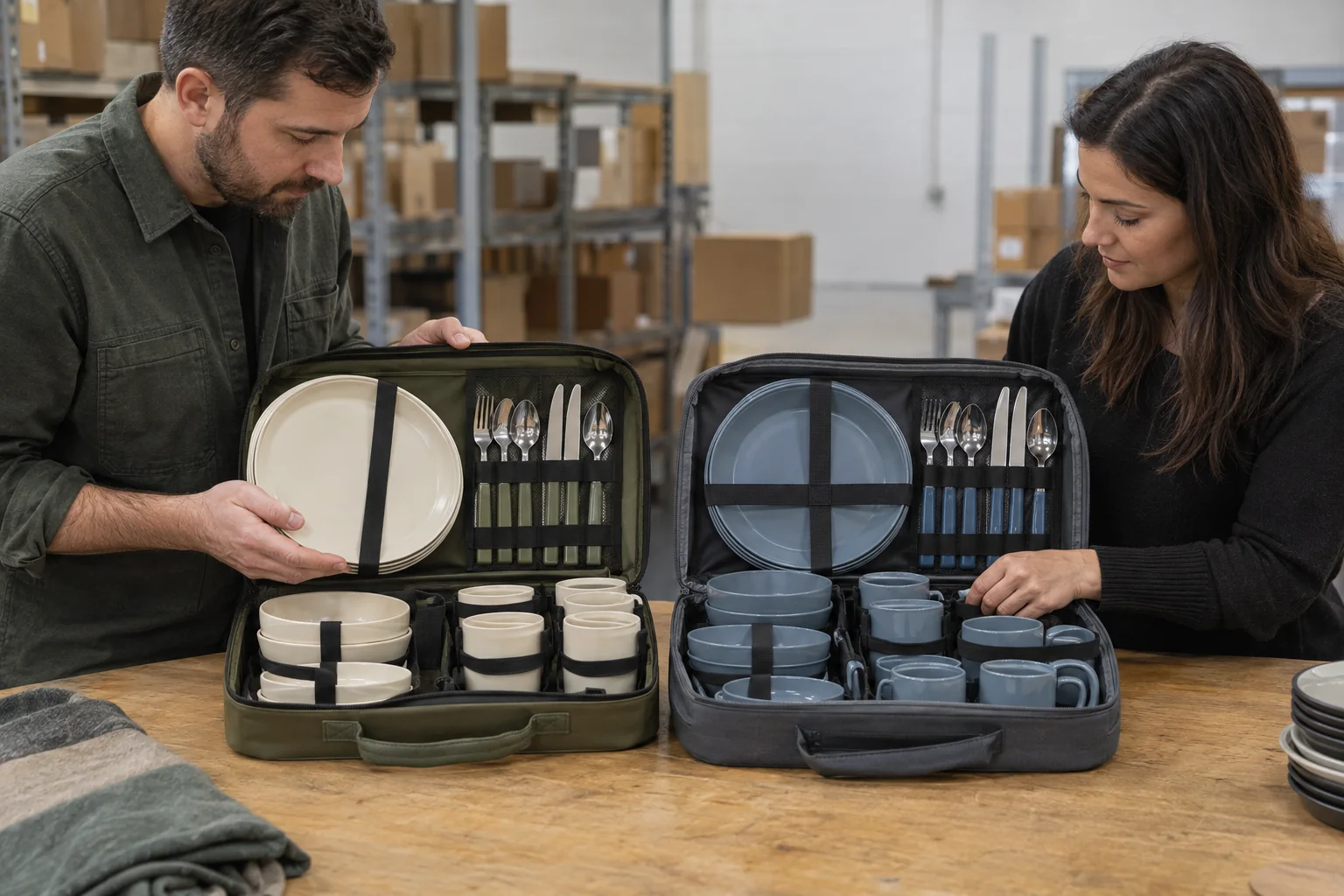
Normalize supplier quotations line by line
Send the same matrix to every bidder. Require one row for each plate, bowl, cup, utensil, container, lid, organizer and carry component, with quantity, proposed material, status of drawing or sample, artwork area, evidence reference and packaging position. Unknowns should remain visibly open rather than being filled with assumptions.
Ask suppliers to identify whether each row is an existing verified item, a proposed adaptation or a new-development request. A picture that resembles the requirement is not confirmation of dimensions, material, compatibility or availability. Written quotation, samples and controlled drawings should converge before approval.
When carry architecture is part of the decision, compare the approved matrix with a published product-format example such as the split-pouch family camping set concept. Treat it as a configuration reference, not proof that unrelated components are interchangeable; fit still requires project-specific drawings and samples.
If Naike Dinner is asked to review a program, provide the component matrix, target users, meal examples, carry target, destination market, cleaning method, artwork files and packaging constraints. The review can then separate available company records from buyer guidance and unresolved project questions. For a structured discussion, use the Naike Dinner contact page.
Record the decision in an approval sheet
The final comparison should end with a signed decision, not an email that says “use the 24-piece version.” Record the selected architecture, commercial count, physical-part count, user capacity, component identifiers, approved sample references, packaging basis and unresolved conditions. Include the reason for each of the four additional pieces so later cost reduction does not remove a function without review.
Add a revision column to the approval sheet. If a knife becomes a serving utensil, a base-and-lid pair replaces a bowl, or a case insert begins to count as a commercial piece, the revision changes both the customer-facing description and the controlled BOM. Product, quality, regulatory, artwork and packaging owners should see the same revision before the set moves forward.
The approval should also state what the choice does not mean. Selecting 24 pieces does not prove five-person capacity, superior durability, lower pack volume or broader compliance. Selecting 20 pieces does not prove a cheaper landed program. Those conclusions require the relevant sample, quotation, packaging and evidence data.
Run a missing-piece and replacement simulation
Before launch, remove one component from the packed set and ask the operational team what happens. If one shared spoon makes the group meal impractical, it is a critical shared item and needs a replacement path. If one of four knives is rarely used, the team may decide that another component provides more value. This exercise turns abstract piece count into service continuity.
For retail programs, decide whether replacement pieces will be offered individually, by component family or only as a complete set. For rentals and guided tours, define the end-of-use count and the trigger for replenishment. The chosen architecture should support the after-sales model instead of creating many visually similar parts that staff cannot identify.
B2B Buyer Checklist
| Check | Question | Why It Matters |
|---|---|---|
| Counting convention | Does the RFQ define how utensils, lids, cases and inserts are counted? | It makes 20-piece and 24-piece offers directly comparable. |
| User allocation | Does every claimed user receive a complete functional place setting? | Piece count alone can exaggerate service capacity. |
| Meal validation | Has the team tested the highest-risk intended meal? | It shows whether knives or shared pieces perform a real task. |
| Component identity | Is every object tied to a drawing, approved sample or controlled reference? | It limits unreviewed substitutions and interface changes. |
| Pack-out | Has the final configuration been packed, carried, opened and repacked? | Four additions may change the bag, insert and carton. |
| Evidence mapping | Does each food-contact component map to applicable supporting records? | One material statement may not cover the complete set. |
| Claims | Are cleaning, heat, leak and use claims scoped to verified conditions? | Marketing language must not exceed product-specific evidence. |
| Quotation basis | Are prices normalized against the same matrix and packaging basis? | It exposes filler pieces and hidden scope differences. |
| Artwork reconciliation | Will final artwork be checked against the approved BOM and sample? | It prevents incorrect count and component illustrations. |
Sequential buyer FAQs
1. Is a 24-piece camping dinnerware set always better value?
No. It is better only when the four additional pieces perform needed tasks and the price, pack-out, evidence and replacement consequences are acceptable. Compare normalized component rows rather than dividing price by the headline count.
2. What is the clearest 20-piece four-person configuration?
One transparent baseline is four each of plates, bowls, cups, forks and spoons. That is an example architecture, not a universal recommendation; the meal plan may require knives, divided plates, food containers or different utensils.
3. Should a three-piece cutlery bundle count as one or three pieces?
Either convention can be used commercially if it is declared. The engineering and inspection list should still show all three physical utensils separately so quantity, material, artwork and defects can be controlled.
4. Can lids be counted in the advertised total?
They can be counted if the description is unambiguous, but buyers should also identify which base each lid fits and how the relationship is inspected. Do not let separate lid counting imply additional user capacity.
5. When should the extra four pieces be knives?
Choose knives when a realistic meal and user review shows that every person needs one. Confirm the intended cutting task, user group, storage and destination requirements instead of adding knives to reach a larger number.
6. When are shared pieces a better addition?
Shared pieces are useful when group serving, leftovers or organization is part of the intended workflow. Give every shared item a defined task, packing position and approval owner; otherwise it may become pack-volume filler.
7. Does a higher count require new compliance testing?
It can expand the evidence needed because new materials, colors, decorations or contact conditions may enter the final set. A regulatory specialist should review the scope of applicable declarations and reports against the approved configuration.
8. What should buyers send for a documented quotation?
Send the counting convention, component matrix, quantities, user and meal scenarios, material direction, destination markets, cleaning and use conditions, carry target, color and artwork needs, packaging brief and required evidence. Mark unresolved fields for written project confirmation.
Approve the component matrix before approving the number
Ask for a sample and written quotation against one controlled 20-piece or 24-piece schedule. Share your users, meals, component rows, pack target, market, artwork and evidence requirements so every proposal can be compared on the same basis.