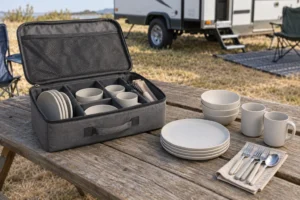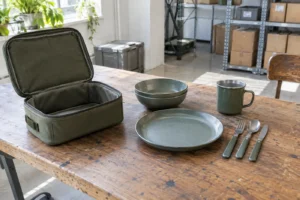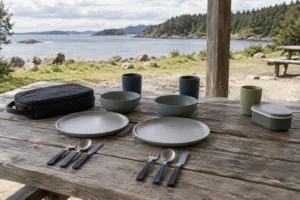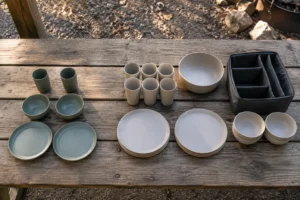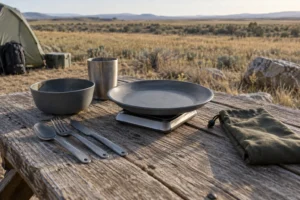
Two-person vs six-person camping sets differ in more than piece count. Individual eating pieces may scale with the intended users, but shared serving, food containers, retention, cleaning and replacement logic need a separate design decision. Approve a user-to-component matrix and a loaded pack-out before accepting either configuration; do not simply triple a two-person bill of materials.
Two-person vs six-person camping sets: the architecture decision
A two-person set is often judged by whether each user has a complete place setting and whether the compact pack is easy to carry and clean. At six users, the buyer must also decide how food is served, which pieces are shared, how identical items remain countable, and whether one case or several sub-kits suit the channel. The question is not which set has more pieces; it is where the extra users change the workflow.
Start with the use case before filling a bill of materials. A family car-camping kit, a rental-fleet kit, an RV cabinet assortment and a backpacking group kit can all serve six people but impose different constraints on storage, replacement, wash-up and transport. A buyer should record the route to market, meal types, user ages, serving style, planned cleaning method and available pack envelope before asking a supplier for a drawing.
The previously published one-person versus four-person comparison explains why user count changes allocation. This page deals with a different jump: from an intimate pair to a group large enough that serving, counting and partial replenishment become independent design tasks. The output is a matrix that can be attached to an RFQ, sample review or approval record, not a universal claim that every six-person kit needs a fixed number of accessories.
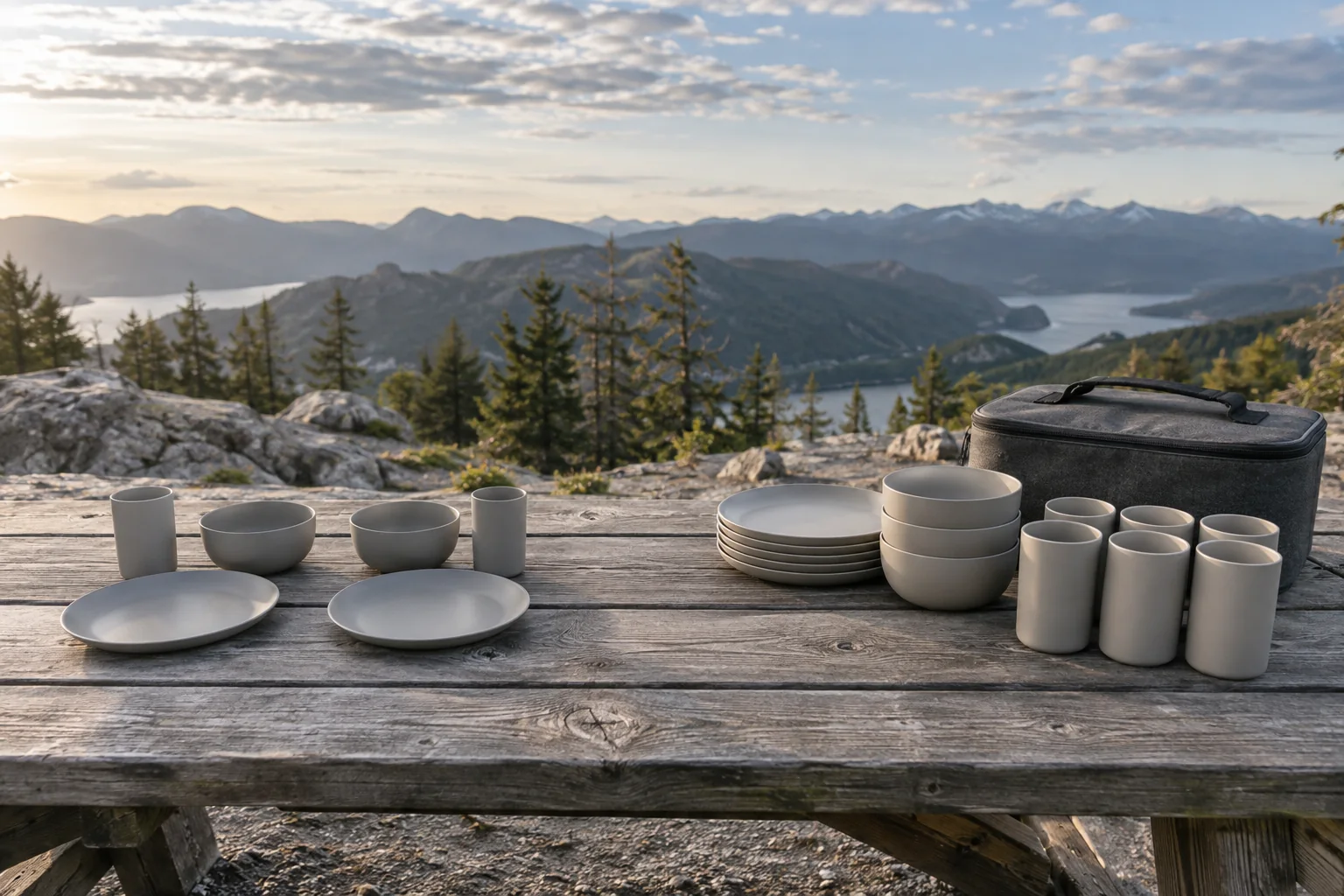
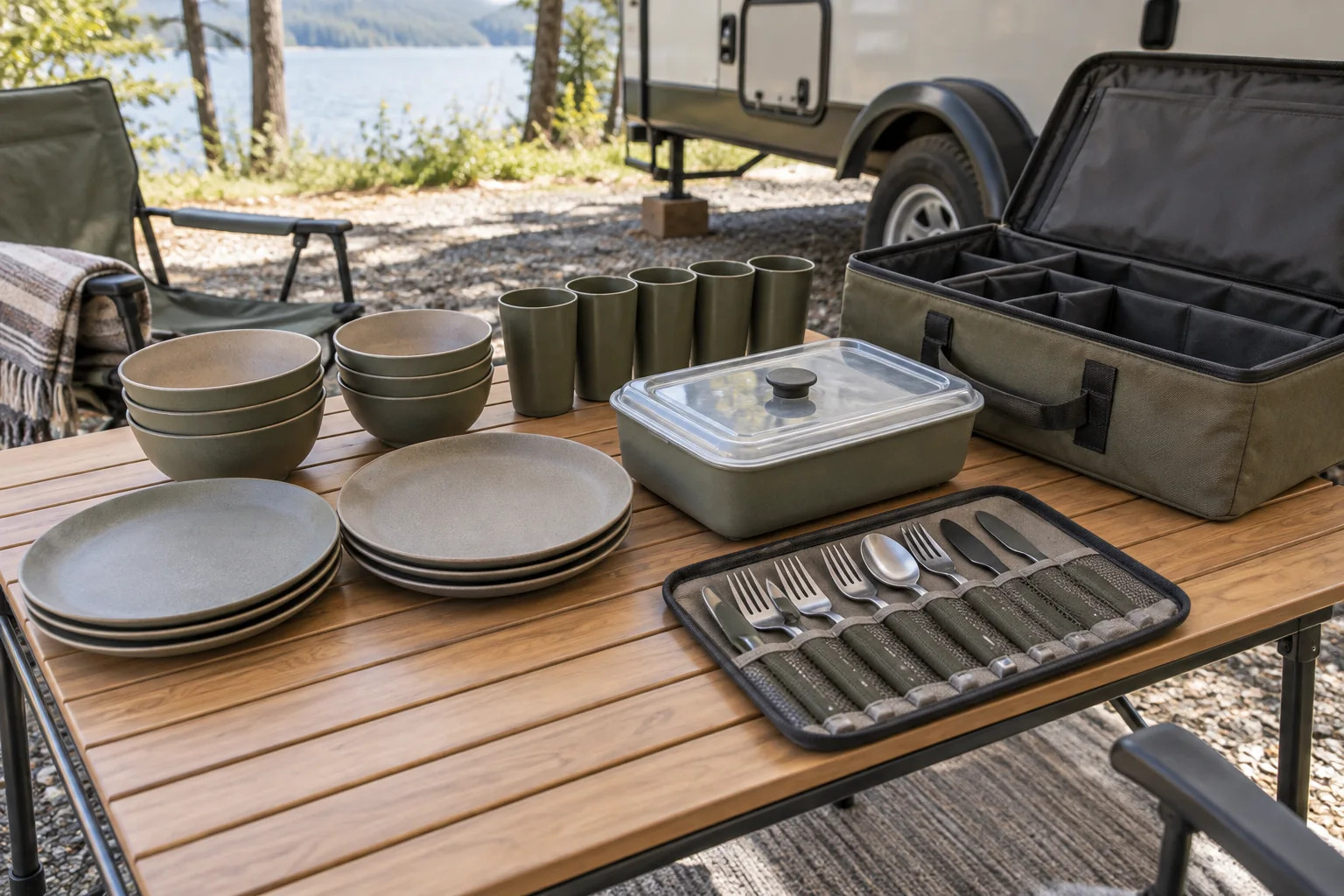
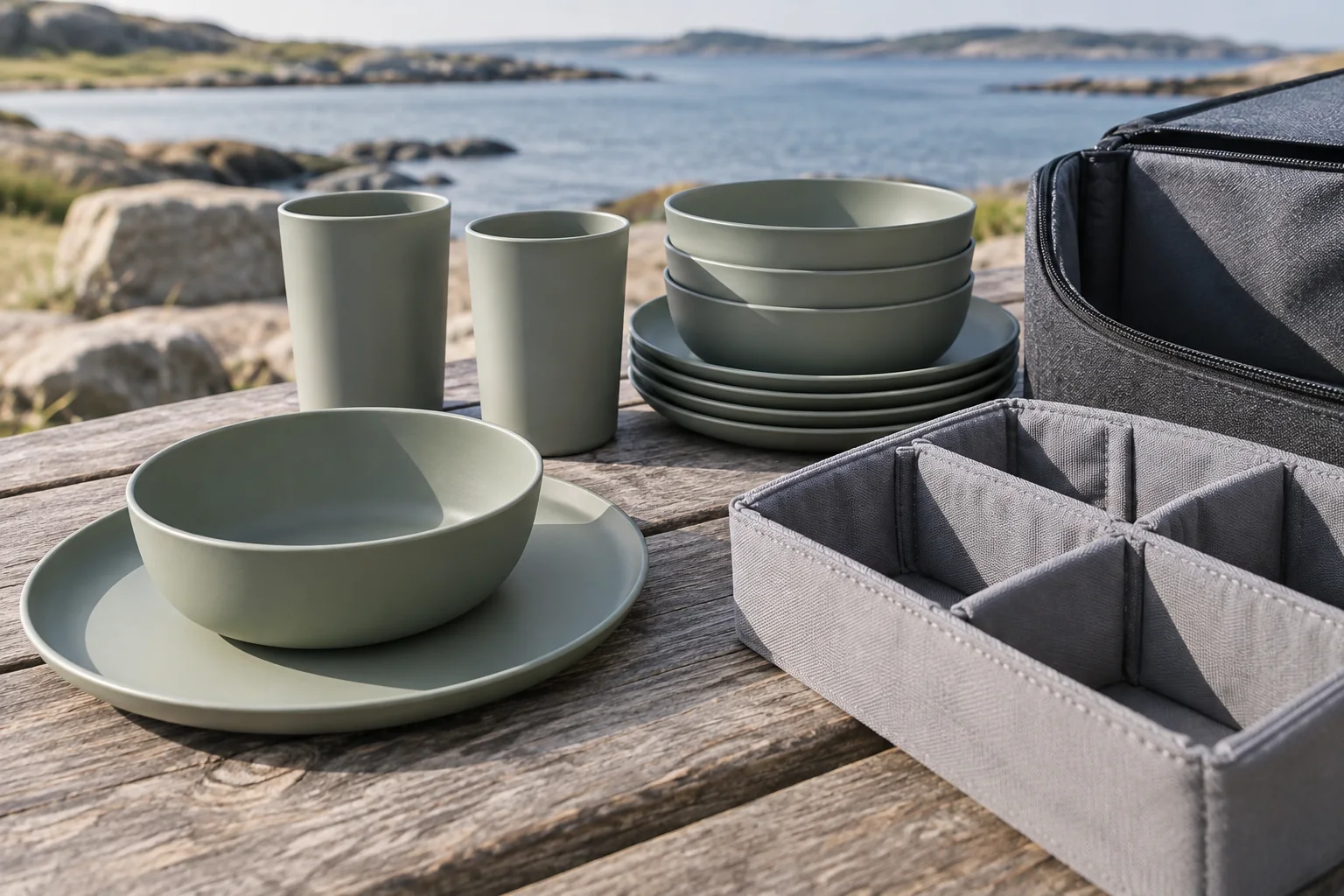
Use “two-person” and “six-person” as intended service capacities, not as unverified SKU claims. A drawing, prototype and complete component list must define the actual product. The pictures on this page are conceptual arrangements for buyer education and are not photographs of a verified Naike Dinner SKU, factory line or tested configuration.
Evidence and boundaries before a component list
Regulatory evidence follows the actual food-contact article and intended use, not the attractive set name. The US FDA food-type and condition-of-use tables distinguish food types and use conditions for food-contact substances. Buyers therefore need to state whether the proposed plate, bowl, cup and container contact hot, oily, acidic, cold or dry foods, and which cleaning or reheating practices are intended.
The European Commission food-contact legislation overview sets out the framework and material-specific rules rather than treating a mixed set as a single generic “food-grade” object. A buyer placing a set in Europe should map each actual material, decoration and food-contact component to the applicable evidence. A compliant bowl does not automatically prove that a differently colored cup, lid, seal or printed item has the same scope.
The FDA guidance on determining regulatory status of food-contact components also reinforces that authorization depends on the substance and conditions of use. These primary sources define evidence boundaries; they do not certify any concept pictured here. For Australia and other target markets, buyers should request a destination-specific review of the final materials and use conditions rather than importing a claim from another jurisdiction.
For packing and weight comparisons, measure the physical sample instead of deriving a number from a rendered image. The NIST mass-unit explanation supports recording mass in consistent units; a buyer worksheet should state whether a value represents an individual component, a nested group, an empty carrier or the complete loaded kit. This article supplies the method and decision columns, not invented unit weights or volumes.
Do not conflate dinnerware with cookware. Plates, bowls, cups, cutlery and lunch containers are dining and food-holding components; no item should be shown or described as burner-, stove-, campfire- or direct-flame-ready without product-specific verified evidence. The proposed user-count architecture remains useful even when every item is intended solely for serving and eating.
A two-user versus six-user component matrix
Use the table as a blank decision framework, not a predetermined commercial specification. In the two-user column, note the minimum individual role and the reason for any shared component. In the six-user column, decide whether the same piece is repeated, divided into zones, replaced by a larger shared item, or omitted because it duplicates another function.
| Component or system | Two-user decision | Six-user decision | Approval evidence |
|---|---|---|---|
| Eating plates | Assign one primary eating surface to each intended user; define any second plate by meal need. | Assign six individual eating surfaces if simultaneous service is required; assess nested stack height and break-out order. | Loaded sample, plate count, nested height and serving trial. |
| Bowls | Decide whether each diner needs one bowl or whether the planned meals are plate-only. | Separate individual bowls from any shared serving bowl; avoid counting the same bowl in both roles. | Meal map, component matrix and labeled sample review. |
| Cups | Specify beverage and cleaning conditions; handled or handleless shape affects packing. | Verify a consistent six-cup count and assess whether cup nesting creates rim or abrasion problems. | Filled-use trial, stack/retention review and intended-use evidence. |
| Cutlery | Choose a defined set per person and a way to see missing items during repacking. | Group by person or utensil type and test count visibility, wash-up and replacement. | Loaded organizer, count sheet and user repack trial. |
| Food container | Decide whether it carries individual lunches or merely supplements serving. | Determine whether one larger shared container, several individual boxes or none best fits the food plan. | Meal flow, leak/closure review for the intended use and pack-out. |
| Serving pieces | Include only where two users cannot serve from their own vessels. | Define a separate shared-serving zone and who is responsible for repacking it. | Serving rehearsal and responsibility map. |
| Carrier and dividers | Optimize access to a small complete kit. | Compare one case with sub-kits; check loaded lift, footprint, retention and washability. | Loaded prototype, carry trial and open/close sequence. |
| Replacement policy | Specify whether a lost cup or utensil can be replenished singly. | Identify high-loss individual items separately from shared parts and case-only hardware. | Spare-parts list and version-controlled BOM. |
A multiplication-only BOM creates false precision. It might triple individual plates yet leave no space for shared food handling, or it might triple a serving piece that should remain singular. Conversely, a “group” claim without six countable place settings can disappoint a retail buyer whose customers expect simultaneous use.
Record three states for every row: proposed, sample-verified and approved. The proposed state is an idea; the sample-verified state requires physical fit and use review; approved means the buyer has signed off on the exact material, count, appearance, packaging and evidence scope. Keeping these states distinct prevents a conceptual illustration from becoming an unsupported product promise.
Separate individual, shared and conditional parts
Individual components are those each diner must have at the same time: usually an eating surface, a drinking vessel and the utensils required by the planned meal. Shared components serve the group, such as a serving bowl or a food container, and should not be multiplied merely because the user count increases. Conditional components depend on the meal plan, route to market, audience and cleaning arrangement.
Write a row for each role rather than a vague “plate set” or “cutlery pack.” For example, a spoon used for eating and a serving spoon are different functional roles even if their appearance is similar. If a product team wants one item to do both jobs, document the use sequence, cleaning step and count consequences instead of assuming the substitution is obvious.
A two-user configuration often allows the two diners to monitor their own pieces informally. In a six-user configuration, the person who packed the case may not be the person who washed or served with it. Put an observable count position in the carrier or a clear layout in the pack-out guide so a missing cup or utensil can be noticed before the kit leaves the campsite.
A “six-person” label must also state whether all six users can eat the intended meal concurrently. If the brief assumes sequential service, fewer shared containers may work, but that assumption belongs in the RFQ and product copy. If simultaneous service is promised, review the maximum concurrent component demand rather than the average number of users who happen to reach for a bowl.
Families may need differently sized utensils or a distinct child-facing piece, but age suitability cannot be inferred from color or scale. If a child variant is proposed, define its intended age, geometry, food-contact use and relevant evidence separately. A family picture alone cannot validate those conditions.
The carrier becomes a different product at six users
At two users, a small pouch may let every piece remain visible in one layer. At six users, repeated items create taller stacks, a larger case or several modules, each with different consequences for carry balance, retrieval and washing. Ask the supplier for a loaded top view and side view, not just a beauty shot of an empty bag.
Use the pack-volume worksheet to record the outside envelope of the fully loaded, closed kit. The critical dimension may be the case height that fits an RV drawer, the width that sits on a retail shelf, or the total footprint required for car-camping storage. The volume of individual components added together is not the same as the outside volume after nesting, dividers and lid clearance.
Try two physical architectures. One larger case can keep a common inventory and a single retail unit but may become awkward to carry or dry. Two or three sub-kits can distribute weight and let a smaller party borrow part of the set, yet introduce more packaging, more chances to leave a module behind and a need for a clear shared-component rule.
For either architecture, inspect where clean and wet items go after a meal. A tight nest can hold moisture between surfaces, and an absorbent carrier needs a practical cleaning and drying plan. Do not promise dishwasher, microwave or temperature suitability for a mixed set until every relevant component and decoration has product-specific evidence for the intended use.
Read nesting versus stacking alongside this decision. A repeated set may save volume when nested, but a deep nested stack can make a plate at the bottom difficult to retrieve without lifting every piece. Approve the extraction sequence with a loaded sample and with the group’s actual meal order.
Use the channel and user scenario to choose the architecture
Family car camping
A family kit may emphasize one accessible case, a mix of individual places and shared meal service, and a repacking method that a tired adult can check quickly. Ask whether plates and bowls are both used in the same meal or whether one is an alternate; this determines whether both counts must cover all six people. A family claim should not silently imply child suitability without a scoped design and evidence review.
RV or caravan assortment
An RV buyer may prioritize cabinet height, stack stability, noise while traveling and washing at a confined sink. The six-user kit can be more compact when dishes nest, but a larger shared container can frustrate drawer access. Request the actual cabinet envelope and test the complete packed sample in the intended storage location rather than assuming a common “RV size.”
Rental and fleet replenishment
A rental operator needs a rapid count and a replacement path for likely missing individual items. Six visually identical forks loose in a pouch may be cheap to assemble yet costly to inspect between rentals. Separate individual utensils into visible positions and include a versioned spare-parts schedule so a replacement retains the intended fit and material.
Retail and e-commerce
Retail copy should make the included pieces intelligible without asking a customer to decode an inflated total. The buyer should approve a front-of-pack component list that distinguishes six personal pieces from shared accessories and packaging. For e-commerce, check the actual shipping carton, cushioning and damage points; a six-user set can fail in transit even when the dinnerware itself is fit for use.
Backpacking or dispersed group travel
A single heavy case may be inappropriate if six users split loads among packs, while modules can complicate ownership of the shared container. State who carries each sub-kit and how the group reunites components at camp. Do not claim a design is “ultralight” without measured sample mass and a comparison boundary; use the component weight-budget method to compare candidates consistently.
Limits, misuse boundaries and commercial failure modes
The largest risk is a title that says “six-person” while the BOM contains a mixed assortment of pieces that cannot serve six people as promised. Another is an apparent six-user photo built from repeated visual objects that do not match the drawing, carton and final sample. Control both with a single approved component matrix tied to the final SKU and revision.
Component count is not a proxy for value. Counting a carrier, dividers and decorative accessories as “pieces” can obscure missing functional places; omitting them from the BOM can hide cost, mass and replacement exposure. Present a transparent count convention in the quotation and retail specification, with a separate line for packaging and carrier components.
Material and decoration scope can diverge across a larger kit. A metal serving spoon, polymer cup, painted lid and textile carrier are not one uniform compliance object. Ask for the material identity and intended use of each food-contact part, and keep non-food-contact carrier statements separate from food-contact evidence. Neither this article nor the illustrations establish that Naike Dinner manufactures any particular mixed-material combination.
A larger kit can also conceal mechanical interference. Plates may nest perfectly in isolation but hit the cup stack or carrier lid when the shared container is added. Test the complete load-out with the final divider pattern, not a component-only photograph. Retest after any meaningful revision to rim, wall, handle, lid, artwork or packing sequence.
Cleaning and drying are operational risks rather than incidental instructions. In a small kit, two diners may rinse and inspect everything at once; with six users, pieces can be returned wet, mixed with food waste or packed by different people. Write a realistic clean-dry-repack sequence and test it with a representative user group before making durability or hygiene claims.
A procurement sequence that yields a quotable brief
First, fix the service definition: six simultaneous diners, the meal styles, whether children are included, food types and temperature exposure, and whether a shared serving item is needed. Second, draft the individual/shared/conditional matrix with proposed counts and indicate which counts remain open. Third, ask for alternate loaded pack-out concepts—one case and modular sub-kits—against the same outside envelope.
Fourth, require a sample schedule and a drawing or photograph for each component role. A visually attractive rendering is useful for discussion, but approval must be based on a physical sample that can be counted, nested, carried, cleaned and packed. Fifth, request written material and food-contact evidence matched to the actual part, color, decoration, market and use conditions.
Sixth, test a complete sample rather than separate loose articles. Have representative users set places, serve food, wash, dry, count and repack while an observer records bottlenecks and missing pieces. Keep the outcomes qualitative until measured data exists; do not insert a guessed mass, capacity, pass result, production rate, MOQ, lead time or price in the brief.
Seventh, normalize quotations line by line. Ask each supplier to identify included components, carrier construction, decoration, packaging, sample scope, tooling assumptions if relevant, testing responsibility, spares and exclusions. If two quotes use different component matrices, they are not comparable prices for the same product.
Eighth, freeze a revision-controlled approval record. The record should pair the final drawing and BOM with the approved sample, artwork, target markets, use conditions, inspection criteria and packaging. Any later substitute should be reviewed against the same service-capacity promise and evidence scope.
| Check | Question | Why It Matters |
|---|---|---|
| Service capacity | Can every intended user eat the specified meal at the same time? | Prevents a six-person claim supported only by inflated accessory count. |
| Role allocation | Which parts are individual, shared or conditional? | Stops blind multiplication and exposes gaps. |
| Count convention | Are carrier, lids, dividers and packaging counted separately? | Makes the set specification and retail claim auditable. |
| Food contact | Does evidence match each actual material, decoration and use? | Prevents a generic compliance statement from covering unlike parts. |
| Loaded case | Does the complete closed kit fit, carry and unpack in the target channel? | Loose samples can hide interference and handling risk. |
| Repacking | Can a user see missing pieces and manage wet items? | Controls loss, complaints and repeated-use friction. |
| Spare parts | Which individual and shared pieces can be replaced under a versioned BOM? | Protects fleet and customer-service continuity. |
| Approval | Do the sample, drawing, BOM, artwork, evidence and carton describe one revision? | Prevents a quotation or production mismatch. |
Buyer FAQs
1. Must a six-person set have exactly three times the pieces of a two-person set?
No. Parts assigned to each diner may scale with simultaneous user capacity, but serving, storage and carrier parts have different logic. Build the matrix by function and meal use, then choose counts from the service promise and physical sample. A simple multiplication can create redundant serving pieces while overlooking pack-out or shared-food needs.
2. Should six-person dinnerware be packed in one case or several modules?
Neither architecture is universally correct. One case simplifies inventory and retail presentation; modules can distribute load or allow partial use. Compare the loaded envelope, carrying method, missing-part visibility, cleaning and packaging for both candidates, then test the chosen architecture with the target users and storage space.
3. Is a shared serving bowl required in every group kit?
No. It depends on the planned meals and whether users serve from a common container or their individual vessels. Define the food flow before adding a serving bowl, and distinguish it from a bowl that must be available to each person. A shared item also needs an assigned storage and replacement position.
4. Can a two-person design become a six-person SKU by changing the label?
Only if a revised physical set supports six intended users under the promised meal conditions and the final BOM, case, evidence and carton agree. A title or image cannot establish that. Review simultaneous service, component counts, complete pack-out and final food-contact scope before approving the new SKU or its marketing copy.
5. Which dimensions and weights belong in a supplier quotation?
Request measured component dimensions, nested group dimensions, the closed loaded carrier envelope, unit mass and complete packed mass from a specified sample revision. Record the measuring convention and unit for each value. This page intentionally provides no fabricated measurements; a rendering cannot establish tolerances, capacity or shipping dimensions.
6. Does a food-contact declaration for one plate cover the whole six-person set?
No automatic conclusion follows. A set may include different materials, colors, additives, decorations, lids or intended uses; evidence must be mapped to the final articles and relevant markets. Ask for a component-by-component evidence index and resolve every gap with the responsible specialist before any compliance claim is published.
7. What is the minimum useful sample-review meeting?
Bring the approved service definition, proposed matrix and a complete loaded sample. Ask participants to count pieces, set six places, handle the shared food flow, clean and dry components, repack the kit and record interference. End with a revision list that names the drawing, BOM, artwork, evidence and next decision owner.
Request a component and pack-out review
For a written six-user concept review, send the intended users and markets, meal and food-contact conditions, individual/shared component matrix, target carrier envelope, cleaning method, artwork and packaging needs, and any existing sample or drawing. Ask for alternative one-case and modular pack-outs where appropriate, with assumptions and unverified points identified rather than hidden.
Contact Naike Dinner with your component brief to discuss whether a project-specific sample and quotation review is possible. Material availability, tooling, component fit, dimensions, evidence, commercial terms and lead time must be confirmed in writing for the proposed configuration. Send the sample and specification questions before approving public product claims.