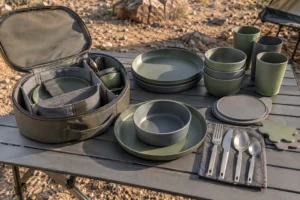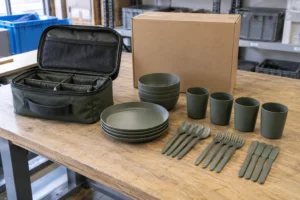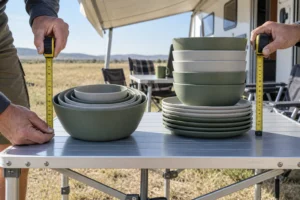
Nesting saves volume by placing progressively smaller or tapered pieces inside one another; stacking repeats the same profile with a controlled rise. For a camping program, neither is automatically superior. Buyers should compare the complete sales unit for packed envelope, component access, release, drainage, abrasion, retention and carton efficiency, then approve the geometry with drawings and final-configuration samples.
Nesting vs stacking camping dinnerware is a pack-out decision
A buyer does not purchase an isolated bowl silhouette. The commercial unit includes the declared quantities of plates, bowls, cups, containers, cutlery, lids, dividers, carry case and packaging. The useful comparison is therefore not “which pile looks lower,” but which architecture produces a repeatable packed system for the intended users and channel.
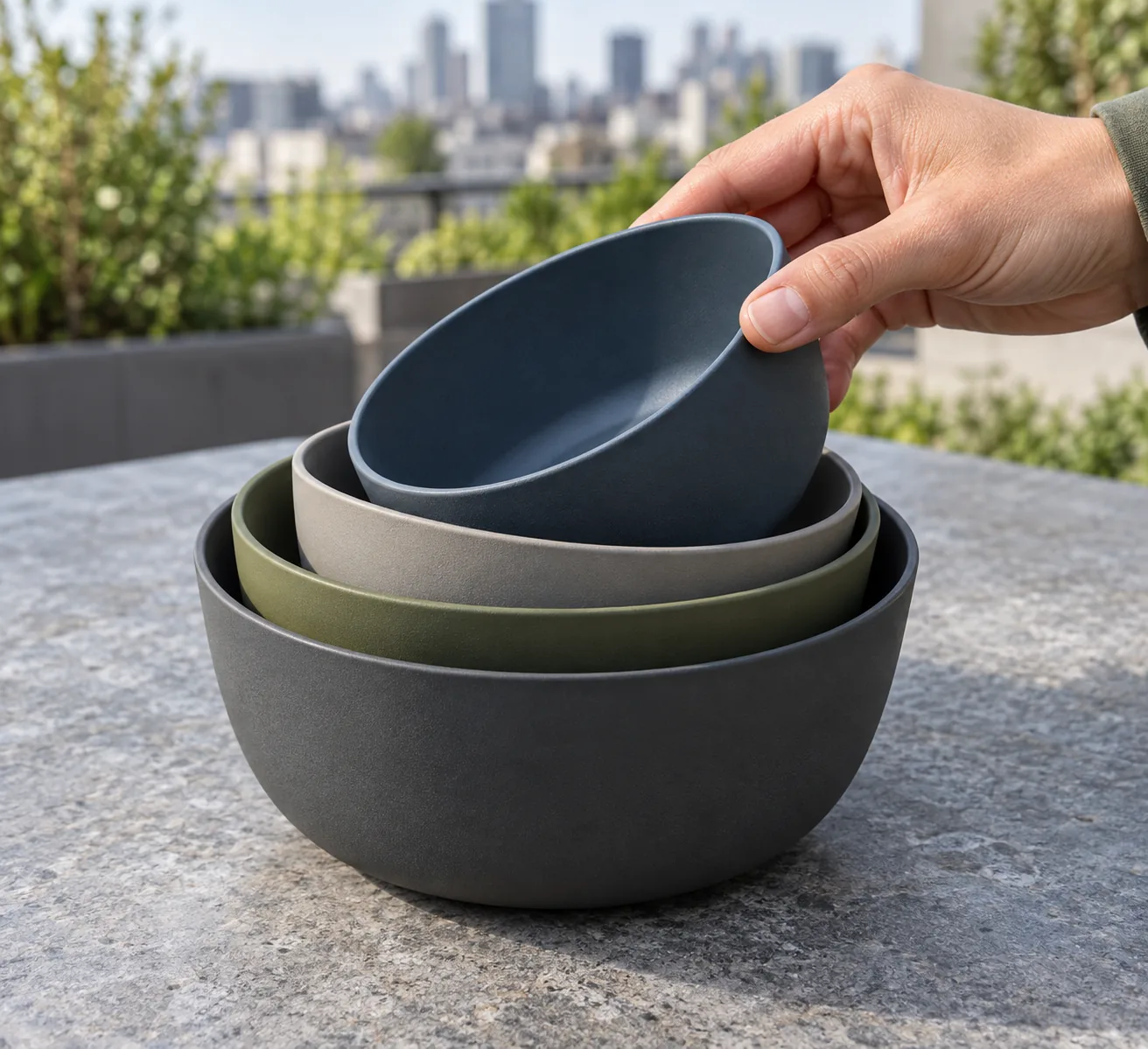
Nesting describes one component entering another component’s usable volume. The pieces may be different sizes, or identical tapered parts may overlap deeply. Stacking describes components resting in a repeated order with a defined contact and incremental height. A family set can use both methods, and many good pack-outs deliberately do.
The decision affects much more than volume. It changes the number of unique parts, how users reach each setting, which surfaces rub, where water can remain after washing, how missing pieces are noticed and what retention the case needs. Those effects should be converted into a controlled worksheet before a buyer approves tooling, artwork or a sales claim.
Use one comparison boundary before collecting measurements
Start by fixing the comparison boundary. State the user count, meal functions, component list, exact quantities, material direction, carry system, packaging channel and destination markets. If one proposal contains lunch boxes and another does not, their packed envelopes are not comparable even if both are described as twenty-piece sets.
Measure every proposal in the condition in which it will be sold and carried. Include the permanent dividers, sleeves, straps and protective parts listed in the BOM. Do not remove retention to obtain a smaller photographed volume, and do not fill unresolved gaps with temporary paper or foam that is absent from the quotation.
Use the same orientation and reference planes for all bidders. Record external length, width and closed height of the complete pack, not just a plate diameter or nested bowl height. Dimensions, tolerances and results that have not been verified belong in the project file as “To be confirmed for the project.”
Buyer comparison table: where each geometry changes the program
| Decision factor | Nesting direction | Stacking direction | Evidence to request |
|---|---|---|---|
| Packed height | Can be reduced when parts overlap deeply, but the largest outer part controls footprint | Builds by repeated incremental rise; height is easier to model when contacts are stable | Complete-quantity measurements and section drawing |
| SKU architecture | Progressive sizes may create more unique components and replacement complexity | Repeated identical pieces can simplify count and replacement | Controlled BOM with part and revision identifiers |
| User access | Inner pieces may require outer pieces to be removed first | A top piece can often be lifted independently, subject to release geometry | Unpack-distribute-repack observation |
| Release risk | Deep overlap can wedge or create suction when damp | Contact ledges can stick or abrade if clearance and texture are wrong | Dry, damp and post-wash handling record |
| Surface contact | Potentially broad wall-to-wall contact | Potentially localized rim, foot or shoulder contact | Intended/prohibited contact map |
| Drainage | Close gaps can hold water if packed before fully dry | Feet and ledges can trap water between repeated pieces | Wash-drain-dry-repack review |
| Retention | One outer shell may locate several inner parts, but removal order matters | Columns often need side restraint and a top stop | Closed-case pack drawing and movement check |
| Counting | Missing inner pieces can be less visible | Repeated columns can make quantity easier to see | Return-count exercise with representative users |
| Change impact | One dimensional change can disturb several interfaces | A profile change affects repeated rise and case clearance | Revision-impact record |
| Carton planning | Lower height does not guarantee lower cube if footprint grows | Narrower footprint can trade against greater height | Sales-unit and master-carton calculations |
The table is not a scorecard with a universal winner. It identifies what changes and which evidence lets the buyer decide. A program can value easy counting over minimum cube, or independent access over the lowest possible profile. Weight each factor according to the actual sales channel and user sequence.
Model the packed envelope, not a marketing piece count
Piece count does not reveal pack efficiency. Twenty small accessories can inflate a headline while contributing little volume, and one large serving plate can define the entire footprint. Build the pack model from named components and quantities so every item has a role and a retained position.
For each subgroup, record the first-piece height and total height at the full quantity. For stacked identical parts, calculate the observed incremental rise as the difference between adjacent quantities. For nested progressive parts, record how far each part enters the next and which rim, wall or base prevents further movement.
Then place those subgroups inside the carry system. A low nested bowl group may still waste space if its broad outer bowl prevents cups from occupying adjacent zones. A taller stack of identical bowls may fit a narrow column beside vertical plates. The case plan decides whether a theoretical saving becomes usable pack volume.
When a carton decision follows, use external closed dimensions of the finished sales unit. A basic rectangular volume can be calculated as length multiplied by width multiplied by height, using one unit system. That number is a planning input, not proof of freight cost or carton performance; master-carton count, protective structure and validated packing arrangement still need confirmation.
Nesting changes the component family and replacement plan
Progressive nesting often uses different diameters or profiles. A four-user set may therefore contain several unique bowls rather than four identical bowls. That can be attractive when the sizes serve different meal roles, but it can also complicate place-setting equality, labeling, replacement inventory and loss recovery.
Ask whether each size has a deliberate function. If the large bowl is shared and the smaller bowls are personal, the hierarchy may be logical. If four users are expected to receive equivalent settings, a chain of four unequal bowls can create an avoidable experience problem even though it packs compactly.
List every unique component as its own controlled BOM line. Replacement pieces must match the correct position in the nesting sequence. A visually similar substitute can wedge, rattle or raise the closed height, so nominal diameter alone is insufficient evidence of compatibility.
The published guide to defining camping dinnerware set components helps assign user and shared roles before pack geometry is chosen. Use that role matrix to decide whether progressive sizes solve a meal requirement or merely make the presentation appear compact.
Stacking changes rise accumulation and column control
A repeated stack is easier to count, but its total height depends on consistent contacts. Small variations in rim, foot, wall or flatness can accumulate through the full quantity. Two samples may align while six reveal lean or inconsistent rise, so approval must use the exact saleable count.
Map the intended contact between consecutive pieces. It may be a foot ring resting on an underside shoulder, a rim ledge, or another defined feature. Mark prohibited contacts as well, especially food-contact faces, decorations, sealing lands and sharp edges that should not carry repeated load.
Measure the first piece separately from the repeated rise. The first piece establishes the base height; each additional part adds only the exposed increment. Record total height after every added part. A changing increment can indicate interference, warpage, rotation sensitivity or a contact that is not operating as intended.
Our companion article on stackable camping dinnerware acceptance provides eight checks for identity, contact, rise, alignment, release, stability, drainage and retained pack-out. Use those checks for each repeated column rather than approving a stack from one photograph.
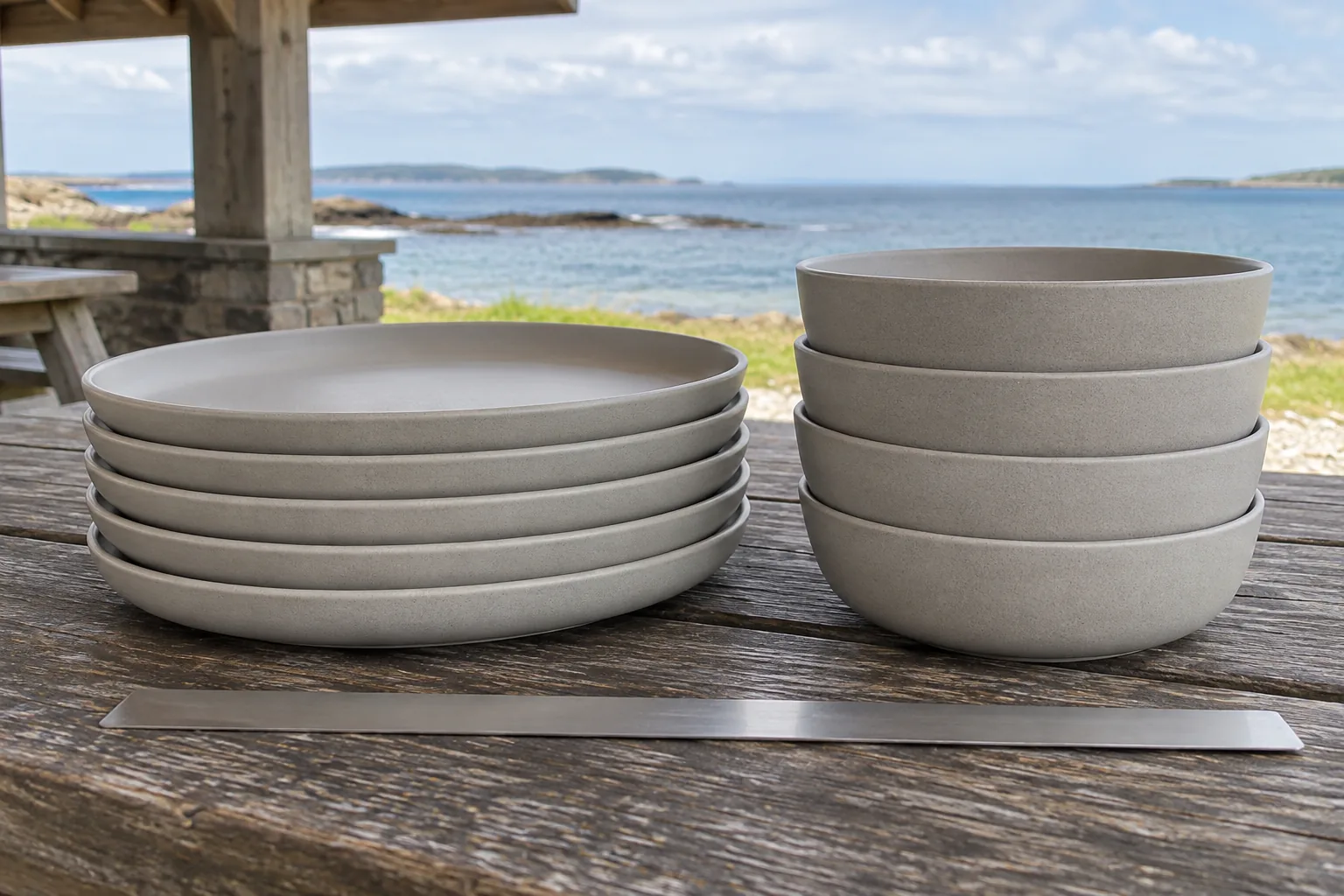
Release behavior can reverse an apparent volume advantage
Deep nesting increases overlapping surface area. If taper, texture and clearance are not controlled, pieces can wedge. Damp close-fitting surfaces can resist air entry and create suction. Users may then twist, pry or knock pieces apart, increasing drop and edge-damage risk.
Stacked parts can also stick. A narrow contact ledge can bind after dimensional variation, while broad face contact can create friction or moisture adhesion. The buyer should specify the intended grip point and separation action instead of assuming users will discover a technique.
Observe representative users unpacking the complete set dry, damp after washing and in any other safely defined project condition. Record whether one part can be removed without tools, excessive force or unloading unrelated components. Do not convert an informal handling demonstration into an unsupported quantified claim.
Finger access is part of pack geometry. A compact case that leaves no safe grip can be slower and less reliable than a slightly larger layout. Provide clearance around the intended lift point, and confirm that straps or dividers do not block the first component.
Cleaning and drying should influence the architecture
Nesting and stacking both create hidden interfaces. Nested walls can trap droplets between close surfaces. Stacked feet and underside recesses can retain water above the next food-contact face. If users repack immediately, residual moisture can transfer into the case.
Define the wash, drain, dry and repack sequence. Some sets may require parts to dry separately; others may use loose spacing or a draining orientation. Any drainage feature must remain cleanable and should not create a new crevice or unsupported hygiene claim.
Dishwasher suitability is a separate claim. Geometry review can include observation after the declared process, but it does not prove material or decoration durability. The buyer should match evidence to final materials, colors, artwork, component revisions and use conditions.
Carry-system materials also need attention. A textile divider that absorbs water behaves differently from a removable molded tray, but neither is automatically superior. Specify cleaning access, drying method and replacement expectation for every permanent retention part.
Choose retention for the movement the geometry allows
A nested group may be self-locating laterally because the largest outer piece contains the smaller ones. It still needs control against vertical lift, rotation or abrupt release when the case opens. A strap should retain the approved outer component without pressing rims into damaging contact.
A stacked column often needs side support to prevent lean and a top stop to prevent bounce. The top stop should not use excessive lid compression to conceal unresolved variation. If the case closes only when forced, the geometry, quantity, dividers or clearance must be reviewed.
Mixed systems need separate zones. Plates can stand vertically in slots, bowls can nest in a center well, cups can occupy corner pockets and cutlery can remain in a sleeve. This can use space efficiently while keeping removal order understandable, provided every zone is defined in the packing instruction.
Compatibility to be confirmed by project sample and drawing. Components from different existing families should not be declared compatible because their nominal sizes look close. Evaluate the actual interfaces, full quantity, final decoration and retained pack-out.
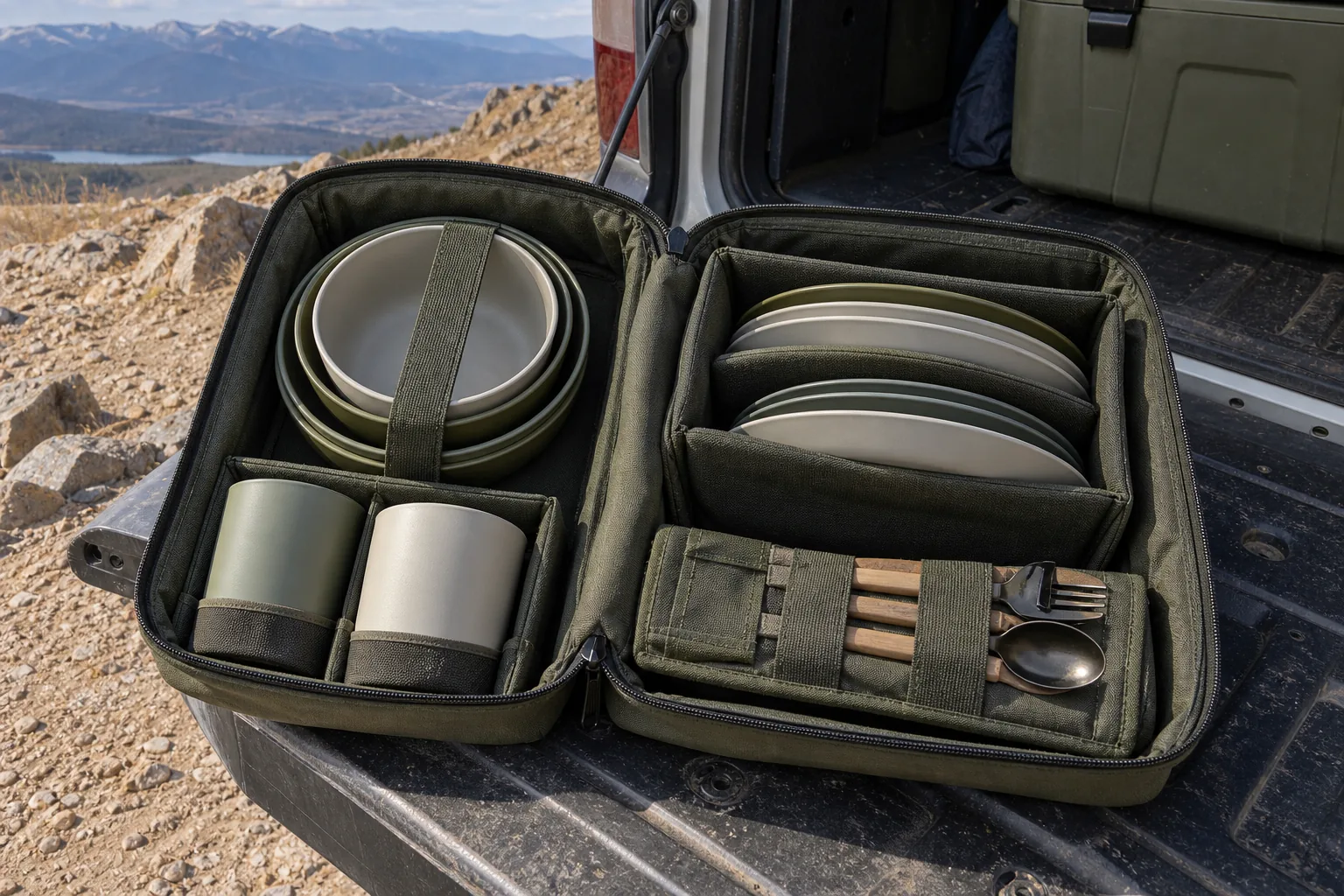
Apply the comparison to four common B2B programs
Family car-camping retail set
Equivalent individual settings and simple repacking often matter. Repeated plates and bowls may support counting, while one or two shared containers can nest separately. Use the family camping set allocation worksheet to keep personal and shared roles explicit.
A hybrid case can place identical plates vertically, stack or nest identical bowls according to profile, and isolate containers. The buyer should test whether an unfamiliar family can distribute and return the set without consulting a complex diagram.
RV and caravan assortment
Cabinet dimensions and access direction may dominate. A low, broad nested group can fit a drawer but waste a narrow shelf; a vertical plate rack can use height while making each plate accessible. Review the actual storage envelope and door clearance, not an abstract compactness claim.
Rattle during travel is also relevant, but no universal movement limit should be invented. Define the road-use scenario, packed orientation and observation method. Separate geometry issues from case and vehicle conditions when diagnosing noise.
Rental fleet or guided group
Fast counting, loss recognition and replacement can outweigh minimum pack volume. Identical stacked components can make missing pieces visible, while progressive nested sizes may require a printed or color-coded return system. Keep that operational material separate from food-contact evidence.
Ask staff to perform a return count with one component intentionally absent. If the pack still looks complete, revise the retention layout or inventory method. The exercise supports operating control; it does not establish durability or compliance.
E-commerce bundle
Sales-unit dimensions influence the carton plan, but transit outcomes depend on the finished package. A nested system can lower height while increasing footprint, and a stacked system can do the opposite. Compare realistic master-carton arrangements rather than assuming the smallest single dimension wins.
Product images, component list and received pack must agree. If a nested bowl is optional or a divider changes, update the BOM, artwork, instructions and evidence scope before shipment. A visual bundle must not promise accessories that are absent from the controlled sales unit.
Limitations, misuse boundaries and commercial risks
Nesting or stacking does not prove food-contact conformity, impact resistance, dishwasher suitability, stain resistance, heat resistance, leak resistance or flame suitability. Dinnerware must not be placed on a burner, stove, campfire or direct flame unless product-specific verified evidence expressly allows it. Pack efficiency cannot be used to infer cookware performance.
Concept images can illustrate order and access but cannot verify dimensions, materials, quantities, availability or test outcomes. Controlled drawings, BOMs, approved samples and project evidence govern the saleable product. Food, vehicles, furniture and landscape props shown in a scene are not included components.
Geometry changes can propagate commercially. A revised bowl taper can alter nesting depth, removal force, case clearance, carton dimensions and photography. A revised plate foot can change stack rise and abrasion contact. Treat every interface revision through formal change control.
Do not approve packaging before the final pack-out is stable. Early artwork based on a concept can become inaccurate after component or divider changes. Require a reconciled list linking the final BOM, drawings, sample revision, pack instruction, images and destination evidence.
Keep compliance evidence configuration-specific
Pack geometry is not a compliance conclusion. For EU-bound projects, start the evidence scope with Regulation (EC) No 1935/2004 and, where applicable to plastic components, Commission Regulation (EU) No 10/2011. These primary legal texts define broad food-contact obligations and plastics requirements; they do not certify a pictured concept.
For United States programs, reconcile the final substances and intended uses with the FDA framework for food-contact substances. Evidence must match each final food-contact component, formulation, color, decoration, food type, contact time and temperature condition. A report for one bowl cannot automatically cover a mixed set.
Keep textile cases, elastic, coatings, adhesives, inks and labels in the configuration record. Their evidence scope can differ from that of dinnerware, yet their placement may create contact or migration questions. Ask the responsible technical party to map each material and process to the destination-market requirement.
Procurement workflow: decide with a controlled worksheet
Step 1: freeze user and meal roles
List personal and shared functions, then assign a component and quantity to each. Remove pieces that have no defined role. This prevents a headline count from driving geometry.
Step 2: describe each pack relationship
Mark every subgroup as nested, stacked, vertical-racked, sleeved or separately retained. Add intended removal order and contact points. Identify interfaces shared by components from different sources.
Step 3: collect comparable measurements
Use the same reference planes and units. Record first-piece height, complete-quantity height, footprint and closed sales-unit envelope. Keep unknowns explicit instead of filling them with estimates.
Step 4: run handling and drying observations
Have representative users unpack, distribute, collect, wash as declared, dry and repack. Record sticking, confusion, water retention, rattle and closure interference without turning observations into unsupported performance claims.
Step 5: reconcile packaging and evidence
Confirm that the final BOM, pack drawing, case, carton, artwork, product images and evidence index all describe the same configuration. Repeat affected checks after any revision.
B2B buyer checklist
| Check | Question | Why It Matters |
|---|---|---|
| Program boundary | Are user count, meals, channel and destination markets fixed? | They determine which compactness and access trade-offs matter. |
| Component roles | Does every piece have an individual or shared function? | Undefined pieces distort count and pack comparisons. |
| Unique parts | Does nesting create several sizes that need separate replacement? | SKU and service complexity can offset volume savings. |
| Contact map | Where should parts touch, and which surfaces must not touch? | Contacts control rise, sticking, wear and stability. |
| Full quantity | Was the exact saleable count measured and handled? | Variation and lean accumulate beyond two samples. |
| Release | Can intended users separate damp and dry pieces safely? | Compact parts that cannot be released are not a usable solution. |
| Drainage | Can every hidden interface dry before repacking? | Residual water can transfer into adjacent pieces and the case. |
| Retention | Does each subgroup have a defined restraint and removal path? | The case must control movement without excessive compression. |
| Closed envelope | Were external sales-unit dimensions compared consistently? | Component-only dimensions do not determine carton efficiency. |
| Revision control | Will geometry, case and artwork changes trigger re-review? | One interface change can affect the complete pack and evidence. |
Sequential buyer FAQs
1. Is nesting always more compact than stacking?
No. Nesting can reduce the height of one subgroup, but the largest outer part can increase footprint and block adjacent zones. Compare the complete retained sales unit and realistic carton arrangement.
2. Can identical bowls nest?
They may partially nest if taper and contacts allow overlap, but identical appearance does not prove controlled release or rise. Review the full quantity, drawing and final sample.
3. Should a four-person set use four bowl sizes?
Only if those sizes have deliberate meal roles. Equivalent place settings usually call for equivalent components, while progressive sizes may suit shared-plus-personal functions.
4. What is the first measurement buyers should request?
Request the complete closed sales-unit envelope together with the controlled component list. Then collect subgroup footprints, first-piece heights, full-quantity heights and relevant overlaps.
5. How should buyers compare release?
Define the intended grip and action, then observe representative users with dry and damp final-configuration samples. Do not invent a universal force limit without a scoped method.
6. Can a concept image approve compatibility?
No. Compatibility to be confirmed by project sample and drawing. Images help discuss arrangement but do not establish dimensions, tolerances, material behavior or retention.
7. Does a lower pack automatically reduce shipping cost?
No. Footprint, protective structure, master-carton arrangement, mass, fulfillment route and carrier rules also matter. Use verified external package data for logistics decisions.
8. What should be frozen before artwork?
Freeze the component BOM, pack relationships, dimensions, retention, case, sample revision and destination evidence scope. Artwork should describe the same approved sales unit.
Request a nesting-versus-stacking specification review
Prepare the user count, meal matrix, controlled component list, proposed quantities, drawings or samples, desired nesting and stacking relationships, carry-system constraints, closed-pack target, materials, colors, decoration, destination markets, washing expectations, packaging channel and evidence needs. Mark unresolved values as “To be confirmed for the project.”
Send the pack-out comparison worksheet for a component and interface review. If alternatives are still open, use the project inquiry form to request a documented configuration discussion before samples, packaging or a written quotation are prepared.