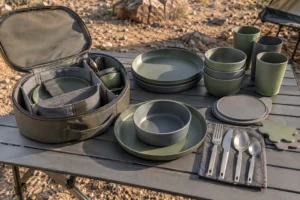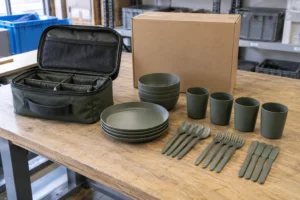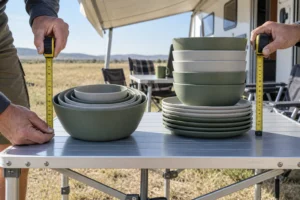
Prevent camping dinnerware rattle by controlling movement at every interface, not by simply tightening the carry case. Freeze the full component list, map every possible contact, establish deliberate clearance or separation, retain each stack without distortion, and review the complete packed sample in its intended orientation. Record the observed sound source and corrective action before approval.
How to prevent camping dinnerware rattle without hiding the cause
A nested set becomes noisy when components gain enough freedom to strike, scrape or chatter against another surface. The source may be plate-to-plate contact, a cup moving inside a bowl, cutlery touching a rigid wall, a loose lid, or the entire stack shifting inside an oversized case. Calling the set “PP,” “metal” or “silicone” does not identify which interface is responsible.
Buyers should diagnose the final saleable configuration because quantity changes the restraint condition. A sample with four plates can behave differently from the same case packed with three, and a missing lunch box can release a neighboring stack. The inspection record therefore needs a configuration ID, revision, piece count and packing sequence.
The practical objective is not absolute silence under every possible movement. It is a repeatable pack whose observed movement and sound remain within the buyer’s defined acceptance boundary during representative handling. That boundary must be agreed for the program rather than inferred from a photograph or a material description.
Build a rattle-risk diagnostic sheet before changing parts
| Diagnostic field | Buyer observation | Evidence to retain | Decision use |
|---|---|---|---|
| Configuration | Component IDs, revisions and full quantities | Controlled BOM and packed-set photograph | Prevents a fix being approved against the wrong bundle |
| Closed orientation | Face-up, edge-up or carry position | Orientation image and handling note | Shows whether gravity changes contact |
| Trigger motion | Lift, carry, place, turn or defined manual movement | Short method record | Makes observations repeatable |
| Sound character | Single knock, repeated chatter, scrape or cutlery ring | Operator note linked to the sample | Narrows the likely interface |
| Suspected source | Named component pair or case zone | Contact map and removable witness material if used | Directs the next controlled change |
| Free movement | Direction and approximate location | Open-case observation | Separates local part movement from whole-stack migration |
| Temporary isolation | Separator, restraint or quantity change used only for diagnosis | Before-and-after configuration record | Tests one hypothesis without changing every variable |
| Permanent proposal | Geometry, sleeve, pad, pocket or pack-sequence revision | Drawing and sample revision | Turns an observation into a controlled engineering action |
| Side effect | Access, cleaning, drying, pack height or deformation impact | Follow-up review | Stops a quiet pack from creating a worse user problem |
Use descriptive observations before reaching for a sound meter. A meter can quantify a defined acoustic method, but a number without a controlled distance, room, background level, motion and sample orientation is not comparable. Most sourcing teams first need a reliable way to find the moving interface and confirm that a proposed restraint has not introduced deformation or hygiene concerns.
Step 1: freeze the exact nested configuration
List every plate, bowl, cup, lid, lunch box, utensil, separator and carry-case element in the reviewed pack. The published camping dinnerware component worksheet can help assign a use role and quantity to each item. Keep optional modules outside the base configuration until they receive their own diagnostic record.
Define the nesting order from the lowest component upward. Record which rims, walls, feet, handles, lids and decorative surfaces can approach one another. If two nominally similar pieces have different revisions, colors or processes, identify them separately because surface texture and dimensional variation may change the interface.
Photograph the completed stack before it enters the case and again after closure. A stable arrangement that changes during closure may indicate interference from a lid, zipper panel or compressible case wall. A configuration that is already loose on the table requires component-interface work before the case can be blamed.
Step 2: distinguish impact, sliding and whole-pack movement
A sharp intermittent knock usually points to clearance that permits one part to accelerate before contact. Repeated light chatter often comes from several similar interfaces, such as nested rims with inconsistent separation. A scrape suggests sustained relative movement under contact pressure, while a metallic ring can direct attention to loose cutlery or metal-to-metal contact.
These descriptions are diagnostic clues, not universal acceptance categories. Confirm the source by immobilizing only the suspected component pair with a temporary neutral separator, then repeat the same movement. If the sound remains, restore the original condition and isolate another interface rather than stacking multiple uncontrolled changes.
Whole-pack movement has a different signature. The nested group may remain internally stable but shift against the case wall when the set is turned or carried. Mark the stack’s initial position, perform the defined motion, reopen the case and compare its location without presenting the result as a transport-test claim.
Step 3: map every contact and near-contact interface
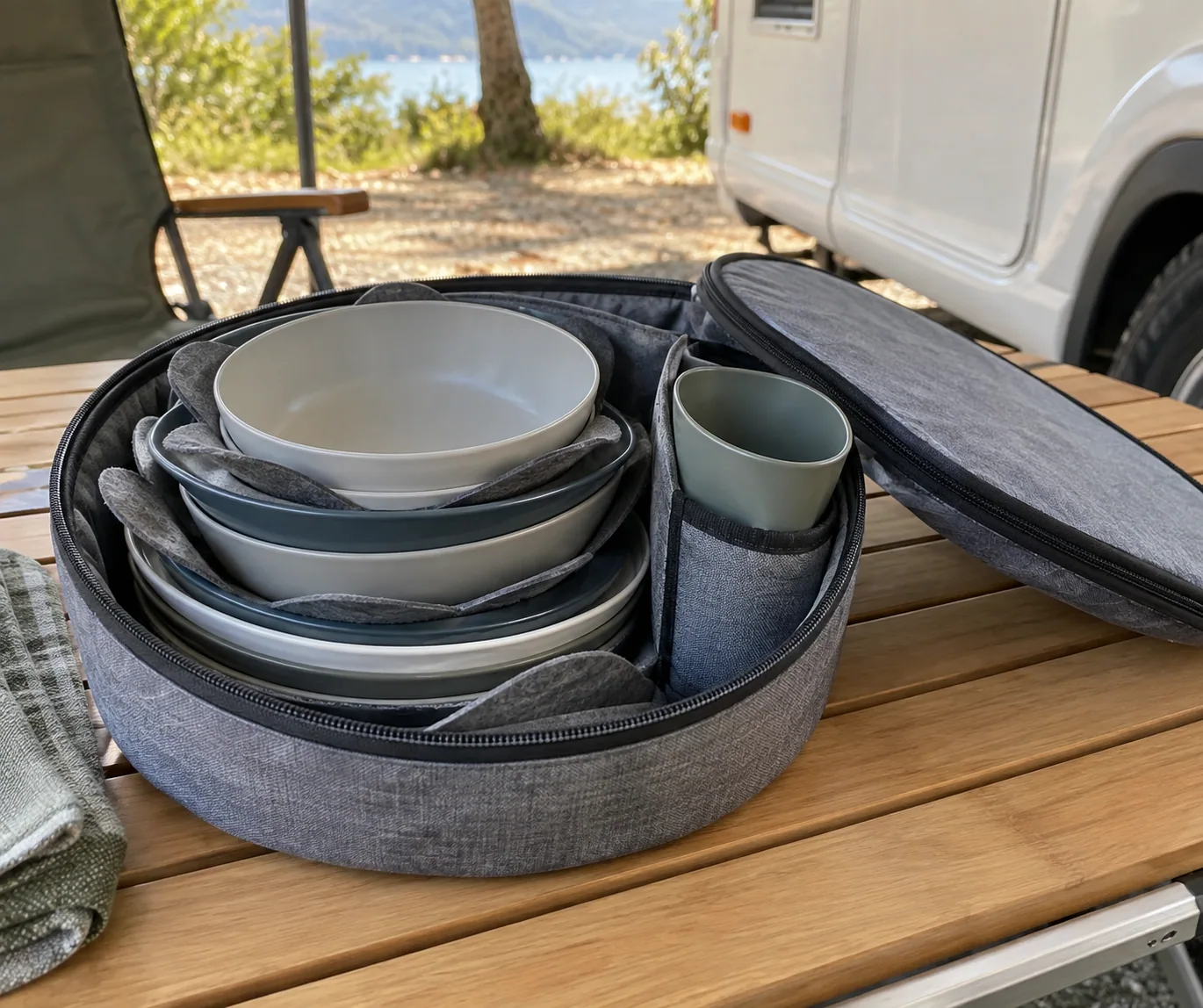
Create a simple interface map using component pairs rather than vague areas. Examples include plate rim to plate face, bowl foot to bowl interior, cup wall to bowl wall, lid edge to container, utensil handle to case shell, and complete stack to divider. For each pair, classify the intended condition as clearance, supported contact, separated contact or restrained contact.
Clearance must be large enough to prevent unintended contact through the declared movement and dimensional variation. Supported contact needs a stable load path that does not concentrate force on a fragile edge or decoration. Separated contact relies on a controlled intermediate material, while restrained contact depends on a sleeve, pocket, strap or formed geometry.
Do not accept “they do not touch in CAD” as the whole answer. Drawings use nominal geometry, while real components and soft cases vary. Compatibility to be confirmed by project sample and drawing, with the final quantity and all permanent separators installed.
Step 4: review nesting clearance without creating loose travel
Nesting needs enough radial and vertical clearance for reliable insertion, removal and dimensional variation. Too little clearance can wedge parts, abrade surfaces or prevent the full quantity from seating. Too much clearance allows lateral travel and repeated rim impact when the stack moves.
Review the nesting versus stacking comparison together with the interface map. A progressive nest may save height yet create many rim contacts, while a repeated stack can be taller but easier to separate with dedicated pads. The correct decision depends on the complete component and case architecture.
Measure the full stack in relaxed condition and after representative packing, but do not force components deeper to obtain a smaller envelope. Look for uneven seating, rocking, visible point contact and recovery after release. If one component consistently sits proud, investigate geometry and quantity instead of hiding it under case compression.
Step 5: choose separators for a defined job
A separator may prevent hard contact, add friction, fill limited clearance or protect a decorated face. Those functions require different material and geometry choices. Buyers should specify which interface the separator controls, whether it is permanent or removable, and how users will recognize its correct position.
Loose discs can be simple but may be misplaced during use. Sewn sleeves remain with the case but must match the final profile and permit cleaning and drying. Molded ribs can locate components without an extra loose part, although their geometry, draft, surface and tooling implications need a separate feasibility review.
Do not describe an unidentified foam, textile or elastomer as food safe, antibacterial, washable or heat resistant. If it may contact a food-contact surface, include that relationship in the risk and evidence review. Unknown material, thickness, color, attachment method and cleaning instruction should be marked “To be confirmed for the project.”
Step 6: restrain stacks without distorting dinnerware
Retention should remove free travel while allowing normal release. An elastic strap, compression panel or fitted pocket can hold a nested group, but excessive load may bend thin components, mark a surface, deform a lid or make the case difficult to close. The approved condition needs a defined adjustment position rather than operator judgment alone.
Check the restraint with the full quantity and with the service-replacement conditions the buyer expects. If one plate is missing, a fixed strap may no longer control the remaining stack. A stepped pad, adjustable buckle or separate sleeve may manage quantity variation, but each adds parts, assembly steps and cleaning considerations.
Observe the release path. Users should not need to flex a plate sharply, drag a decorated face through abrasive fabric or place fingers near a knife edge. Rattle reduction is not successful if it creates an unsafe or frustrating unpack sequence.
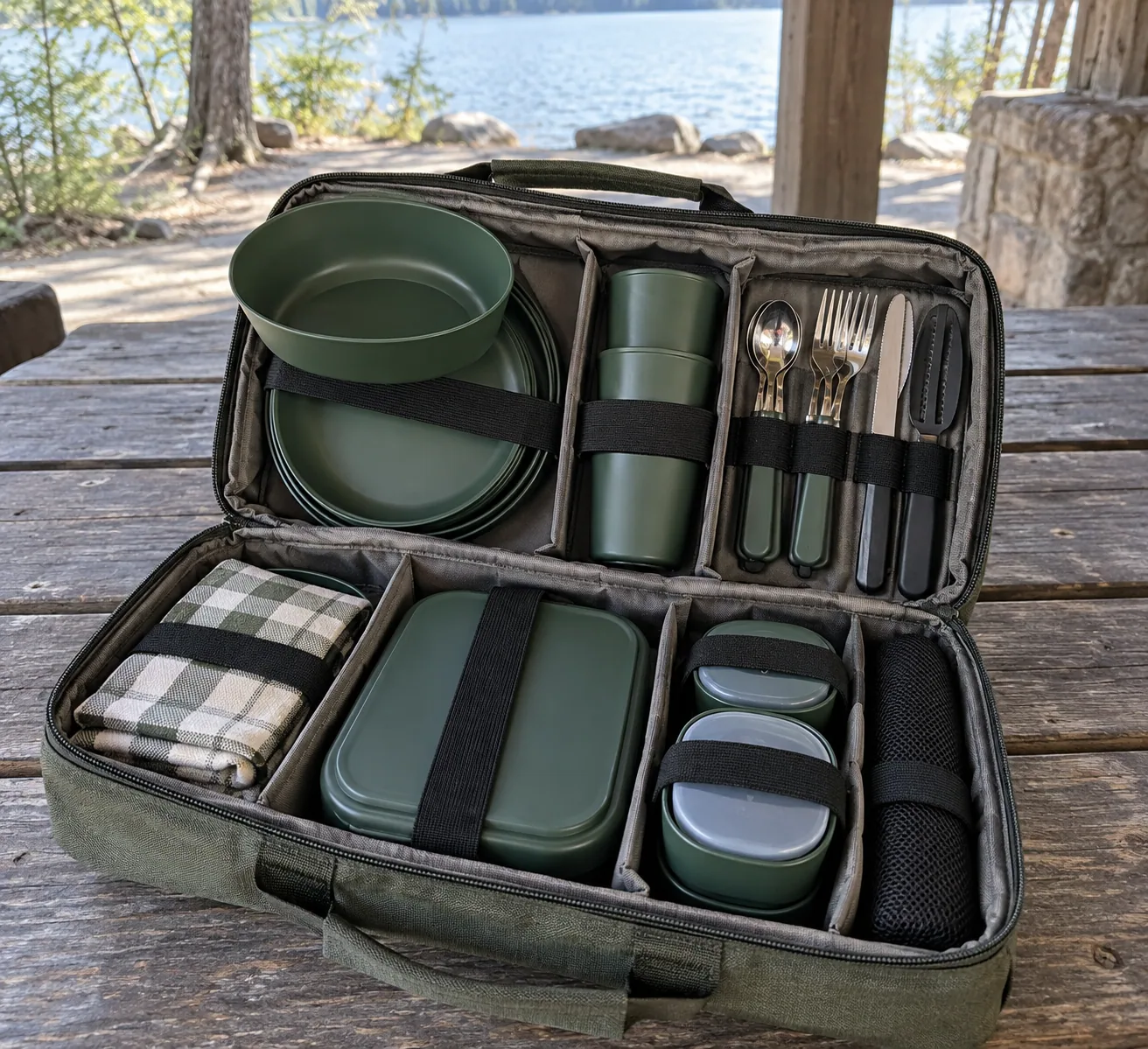
Step 7: isolate cutlery, lids and other high-frequency sources
Cutlery can produce a prominent sound even when the main dinnerware stack is stable. Keep knife, fork and spoon groups in fitted loops, a roll, a sleeve or a hard compartment that controls handle and working-end movement. Confirm that retention works with the approved utensil length, handle section and finish.
Lids deserve their own interface review because clips, seals and loose inserts may move independently. A lid nested between plates can also create a new contact path that was absent in the component-only sample. Record whether each lid is attached, separately retained or nested, and do not claim leak resistance without a scoped validation method.
Serving tools, bottle openers and accessories should not be added to an existing pocket only because space appears available. Their edges, mass and geometry can change noise, abrasion and access. Treat every added piece as a controlled configuration revision.
Step 8: control the case cavity and closure
The case should support the packed architecture rather than merely surround it. Map side clearance, lid clearance, corner voids and the location of compressible panels. A soft shell may appear fitted on the table yet allow the entire pack to swing when carried by its handle.
Compare the closed envelope with the camping tableware pack-volume worksheet. Adding a restraint panel can increase pack height, while removing voids can reduce movement but restrict finger access or drying. Record both effects so the team does not trade an audible problem for an unmeasured packaging problem.
Close the zipper or latch through its normal path. If an operator must press heavily on the case to engage it, document the interference and stop the review. Forced closure can temporarily silence loose parts while loading components in a condition that the design did not intend.
Use one-change-at-a-time diagnosis
Start from a documented baseline and change only one interface. Add one temporary separator, adjust one retention point or remove one suspect accessory, then repeat the same motion. Record whether the target sound stopped, changed location or remained unchanged.
If several changes are made together, the team cannot know which one worked or which created a side effect. A quiet result may be credited to a pad when the real cause was a different packing order. Controlled diagnosis reduces unnecessary components and makes the permanent specification easier to audit.
After identifying the source, replace the temporary aid with a project-appropriate design proposal. Update the drawing, BOM, packing instruction and sample revision together. Never leave an improvised pad or tape in a quotation sample without declaring it.
A practical movement review for buyer samples
| Review stage | Controlled action | What to observe | Stop or investigate when |
|---|---|---|---|
| Bench baseline | Move each nested group gently by hand while outside the case | Rocking, rim contact, scrape and release | A component wedges, deforms or has uncontrolled travel |
| Open-case check | Place every group in its assigned zone | Fit, grip clearance, restraint engagement and loose accessories | Parts require forcing or occupy an unapproved location |
| Normal closure | Close the case using the documented sequence | Bulging, displaced dividers and closure effort | Closure depends on abnormal compression |
| Lift and carry | Lift by the intended handle and walk the agreed short route | Single knock, repeated chatter, scrape or whole-pack shift | The method cannot be repeated or the source is unclear |
| Orientation change | Place the case in each intended storage orientation | Migration after gravity changes | A retained group releases or sharp parts move |
| Access cycle | Unpack, distribute, return and close | Misplacement, missing-piece behavior and user sequence | Correct packing is not obvious or components are damaged |
| Post-cleaning review | Repeat only after the declared cleaning and complete drying | Changed friction, pad shape, elastic recovery and fit | The cleaning condition was not defined or parts remain wet |
This is a buyer diagnostic sequence, not a standardized transport test. Define the number of cycles, route, orientation and acceptance language for the specific project. If formal distribution simulation is required, select an appropriate protocol with qualified packaging personnel and test the final packaged configuration.
Connect the diagnostic to distribution evidence
The International Safe Transit Association procedure index shows that distribution evaluations are scoped by package and route conditions. It does not establish that a quiet hand-carried sample will survive shipment, nor does it certify the set shown here. Use it to frame a separate packaging decision after the internal component interfaces are controlled.
Carrier guidance also treats the finished package as the shipping object. The official UPS dimensions and weight guidance and USPS physical standards help buyers understand why final outer geometry and service rules matter. These sources do not provide a rattle acceptance limit for dinnerware.
Keep internal product review, retail-pack protection and shipper-carton validation as linked but separate records. A divider that controls plate chatter may not cushion the retail unit inside a master carton. Conversely, external cushioning cannot correct cutlery moving freely inside the carry case.
Apply different controls to different program scenarios
Family retail sets
Family sets often contain repeated plates, bowls, cups and utensils, so quantity visibility and return sequence matter. Dedicated zones and countable retention can reduce movement while helping customers rebuild the set. Review the pack with every advertised piece present and with realistic user replacement scenarios.
RV and caravan storage
RV storage may expose the closed set to repeated low-level movement in different orientations. The buyer should define the intended cupboard or drawer position and review whether the whole pack shifts internally. Do not convert a short handling observation into a vehicle-vibration performance claim.
Rental and guided programs
Rental operators may value fast missing-piece identification more than minimum cube. Sleeves, loops and shaped pockets can reveal an empty position, but they must also tolerate the agreed cleaning and return process. Replacement parts need the same geometry and revision control as the approved set.
E-commerce bundles
An e-commerce bundle needs internal component control plus outer-package planning. The buyer should confirm that product imagery, component list, carry-case arrangement and shipper configuration describe the same unit. A quiet display sample is not evidence that the mailed package has passed a distribution protocol.
Limitations and misuse boundaries
Sound perception varies with room, background noise, operator motion and listener expectation. Avoid unsupported statements such as “silent,” “noise-free” or “rattle-proof” unless the project has a documented method, acceptance criterion and representative evidence. A diagnostic observation should name its conditions.
Added friction is not always beneficial. Soft coatings or pads can retain moisture, collect debris, transfer color or change after cleaning. Any food-contact relationship, cleaning claim or durability claim needs material-specific and final-configuration evidence.
Dinnerware remains separate from cookware. A plate, bowl, cup, separator or carry case must not be placed on a burner, stove, campfire or direct flame unless product-specific evidence expressly supports that use. Rattle control does not change the thermal-use boundary.
Concept images on this page illustrate contact, separation and retention ideas. They are not factory photographs, customer orders, inspection results or proof that a pictured configuration is available. Final products, materials, dimensions and compatibility are to be confirmed for the project.
B2B buyer checklist
| Check | Question | Why It Matters |
|---|---|---|
| Configuration control | Does the reviewed sample match the released BOM and full quantity? | Rattle behavior changes when pieces or revisions change |
| Nesting order | Is the placement sequence written and visually clear? | Different sequences create different contacts |
| Interface map | Which component pairs may strike, slide or scrape? | A named source supports a targeted fix |
| Clearance | Is clearance controlled across realistic variation? | Nominal CAD separation may disappear in samples |
| Separators | What job, material, thickness and location does each separator have? | Loose unspecified pads create evidence and service risks |
| Retention | Does the restraint remove travel without deforming parts? | Excess compression can create damage or poor access |
| Cutlery and lids | Are small hard components independently secured? | They can dominate the sound even when stacks are stable |
| Case cavity | Can the complete pack migrate in any intended orientation? | Whole-stack movement needs a case-level correction |
| Cleaning state | Was the review repeated after the declared cleaning and full drying? | Friction and textile behavior may change |
| Evidence language | Does every claim state the method and sample revision? | Prevents an observation becoming an unsupported guarantee |
Procurement recommendation: approve the interface record
Ask each bidder to submit the same four linked outputs: controlled component matrix, nesting and case map, diagnostic observation sheet, and proposed permanent control. The submission should identify every unresolved field rather than hiding it behind general statements about quality. Compare proposals by how clearly they control interfaces and side effects.
Review changes in a full packed sample. Confirm normal closure, access, component return, quantity variation and post-cleaning behavior before releasing packaging artwork. If a new pad, sleeve, rib or case panel is proposed, add it to the BOM and drawing set with material and cleaning requirements.
Request a written quotation only after the chosen architecture is defined. MOQ, price, tooling route, timing and availability are not supplied by this guide and must be confirmed for the project. To start a controlled review, send Naike Dinner your component and case brief.

Sequential buyer FAQs
1. Should a nested camping dinnerware set be completely silent?
Do not use an undefined absolute promise. Establish representative motions, orientations, environment and an agreed descriptive or measured acceptance boundary. The goal is controlled performance under the documented project method.
2. Is a tighter nest always quieter?
No. Too little clearance can wedge parts, increase rubbing or make release difficult, while too much clearance can permit impact. Review nominal geometry, variation, full-quantity seating and the final case restraint together.
3. Can a fabric disc solve plate chatter?
It may isolate one interface, but its job, material, thickness, location, retention, cleaning and food-contact relationship need control. A temporary diagnostic pad should not silently become an undeclared production component.
4. How should cutlery be packed?
Use a fitted loop, sleeve, roll or compartment matched to the approved utensil geometry. Keep sharp working ends controlled and confirm that the user can remove and return each piece without over-stretching or abrasion.
5. What if the pack becomes noisy when one piece is missing?
Document whether partial quantity is an intended service condition. If it is, evaluate adjustable retention, stepped fillers or separate sleeves; if not, make the complete-pack requirement clear. Compatibility remains subject to the project sample and drawing.
6. Does a quiet hand-carry check replace transit testing?
No. It helps diagnose internal movement during a defined buyer review. Distribution simulation, carton strength and carrier handling require a separately selected method applied to the final packaged configuration.
7. When should the rattle review be repeated?
Repeat it after any change to component count, geometry, material, decoration, separator, retention, case, cleaning instruction or packing sequence. Link the result to the new revision so an obsolete approval cannot follow a changed set.
Request a nested-set diagnostic review
Provide the intended users and meals, controlled component list, drawings or sample photographs, nesting order, carry-case architecture, intended storage orientations, cleaning method, destination markets and the exact sound or movement concern. Include any proposed separator or restraint and identify whether the project needs a descriptive buyer check or a separately scoped formal test.
Request a component-interface and packed-sample review. Naike Dinner can evaluate the information supplied and identify fields that still require written confirmation; availability, dimensions, materials, MOQ, price, tooling, lead time, compatibility and claims remain subject to the final project record.