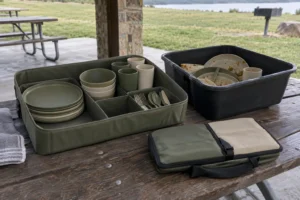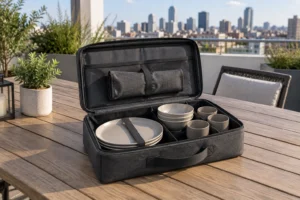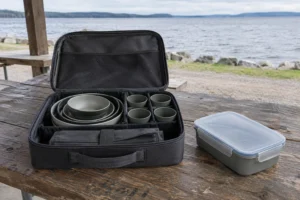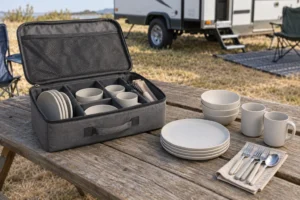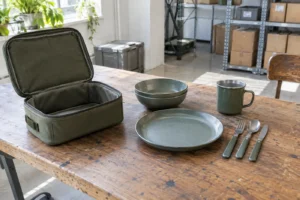
Camping dinnerware separation needs two controlled flows, not merely two pockets. Separate clean and used pieces by protecting ready-to-use items in a closed dry zone, moving every used item into a removable washable return liner, and preventing either route from crossing during service. Approve the system only after a loaded sample demonstrates access, containment, washing, complete drying and repeatable repacking.
This guide gives buyers a clean/used handling-flow diagram, a zone specification and an approval checklist. The images are configuration concepts rather than verified Naike Dinner products, test records or hygiene claims. The useful output is a workflow tied to the buyer’s actual components, food use, water access and cleaning instructions.
Define the camping dinnerware separation boundary
“Clean” should mean ready for the next intended food-contact use under the program’s written handling procedure. “Used” includes any plate, bowl, cup, utensil, lunch-box part or liner that has contacted food, hands, the ground or wash water and has not completed the approved clean-and-dry cycle. A piece does not become clean because visible crumbs were wiped away.
The CDC’s food-safety prevention guidance organizes safe handling around clean, separate, cook and chill, including washing utensils and keeping contamination routes apart. For outdoor use, USDA camping food-safety guidance says to plan equipment, bring safe water when necessary and avoid reusing platters or utensils that held raw foods for cooked foods. These sources guide the handling logic; they do not certify a bag, liner or dinnerware set.
Define the boundary on a component list. Include every food-contact part, removable lid, divider, utensil sleeve, drying accessory, clean-zone insert and used-item liner. If the set also contains cookware, raw-food preparation tools or waste bags, keep those routes separate from dinnerware rather than assuming one “dirty side” solves every risk.
Use a six-step clean/used handling flow
| Step | Clean route | Used route | Approval evidence |
|---|---|---|---|
| 1. Depart | Dry pieces are counted and secured in the protected zone. | Return liner is empty, dry and separately folded. | Pack-out photograph and count record. |
| 2. Set the table | Only required pieces leave the clean zone; remaining pieces stay protected. | Return zone opens without touching clean food-contact surfaces. | Observed access sequence. |
| 3. Collect | No clean piece is placed on the collection surface. | All used pieces go directly into the removable liner or designated tub. | Handoff observation and contact map. |
| 4. Transport to wash | Clean compartment remains closed and dry. | Used items are contained without forcing, leakage claims or contact with clean items. | Loaded closure and movement check. |
| 5. Wash and dry | Only completely cleaned and dried parts can re-enter. | Liner and case surfaces follow their own clean-and-dry instructions. | Cleaning instruction and visual/touch check. |
| 6. Repack | Count, orientation and condition are verified before closure. | Return zone is empty and dry before storage. | Repack sign-off linked to the sample revision. |
This camping dinnerware separation flow is deliberately one-way during service. If a user must reach across the used zone to retrieve a clean cup, or must place a damp liner on clean plates to close the case, the architecture has failed even if the pieces technically fit. Compare this sequence with the site’s repeatable pack-out instruction and add a separate return route rather than overwriting the outbound steps.
Specify the two zones as functional assemblies
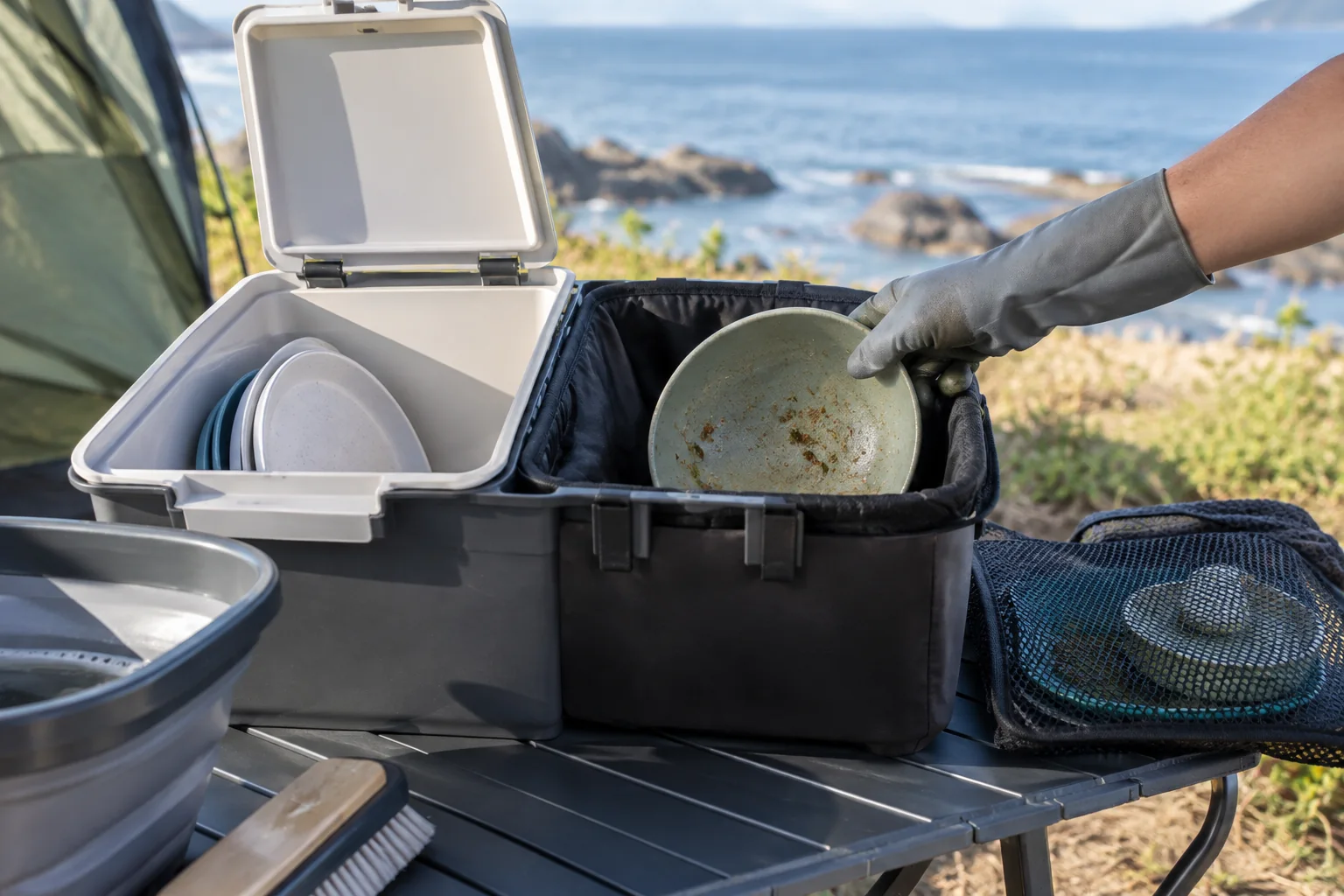
Effective camping dinnerware separation needs more than a light-colored clean zone. Specify whether food-contact surfaces face inward, whether the compartment closes independently, how utensils avoid exposed tips, and whether the interior can be inspected and cleaned. A rigid divider may improve separation but can trap residue at seams; a removable insert may improve access but needs a retention method that works when the case is carried.
The return zone should be removable or otherwise accessible for complete cleaning and drying. Record its opening, seam construction, closure, wet-load behavior and relationship to the case base. Do not call a textile liner waterproof, leakproof, antimicrobial or food-safe from appearance. Those are product-specific claims requiring appropriate evidence and intended-use scope.
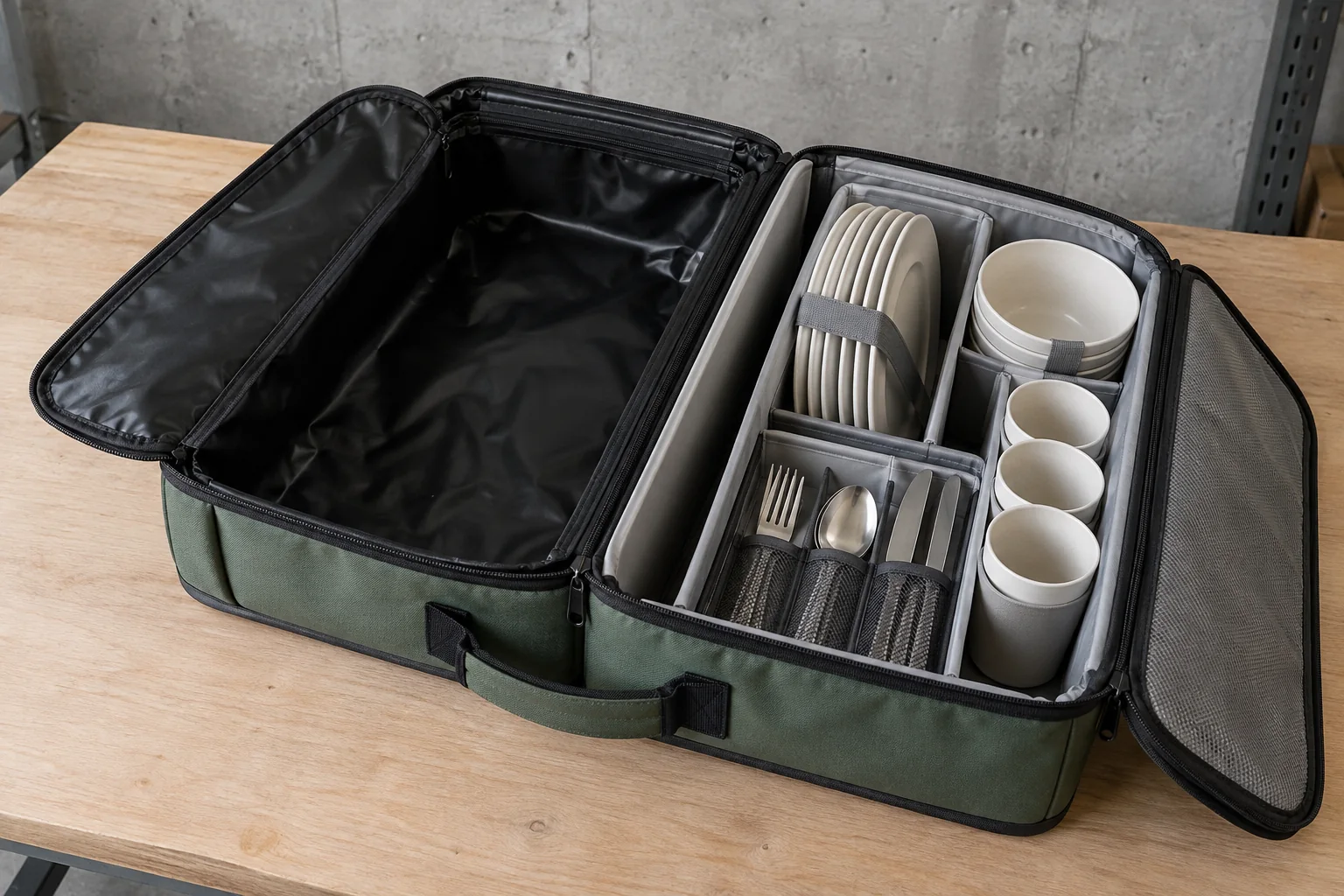
A dual-zone case can still fail because the zipper paths overlap, the used liner must pass over clean utensils during removal, or the case cannot stand open on the intended table. Use the carry-case opening review sheet to verify the real open footprint, access side and component lift-out path.
A camping dinnerware separation plan is useful only when its zones match the real meal, collection and wash sequence.
Choose the separation method for the real scenario
| Scenario | Preferred handling hypothesis | Main risk to review |
|---|---|---|
| Family car camping | Closed clean tray plus removable used-item tub carried to a wash point. | Children or multiple users returning pieces to the wrong zone. |
| RV or caravan pitch | Clean module stays in the vehicle; used pieces move in a washable caddy. | Damp repacking before complete drying. |
| Rental or event fleet | Color- or geometry-distinct return module with count control. | Missing pieces and inconsistent cleaning ownership. |
| Day picnic without a wash point | Used liner closes for return; clean compartment remains isolated. | Unverified leakage and overfilling. |
| Raw-food cooking program | Separate preparation tools and raw-food route in addition to dinnerware return. | Cross-contamination from treating all used items as one category. |
USDA’s cleanliness guidance advises outdoor users to take sufficient clean utensils and not reuse platters or utensils that held raw product for cooked food. A buyer should translate that principle into the intended kit workflow, not make a generic “hygienic” product claim.
Review camping dinnerware separation as an operating process, not as a color or styling feature.
Limits and predictable failure modes
Separation is not sanitation. A divided bag cannot replace safe water, an appropriate washing method, a validated sanitizing step where required, or full drying. The FDA Food Code is a model for retail and food-service regulation rather than a consumer camping-product certificate, but its treatment of clean utensils and protected storage illustrates why washed items should not be returned to contamination-prone locations.
Moisture is a common hidden failure. A used liner may be washed but still damp; a cup may retain water at its base; a textile divider may absorb a spill. If the closed case traps moisture, the clean/used distinction becomes unreliable for storage. Define an air-dry state and an inspection point before repacking rather than promising a drying time that has not been measured.
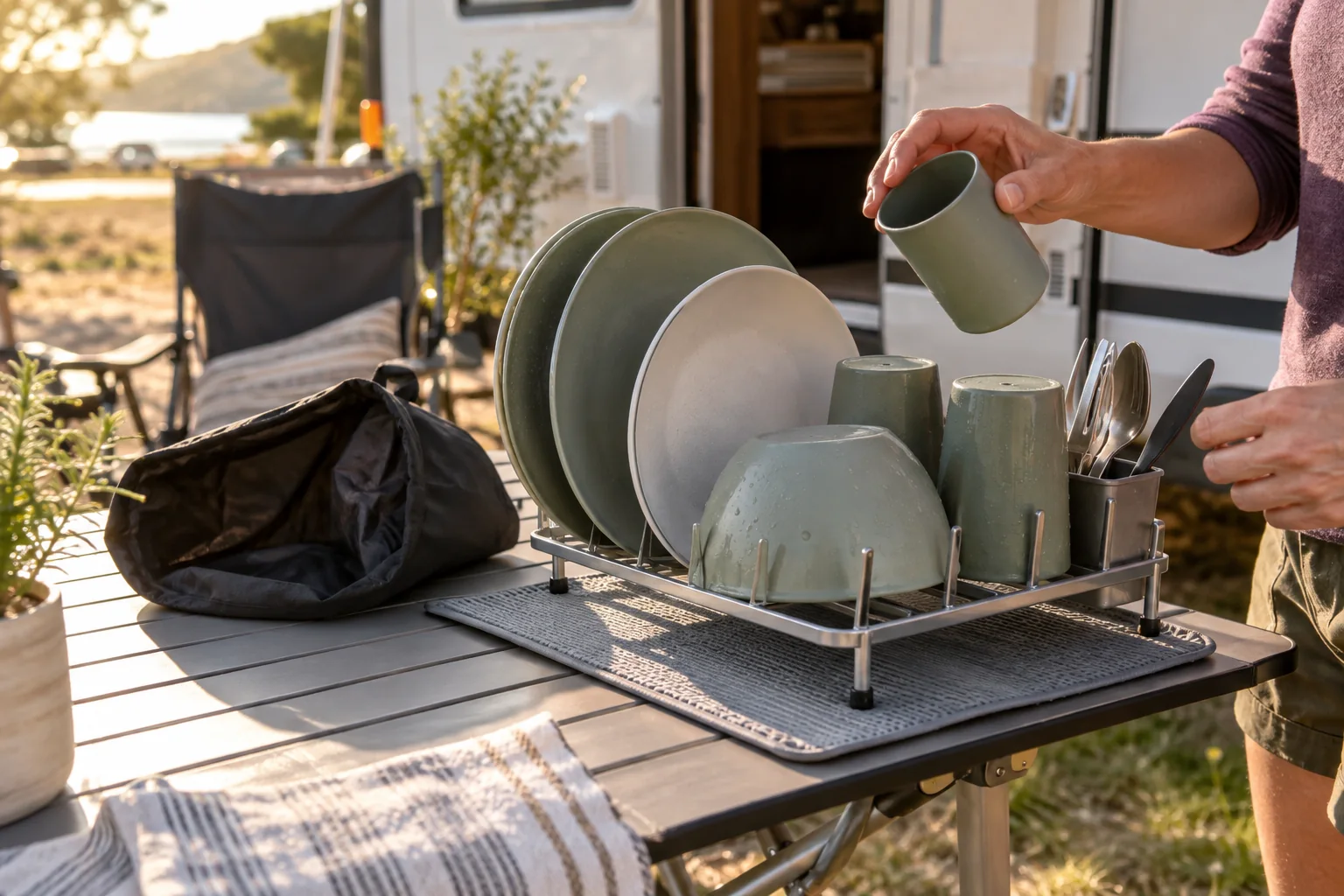
Another failure is ambiguous ownership. At group meals, one person may collect pieces while another retrieves clean items. Use distinct openings, tactile differences or controlled colors, but verify that the distinction is understandable without relying only on printed labels. Never invent a universal color rule; document the instruction for the actual market and sample.
The sample review must show whether camping dinnerware separation still works when the proposed case is fully loaded.
Run a sample review before approving the case
Test camping dinnerware separation with the final revision of every component. Photograph the empty zones, then load the clean side according to the proposed pack-out. At the table, remove one place setting at a time, place simulated used pieces into the return zone, close and carry the system, and inspect every potential contact point. Use ordinary harmless food residue only under a controlled internal review procedure; do not turn the result into a food-safety certification.
After washing, inspect each piece and the liner before repacking. Record whether surfaces are clean to sight and touch, whether the liner can be turned out, whether seams are accessible, and whether everything can dry without touching the ground or clean food-contact surfaces. Repeat the sequence with the fullest intended component configuration because spare or optional pieces change access and volume.
Use the following questions to turn camping dinnerware separation into a controlled buyer decision.
B2B buyer checklist
| Check | Question | Why It Matters |
|---|---|---|
| Boundary | Which exact parts are clean, used, raw-food tools or waste at each step? | Prevents one vague “dirty zone” from hiding different risks. |
| Independent access | Can either zone open without crossing or unloading the other? | Protects remaining ready-to-use pieces during service. |
| Return liner | Can it be removed, inspected, cleaned and fully dried? | A fixed inaccessible pocket may retain residue or moisture. |
| Contact map | What touches when the case is full, carried and reopened? | Fit alone does not demonstrate separation. |
| Instructions | Does the pack-out show both outbound and return sequences? | Users need a repeatable flow, not only a beauty photograph. |
| Evidence | Which claims are supported for each finished material and component? | Avoids converting an illustrated concept into an unverified hygiene claim. |
Buyer FAQs
1. Is a two-color bag enough to separate clean and used pieces?
No. Color may help users, but independent openings, controlled contact surfaces, a washable return route and clear instructions determine whether the flow is workable.
2. Can used dishes return in the original clean compartment?
Only if the approved procedure changes that compartment’s status and requires it to be cleaned and dried before reuse. A removable return liner is often easier to control, but it still needs sample review.
3. Should leftover food go into the dinnerware return liner?
No assumption should be made. Define food storage, waste and tableware routes separately. Perishable leftovers also need the appropriate temperature-control plan.
4. Does a waterproof-looking liner prove leak containment?
No. Material appearance, coated fabric and taped-looking seams do not prove a leakage claim. State the intended use and request product-specific evidence or a scoped sample trial.
5. When can washed pieces re-enter the clean zone?
After the applicable cleaning procedure is complete and the pieces and storage surfaces are fully dry and ready for the next intended use. Record this as a repack checkpoint.
6. What should the RFQ include?
Provide the component matrix, clean/used flow, case drawing, intended food and cleaning conditions, target markets, required artwork and the sample observations you expect the supplier to return.
Request a clean/used workflow sample review
Send the component list, case concept, intended meal setting, water and washing assumptions, target markets and required return sequence through the Naike Dinner inquiry page. Ask for a written response separating verified existing capabilities from development questions and identifying which interfaces require drawings or samples.
For a controlled comparison, request two configuration proposals: a removable return-liner version and a separate wash-caddy version. Compatibility, materials, dimensions, MOQ, price, lead time and tooling feasibility must be confirmed for the project rather than inferred from these images.