A camping dinnerware transport scuff test should compare the same identified surfaces before packing and immediately after the defined transport route. Map every contact interface, keep load, divider and orientation records, and classify change without guessing its cause. The result supports a packaging decision; it does not prove universal abrasion resistance or product life.
Surface marks found after transport can come from component-to-component contact, hard particles, loose cutlery, divider edges, strap hardware or an unstable pack. A useful review therefore begins with traceability, not a verdict. This guide provides a before/after contact and abrasion map for packed camping dinnerware. It concerns dinnerware surfaces and pack interfaces; cookware coatings and heated-use performance require a separate evidence plan.
Define the transport route and evidence boundary
Record what actually happened: sample identity, approved BOM revision, initial condition, packing sequence, dividers, total packed mass, orientation, handling route and unpacking time. If the route is a courier simulation, truck transfer, manual carry or internal shake review, name it precisely. Do not label an informal route as an ISTA or other standardized procedure.
| Scope item | Record before movement | Decision use |
|---|---|---|
| Samples | Unique sample IDs and component positions | Prevents mixing surfaces between units. |
| Pack state | BOM, divider map, restraint and closure | Links a mark to the approved configuration. |
| Route | Stages, duration, orientations and handlers | Defines where the observation applies. |
| Surface baseline | Lighting, viewing distance and photographs | Separates pre-existing marks from new change. |
| Acceptance rule | Buyer-approved visual classes and critical zones | Avoids inventing pass/fail after the event. |
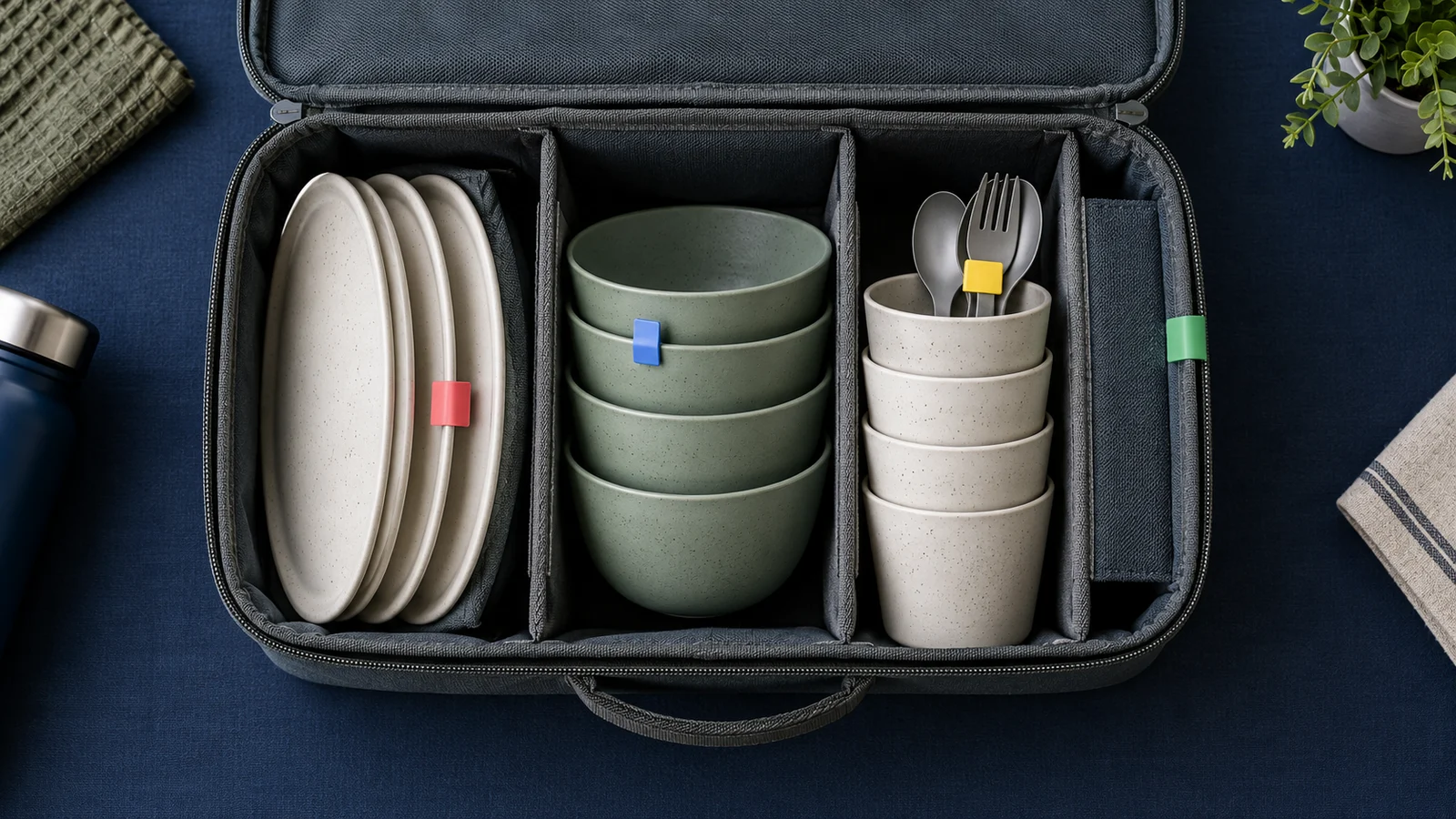
Map eight contact zones before packing
| Zone | Likely interface to document | Evidence to keep |
|---|---|---|
| 1. Plate face | Plate base or divider against eating surface | Position, separator and clean baseline image |
| 2. Plate rim | Adjacent rim, case wall or strap pressure | Clock position and rim-to-rim clearance |
| 3. Bowl interior | Nested bowl base | Nesting order and pad location |
| 4. Bowl foot | Lower bowl interior or tray | Foot-ring image and load direction |
| 5. Cup wall | Divider, handle or adjacent cup | Cup orientation and contact witness |
| 6. Cup rim/handle | Cutlery or closure hardware | Clearance and restraint route |
| 7. Cutlery pocket | Loose metal or hard utensil edges | Pocket closure and piece count |
| 8. Case/divider edge | Textile seam, hook-and-loop or rigid insert | Edge finish and component alignment |
Use the same zone names on photographs, inspection sheets and corrective-action records. A map is most useful when it points to a physical interface that packaging or component teams can change.
Run a controlled before-and-after comparison
- Clean and condition samples only according to the agreed preparation; record any deviation.
- Inspect each zone under the same lighting and viewing geometry. Photograph pre-existing marks.
- Pack by the written sequence. Record who packed it and photograph each separator or restraint.
- Apply only the defined route. Keep intermediate orientation or handling records where relevant.
- Unpack without wiping the surfaces. Preserve loose particles or displaced dividers for review.
- Reinspect with the same light, angle and distance. Pair before and after images by sample and zone.
- Classify change using the pre-agreed visual rule, then assign cause only when the interface evidence supports it.

A simple coverage calculation
For four packed samples, two defined transport runs and eight mapped zones, the review contains 4 samples × 2 runs × 8 zones = 64 paired zone comparisons. This is an inspection workload calculation, not a statistical assurance statement. Increase samples or routes only for a documented risk reason.
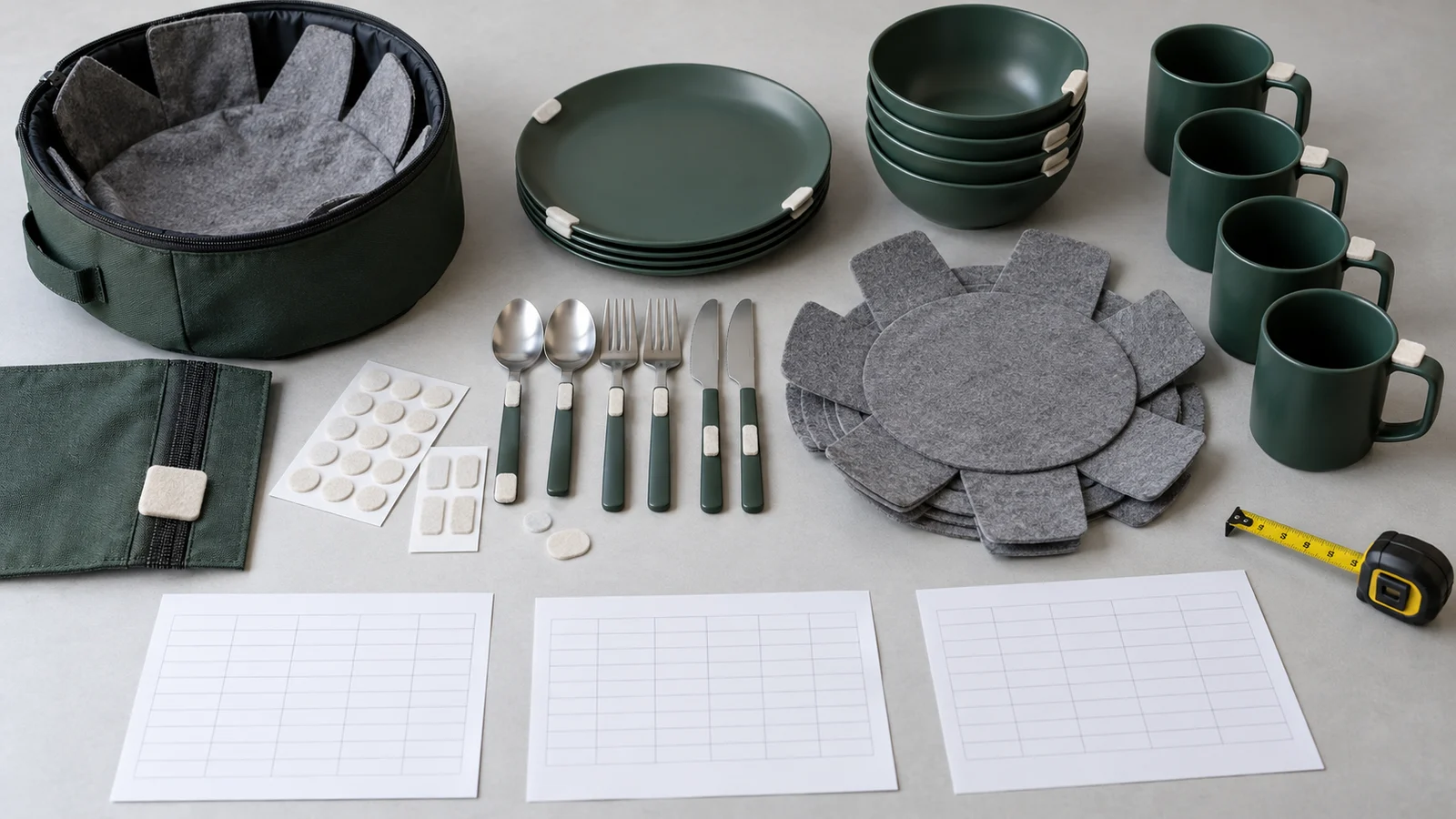
Before/after contact and abrasion map
| Field | What to enter | Approval record |
|---|---|---|
| Sample / zone | Traceable ID and one of the eight map zones | Links photographs to the correct component. |
| Baseline | Clean, pre-existing mark, texture or decoration condition | Prevents false attribution. |
| Post-route change | No change, polish, rub, transfer, scratch or indentation—using buyer definitions | Observation, not assumed mechanism. |
| Contact evidence | Mating surface, particle, divider edge or displaced component | Supports or rejects a cause hypothesis. |
| Severity / location | Buyer class, dimensions if relevant and clock position | Enables repeat review. |
| Action | Accept, hold, add separator, change pocket, alter finish review or rerun | Named owner and due date. |
Turn observations into controlled packaging decisions
A new mark does not automatically identify the root cause. First compare its location and direction with the contact map. If a plate face change aligns with a bowl foot, trial a traceable separator change. If cup-wall marks align with loose cutlery, control the pocket or retention. If observations vary by sample, review surface baseline, molding variation, particles and pack sequence before changing materials.
For distribution-test planning, consult the ISTA procedure directory. Use the NIST/SEMATECH statistical handbook when designing a defensible sampling or analysis approach. If a packaging change alters food-contact use, revisit the FDA conditions-of-use framework. These sources guide scope; they do not certify a Naike product.
Connect the result to the approved loaded carry-case inspection, BOM revision control and component change record.
Buyer checklist
| Ask the supplier | Verify in evidence | Approve or hold |
|---|---|---|
| Which surfaces touch in the final packed BOM? | Contact map matches photographs and pack sequence. | Approve map or hold for missing interfaces. |
| What route and load state were used? | Mass, orientation, restraint and route are traceable. | Limit conclusions to that route. |
| Was each surface documented before packing? | Matched sample/zone images exist. | Reject unsupported “new damage” claims. |
| How was change classified? | Buyer definitions and viewing conditions are recorded. | Accept, revise criteria or request review. |
| What corrective action is proposed? | Action changes a documented interface and has an owner. | Authorize a controlled rerun only. |
FAQ
Does one clean result prove the finish is transport-proof?
No. It applies only to the documented samples, pack state and route.
Can photographs alone determine the cause?
Usually not. Pair images with the physical contact map, displaced components, particles and divider records.
Should surfaces be wiped before the post-route review?
Not until loose transfer or particles are documented. Cleaning can remove useful evidence.
Is this an abrasion standard?
No. It is a buyer-facing inspection framework. Use an applicable standardized method only when its scope and procedure are actually followed.
What should be sent with an RFQ?
Send the target BOM, finish/decoration, approved sample, packed configuration, channel route, acceptance language and required evidence.
Request a packed-surface review
Share component drawings or samples, surface/decoration scope, dividers, pack sequence, target route and buyer acceptance definitions.
Request a sample review · Send the packed BOM · Submit an RFQ brief