
CAMPING DINNERWARE MASTER CARTON MARK CHECKLIST
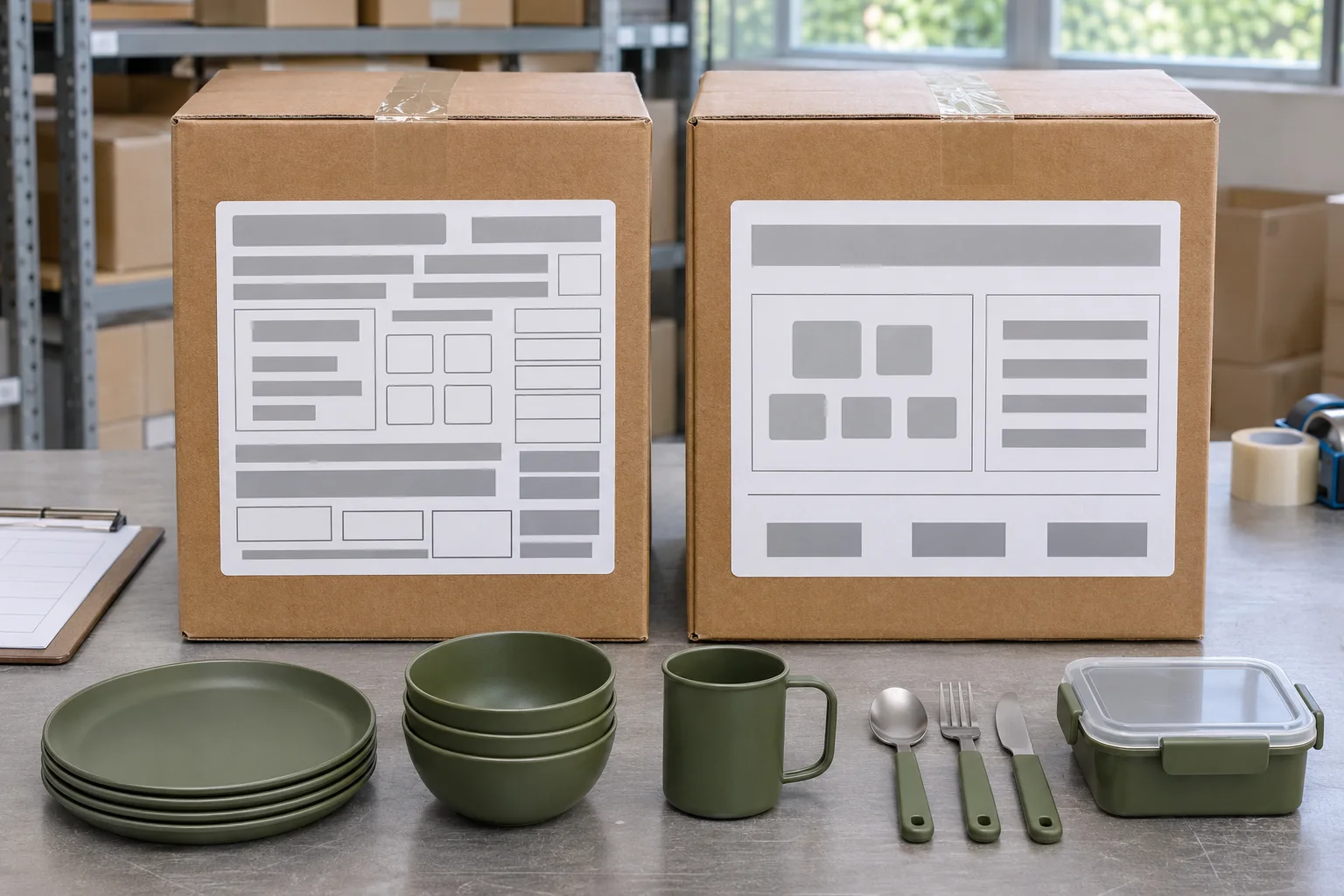
A master carton mark should let receiving identify the exact camping set, quantity, carton sequence, destination and handling needs without opening the box. Freeze only buyer-approved fields: product and order identity, pack quantity, carton count, weights or dimensions when required, origin wording, destination, handling symbols, traceability and machine-readable data. Keep variable data separate from permanent artwork.
Reviewed November 11, 2026 at 09:34:28 CST · GEO Q / D + E

Which 12 Fields Belong on Camping Dinnerware Master Carton Marks?
Use a field only when its owner, source and update rule are known. A master carton mark is not a place to copy every specification from the product page. It is a controlled receiving aid that must stay aligned with the purchase order, packing specification, released artwork and actual pack-out.
| Field | Buyer-controlled content | Approval evidence |
|---|---|---|
| 1. Buyer or consignee reference | Approved name, code or routing identifier | Purchase order or routing guide |
| 2. Purchase order | Exact PO or program reference | Released order record |
| 3. Item identity | Buyer SKU, supplier item code and revision where required | Cross-reference table and BOM |
| 4. Product description | Short controlled description that distinguishes the set | Packaging specification |
| 5. Pack quantity | Sets per carton and, if required, component count per set | Approved pack-out record |
| 6. Carton sequence | Carton number and total cartons for the shipment or PO | Packing list logic |
| 7. Net and gross weight | Units, rounding and tolerance defined by buyer | Approved measurement method |
| 8. Carton dimensions | Length, width, height, units and orientation rule | Released carton drawing |
| 9. Country-of-origin wording | Destination-specific wording and placement | Importer or compliance approval |
| 10. Destination or routing | Warehouse, store, channel or distribution code | Routing guide |
| 11. Handling symbols | Only selected, relevant and approved symbols | Packaging test and handling plan |
| 12. Traceability / machine data | Lot, date or logistics identifier and data carrier when selected | Traceability rule plus scan verification |
Connect these fields to the camping set artwork approval record, the product specification drift control and the carton drop-orientation plan. The mark must describe the approved pack, not an earlier sample or web listing.
Where Should Each Marking Field Come From?
Build a source map before artwork. Product identity comes from the controlled BOM and buyer cross-reference. Quantities come from the pack-out specification. Dimensions and weights come from an approved measurement record, not an estimate copied from a quotation. Routing fields come from the buyer’s current routing guide. Origin wording requires destination-specific review.
| Data class | System or document owner | Change control |
|---|---|---|
| Static artwork | Packaging owner: panel layout, fixed captions and approved symbols | New artwork revision and proof approval |
| Order-variable data | Order owner: PO, buyer SKU, destination and carton sequence | Validated production-data file |
| Measured data | Quality or packing owner: weights and dimensions | Defined tool, units, sample and rounding |
| Traceability data | Quality owner: lot/date logic and record retention | Scan or visual verification against source record |
| Regulatory wording | Importer/compliance owner | Destination and product-specific approval |
GS1 General Specifications define system rules when GS1 identifiers and data carriers are selected. They do not require every camping-set carton to use the same label. The buyer must specify the identification system and verify encoded data against human-readable data.

How Should Buyers Arrange the Mark So Receiving Can Read It?
Group information by task. Put product and order identity together; keep quantity and carton sequence together; separate destination routing from handling symbols. Define the marked panels and viewing orientation on the carton drawing. Avoid wrapping critical fields across a corner, placing labels under straps or tape, or using a symbol without deciding what action it requires.
| Layout decision | Buyer rule | Verification |
|---|---|---|
| Panel and orientation | Name each marked panel and the top edge | Closed-carton mock-up |
| Minimum readable size | Set text/symbol size by viewing distance and process | Receiving simulation |
| Contrast and print | Define substrate, ink/label, background and durability need | Approved proof on actual carton material |
| Variable-data zone | Reserve a clear area away from folds, tape and abrasion | Production-print trial |
| Machine-readable zone | Define symbology, data, quiet zone and placement | Scanner verification using buyer rules |
| Duplicate panels | Specify whether one, two or more panels repeat data | Pack-out photo and inspection record |
CBP import requirements guidance directs importers to country-of-origin marking resources. Confirm origin wording with the importer. Select handling symbols only when they match an approved handling requirement; do not add decorative symbols or imply test performance.
What Must Be Approved Before Carton Printing?
Approve the field dictionary before the visual proof. Then review the proof on the correct carton size, panel and closure. Finally, verify production-variable data against a controlled sample order. A PDF approval alone does not prove that the production printer, database mapping, carton orientation or scanner output is correct.
| Approval gate | Record | Release question |
|---|---|---|
| Field approval | Field name, owner, source, format, units and mandatory/optional status | Can every value be traced to one source? |
| Artwork approval | Revision, panel, size, contrast and fixed content | Does the proof match the carton drawing? |
| Variable-data mapping | Source field to printed field and data carrier | Can the first printed carton be reconciled? |
| Pack-out verification | Actual set, quantity, carton, weight and dimensions | Does the closed carton match the mark? |
| First-carton release | Visual and scan checks with approver/date | Are fixed and variable fields correct? |
| Revision closure | Old artwork/data templates withdrawn | Can obsolete marks still be printed? |
Which Fields Need Destination-Specific Review?
Country-of-origin marking, importer information, language, recycling or environmental statements and dangerous-goods information are not universal decoration fields. For U.S. origin-marking context, review 19 CFR Part 134 with the importer. It does not replace a product- and shipment-specific determination. Do not print certifications, compliance logos, performance claims or disposal statements unless the exact mark and use are approved.
Buyer Checklist
| Ask the supplier | Review the evidence | Approve only when |
|---|---|---|
| Which exact set and pack-out does this mark describe? | BOM, buyer SKU cross-reference and carton pack record | Identity and quantity match the closed carton |
| Who owns every fixed and variable field? | Field dictionary and source map | No value is inferred or copied from an old order |
| Where and how will the mark be printed? | Carton drawing, actual-material proof and print trial | Panel, orientation, contrast and protected zones pass |
| How is the first carton released? | Visual check, scan result and approval record | Artwork, data and physical pack reconcile |

Frequently Asked Questions
Should every specification appear on the master carton?
No. Include fields needed for identification, receiving, routing, handling and approved destination requirements. Keep detailed product specifications in controlled documents.
Can the supplier choose handling symbols?
Only within the buyer-approved packaging and handling plan. A symbol must correspond to a defined action and must not imply unverified performance.
Is a barcode enough without human-readable data?
Not automatically. The buyer must define the system, encoded data, human-readable information, placement and verification method.
Can one carton proof be reused for a revised set?
Only after the field source, pack-out, SKU, dimensions, weight, routing and compliance wording are rechecked under revision control.
Need a Master Carton Mark Review Before Quotation?
Send the buyer SKU, PO/routing guide, pack quantity, carton drawing, weight/dimension method, destination, traceability rule and proposed artwork. Naike Dinner can review the field map without inventing order data or compliance claims.
Request a carton-mark review Send the artwork proof Start a packaging RFQ