
Custom camping dinnerware MOQ is not one universal number. It is the smallest commercially workable quantity for a defined set, material, color, decoration, packaging and production route. Stock shapes with simple branding may support a lower starting quantity, while custom colors, mixed components, dedicated packaging or new tooling can create separate batch minimums that must be reconciled in a project quotation.
Custom Camping Dinnerware MOQ Starts with One Defined Configuration
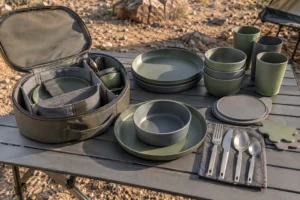
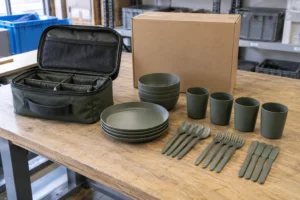
An MOQ has no meaning until the unit is defined. “One set” could mean a plate, bowl, cup and cutlery for one person; a family assortment with four place settings; or a mess kit that adds cookware, lids, storage and a pouch. The purchasing team should state every component, quantity per set, material direction, color, decoration and unit pack before comparing supplier answers.
Separate dinnerware from cookware at the same time. Plates, bowls and eating utensils do not acquire direct-flame capability simply because they are packed beside a pot. If cookware is included, quote and validate it as its own product family with its own manufacturing route, evidence, inspection and use instructions.
The practical camping mess kit component checklist helps buyers identify what belongs in the configuration before requesting a quantity. Deleting an unnecessary component can remove an entire supplier, tooling, color or packaging constraint, while adding one low-volume accessory can become the limiting item for the whole set.
The MOQ Stack: Six Minimums Behind One Finished Set
A finished-set MOQ is usually the result of several constraints rather than one factory policy. The molded or formed parts need an economical production batch; color or finish may require setup and material preparation; printing or other decoration has its own changeover; fabric pouches and printed packaging may be produced elsewhere; and assembly needs balanced quantities of every component.
The largest constraint is not always decisive by itself. A supplier may have enough plates for a project but lack matching cups, or a printer may require more sleeves than the tableware line requires sets. The quotation must show whether excess components can be carried forward, charged as surplus, used across variants or discarded. Hidden imbalance is a common source of price changes after sample approval.
| MOQ layer | What creates the minimum | Buyer question | Possible simplification |
|---|---|---|---|
| Core product batch | Tool setup, line changeover, cycle efficiency and yield | Which component sets the base production batch? | Use an existing shape and standard construction |
| Material or color batch | Resin, alloy, coating, masterbatch or compound preparation | Is the minimum per material, per color or per SKU? | Share one material and color across components |
| Decoration batch | Artwork setup, fixtures, inks, curing or laser programming | Is setup charged once or repeated per component? | Use one position and one decoration method |
| Accessory batch | Pouch sewing, cutlery, lids or third-party components | Which outside component has the highest minimum? | Select an existing accessory or remove it |
| Packaging batch | Board grade, print setup, die-cutting and carton conversion | Is packaging MOQ higher than the set MOQ? | Use plain stock packaging with a simpler insert |
| Assembly and shipment | Balanced component counts, carton quantity and release lot | Can excess components be stored for a scheduled repeat? | Align variants and replenishment timing |
Stock Shape, Custom Color or New Tooling: Three Different Projects
The lowest-complexity route normally uses a current production shape, established material, standard color and existing pack-out. The supplier still needs to confirm availability, evidence and production status; “stock mold” does not mean finished inventory exists. Simple decoration or a plain pouch can add differentiation without changing the core manufacturing route.
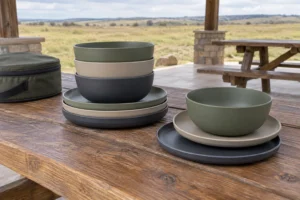
A custom-color project keeps the physical design but creates a separate material or finish batch. The buyer must approve the color on the intended substrate and process, because the same color reference can appear different on metal, molded composite, fabric and printed board. Each additional color can multiply setup, sampling, retained inventory and component-balancing work.
New tooling changes the commercial model. The factory must review manufacturability, tool ownership, cavities, maintenance, expected life, sample stages and the production quantity needed to use the tool economically. Tooling cost and MOQ are related but not interchangeable: paying for a mold does not automatically eliminate material, color, decoration or packaging minimums.
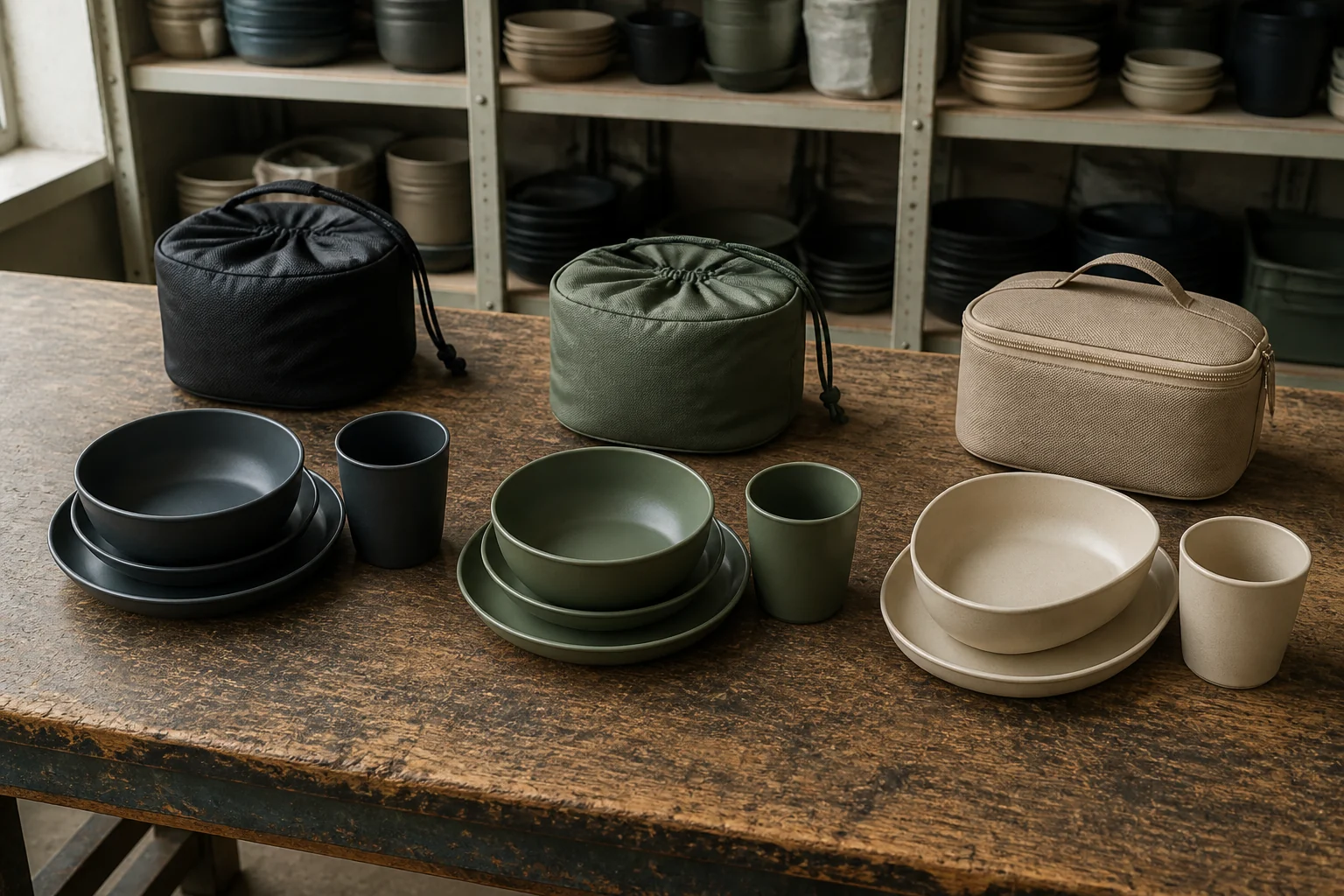
Why Component Count Can Raise MOQ Faster Than Set Quantity
Consider a four-piece one-person set with one plate, bowl, cup and utensil. If every component shares the same material, color family and supplier route, planning can be relatively direct. Add a second cup color, metal cutlery, a sewn pouch and a printed sleeve, and the project now combines several production calendars and independent minimums.
Family sets add another balancing problem. Four plates and bowls may be packed with only two serving pieces and one shared pouch. The factory must convert each component’s batch into complete-set yield, allow for rejects and inspection samples, and decide what happens to the remainder. Buyers should ask for the arithmetic rather than accept a finished-set number without its component basis.
Replacement parts can improve the equation if planned early. Excess cups or utensils may support after-sales replacement instead of becoming unusable remainder, but they need their own identification, packaging and inventory policy. Do not assume a supplier will store surplus indefinitely or that a future batch will match color and fit without a written agreement.
Material and Color Batches Are Often the Real Constraint
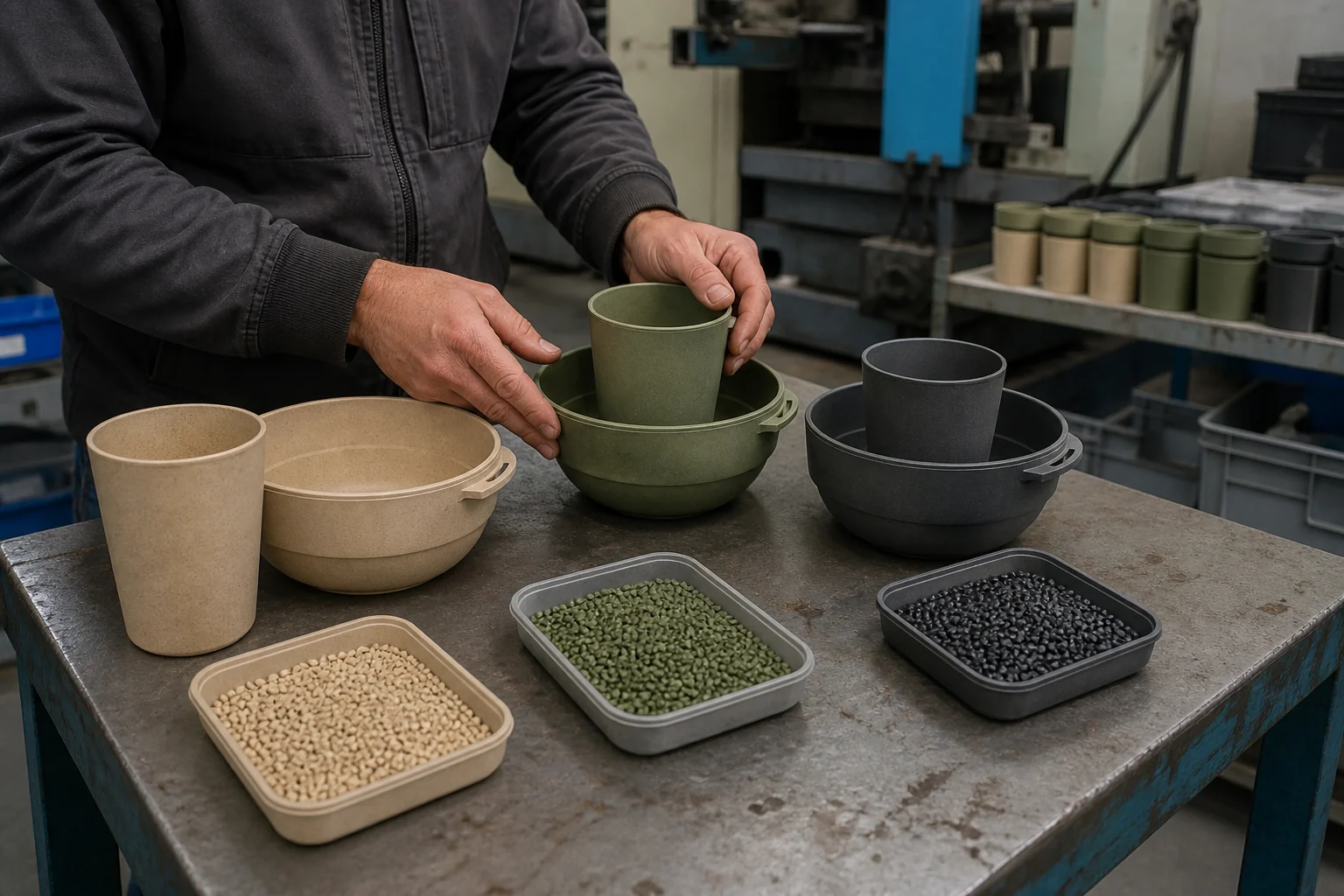
For molded dinnerware, the factory may need a workable batch of base resin or composite, color masterbatch and process setup. For metal products, alloy sourcing, sheet or coil quantity, finish, coating or polishing route may drive the batch. These are product-specific questions; no generic material reputation reveals the commercial minimum for a finished SKU.
Ask whether natural, black or an established production color can join another run, and whether the supplier accepts that scheduling dependency. A lower quantity achieved by waiting for a shared run may have a longer or less predictable window. The quotation should separate confirmed production timing from a conditional opportunity to combine material.
Color should be approved as a range appropriate to the material and process. A promise of perfect visual identity across plant-fiber composite, metal, textile and kraft board can be unrealistic. Set tolerances for each substrate and define which variation is acceptable within a set and between orders.
Ask for the limiting batch, not a generic number
Send Naike Dinner the exact component list, intended material, number of colors, decoration, packaging route, target market and order cadence. The team can identify which questions must be answered before a project-specific MOQ and quotation can be documented.
Request an MOQ feasibility reviewDecoration MOQ Depends on Method, Area and Component Count
A small logo can still create substantial setup if it appears on several differently shaped components. Each plate, bowl and cup may require a fixture, alignment check and process setting. Curved surfaces, textured composites, coated metal and flexible pouches behave differently, so one approved artwork file does not prove that one method suits every item.
Ask the supplier to quote decoration by component and method. Separate one-time setup or tooling from recurring unit cost, and define whether the minimum applies per artwork, color, position or SKU. If several market variants share the same core set, a common physical product with market-specific outer packaging may reduce production fragmentation.
Durability evidence must match the intended care cycle. A logo that looks good on a sales sample may abrade during nesting, washing or pouch transport. Specify the exposure and acceptance method without inventing a universal number; approve a production-intent decorated sample before releasing the full batch.
Packaging Can Exceed the Product MOQ
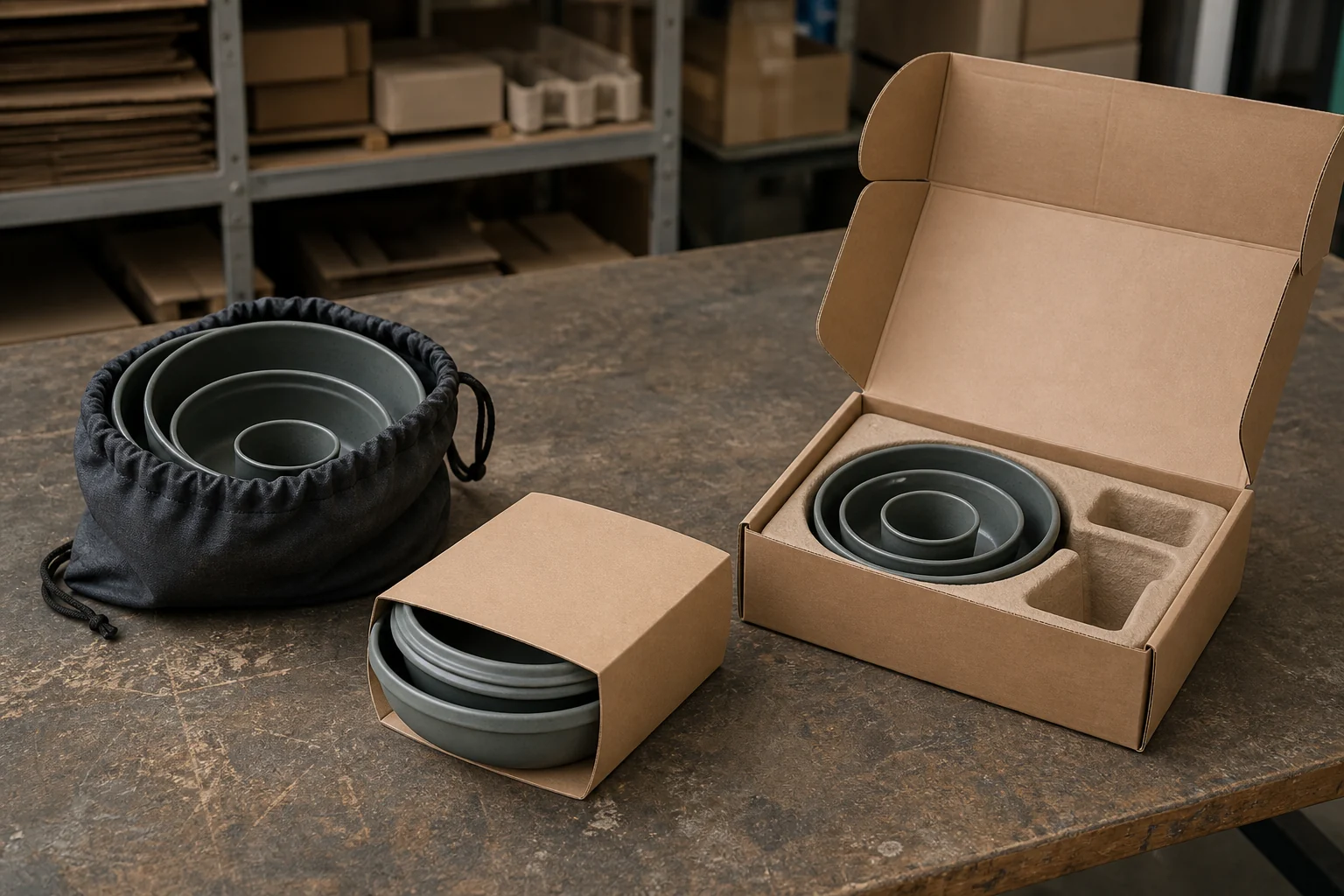
Plain pouches, stock cartons and unprinted sleeves can sometimes be sourced in smaller practical lots than fully printed retail packaging. Custom board, structural inserts, multiple print colors, special coatings and market-specific language can create separate conversion and print minimums. A product factory may have no authority to reduce the packaging converter’s requirement.
Define whether leftover printed packaging can be stored, who owns it and what happens after artwork or legal information changes. Buying excess boxes can appear economical until a barcode, responsible-party address, warning or product configuration is revised. Packaging inventory should be included in the change-control and obsolescence plan.
The EU’s General Product Safety Regulation is the authoritative source for applicable general product-safety and traceability obligations in that market. Packaging decisions should preserve space and process control for required product and economic-operator information, while qualified market review determines the exact content for the commercial article.
Food-Contact Evidence Is Part of the MOQ Decision
Low quantity does not reduce the need for suitable evidence. The U.S. FDA explains that the regulatory status of a food-contact material depends on the status, specifications and limitations of the substances that comprise it. Its official page on determining food-contact component status also notes that some notifications are manufacturer-specific, which is why a buyer must trace the proposed formulation and source.
The European Commission describes tableware and kitchenware as food-contact materials and routes businesses to the EU framework, good manufacturing practice and material-specific rules on its food-contact materials page. A custom color, coating, ink or adhesive can affect the evidence review even when the base shape is unchanged.
Ask whether existing evidence covers the exact material, color, finish, food types, temperature and repeated-use conditions. If additional testing or technical review is needed, treat it as a project cost and timing stage, not as a quantity discount. Never select an unsupported formulation merely because its supplier offers a lower MOQ.
Sample Quantity Is Not Production MOQ
A prototype or sample order may be made through hand finishing, trial molding, machining, existing colors or substitute packaging. That route is useful for design decisions but can differ from mass production. Record every deviation so the team knows what the sample proves and what remains open.
Use stages: configuration sample, engineering sample, decorated or color sample, production-intent sample and shipment inspection. Not every project needs a separate physical round for each label, but the approval record should identify material, process, artwork, pack-out and evidence status. Skipping a stage transfers risk rather than removing it.
The related guide on choosing camping tableware for a brand explains how to build the initial brief. MOQ analysis should follow that brief, because asking factories for quantities before use conditions and set architecture are settled produces answers that cannot be compared.
Use a Quotation Ladder Instead of One MOQ
Request three or four controlled options. Option A might use an existing shape, standard color and plain pack-out. Option B might add custom color or one decoration. Option C might add printed retail packaging, and Option D could introduce new tooling. Each option should state finished-set quantity, component constraints, assumptions, setup charges, evidence scope and timing.
This ladder shows where commitment rises. A buyer may discover that changing only the pouch color creates little complexity, while adding a custom cup pushes the entire set into a separate batch. The supplier can also suggest which components are genuinely shared rather than promising an unrealistic all-custom package at the stock-program minimum.
| Quotation route | Customization scope | Typical constraint to verify | Best use |
|---|---|---|---|
| Stock program | Existing shapes, material, color and pack-out | Actual availability and evidence for the exact SKU | Demand test or urgent channel launch |
| Light customization | Existing product plus simple mark or stock pouch | Decoration setup by component and artwork | Brand identification without new product architecture |
| Color and packaging program | Coordinated color, pouch and retail pack | Separate material, sewing and print batches | Retail differentiation with existing tooling |
| Fully custom set | New shapes, interfaces, tooling and pack-out | Tooling, validation and multiple component minimums | Established demand and long-term assortment |
Commercial Scenarios and the Right MOQ Strategy
New brand testing one channel
Protect cash by reducing variants before negotiating quantity. Use one set architecture, one color, simple packaging and an existing production shape whose material and evidence fit the target market. The objective is not the lowest theoretical unit price; it is a controlled first order that can generate reliable demand data.
Established retailer launching several colors
Aggregate shared components and separate only the visible color-dependent pieces when the product design permits it. Ask whether colors can run sequentially under one material order and how yield or shade change affects each lot. Approve carton and shelf presentation after real packed dimensions are known.
Corporate or promotional project
A fixed event date increases the cost of unresolved assumptions. Prefer established shapes and materials, limit decoration positions, and use packaging that does not require a long custom conversion route. Confirm evidence and sample timing before promising delivery to the campaign team.
Outdoor brand building a long-term platform
A higher commitment may justify dedicated tooling, component replacements and controlled packaging. Model several orders rather than one shipment, define who owns tooling and excess components, and agree how future changes are approved. Platform economics depend on repeatability, not merely the first-order MOQ.
Risks Hidden Behind an Unusually Low MOQ
A low number may be based on leftover material, mixed production, off-the-shelf components, hand decoration or unprinted packaging. Those routes can be valid, but the quotation should say so. If the buyer assumes a controlled repeatable program while the supplier assumes a one-time opportunity, the second order may change color, price or timing.
Another risk is silent substitution. To meet a small order, a supplier may propose an “equivalent” colorant, accessory, pouch or coating. The buyer should prohibit unapproved changes and define which material, site, process and packaging changes require written notice and review.
Quality sampling also needs a lot definition. NIST explains that acceptance sampling supports a decision about a lot rather than proving every unit is conforming. A small production run still needs critical-risk prevention, clear defect classes and an inspection approach appropriate to the lot and product.
Ways to Reduce MOQ Without Weakening Control
First, reduce independent variables. One color, one artwork, one packaging language set and fewer components usually simplify planning more effectively than repeatedly asking for an exception. Second, reuse verified shapes, materials and pack-outs where they genuinely suit the brief. Third, schedule variants so shared components can be produced or purchased together.
Consider a blanket or call-off arrangement only when both parties can manage it. The agreement should define total commitment, release quantities, storage conditions, ownership, shelf-life or color-drift concerns, inventory reporting, change control and the date by which remaining goods must ship. It is not a way to pretend that no commitment exists.
Use neutral packaging for early runs if the channel permits it, then move to printed packaging after demand is clearer. Retain customer-facing legal and traceability requirements through suitable labels or inserts reviewed for the destination; do not remove required information simply to lower the packaging minimum.
Build a quotation ladder for your project
Naike Dinner can review a buyer brief and separate stock-shape, color, decoration, packaging and tooling scenarios within the company’s verified scope. The response should document assumptions rather than invent a universal quantity.
Ask for a project-specific quotation pathB2B Buyer Checklist Before Accepting an MOQ
| Check | Question | Why It Matters |
|---|---|---|
| Set definition | What exact components and quantities make one finished set? | Prevents incompatible supplier assumptions. |
| Product boundary | Which pieces are dinnerware, drinkware, cutlery or cookware? | Keeps heat and use claims product-specific. |
| Limiting component | Which component or process sets the finished-set minimum? | Shows where simplification has real effect. |
| Color basis | Is the quantity per color, per material batch or across all variants? | Reveals hidden multiplication of commitment. |
| Decoration | Does setup repeat by component, artwork, color or position? | Makes branding costs and batches comparable. |
| Packaging | Is packaging MOQ higher than product MOQ, and who owns excess? | Controls surplus and artwork obsolescence. |
| Evidence | Does the exact material, color and intended use have suitable support? | Stops quantity savings from weakening compliance. |
| Sample route | Which sample differences remain before mass production? | Prevents prototype approval from hiding production risk. |
| Remainders | What happens to excess components, material and packaging? | Avoids later charges or uncontrolled reuse. |
| Repeat order | Can the same color, construction and evidence be repeated? | Tests whether the low quantity is a program or one-time event. |
| Change control | Which substitutions require written buyer approval? | Protects specification and evidence continuity. |
| Quotation scope | Are unit cost, setup, tooling, testing, inspection and freight separated? | Enables like-for-like commercial comparison. |
Frequently Asked MOQ Questions
1. What is a normal MOQ for a custom camping dinnerware set?
There is no reliable universal number. The workable quantity depends on the exact component list, material, production route, colors, decoration, accessories, packaging and evidence needs. Request a project breakdown and identify the limiting component instead of using an industry rumor as a purchasing rule.
2. Can I mix several colors inside one MOQ?
Sometimes, but only if the supplier confirms how material preparation, setup and component balancing work. Each color may require its own batch, yield allowance and approval. A total order quantity does not automatically override per-color constraints.
3. Does paying for a new mold remove the MOQ?
No. Tool ownership addresses only one part of the project. Material, color, decoration, accessory, packaging, assembly and inspection minimums can remain. Ask for both the tooling terms and the recurring production economics.
4. Is a sample order proof that the factory can produce the same quantity again?
No. Samples may use trial material, hand finishing, substitute packaging or a different route. Require a deviation list and approve a production-intent sample before treating the sample as the mass-production reference.
5. Can different set sizes share components to lower commitment?
They may share plates, bowls, cups or packaging elements when the specification and color are identical. The quotation should show the component arithmetic, extra pieces and pack-out effects. Shared components also need clear traceability across finished SKUs.
6. Why is printed packaging MOQ sometimes higher than product MOQ?
Board purchasing, print setup, die-cutting and conversion have their own economical batches. Ask whether plain packaging, a stock carton or a simpler structural insert can support the first run without compromising required information or product protection.
7. How can a buyer compare MOQ offers from two suppliers?
Issue the same controlled brief and compare finished-set quantity, per-color and per-component minimums, included customization, excess inventory, setup charges, evidence, sample route, inspection and delivery assumptions. A lower headline number may cover a different product.
8. Does Naike Dinner have one MOQ for all outdoor dinnerware?
No universal MOQ is asserted here. Naike Dinner’s verified public scope centers on reusable wheat-straw composite tableware, and any outdoor project must be reviewed against actual product, material, process, customization and packaging capability before a quantity or quotation is confirmed.
Get a documented MOQ scenario instead of a guess
Send the exact set configuration, target market, intended foods and temperatures, material direction, colors, artwork, packaging, timing and demand scenario. Request separate stock-shape, light-customization and fully custom options so your team can see which decision changes commitment, evidence and repeatability.
Request an MOQ and quotation reviewReview the manufacturer checklist
Next approval step
Connect MOQ Planning to the Sample Process
MOQ should be confirmed together with the sample route, tooling status, color, decoration, packaging and test scope. After defining the commercial quantity, continue with the OEM camping tableware sample process so the approved sample and evidence list remain tied to the final purchase specification.