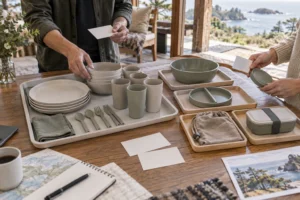
An actionable custom camping dinnerware brief defines the users, meal occasions, exact component matrix, controlled interfaces, carry-case envelope, materials still under review, target markets, evidence expectations, artwork and packaging decisions. It also labels every unknown and assigns who must decide it. A supplier should be able to identify feasible reuse, drawing work, samples, tests and quotation gaps without guessing.
A useful brief reduces decisions left to assumption
A product mood board can show direction, but it cannot control a multi-part outdoor set. Words such as “portable,” “durable,” “food grade,” “compact” or “premium” are not decision fields. An actionable brief converts each intention into an input, an acceptance question or an explicitly unresolved item. That allows the buyer and development team to separate existing components from proposed geometry, styling choices from compliance evidence, and sample observations from claims.
Start with the commercial job. State whether the set is for family retail, rental fleets, promotional programs, outdoor hospitality, a vehicle accessory line or another defined channel. Record the intended user count and meal occasions. A breakfast-and-drink set does not need the same bowl depth, utensils or food-container architecture as a dinner set. Describe how the set will be carried, opened, counted, cleaned, dried, repacked and stored. Do not start by selecting a material name or piece count before those service conditions are clear.
This guide covers dinnerware, food containers, utensils and their carry system. It does not establish cookware, flame, burner, stovetop or direct-heat suitability. Material identity, temperature claims, food-contact status, dishwasher statements, impact performance and market authorization require project-specific evidence.
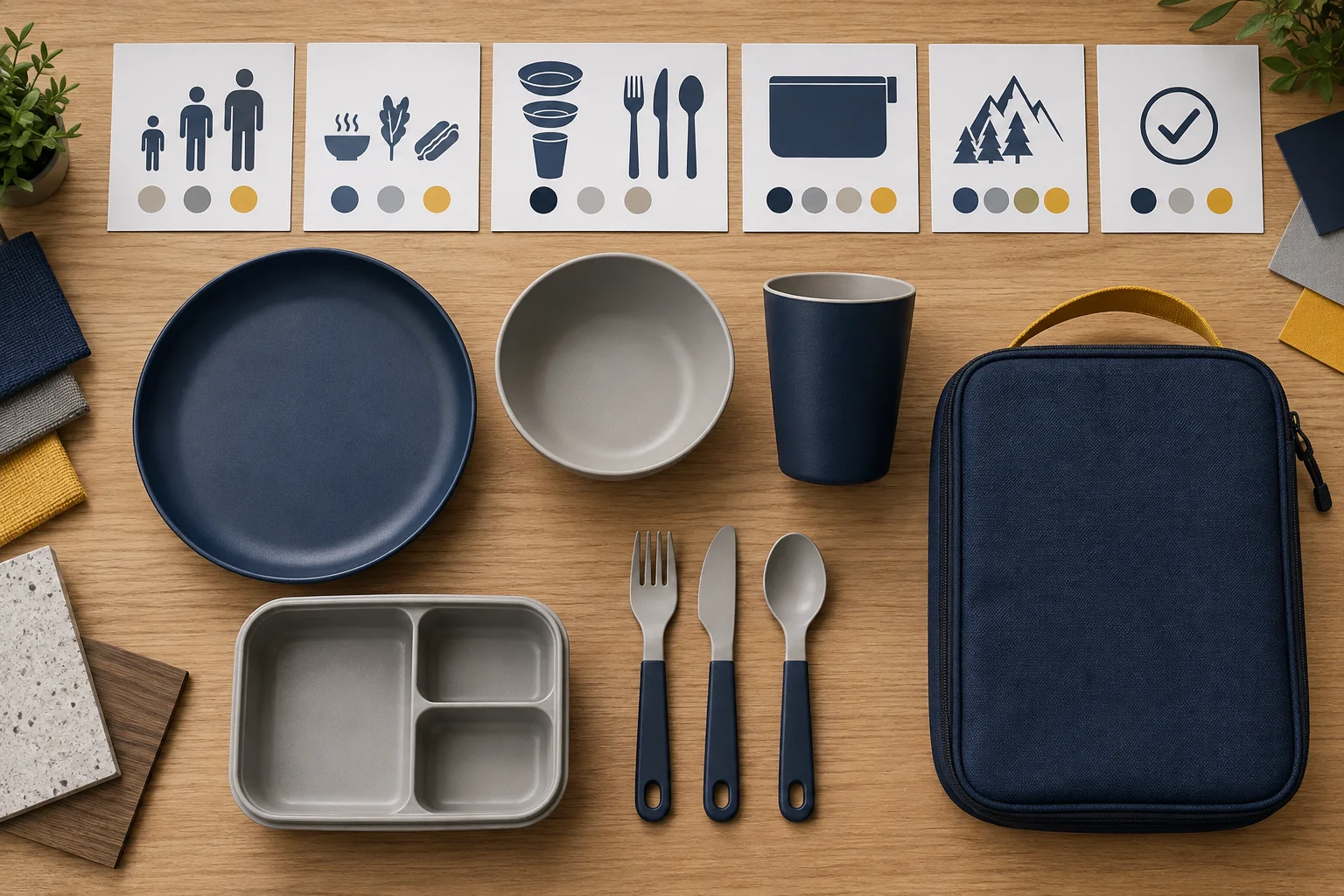
Copyable custom camping dinnerware brief template
| Decision field | Buyer input | What the development team must return |
|---|---|---|
| Program and channel | Market, channel, launch window and buyer organization | Scope assumptions and missing commercial inputs |
| Users and meals | User count, individual/shared use, meal types and serving pattern | Proposed component matrix with alternatives |
| Core components | Plate, bowl, cup, lunch box, fork, knife, spoon and any optional pieces | Existing, modified or new-development status for each part |
| Component interfaces | Nesting, stacking, lid fit, dividers, handles, utensil retention and case positions | Interface drawing list and open tolerances |
| Carry system | Maximum external envelope, opening direction, handle/strap and pack sequence | Pack-out concept, access review and clearance questions |
| Use conditions | Foods, contact time, temperatures, cleaning, drying and transport orientation | Claim boundary and evidence-gap list |
| Materials and finish | Required, preferred or prohibited options; color and surface intent | Feasible options plus facts requiring written confirmation |
| Target markets | Countries, sales channels and intended users | Evidence plan scoped to final components and uses |
| Branding | Logo files, placement zones, color references and prohibited contact areas | Artwork map, process questions and approval samples |
| Packaging | Retail box, mailer, insert, labels, languages and count-control needs | Packaging inputs, pack drawing and missing artwork |
| Samples and approvals | What each sample must decide and who signs it off | Sample stages, revision IDs and approval record |
| Quotation scope | Requested configuration, quantity scenarios and included services | Itemized inclusions, exclusions and unresolved cost drivers |
Do not fill unknown values with confident estimates. Use “To be confirmed for the project” and name the decision owner. If an existing component is proposed, ask for its controlled drawing or sample reference. If new geometry is discussed, treat feasibility, tooling, ownership, timing and validation as open project questions until confirmed in writing.
Build a component matrix before discussing “pieces”
| Component | Reference decision | Interface to control | Open evidence question |
|---|---|---|---|
| Plate | Count, eating area, rim and stack direction | Grip, bowl contact, case slot and abrasion points | Material/use claims and finished-color scope |
| Bowl | Count, depth, base and serving role | Nesting release, plate fit and packed height | Food, temperature and cleaning conditions |
| Cup | Count, capacity range and handle decision | Stack, pocket, rim and lid if any | Permitted temperature and cleaning claims |
| Lunch box | Shared/individual, lid and divider format | Lid seating, divider retention and case bay | Leakage or sealing claim requires a separate method |
| Cutlery | Count, utensil types and grip profile | Sleeve/rail retention and surface contact | Material and use-condition evidence |
| Carry case | Opening, handle, inserts and service access | Every component envelope and pack sequence | Construction and loaded-use checks |
A 24-piece label may count lids, dividers or shared utensils differently from another supplier. The component matrix removes that ambiguity. It also makes quotation comparisons possible because every requested part, optional part and excluded part has a defined row.
Control the interfaces, not only the individual objects
Most late changes happen between components: a bowl stack becomes taller, a cup handle collides with the case wall, a lunch-box lid has no clean storage position, a plate rim prevents release, or artwork is approved before the final process is known. Draw an interface map for every fit, contact, retention and sequence that can affect the complete set.
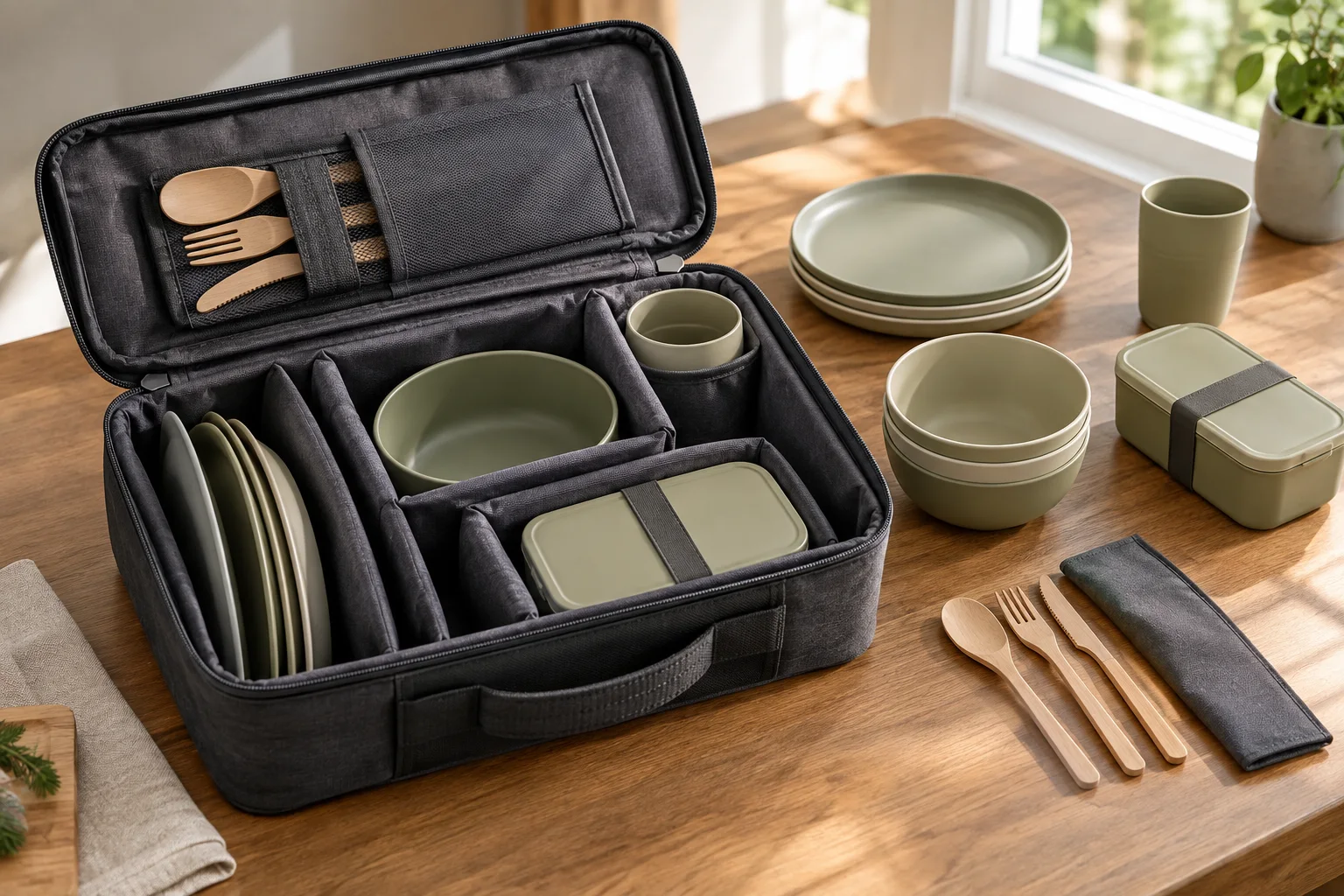
Connect the brief to the carry-case fit checklist, the repeatable pack-out method and the modular component map. Compatibility to be confirmed by project sample and drawing.
Scope evidence before a material or claim is approved
The brief should state target markets, food types, contact time, temperatures, repeated-use expectations, cleaning and any decoration. Evidence must match the final material, color, finish, component and intended condition. The FDA food-contact substances overview explains the U.S. food-contact framework. The EU Framework Regulation (EC) No 1935/2004 establishes general requirements for food-contact materials, while the EU plastics regulation applies when the final plastic material and scope make it relevant. These sources do not approve a concept image or an unspecified complete set.
Ask the development team to return an evidence-gap list, not a blanket promise. Separate verified documents, documents still required, buyer-supplied assumptions and claims that must not be used. When measurements or test results matter, identify the sample revision, method, equipment and acceptance rule; NIST traceability guidance provides useful measurement context without certifying the product.
Use decision gates so the brief stays current
| Gate | Required buyer output | Do not advance if |
|---|---|---|
| Concept gate | Users, meals, channel and initial component matrix | The service job is still only a style reference |
| Drawing gate | Revision list, interfaces and open issues | Components have no controlled identity |
| Sample gate | Questions, conditions and acceptance observations | The sample is being ordered “to see how it looks” |
| Evidence gate | Final component/use matrix and evidence gaps | Claims are copied from a different material or revision |
| Artwork gate | Approved placement, process and files | Geometry or decoration process is not frozen |
| Quotation gate | Comparable scope, inclusions, exclusions and quantities | Suppliers are pricing different component mixes |

Commercial risks of a weak brief
A weak brief creates quotations that look comparable but include different components, case constructions, artwork work, packaging and evidence. It can also lock the team into a material or geometry before the intended meals and handling are known. Other risks include approving color before the final substrate, using one component report as a set-wide claim, ordering samples with no decision question, and accepting a case layout that cannot be packed consistently.
The remedy is not a longer document. The remedy is a controlled decision record. Remove background material that does not change a choice. Add the missing field, owner, evidence boundary or acceptance question that does.
B2B Buyer Checklist
| Check | Buyer question | Required outcome |
|---|---|---|
| Program | Which user, meal and channel problem must the set solve? | One-sentence service definition |
| Components | Is every core, optional and excluded part listed? | Revision-controlled component matrix |
| Interfaces | Which parts fit, touch, retain or sequence together? | Interface and pack-out map |
| Unknowns | Are assumptions labeled with a decision owner? | Open-issue register |
| Evidence | Do claims match final components and uses? | Evidence-gap and claim-boundary list |
| Samples | What decision will each sample answer? | Sample review plan |
| Artwork/packaging | Are geometry, process and language inputs controlled? | Release checklist |
| Quotation | Can every supplier price the same scope? | Comparable line-item request |
Buyer FAQs
Should the brief name a preferred material?
Yes, when it is a real requirement or preference. Also state the food, temperature, cleaning, market and evidence conditions that the final material must support.
How detailed must the first drawing be?
It should be detailed enough to identify components, envelopes, interfaces and open issues. Do not treat an early concept drawing as a released manufacturing drawing.
Can reference photos replace dimensions?
No. Photos can communicate direction, but critical envelopes, interfaces and acceptance questions need controlled drawings or project samples.
When should a new mold be discussed?
After the service job, component matrix and existing-component options are understood. Feasibility, ownership, cost and timing remain subject to written project confirmation.
What makes a sample request actionable?
Name the sample revision, the decision questions, use conditions, comparison method and who will approve or reject it.
What should accompany an RFQ?
Send the completed brief, component matrix, drawings or references, target markets, use conditions, case envelope, artwork and packaging scope, quantity scenarios and evidence expectations.
Request a brief and sample-scope review
Share your user scenario, component matrix, reference drawings, case envelope, target markets, food-use conditions, branding, packaging and open decisions. Naike Dinner can review the request against verified capabilities and identify the drawings, samples, evidence and written confirmations needed before a quotation is compared.
Send your custom set brief or use the inquiry form beside this article. Contact Naike Dinner for sample and quotation review.