CAMPING TABLEWARE COLD BRITTLENESS REVIEW
A camping tableware cold brittleness test should compare matched ambient and cold-conditioned specimens under the same defined impact condition. Fix sample revision, conditioning temperature and time, transfer interval, support geometry, impact energy and failure definition before testing. The result supports only those conditions; it does not prove universal freezer safety or suitability for every outdoor climate.
Reviewed November 9, 2026 at 16:50:19 CST · GEO X / Q + E
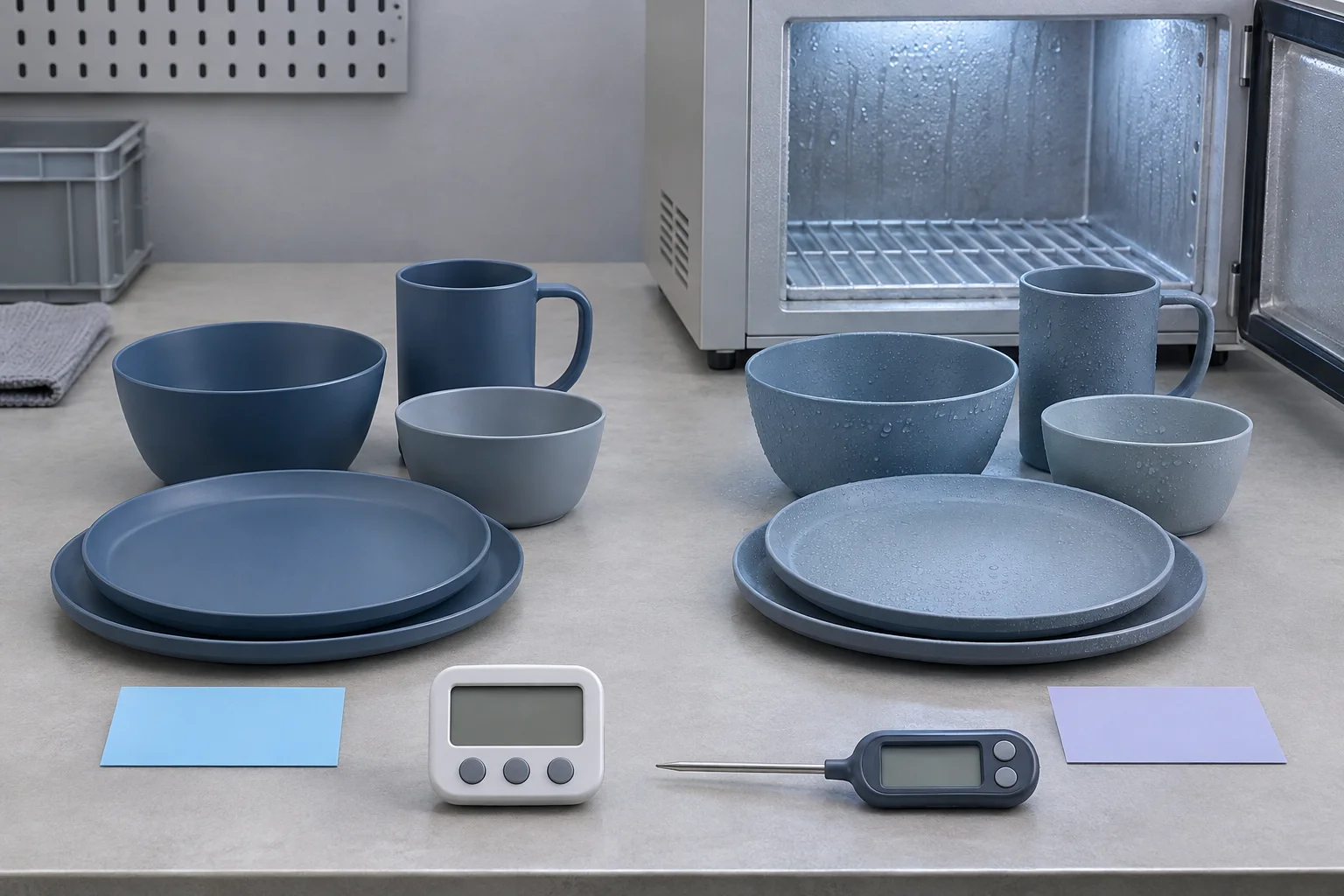
What Should a Conditioned-Impact Comparison Plan Include?
The useful purchasing question is not “Is this dinnerware freezer safe?” It is “How did identified samples behave after a defined cold exposure and a defined impact compared with matched ambient controls?” Start with components from the same revision and, where possible, the same production reference. Pair plates with plates, bowls with bowls and cups with cups; do not compare different wall geometry as if temperature were the only variable.
| Plan field | Ambient control | Cold-conditioned set |
|---|---|---|
| Sample identity | Component code, revision, color and lot/cavity reference where available | Matched code, revision, color and production reference |
| Precondition | Recorded room atmosphere and duration | Target air or medium temperature, tolerance and duration |
| Temperature evidence | Ambient reading and instrument ID | Chamber/medium and specimen-proxy readings with timestamps |
| Transfer | Time from storage to fixture | Maximum allowed time from cold environment to impact |
| Impact condition | Same support, orientation, striker, energy/height and location | Same defined settings; deviations recorded |
| Result | Crack, chip, fracture, deformation or no observed damage | Same failure definitions, photos and individual result |
Connect the plan to the controlled camping tableware material-change review, the plate and bowl geometry review and the tableware claim-approval matrix. Those records help prevent a result from one geometry or revision being silently transferred to another.
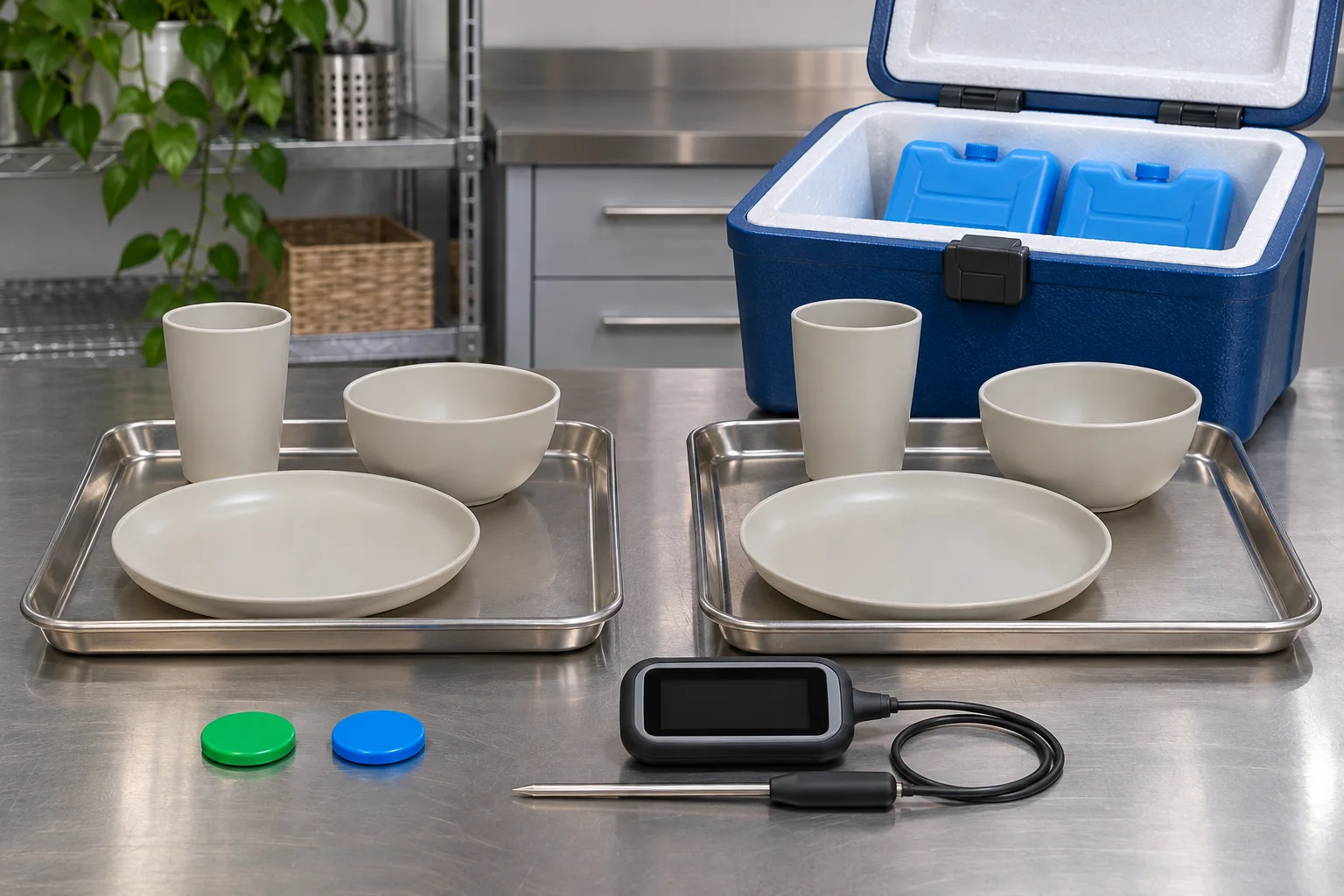
Which 7 Controls Make the Comparison Usable?
| Control | Buyer must define | Risk if omitted |
|---|---|---|
| 1. Matched specimens | Component, revision, color, source reference and pre-existing condition | Geometry or process variation is mistaken for a temperature effect |
| 2. Conditioning environment | Air or liquid medium, target temperature, tolerance, duration and loading arrangement | Specimens experience different thermal histories |
| 3. Temperature verification | Instrument, calibration status, sensor location, reading interval and proxy method | A chamber setpoint is treated as specimen temperature |
| 4. Transfer time | Maximum time and handling from conditioning to impact | Cold samples warm by different amounts before evaluation |
| 5. Impact setup | Support, orientation, location, striker, energy or drop height and cycle count | Different mechanical conditions are compared |
| 6. Failure definition | Crack, chip, complete fracture, hinge whitening, permanent deformation and no-damage categories | Observers use inconsistent pass/fail language |
| 7. Decision rule | Sample count, allowed failures, retest policy and claim wording | One result becomes an unsupported universal claim |
ASTM D746 addresses brittleness temperature under specified impact conditions and explicitly limits prediction to applications with similar deformation conditions. The official 21 CFR Part 177 addresses specified indirect food additives, not a low-temperature impact acceptance limit. Method evidence and food-contact evidence therefore remain separate; neither source turns a complete camping plate, bowl or cup into a universally freezer-safe product.
How Should Buyers Record Conditioning and Failure Modes?
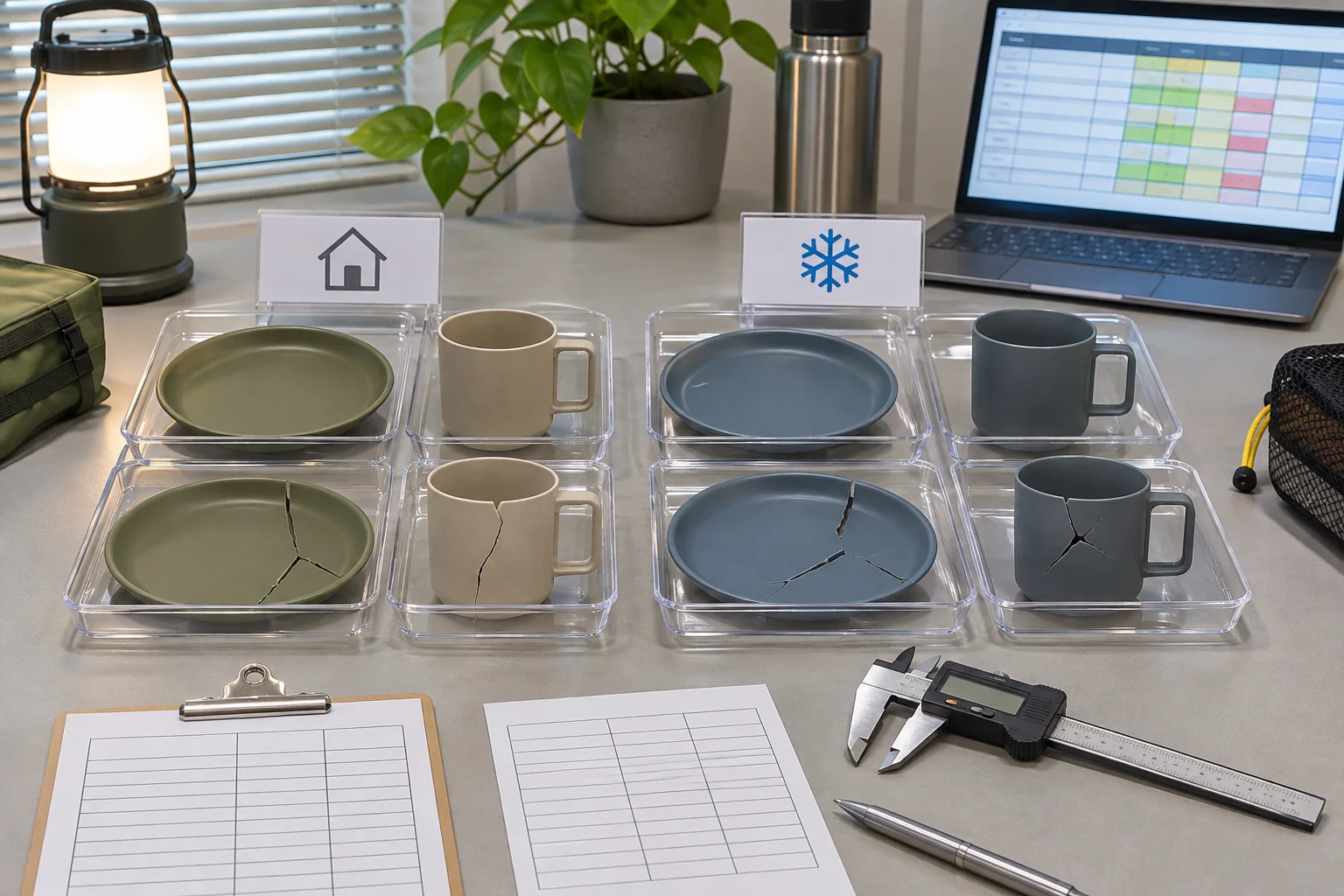
Write one row for every specimen. Record conditioning start/end, temperature readings, transfer start, impact time, fixture orientation and result. Preserve individual outcomes; a percentage alone can hide that every failure occurred at one rim feature, utensil slot or molded transition. Photograph the complete item and the damage location under consistent lighting and include a scale without obscuring the crack.
| Record field | Minimum entry | Approval question |
|---|---|---|
| Conditioning | Target, actual range, duration, load arrangement and deviations | Was the cold exposure repeatable? |
| Transfer | Removal and impact timestamps | Did every cold sample stay within the transfer window? |
| Impact | Fixture, support span, orientation, location and energy/height | Were ambient and cold samples tested identically? |
| Failure mode | Defined category, location, photo ID and observer | Can another reviewer understand the outcome? |
| Disposition | Accept, reject, investigate or repeat with reason | Does the decision match the approved rule? |
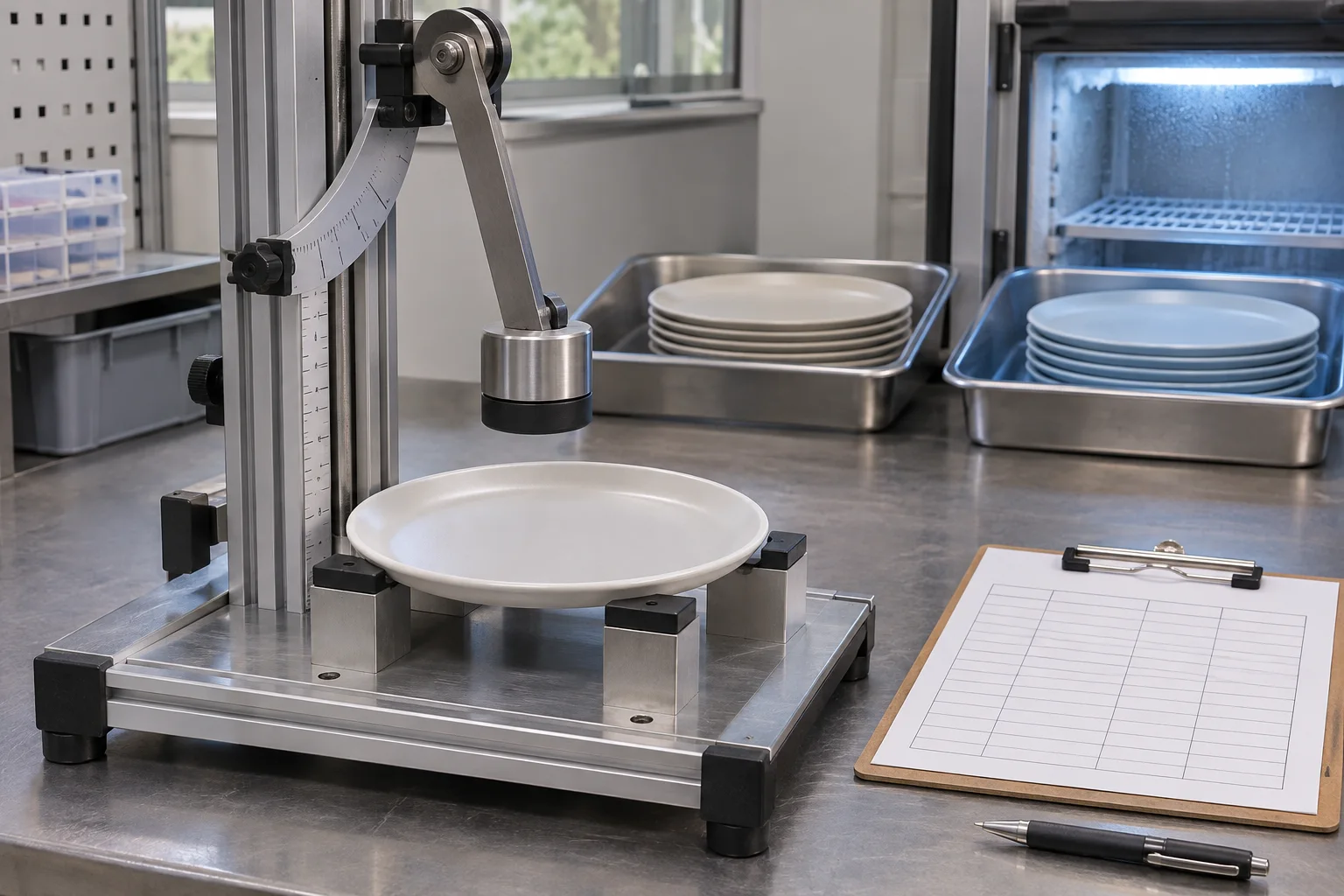
How Should a Buyer Set the Decision Rule?
Choose the sample count and allowed outcome before seeing the results. A conditioned-impact comparison may be exploratory, a design-screening review or a lot-acceptance check; those purposes need different sampling and decision rules. If the buyer changes temperature, impact energy, geometry or sample source, treat that as a new evidence scope rather than combining unlike results.
Regulation (EC) No 1935/2004 provides an EU framework for materials intended to contact food, but it does not prescribe this conditioned-impact comparison or a universal freezer-safe claim. Keep destination food-contact evidence separate from the project-specific cold condition, fixture and decision rule.
What Does the Review Prove—and What Does It Not Prove?
A camping tableware cold brittleness test can document how identified samples behaved after one defined conditioning and impact sequence. It does not prove universal freezer safety, food-contact compliance, migration performance, dishwasher safety, thermal-shock resistance, production consistency or suitability as cookware. Plates, bowls, cups, lunch boxes and utensils remain dinnerware or food-contact articles; a cold-impact record does not authorize heating or cooking claims.
Buyer Checklist
| Ask the supplier | Review the evidence | Approve only when |
|---|---|---|
| Which samples are paired for comparison? | Codes, revisions, source references and baseline photos | Ambient and cold groups are genuinely comparable |
| How is cold exposure verified? | Conditioning log, instrument details and timestamps | Actual ranges and transfer time are visible |
| How is impact controlled? | Fixture drawing, orientation, energy/height and location | Both groups receive the same defined input |
| What claim follows? | Individual results, failure map and approval wording | The claim stays within the tested condition and revision |
Frequently Asked Questions
Does surviving one cold drop prove freezer safety?
No. It records one specimen set under one conditioning and impact sequence. Universal claims require a defined use scope and adequate evidence across relevant revisions and production variation.
Can a chamber setpoint be reported as specimen temperature?
Not without an approved relationship. Record chamber conditions and the buyer-approved specimen or proxy measurement method separately.
Should cracked samples be averaged with intact samples?
Keep every individual result and failure location. A summary rate may be added, but it must not erase the underlying outcomes.
Can dinnerware cold-impact evidence support cookware claims?
No. Cold-conditioned dinnerware impact evidence does not establish heating, flame, stovetop, oven or cooking suitability.
Need a Cold Brittleness Comparison Plan Before Quotation?
Send the component codes, revision, intended cold-use scenario, target conditioning range, transfer limit, impact condition, sample count, failure definitions and destination market. Naike Dinner can review the inputs needed for a project-specific RFQ without inventing freezer-safety or material-performance claims.
Request a comparison-plan review Send the impact specification Start a tableware RFQ