OUTDOOR TABLEWARE UV COLOR TEST EVIDENCE PLAN
An outdoor tableware UV color test is useful only when the buyer fixes the sample revision, exposure source, radiant or time basis, temperature and moisture cycle, specimen orientation, color-measurement method and approval rule before exposure. Keep an unexposed control, record every interruption and compare like surfaces under the same viewing condition. The result applies only to the stated samples and cycle; it does not prove unlimited outdoor life.
Reviewed November 10, 2026 at 16:11:40 CST · GEO D / X + E
What Should the Exposure Scope Define?
Begin with the exact commercial question. A buyer may need to compare two colorants, review a decoration process, check an exposed carry-case surface or set a limited-use claim. Those decisions require different specimens and observations. Identify the component code, material and color revision, surface texture, decoration, lot or cavity reference where available, intended outdoor scenario and the claim that may be released.
| Scope field | Buyer-controlled input | Required record |
|---|---|---|
| Sample identity | Component, drawing, color master, decoration and revision | Exposed and control sample IDs |
| Exposure source | Natural site or named laboratory source and apparatus | Source, lamp or site record plus calibration status |
| Cycle | Radiation, temperature, moisture, dark periods and duration | Actual cycle, interruptions and accumulated exposure |
| Orientation | Angle, face, masking, holder and repositioning rule | Mounting photographs and position log |
| Color review | Instrument geometry, illuminant, observer, backing and visual condition | Raw coordinates, difference calculation and visual notes |
| Decision | Buyer-approved limit, sample rule and claim wording | Pass, fail or review with approver and revision |
Link this work to the material-change review, the product-photo evidence checklist and the hot-fill deformation worksheet. Color evidence does not replace material, thermal or food-contact evidence.
Which 7 Controls Make an Outdoor Tableware UV Color Test Comparable?
| Control | Define before exposure | Risk if missing |
|---|---|---|
| 1. Matched specimens | Same revision, molding condition, colorant and surface finish | Normal production variation is called fading |
| 2. Unexposed control | Storage, wrapping, temperature and identification | The reference changes or becomes untraceable |
| 3. Exposure source | Natural site or lamp type, spectrum and apparatus | Hours are compared across unlike sources |
| 4. Environmental cycle | Irradiance or radiant exposure, temperature, moisture and dark period | Heat or water effects are hidden inside a UV label |
| 5. Mounting | Face, angle, distance, backing, masking and rotation | Different surfaces receive different exposure |
| 6. Color measurement | Instrument, geometry, illuminant, observer, backing and repeated points | Different optical conditions create false differences |
| 7. Approval | Tolerance, visual review, sample quantity and claim boundary | A single number becomes an unsupported life claim |
How Should Buyers Record Color Change?
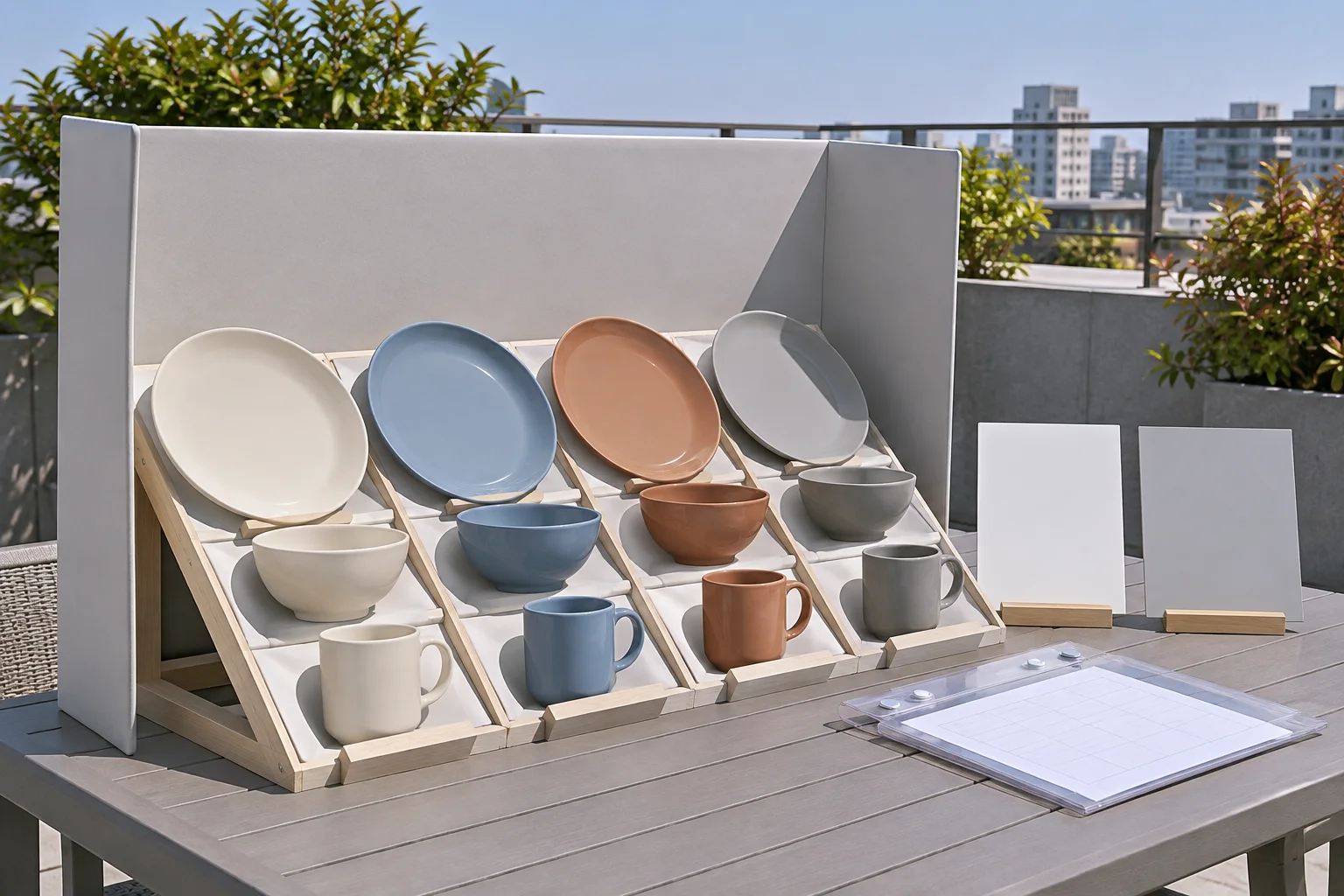
Record baseline color coordinates before exposure at named locations. Use the same clean surface, backing, orientation and instrument settings for every reading. If the surface is textured or curved, define a repeatable fixture and enough points to represent local variation. Keep the raw coordinates and the selected difference formula; a rounded summary value alone is not traceable.
| Record stage | Minimum evidence | Buyer question |
|---|---|---|
| Baseline | Conditioning, cleaning, instrument, geometry, backing and repeated readings | Can another inspector reproduce the starting value? |
| During exposure | Accumulated exposure, cycle status, interruptions and specimen position | Did every sample receive the intended condition? |
| Post-exposure | Conditioning interval, same measurement points and raw coordinates | Were hot or wet samples measured too soon? |
| Visual review | Approved light, background, observer instruction and sample order | Do gloss, texture or metamerism affect acceptance? |
| Claim review | Exact exposure scope, exclusions and destination wording | Does the claim stay inside the evidence? |
ASTM G151 provides general principles for accelerated test devices that use laboratory light sources, while ASTM G154 addresses fluorescent ultraviolet lamp apparatus. Neither practice supplies a universal acceptable color change for every finished outdoor tableware article.
How Should the Buyer Set a Decision Rule?
Approve the tolerance before exposure. If instrumental color difference is used, name the color space, formula, illuminant, observer, measurement geometry and rounding rule. Keep a separate visual review because gloss, texture and metamerism can affect commercial acceptance. ASTM D2244 states that purchaser and seller should agree on the permissible tolerance and calculation procedure; it does not prescribe one universal value for outdoor tableware.
| Decision field | Required evidence | Approval record |
|---|---|---|
| Instrumental limit | Formula, settings, locations, repeats and rounding | Signed buyer specification |
| Visual condition | Light, background, distance and observer instruction | Approved visual method |
| Sample rule | Quantity, lot/cavity scope and handling of outliers | Individual and lot disposition |
| Functional follow-up | Separate checks for brittleness, warpage, printing or surface change | Do not infer function from color alone |
| Claim wording | Exact cycle or intended-use scope and exclusions | Released only after evidence review |
What Does This Evidence Prove—and What Does It Not Prove?
The record can compare identified samples under a stated natural or laboratory exposure and a defined color-review method. It does not prove a universal service life, climate equivalence, outdoor safety, structural retention, food-contact compliance or identical behavior in every color. Laboratory exposure is an accelerated comparison; natural exposure varies by latitude, season, orientation, temperature, moisture and pollution.
Do not convert exposure hours directly into years outdoors unless a justified correlation exists for the material, construction and use environment. Keep colorant, base material, recycled-content changes, decoration and surface texture within the controlled revision. A passed color record does not authorize a broader environmental or durability claim.
Buyer Checklist
| Ask the supplier | Review the evidence | Approve only when |
|---|---|---|
| Which exact component, color and finish are exposed? | BOM, drawings, color master and sample IDs | Control and exposed samples are traceable |
| What source, cycle and orientation apply? | Executable method and apparatus or site record | Every condition has units and tolerances |
| How is color change measured? | Instrument settings, locations, raw coordinates and visual method | The comparison is reproducible |
| What claim may be released? | Limits, exclusions and approval matrix | Wording stays within the exposure evidence |
Frequently Asked Questions
Does 500 hours in a UV apparatus equal a fixed number of outdoor years?
No. A conversion requires a justified correlation for the specific material, color, construction and use environment.
Can buyers compare results from different lamp types?
Not by hours alone. Source spectrum, irradiance, temperature, moisture cycle and specimen mounting must be considered.
Is a color-difference number enough for approval?
No. Keep raw coordinates, settings and visual review because gloss, texture and metamerism can influence commercial acceptance.
Does acceptable color change prove the component remains functional?
No. Brittleness, warpage, printing adhesion, fit and other functions need separate controlled checks.
Need a UV and Color-Change Evidence Plan Before Quotation?
Send the component revisions, colors, intended outdoor scenario, proposed exposure source and cycle, sample quantity, measurement method, tolerance, destination market and exact claim wording. Naike Dinner can review the project inputs without inventing a life claim or test result.
Request an exposure-plan review Send the color-tolerance specification Start an outdoor tableware RFQ