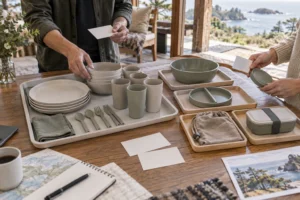
Choose molded camping set retention when component geometry is stable and fast visual count control, crush resistance and wipe-clean surfaces dominate. Choose elastic loops when the set will accept controlled component variation, compact folding or replaceable textile organization. Approve neither from appearance alone: test revision-matched samples for removal, cleaning, rattle, wear and pack compatibility.
Define the retention job before choosing a format
The camping set retention decision is not simply hard versus soft. It determines how components are located, how missing pieces are noticed, how water and soil leave the organizer, how much geometry may change after approval, and how the user repacks the set. Start with a frozen component matrix and a realistic pack envelope.
List every plate, bowl, cup, lunch box and utensil that touches the retention system. Record drawing revision, maximum product envelope, orientation, removal sequence and whether a wet item may return to the organizer. If the set has replacement SKUs, state whether a later replacement must fit the original organizer.
This comparison covers dinnerware storage. It does not establish cookware or direct-heat suitability, food-contact compliance, mechanical performance or a universal hygiene result. Those claims require final materials, intended use and project-specific evidence.
What the two mechanisms actually control
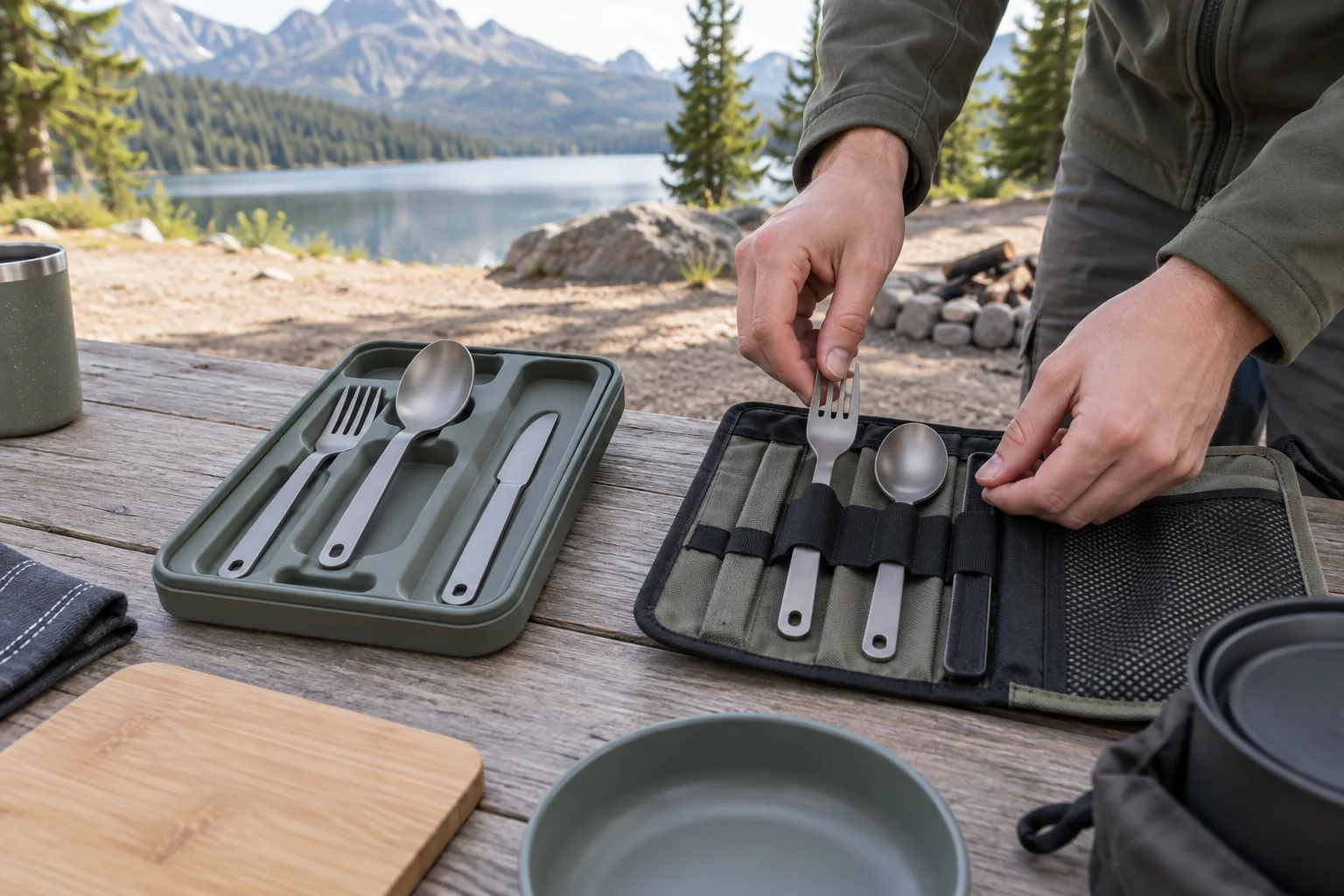
A molded tray locates a component through shaped walls, ribs, pockets or snap details. The interface can make count control intuitive, but the cavity inherits the component’s dimensional assumptions. A new handle width, deeper bowl or revised cup foot may require a tray change rather than a simple packing update.
Elastic loops use band tension and contact length to hold components against a textile or semi-rigid panel. They can tolerate a defined size range, yet retention depends on elastic recovery, stitch layout, component surface and insertion direction. A loop should never be described as universally compatible without sample and drawing confirmation.
For work-system context, the NIOSH ergonomics overview supports reviewing task, tool and user together. For material evidence, consult the FDA food-contact substances overview and, for EU market scope, Regulation (EC) No 1935/2004. These sources frame evidence needs; they do not certify a proposed organizer.
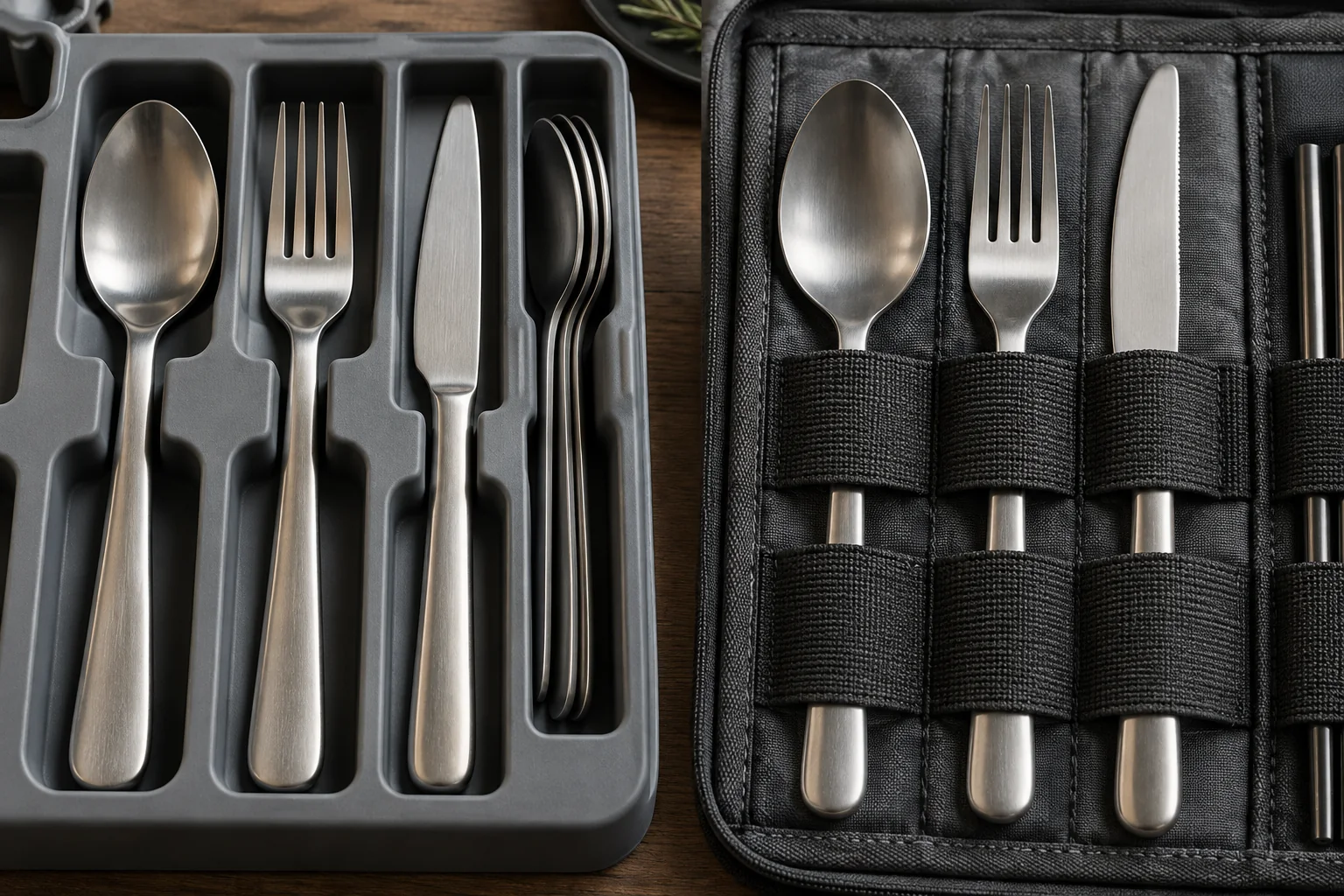
Camping set tray vs elastic retention choice matrix
| Decision factor | Molded tray | Elastic loops | Evidence before approval |
|---|---|---|---|
| Component variation | Best with stable, controlled envelopes | May accept a defined range | Revision-matched drawings and min/max samples |
| Count control | Empty cavities can be immediately visible | Empty positions may be visible if layout is disciplined | Timed inventory observation under real lighting |
| Rattle and movement | Depends on cavity clearance and local restraint | Depends on band tension, contact length and panel stiffness | Closed-pack handling with witness marks and inspection |
| Crush and edge separation | Rigid walls may add separation | Usually relies on surrounding case structure | Pack stack and exposed-edge review |
| Wet cleaning | Smooth surfaces may wipe clean; recesses need drainage | Textile layers and stitching need wash/dry access | Defined wash, drain and dry observation |
| Revision cost | Geometry change may affect tooling or insert | Loop position or length may be revised, subject to construction | Supplier feasibility and written change record |
| Field service | Insert replacement depends on case construction | Loop repair depends on stitch access and replaceable panel design | Service route and spare-part policy |
| Pack efficiency | Cavity walls consume space but control orientation | Can fold compactly but may stack thickness locally | Closed dimensions and pack-volume calculation |
Where each system usually earns consideration
Fixed retail assortment: a molded tray can support presentation and missing-piece checks when component geometry is unlikely to change. Configurable B2B program: elastic positions may help a buyer serve several controlled configurations, but every approved range still needs retention and cleaning evidence. Rental or group equipment: count speed and replaceability should be measured. Wet outdoor service: drainage, absorbent layers and dry-out time can outweigh the visual neatness of either option.
Connect this choice to the cutlery roll versus hard-case decision, the nested-set rattle review and the pack-volume calculation method. The retainer, case and components must be approved as one pack-out.
Run a revision-matched retention trial
| Step | Buyer action | Record |
|---|---|---|
| 1. Freeze inputs | Identify every sample and drawing revision. | Traceable matrix and photos |
| 2. Load the set | Use the intended order without forcing components. | Insertion difficulty and interference |
| 3. Inventory | Ask an unfamiliar reviewer to find a missing item. | Time, errors and hidden positions |
| 4. Handle closed pack | Carry, rotate and place the closed case as specified. | Movement, rattle and exposed edges |
| 5. Remove and return | Repeat representative service order. | Snag, rebound, regrip and sequence conflict |
| 6. Clean and dry | Use the planned cleaning method. | Residue traps, drainage and dry-out observations |
| 7. Inspect wear points | Check cavity polish, elastic recovery, stitches and bindings. | Location-specific condition notes |
| 8. Disposition | Accept, revise or request a controlled retest. | Owner, date and open evidence |
Limitations and commercial risks
A molded tray can create false confidence if generous cavities allow rattle or if recesses hold water. Elastic can create false flexibility if a loop overstretches, rebounds onto a food-contact surface or loses useful tension. Neither system compensates for an undefined component list.
Do not claim shock protection, washability, durability or universal compatibility from a single concept sample. Mixed materials, adhesives, coatings and textile finishes may add evidence questions. Compatibility to be confirmed by project sample and drawing.

B2B Buyer Checklist
| Check | Question | Why It Matters |
|---|---|---|
| Component freeze | Are the count and drawing revisions locked? | Prevents testing the wrong interface. |
| Fit range | What minimum and maximum envelopes must be retained? | Defines real compatibility. |
| Inventory | Can a missing item be found quickly? | Supports rental and group control. |
| Cleaning | Can every recess, layer and stitch dry? | Reduces hygiene and odor risk. |
| Wear | Where do hard edges, elastic and bindings contact? | Targets inspection and revision work. |
| Service | Can the retainer or panel be replaced? | Changes lifecycle and spare-part planning. |
| Pack-out | Does the closed set meet volume and removal-order targets? | Prevents a local fix from breaking the system. |
Buyer FAQs
1. Is a molded tray always more protective?
No. Protection depends on case structure, cavity clearance, restraint and the loading scenario. Verify the complete pack.
2. Can one elastic layout hold several utensil styles?
Possibly within a defined range. Compare minimum and maximum approved envelopes and record tension, removal and wear.
3. Which format is easier to clean?
It depends on recess geometry, removable inserts, textile layers and the planned method. Run a wash-and-dry observation.
4. Does an empty tray cavity improve inventory?
Often visually, but confirm under real lighting and packing order. Deep stacks may still hide missing pieces.
5. Can retention be mixed?
Yes as a project concept—for example, shaped plate zones with elastic utensil keepers—but every interface needs sample approval.
6. What should an RFQ include?
Send the component matrix, drawings, tolerances, pack envelope, removal order, cleaning conditions, target markets, service expectations, branding and evidence requests.
Request a retention-layout review
Provide the component matrix, revision-controlled drawings, organizer envelope, cleaning method, carry scenario and approval criteria. Naike Dinner can review the brief against verified capabilities and identify drawings, samples and written confirmations still required.
Send the retention brief or use the inquiry form beside this article. Contact Naike Dinner for sample and quotation review.