CAMPING TABLEWARE STAIN AND ODOR RETENTION PROTOCOL
A camping tableware stain odor test is useful only when the buyer fixes the food challenge, food preparation, contact surface, temperature, contact time, cleaning sequence, drying time and scoring method before comparison. Stain and odor are separate observations. Record the unwashed control, the cleaned result and any panel disagreement; do not turn one food or one cleaning cycle into a universal material claim.
Reviewed November 9, 2026 at 09:37:26 CST · GEO D / S + E
What Should a Camping Tableware Stain Odor Test Matrix Include?
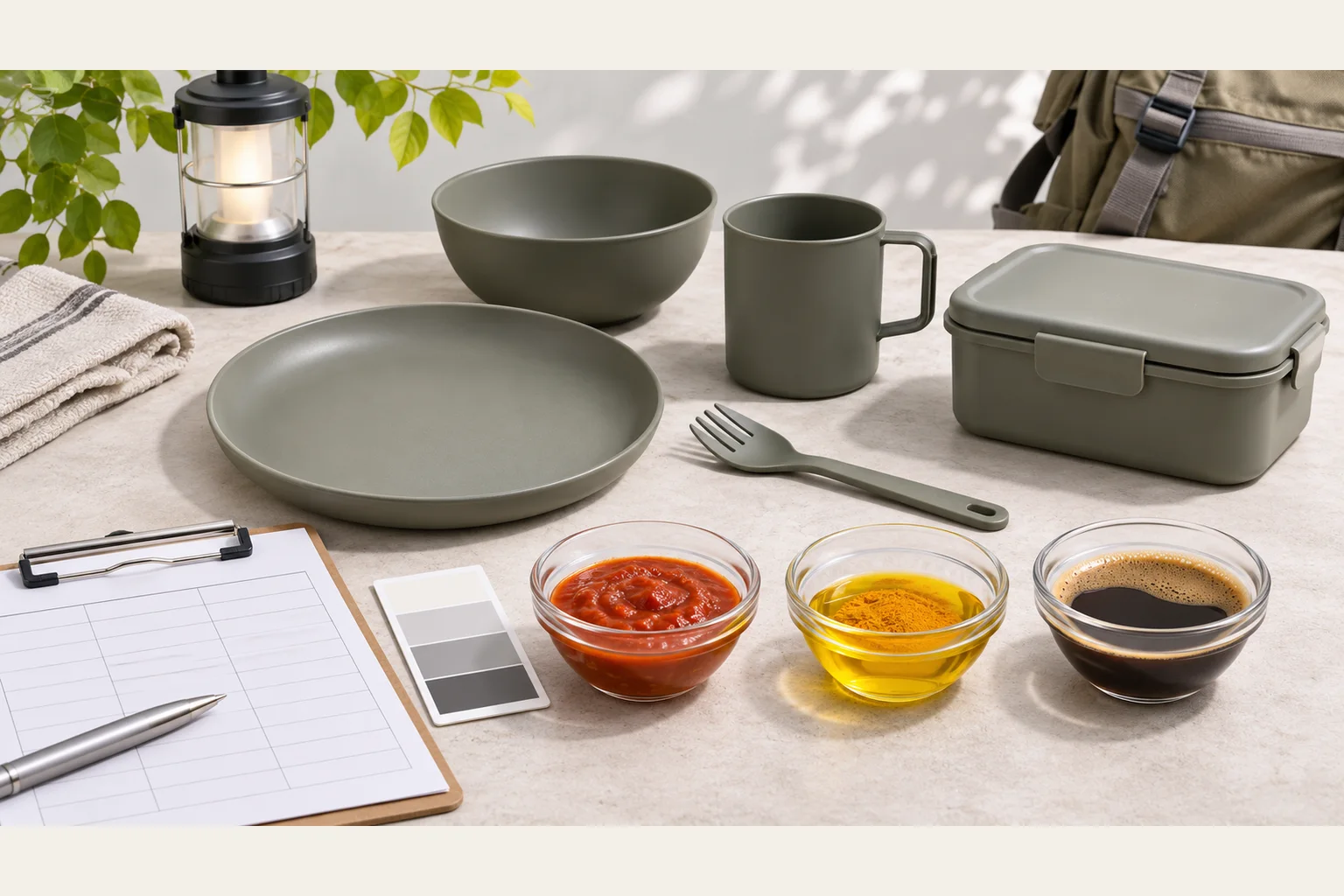
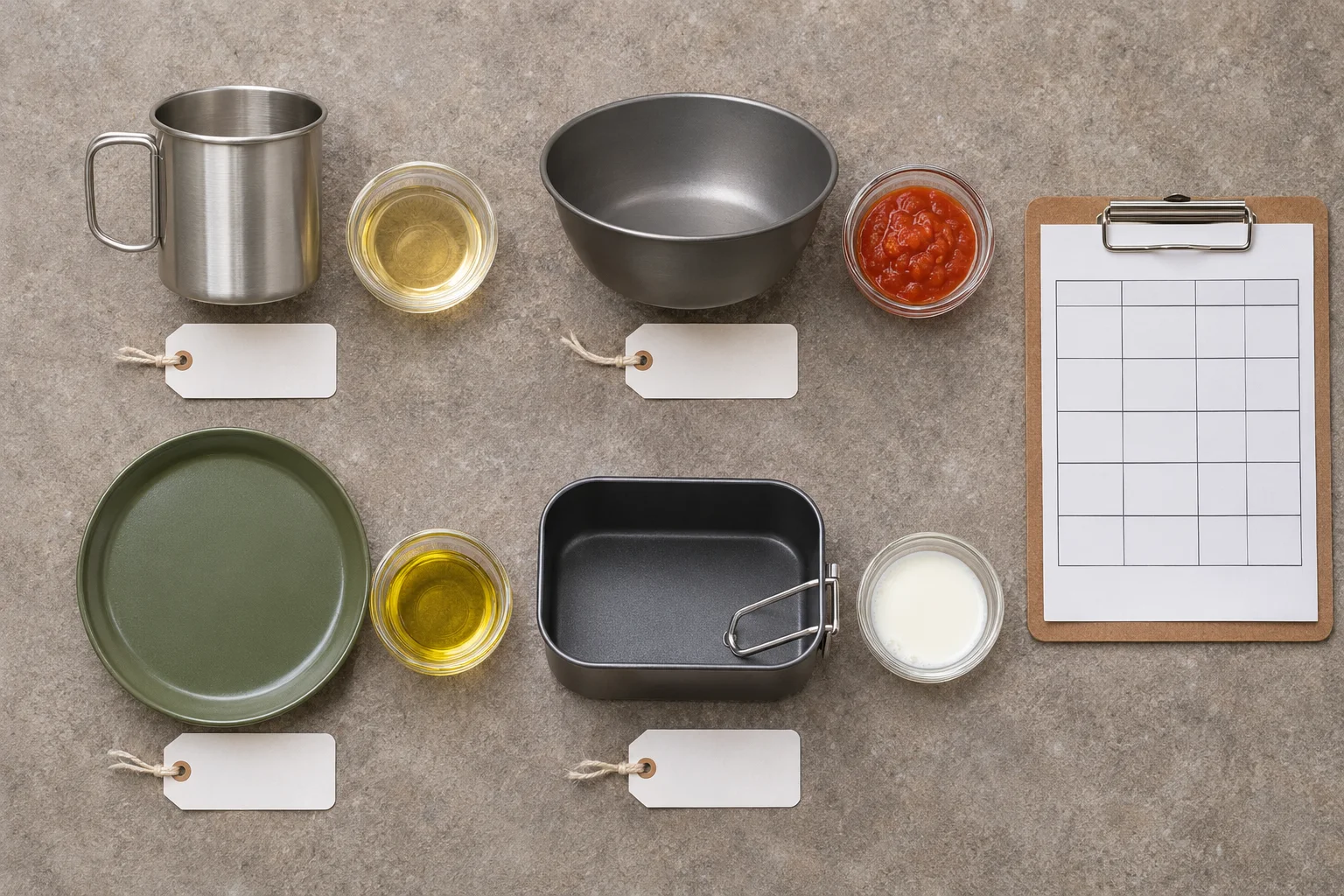
Use the camping tableware stain odor test to start with the intended food and use conditions, then select representative challenges rather than an arbitrary pantry list. A tomato-based sauce may be useful for visible color transfer, an oil-rich food for greasy residue, and a strongly aromatic food for odor review. Those are candidate challenges, not universal requirements. The buyer must approve the exact recipe, concentration, mass, contact area, temperature and duration.
| Matrix field | Record before exposure | Record after cleaning |
|---|---|---|
| Test article | Component code, revision, color, cavity or lot reference where available | Same sample identifier and inspected surfaces |
| Food challenge | Food identity, preparation, concentration, mass and batch | Residue removed, retained or not assessable |
| Contact condition | Surface, fill level, temperature, duration, cover state and orientation | Elapsed time before wash and before scoring |
| Cleaning | Water, detergent, tool, cycle count and rinse method | Actual sequence, deviations and visible damage |
| Stain result | Baseline photo and color reference under controlled lighting | Score, image, location and reviewer |
| Odor result | Blank control and panel conditions | Score, panel responses, disagreement and ventilation time |
Keep each food in a separate cell or sample unless the approved method intentionally studies a mixture. Cross-contact between challenges can make the cause of a result impossible to identify. Review the broader camping tableware material-change review, camping dinnerware cleaning instructions and camping-set critical-quality-characteristic matrix when connecting this observation to a controlled specification.
Which 8 Controls Make the Result Comparable?
| Control | Buyer must define | Risk if omitted |
|---|---|---|
| 1. Baseline | Clean sample, lighting, background and blank odor control | Existing color or odor may be blamed on exposure |
| 2. Food preparation | Recipe, concentration, particle size, oil content and batch | Different challenges are compared as if identical |
| 3. Contact surface | Interior, rim, seal groove, utensil face or other exact area | A local result becomes a whole-product claim |
| 4. Temperature | Food and article temperature plus measurement timing | Hot and ambient exposures are mixed |
| 5. Duration | Contact time and whether the article is covered | Evaporation and exposure time vary |
| 6. Cleaning | Water, detergent, tool, force or machine program, rinse and cycles | A harsher wash hides retention or damages the surface |
| 7. Drying | Drain position, ventilation, time and evaluation interval | Residual detergent or moisture affects odor |
| 8. Scoring | Scale anchors, reviewers, lighting and decision rule | Subjective words replace a reproducible record |
The FDA Food Code discusses cleaning and sanitizing food-contact surfaces in retail and food-service settings. It does not prescribe a camping dinnerware stain limit. The official 21 CFR Part 177 contains requirements for specified indirect food additives, but it does not establish a pass/fail stain or odor score for this product. Use those sources to clarify regulatory and hygiene context, not to invent acceptance criteria.
How Should Buyers Control the Cleaning Sequence?
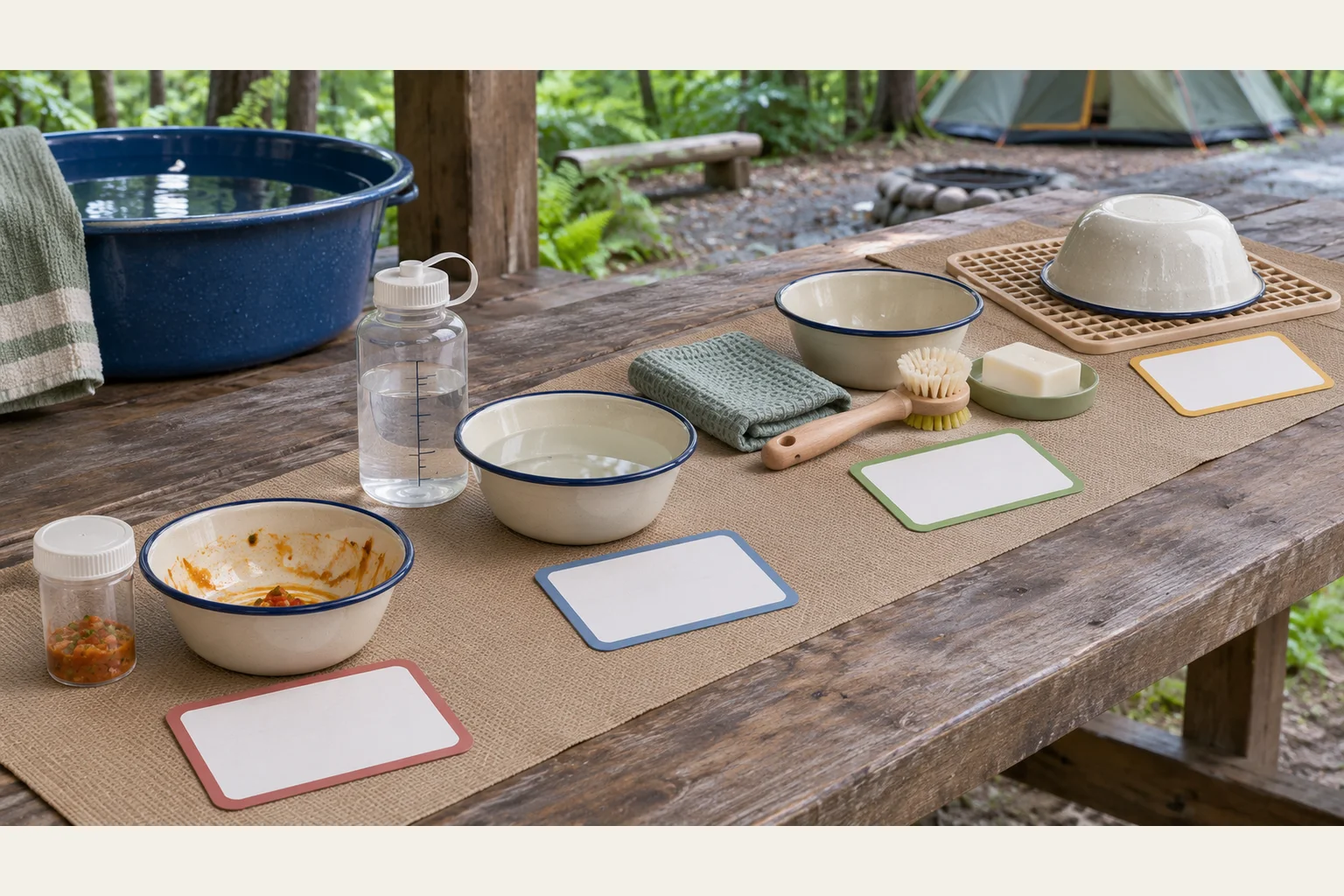
In a camping tableware stain odor test, write the cleaning sequence as an executable instruction. Identify the water temperature range, detergent product or controlled formulation, concentration, wash tool, number of strokes or machine program, rinse steps and drying method. If hand washing is used, define the contact surface and pressure control as far as practical. Photograph the sample after exposure, after rinse and after drying under the same lighting.
| Stage | Minimum record | Approval question |
|---|---|---|
| Pre-rinse | Delay, water condition and duration | Was loose residue removed consistently? |
| Wash | Detergent, concentration, tool, time and cycle count | Could another inspector repeat it? |
| Rinse | Water condition, time and number of rinses | Could detergent residue affect odor scoring? |
| Dry | Orientation, airflow, time and environment | Was every sample scored at the same interval? |
| Inspect | Lighting, background, panel conditions and sample order | Were reviewers blinded where the plan requires it? |
How Should Stain and Odor Be Scored?
For a camping tableware stain odor test, score stain and odor separately. A practical buyer scale may use defined anchors such as no observable change, slight change visible only under inspection, clear retained change, and severe retained change. The buyer must write the anchors, viewing distance, lighting, panel size and decision rule. Preserve individual panel scores; do not report only an average that hides disagreement.
For color observations, controlled photography can support traceability but does not replace an approved instrument method. For odor, use a blank control, random sample order and a ventilated evaluation area. Stop the panel if safety information is missing or the exposure produces an unexpected condition. Regulation (EC) No 1935/2004 provides the EU framework for materials intended to contact food at EUR-Lex; this protocol does not establish regulatory compliance.
What Does the Test Prove—and What Does It Not Prove?
A camping tableware stain odor test can document a defined sample’s visible stain and perceived odor after specified food contact and cleaning. It does not prove material identity, migration compliance, antimicrobial performance, dishwasher safety, universal food compatibility, production consistency or cookware suitability. Plates, bowls, cups, utensils and lunch boxes here are dinnerware or food-contact articles, not cookware. Each additional claim needs its own relevant evidence.
Buyer Checklist
| Ask the supplier | Review the evidence | Approve only when |
|---|---|---|
| Which foods and conditions represent our intended use? | Approved challenge matrix and sample IDs | Recipe, temperature, time and contact area are fixed |
| How is every sample cleaned and dried? | Executable cleaning record and deviations | The same sequence is reproducible across samples |
| How are stain and odor scored? | Separate anchored scales, photos and panel sheets | Individual results and disagreement remain visible |
| What decision can the record support? | Released specification and approval signature | The claim is limited to the tested conditions and revision |
Frequently Asked Questions
Can one tomato-sauce test prove stain resistance?
No. It documents one defined challenge on identified samples. Broader claims require an approved range of foods, conditions, samples and decision rules.
Should odor be scored immediately after washing?
Only if the approved method says so. Record the drying and ventilation interval because moisture and detergent residue can affect perception.
Can buyers combine stain and odor into one score?
That can hide different failure modes. Record both separately before applying any buyer-approved combined decision.
Does a clean appearance prove food-contact compliance?
No. Visual or sensory observations do not replace material, migration or destination-specific compliance evidence.
Need a Stain and Odor Protocol Review Before Quotation?
Send your camping tableware stain odor test brief with the component codes, intended foods, contact temperatures and times, cleaning method, score anchors, sample plan and destination market. Naike Dinner can review the information needed for a project-specific specification and RFQ without inventing test results or product capabilities.
Request a protocol review Send the cleaning specification Start a tableware RFQ