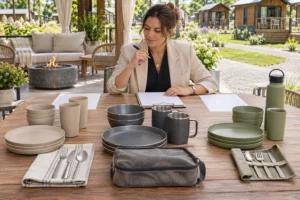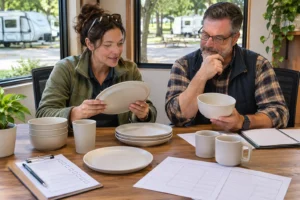
CAMPING DINNERWARE HOT-FILL DEFORMATION WORKSHEET
A camping dinnerware hot fill deformation review is comparable only when the buyer fixes the liquid temperature, fill mass, support condition, exposure time, measurement points, cooling interval and acceptance rule before testing. Record dimensions before filling, while loaded where safe, and after recovery. The result applies to the identified dinnerware sample and conditions; it does not make the article cookware or prove universal heat resistance.
Reviewed November 10, 2026 at 09:10:22 CST · GEO X / Q + E
What Belongs in a Hot-Fill Deformation Worksheet?
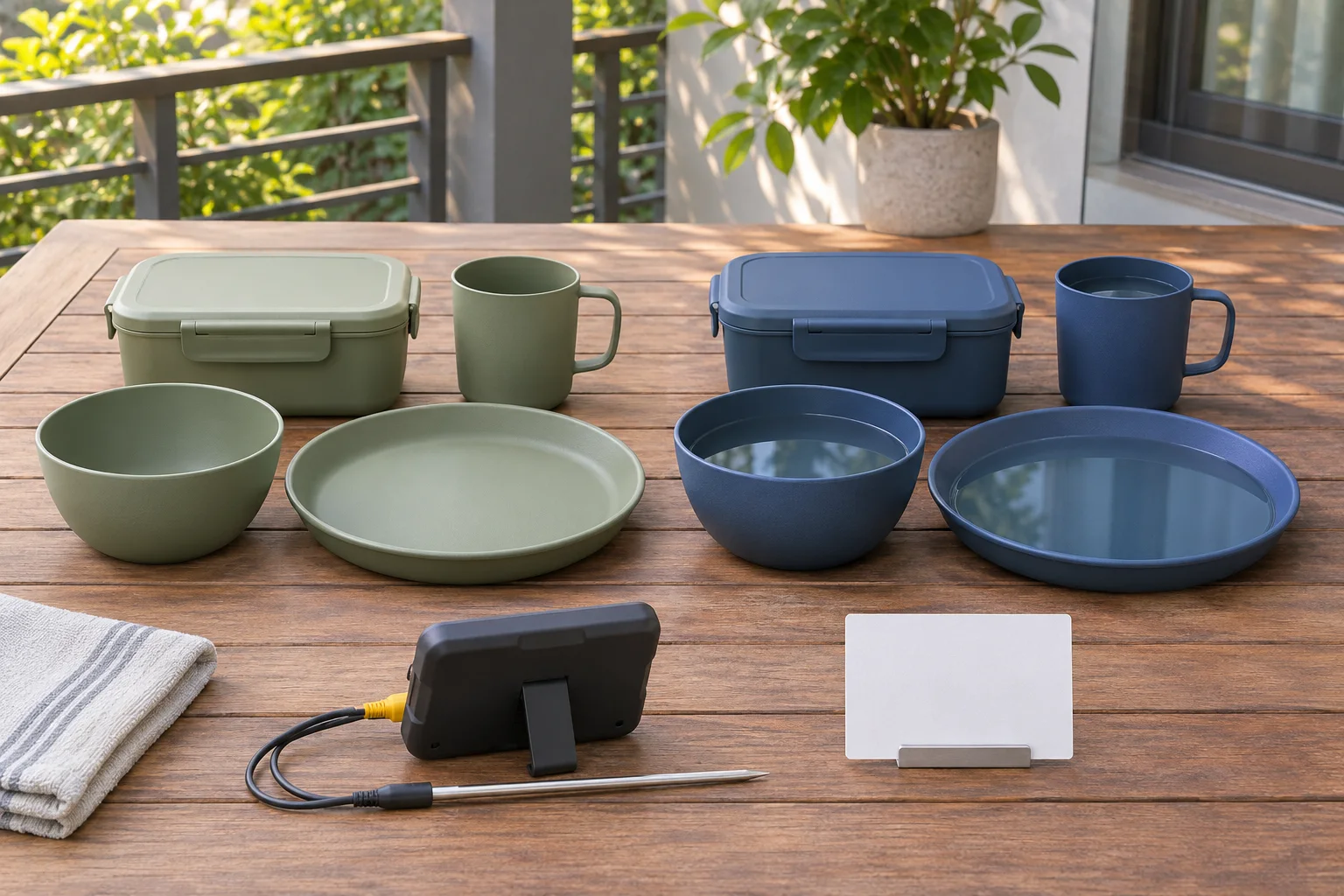
Start the camping dinnerware hot fill deformation worksheet with the intended use, component revision and buyer-approved exposure. A cup, bowl, plate or lunch box may have different fill geometry, rim support and load distribution. Do not transfer a result from one component to another. Use matched samples where possible: one unexposed reference and one or more exposed articles from the same controlled revision.
| Worksheet field | Buyer-controlled input | Record after exposure |
|---|---|---|
| Sample identity | Component code, drawing revision, color and lot or cavity reference where available | Same sample ID, inspected area and any deviation |
| Liquid condition | Liquid identity, target temperature range and measurement point | Actual start/end readings and instrument ID |
| Fill load | Mass or volume, fill line and headspace | Actual load and spill or leakage observation |
| Support | Flat surface, rack, rim support or intended-use fixture | Contact points and any support movement |
| Time | Transfer limit, exposure duration and measurement sequence | Actual timestamps and missed windows |
| Dimensions | Named points, datum, tool, units and resolution | Before, loaded, unloaded and recovered values |
| Decision | Buyer-approved limits and claim wording | Pass, fail or review with approver and revision |
Connect the record to the camping tableware material-change review, the stain and odor protocol and the tableware claim approval matrix. These links keep a dimensional observation from becoming an unsupported material or performance statement.
Which 8 Controls Make the Comparison Usable?
| Control | Define before testing | Risk if missing |
|---|---|---|
| 1. Sample pairing | Reference and exposed sample IDs plus revision match | Normal part variation is mistaken for heat response |
| 2. Starting condition | Sample conditioning, initial temperature and baseline dimensions | Samples begin from different states |
| 3. Fill temperature | Target range, probe location, instrument and reading time | Nominal temperature replaces measured exposure |
| 4. Fill load | Mass or volume, fill line and liquid density assumption | Different mechanical loads are compared |
| 5. Support | Contact surface, level condition and restraint | The fixture creates or hides deformation |
| 6. Exposure time | Transfer limit, dwell time and draining sequence | Cooling changes the comparison |
| 7. Measurement | Datums, tools, points, units and operator method | Different locations produce false change |
| 8. Recovery | Unloaded cooling condition and recheck interval | Temporary and retained change are mixed |
How Should Buyers Measure Dimensional Change?
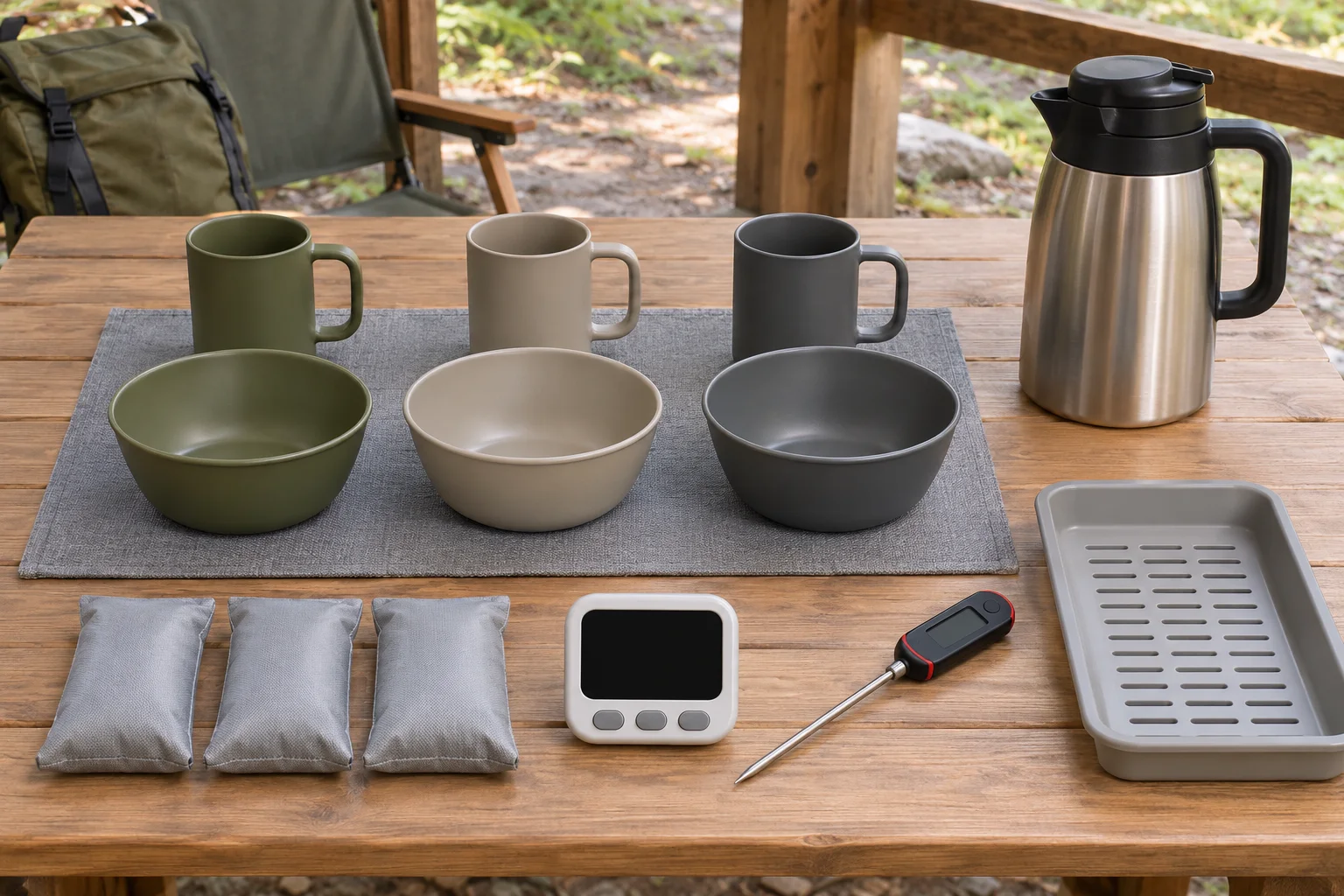
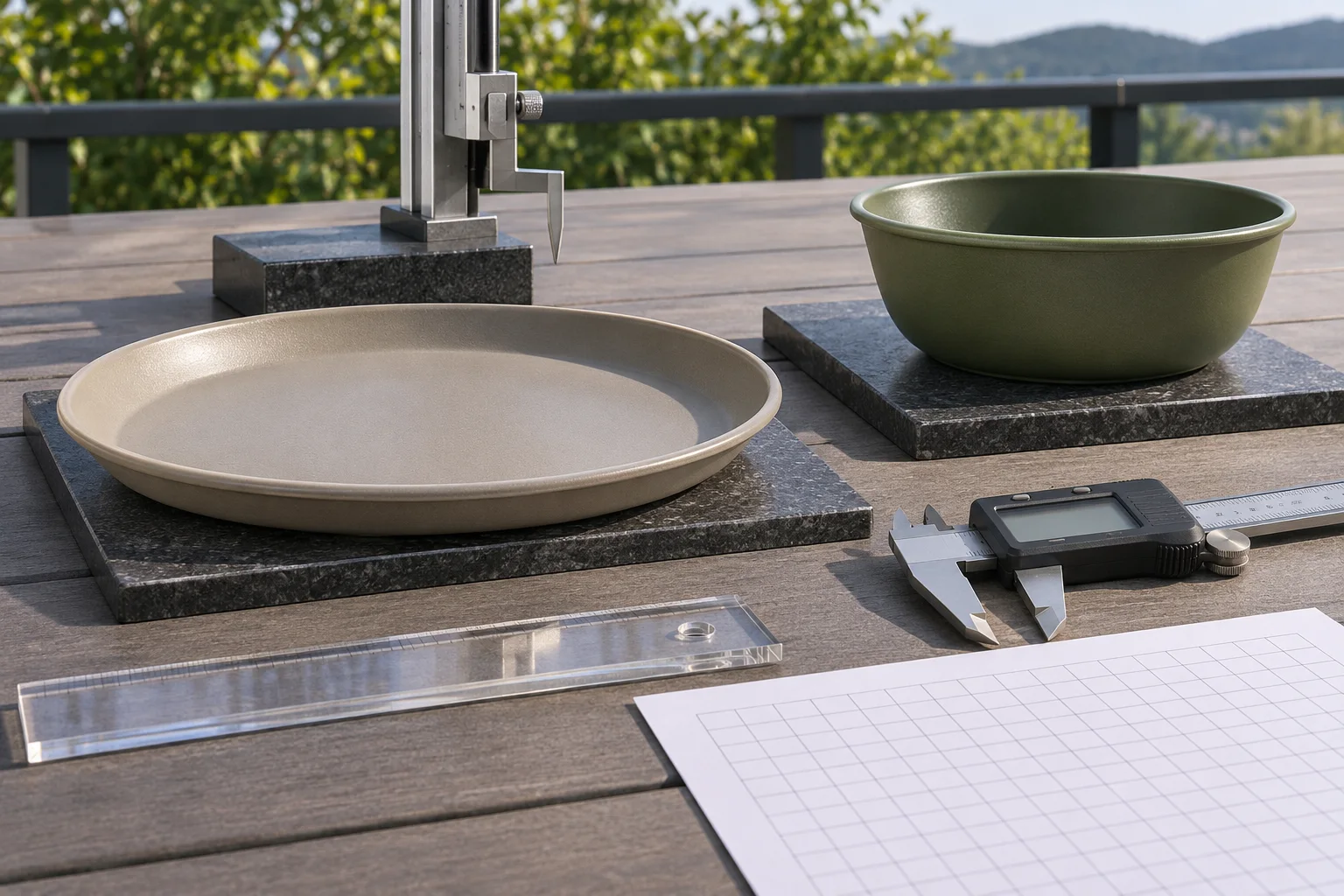
Define the datum before the hot-fill exposure. For a plate, the buyer may approve a flat reference support and named rim-height points. For a bowl or cup, the record may include opening diameter, height at fixed locations, base contact and lid-interface dimensions. Measure only where the tool can contact the article repeatably without forcing it back into shape. A photograph supports traceability but is not a dimensional result.
| Stage | Minimum record | Buyer question |
|---|---|---|
| Baseline | Conditioning, datum, named points and repeated readings | Can another inspector reproduce the setup? |
| Loaded | Fill condition, support, elapsed time and safe accessible points | Does measurement disturb the article? |
| After drain | Drain method, unloading time and immediate readings | Was the transfer window met? |
| Recovered | Cooling condition, interval and repeated readings | Is the change temporary or retained? |
| Interface check | Lid, nesting or stack-fit observation using matched revisions | Was compatibility assessed separately from dimension? |
The ASTM D648 method addresses deflection temperature of plastics under flexural load. It is not a ready-made camping dinnerware hot-fill acceptance test. The buyer must not copy a material-level result into a finished dinnerware claim without a justified relationship and controlled finished-article evidence.
How Should Buyers Calculate and Approve Change?
For each named point, record dimensional change as measured value after exposure minus the paired baseline value. If the buyer needs a percentage, define the denominator and rounding rule before calculation. Keep raw values, instrument resolution and operator notes visible. Do not average away a local rim lift, base-rocking condition or lid-interface change that matters to use.
| Decision field | Required evidence | Approval record |
|---|---|---|
| Limit | Signed drawing or specification with units and measurement point | Buyer owner and revision |
| Sample plan | Quantity, pairing, lot/cavity scope and retest rule | Approved before exposure |
| Observed change | Raw readings, calculation and photographs | Individual sample disposition |
| Functional follow-up | Separate lid, nesting, stability or leakage method where relevant | Do not infer from dimensions alone |
| Claim wording | Exact use condition and exclusions | Released only after evidence review |
What Does This Review Prove—and What Does It Not Prove?
A camping dinnerware hot fill deformation record can show dimensional observations for identified samples under a defined liquid temperature, fill load, support and timing sequence. It does not prove cookware use, microwave safety, oven safety, dishwasher safety, migration compliance, burn safety, universal temperature resistance or production consistency. Dinnerware receives food or drink; cookware is intended for cooking. Keep those uses separate.
For regulatory context, review applicable food-contact substances in 21 CFR Part 177 and the EU framework in Regulation (EC) No 1935/2004. Neither source supplies a universal hot-fill deformation limit for camping dinnerware.
Buyer Checklist
| Ask the supplier | Review the evidence | Approve only when |
|---|---|---|
| Which exact component and revision will be exposed? | Sample IDs, BOM and drawings | Reference and exposed samples are traceable |
| What temperature, fill load, support and time apply? | Executable worksheet and instrument record | Every condition has a unit and tolerance |
| Where are dimensions measured? | Datum sketch, named points and raw readings | Another inspector can repeat the method |
| What claim may be released? | Limits, recovery results and claim matrix | Wording stays within tested conditions |
Frequently Asked Questions
Does one hot-water fill prove heat resistance?
No. It records one defined exposure on identified samples. Broader claims need justified conditions, sampling and separate evidence.
Should a plate be tested like a bowl?
Not automatically. Geometry, fill distribution, support and intended use differ, so the buyer must approve component-specific setups.
Can a dimensional result prove lid compatibility?
No. Compatibility to be confirmed by project sample and drawing, using matched revisions and a separate fit or functional check.
Does hot-fill dinnerware become cookware?
No. A hot-fill review does not authorize direct heating, cooking, microwave, oven or flame use.
Need a Hot-Fill Worksheet Review Before Quotation?
Send the component codes, intended liquid temperature, fill mass, support, exposure time, measurement points, recovery interval, sample plan and destination market. Naike Dinner can review the project inputs without inventing results or cookware capability.
Request a worksheet review Send the dimensional specification Start a tableware RFQ