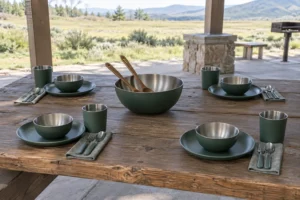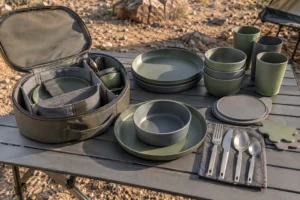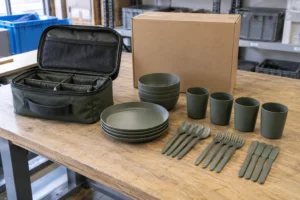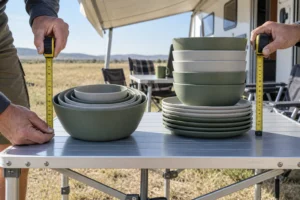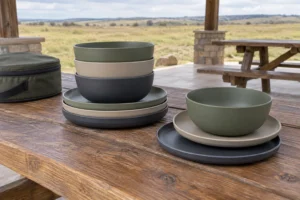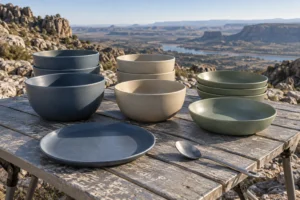
How to choose camping tableware for your brand starts with the user, meal, transport method, cleaning reality and sales channel—not with a fashionable material. Convert those conditions into component specifications, verify food-contact and performance evidence for the intended market, compare like-for-like samples, and lock packaging, inspection and change-control requirements before approving a supplier quotation.
How to Choose Camping Tableware for Your Brand: Start with the Brief
The first document should describe the intended customer and use cycle in plain language. Define whether the set serves backpackers, family car campers, RV users, outdoor schools, rental fleets, festivals or retail gifting, because each group carries, heats, washes, stores and replaces items differently. State the meals, serving sizes, expected reuse period and whether pieces must nest inside cookware or a storage bin.
Separate required functions from optional merchandising. A plate, bowl, cup and eating utensil may be the core, while a cooking pot, frying pan, cutting board, storage lid or pouch may be optional. The guide explaining what a camping mess kit is helps teams distinguish cooking, serving, eating, drinking, cleaning and carrying functions before a brief turns into an ambiguous “all-in-one” request.
Write exclusions with the same care. If a plate is not cookware, the brief should prohibit burner, campfire and direct-flame claims. If a cup is intended only for cold and warm drinks, do not let lifestyle photography imply boiling or stove use. These boundaries protect the end user and make supplier evidence much easier to evaluate.
Turn the assortment idea into a buyer brief
Send Naike Dinner the target market, user profile, pieces, meal types, heat and cleaning conditions, branding area, packaging route and annual demand scenario. The team can identify missing specification questions without assuming that every requested material or process is available.
Request a project-scope reviewBuild the Set Architecture Before Comparing Materials
Set architecture determines most downstream trade-offs. Record the quantity and function of every component, its target capacity or usable area, nesting order, packed dimensions and whether replacement pieces must be sold separately. A four-person set is not simply four copies of a one-person kit when communal bowls, serving tools, cookware and storage are shared.
Use the published camping mess kit component checklist as a question bank, then delete components that do not serve the brief. More pieces can raise perceived value but also increase weight, carton volume, washing effort, mismatched-loss risk and quality-control points. A focused set often produces a clearer retail story and a more stable factory specification.
Check physical interfaces early. Plate diameter affects pack-out; cup handles can prevent nesting; deep bowls may trap utensils; pouch seams need space for stacked rims; and lids may rattle or abrade decorated surfaces. Draw the packed system and request a physical stacking demonstration before approving styling.
Compare Materials by Use Condition, Not Reputation
No material wins every camping program. Titanium can support a premium lightweight story for certain cookware or metal tableware, stainless steel can support familiar durability, aluminum can reduce weight in designed cookware systems, enamel can offer visual character, and polymer or plant-fiber composites can deliver quieter handling and color flexibility. Each statement remains conditional on the finished construction, food-contact evidence and specified use.
The article on the best material for camping dinnerware provides a wider comparison, while the titanium versus stainless steel guide separates material reputation from SKU-level decisions. Do not copy a headline property into a purchase order without defining thickness, finish, joints, coatings, colorants, reinforcing features and care limits.
| Decision factor | Metal route | Polymer or composite route | Buyer evidence |
|---|---|---|---|
| Carried weight | Depends on alloy, gauge, forming and component count | Depends on resin system, wall design and reinforcement | Verified finished-set weight and tolerance |
| Heat boundary | Some cookware designs may suit controlled heating; dinnerware does not inherit that claim | Usually serving or eating use unless product-specific evidence says otherwise | SKU instructions, heat source, food temperature and duration |
| Drop and deformation | May dent, bend, chip a coating or loosen a joint | May crack, whiten, warp or damage a molded feature | Production-intent sample testing and defect criteria |
| Noise and touch | Can feel cold, hot or noisy depending on construction | Often quieter with warmer touch and broad color options | User trial with intended meals and environment |
| Decoration | Laser, pad print, coating or other process must be verified | Molded color, print or in-mold options depend on system | Artwork proof, durability method and restricted-substance review |
| End-of-life claim | Local collection and material separation determine the realistic route | Resin mix, additives and local infrastructure control options | Destination-specific claim substantiation, not a generic icon |
Verify the Finished Food-Contact Article
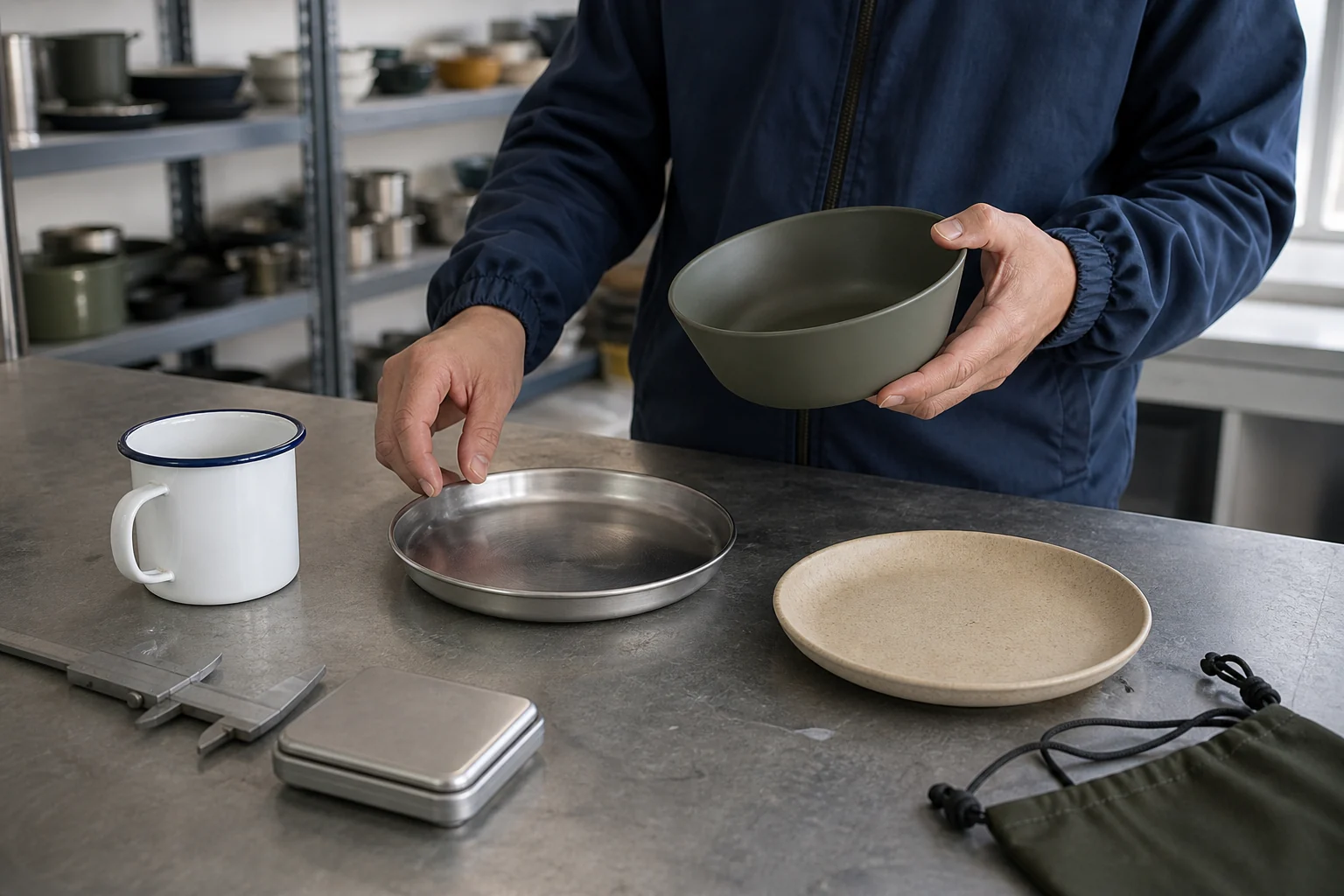
Raw-material names are not finished-product approvals. The U.S. FDA distinguishes a food-contact substance, food-contact material and finished food-contact article in its official food ingredient and packaging terms. Ask the supplier to connect resin, metal, additives, colorants, coatings, inks, adhesives and processing aids to the exact commercial SKU and revision.
Intended use defines the evidence scope. FDA’s official food types and conditions-of-use tables distinguish food characteristics and temperature scenarios, demonstrating why one generic “food grade” document cannot automatically cover hot soup, oily food, acidic food, freezing, reheating and repeated use. Write the actual foods, temperatures, contact duration and cleaning cycle into the brief.
For Europe, the European Commission explains that kitchenware and tableware are food-contact materials and points buyers to the framework regulation and good manufacturing practice requirements on its official food-contact materials page. The procurement file should identify the destination market, responsible economic operator and evidence relevant to the material category rather than treating an FDA-oriented statement as automatic EU coverage.
Translate the Brand Promise into Measurable Requirements
Words such as rugged, lightweight, premium, family-safe, compact and easy-clean are useful marketing directions but poor acceptance criteria. Convert each one into a measurable or observable requirement. “Compact” may mean a maximum packed volume; “easy-clean” may mean no trapped residue after a stated field-wash method; “quiet” may mean no unacceptable rattle in the closed pouch during a defined movement check.
Limit tolerances to characteristics that matter. Control overall dimensions, usable capacity, mass, rim condition, nesting interface, handle movement, closure fit, color range, decoration position and pack-out where those affect function or customer expectation. Excessively tight tolerances add cost and disputes, while missing tolerances allow samples and production to drift.
Create an approved-sample record that links the physical sample to the drawing, bill of materials, artwork, color reference, packaging specification and evidence file. Photographs are helpful but cannot capture feel, balance, odor, sharpness, surface friction or actual fit. Keep one sealed reference sample with the buyer or inspection party when practical.
Test the Actual Camping Use Cycle
A laboratory report answers only the questions inside its scope. Brand approval also needs practical checks that reflect filling, carrying, eating, cleaning, drying, stacking and storing. Use production-intent samples, realistic food portions and the intended accessories; a plate tested alone may behave differently when packed under a cup, cutlery and tight pouch.
Plan misuse boundaries without turning the evaluation into unsupported torture testing. Check foreseeable drops, rim impacts, loaded-handle movement, hot-food handling, surface scratching, nesting abrasion, odor retention, staining, drainage and pouch closure. Record the method, sample identity and result so the team can compare revisions rather than relying on memory.
Cookware needs a separate protocol. The recent guide asking whether titanium cookware is safe for camping shows why heat source, empty heating, burner concentration, handles, steam and stability must be evaluated for the exact pot or pan. Never place a dinnerware component over flame merely because the wider set includes cookware.

Match Product Design to the Sales Channel
Outdoor specialty retail, mass retail, direct-to-consumer, promotional gifting and institutional supply use different decision filters. Specialty retail may need a clear technical story and shelf comparison; DTC may prioritize parcel resistance, photography and replacement service; rental fleets may value component identification and repeat purchasing more than gift-box presentation. Define the channel before styling and packaging are frozen.
Keep visual differentiation compatible with manufacturing control. A unique molded form may require dedicated tooling and higher commitment, while color, decoration, sleeve artwork or pouch construction may offer lower-risk differentiation. Ask which changes affect tooling, setup, material purchasing, approval time, minimum quantity and replacement compatibility.
Naike Dinner’s verified public scope is centered on reusable wheat-straw composite tableware. This article does not establish company capability in titanium, stainless steel, aluminum, enamel, silicone, PP, Tritan or cookware. For any requested outdoor material or process, obtain a documented project-scope response before presenting the item as part of the company’s supply range.
Design Packaging Around Protection and Operations
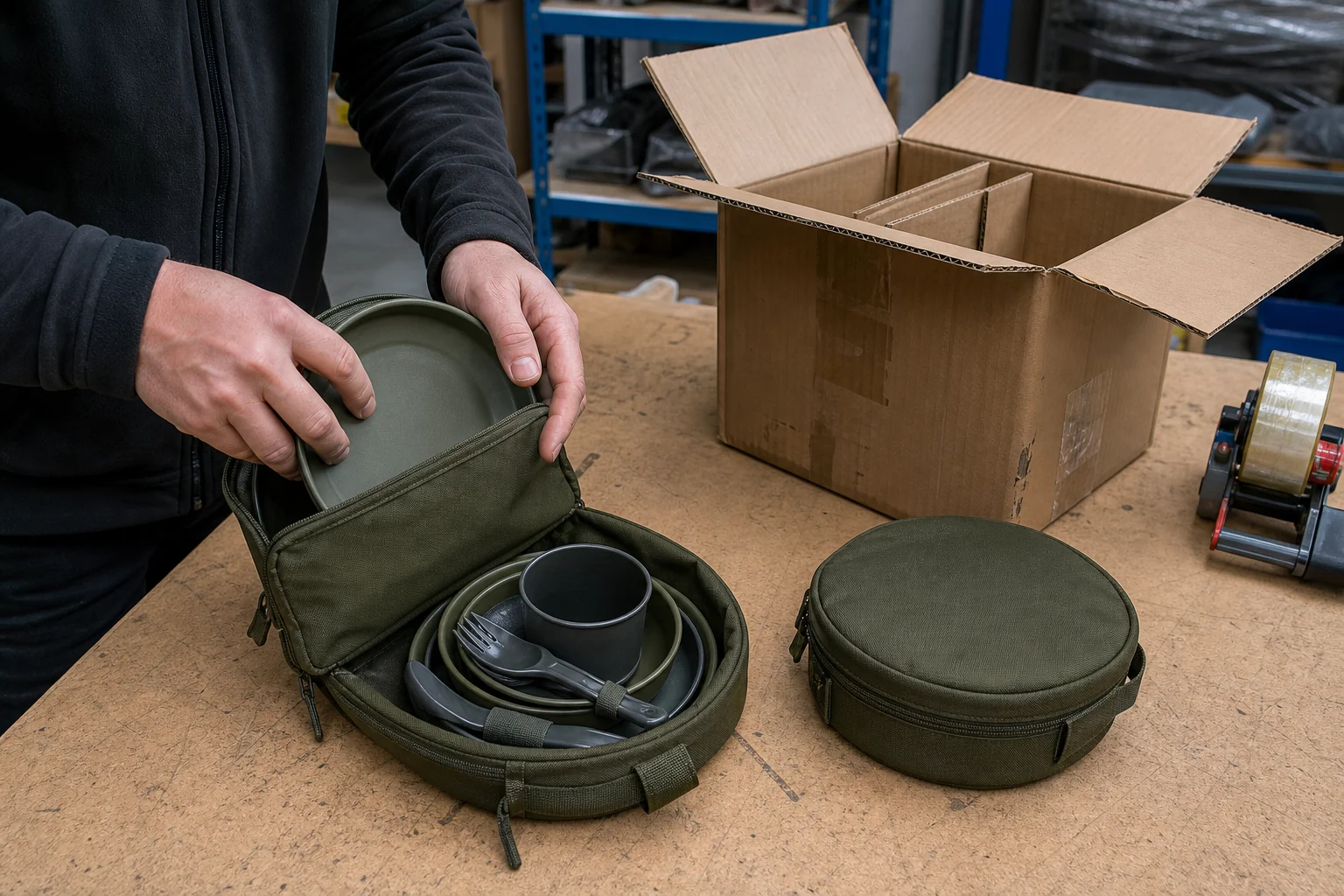
Packaging is part of product performance. Identify how the set remains complete, dry and protected from rim abrasion, decoration rub, handle pressure and transport movement. A pouch can support field carrying, a sleeve can communicate at retail, and a box can improve presentation, but each adds different material, assembly and inspection requirements.
Calculate packed dimensions from real samples, not optimistic CAD nesting. Verify unit weight, master-carton quantity, carton dimensions, gross weight, internal protection and parcel or pallet route. A small increase in handle clearance can change carton efficiency across a large order, so packaging should be approved with the final component revision.
Labels and instructions must match the destination and channel. Confirm product identity, responsible-party information, traceability code, material or care statements, warnings and language needs with qualified market-specific review. The EU’s official General Product Safety Regulation provides the legal source for general product safety and economic-operator obligations; do not reduce that review to a generic “GPSR compliant” icon.
Make Supplier Quotations Comparable
A price without a specification is not a comparable quotation. Issue the same request package to each candidate: component list, drawings or dimension targets, material construction, colors, artwork, food and heat conditions, evidence expectations, packaging, inspection plan, delivery term and demand scenarios. Require suppliers to list assumptions and exclusions rather than silently filling gaps.
Separate recurring unit cost from one-time and conditional charges. Tooling, artwork setup, sampling, testing, packaging plates, inspection, replacement components and freight may sit outside the quoted unit price. Ask how price changes by quantity, color count, pack-out and order cadence, but do not assume a universal MOQ or lead time before the supplier reviews the exact configuration.
Commercial flexibility is useful only when product control survives it. A supplier offering low initial quantity may still require a high material minimum, allow uncontrolled color changes or use a sample route different from mass production. The quotation should identify production site, process route, material source assumptions and which changes require buyer approval.
Compare one specification, not several assumptions
Naike Dinner can review a buyer-created request package for missing dimensions, use conditions, evidence scope, artwork, packaging and quotation assumptions. This review does not confirm unverified materials or factory capabilities; it creates a clearer basis for a documented response.
Submit your sourcing briefPlan Sample Approval in Three Stages
Use an appearance or concept sample to confirm overall direction, then an engineering sample to validate construction and interfaces, and finally a production-intent sample made with the proposed materials, tooling, decoration and packaging route. Do not treat a hand-finished prototype as proof that mass production will match. Record every deviation and its planned closure.
At each stage, maintain a decision log. Mark each item approved, approved with action, or rejected; identify the responsible party and required evidence; and retain revision numbers. An enthusiastic video call does not replace a signed sample record when several teams or suppliers are involved.
Define the golden sample carefully. It should be clean, complete, date-coded, cross-referenced to controlled files and stored to prevent fading, distortion or component loss. If color or surface texture has a tolerance range, retain approved boundary references rather than one ideal sample that production can never match exactly.
Use an Inspection Plan That Reflects Real Risk
Inspection should begin with critical function and safety, then cover major performance and minor appearance issues. Define defects with photographs or objective descriptions: sharp rim, unstable base, loose handle, wrong component, failed closure, unreadable traceability mark, color outside range or packaging shortage. Avoid vague criteria such as “poor quality” that different inspectors interpret differently.
The U.S. National Institute of Standards and Technology explains in its official acceptance-sampling handbook that sampling is used to decide whether a lot is likely to be acceptable rather than to estimate its complete quality. An AQL-based plan does not make a defective product safe and does not replace process control; buyers must still define the lot, sample, defect classes and acceptance criteria. Critical hazards may require different controls or zero acceptance depending on the risk program.
Connect inspection to change control. If material, thickness, tooling, coating, print, supplier site or packaging changes, decide whether the approved sample, compliance rationale and performance tests still apply. The supplier should notify the buyer before implementation, not after a shipment fails comparison.
Common Selection Risks and How to Control Them
The first risk is choosing by one headline property. The lightest cup may be uncomfortable with hot liquid; the toughest plate may be too heavy for the channel; the most colorful finish may complicate evidence or abrasion control. Use a weighted decision matrix that reflects the actual user and channel rather than declaring one property universally best.
The second risk is document transfer. A report for raw resin, a different color, another factory, a different food condition or a previous SKU may not support the proposed article. Check names, identifiers, dates, sample photos, construction and conditions before accepting a document into the project file.
The third risk is visual overclaim. Outdoor photography can suggest open-flame, dishwasher, freezer, child-use or extreme durability even when instructions and evidence do not. Review marketing images, packaging and marketplace copy against the same controlled use matrix used by product and compliance teams.
Brand-Specific Camping Tableware Buyer Checklist
| Check | Question | Why It Matters |
|---|---|---|
| User and channel | Who carries, uses, washes, stores and replaces the set? | Prevents a generic design from missing the real operating cycle. |
| Component architecture | Which pieces are required, optional, shared or replaceable? | Controls weight, count, nesting, cost and merchandising clarity. |
| Use boundary | Which pieces contact heat, hot food, flame, a dishwasher or a freezer? | Separates cookware, dinnerware and unsupported lifestyle claims. |
| Construction | Are material grade, additives, coatings, joints, dimensions and tolerances defined? | Makes samples, evidence and quotations comparable. |
| Food-contact file | Does evidence identify the SKU and intended market, foods, time and temperature? | Stops unrelated raw-material or generic reports from being transferred. |
| Performance | Which field-use, drop, fit, handling, cleaning and abrasion checks apply? | Connects the brand promise to observable acceptance criteria. |
| Branding | Which color, decoration and artwork controls survive intended use? | Protects appearance without creating an unverified process claim. |
| Packaging | Is the final nested set validated in its pouch, retail pack and master carton? | Controls protection, completeness, freight and channel presentation. |
| Quotation | Are tooling, sampling, testing, inspection and quantity assumptions separated? | Reveals true landed decisions instead of a misleading unit price. |
| Sample and change control | Are revisions, golden samples and supplier-change notifications defined? | Keeps mass production aligned with the approved project. |
Buyer FAQs
1. What pieces should a branded camping tableware set include?
Start with the meal and user count, then include only the functions the customer needs. Plates, bowls, cups and eating utensils are common, while cookware, serving tools, lids, cutting surfaces and pouches should be added only when the use case and pack architecture justify them.
2. Which material is best for an outdoor brand?
There is no universal best material. Compare finished constructions against carried weight, heat boundary, impact mode, noise, touch, care, branding, evidence, price position and destination. Test the exact production-intent sample rather than buying a material reputation.
3. Should we choose cookware and dinnerware from the same material?
Not necessarily. Cooking, serving, eating and drinking create different heat, weight and handling requirements, so a mixed-material system may be more rational. The bill of materials, care instructions and marketing must make each component’s function clear.
4. How do we verify a food-grade claim?
Request evidence linked to the finished SKU, full construction, intended market, foods, temperature, time and repeat-use conditions. Review whether the document covers colorants, coatings, inks and joined components, and obtain qualified compliance advice for the destination.
5. When should branding be approved?
Approve the process and artwork after the substrate and surface are defined, then assess appearance and durability on the intended production route. Packaging and online imagery should be reviewed against the same approved color, position and use boundaries.
6. How many sample stages are needed?
Most custom programs benefit from concept, engineering and production-intent stages, although a simple existing product may need fewer. The key is to identify what each sample proves and to avoid treating a hand-finished prototype as mass-production evidence.
7. Can Naike Dinner supply every outdoor material discussed here?
No such conclusion should be drawn from this buyer guide. Naike Dinner’s verified website scope centers on reusable wheat-straw composite tableware. Request a written project-scope review for any other material, product or process before including it in a sourcing plan.
Approve the System Before You Approve the Price
A strong camping tableware program begins with a user and channel brief, becomes a component and use matrix, and ends as a controlled sample, evidence pack, packaging specification and inspection plan. That sequence exposes trade-offs early, lets suppliers quote the same requirement and prevents a material slogan from becoming an unsupported product claim.
Bring the target customer, market, component list, use conditions, annual demand scenarios, artwork direction and packaging route. Naike Dinner can review the specification questions relevant to its verified scope and state where additional supplier or specialist evidence is required.
Request a camping tableware specification workshop
Share your assortment brief and receive a structured question list covering functions, materials, evidence, samples, decoration, packaging and quotation assumptions. The response will distinguish verified capability from open items that still require documentation.
Request the specification workshop