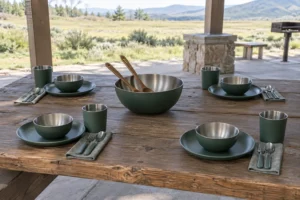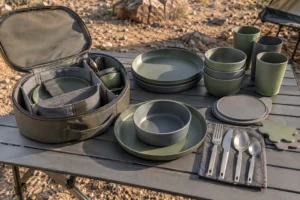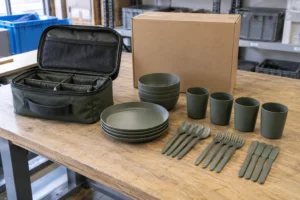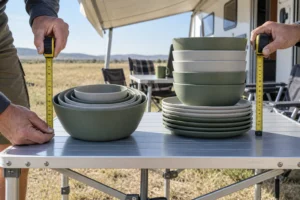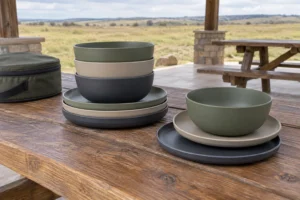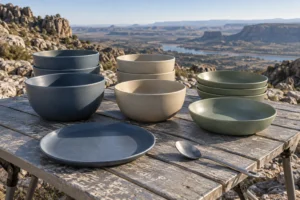
The best outdoor tableware for RV and caravan brands is compact, stable, quiet in transit and easy to replace as individual pieces. Buyers should select the set architecture before choosing a material: define cabinet space, user count, meal style, cleaning method and destination-market evidence, then approve the complete packed system rather than a visually attractive assortment of unrelated items.
Why RV camping tableware is a system decision
An RV or caravan collection lives in two environments at once. It must work as normal dinnerware at a table, then disappear into a small moving storage space without uncontrolled noise, abrasion or awkward dead space. A plate that performs well at home can still be a poor caravan choice if its rim catches a cabinet door or its glaze chips against a neighboring bowl.
For brands, the buying question is therefore not “which material is best?” in isolation. It is “which combination of shapes, materials, pack-out features and care instructions fits the intended vehicle, user and retail promise?” The answer changes between compact camper vans, family caravans, rental fleets, premium motorhomes and glamping vehicles.
The practical unit of approval is the complete set. Buyers should examine the components in use, nested in storage, packed for distribution and removed for cleaning. If the program includes replacement pieces, the approval file should also show how a single missing cup or lid can be replenished without changing the whole assortment.
RV camping tableware decision table
| Decision area | Buyer question | Evidence or check | Risk if missed |
|---|---|---|---|
| Storage footprint | Will the complete set fit the measured drawer or cabinet? | Internal dimensions, pack-out drawing and physical set sample | Doors do not close or space is wasted |
| Transit control | What stops pieces moving and contacting each other? | Divider, sleeve or retention review under representative travel | Rattle, scratches, chips or damaged decoration |
| User allocation | How many people and meal occasions does the set support? | Component matrix by user and function | Duplicate pieces but missing functions |
| Cleaning | Can shapes drain and can users reach all food-contact surfaces? | Care instructions and finished-item cleaning evidence | Trapped water, residue or unsupported claims |
| Material scope | Does each component have relevant declarations? | Bill of materials and destination-market evidence map | One document is incorrectly applied to the whole set |
| Replacement | Can a cup, lid or utensil be reordered consistently? | Component codes, revision control and color standards | Premature replacement of complete sets |
| Merchandising | Does the pack explain nesting, care and included pieces? | Approved artwork, photography and instruction review | Returns and consumer misuse |
The table is a procurement framework rather than a universal performance standard. Acceptance limits, travel simulation, cleaning conditions and documentation should be agreed for the exact project. Values not supported by a verified specification or sample remain project questions, not marketing claims.
Start with the vehicle and buyer use case
A compact camper van may need two settings that fit one shallow drawer, while a family caravan may prioritize four color-coded settings and divided lunch boxes for day trips. Premium motorhomes can support heavier pieces but may demand quieter storage and refined finishes. Rental fleets usually care more about inventory control, simple cleaning and rapid replacement than decorative complexity.
Measure the real storage zone, including hinges, rails, latches and the clearance needed for a hand to lift the set. Nominal cabinet dimensions can hide obstructions. A physical pack-out sample should show the direction in which each component is removed and whether the user must unload several unrelated items to reach one bowl.
Meal style matters as much as headcount. A breakfast-oriented set may need mugs, bowls and a small plate; a touring family may require lunch boxes and spill-resistant cups; a glamping program may prefer coordinated serving bowls. Define what the user actually eats and where before expanding the component list.
Build the component architecture before choosing finishes
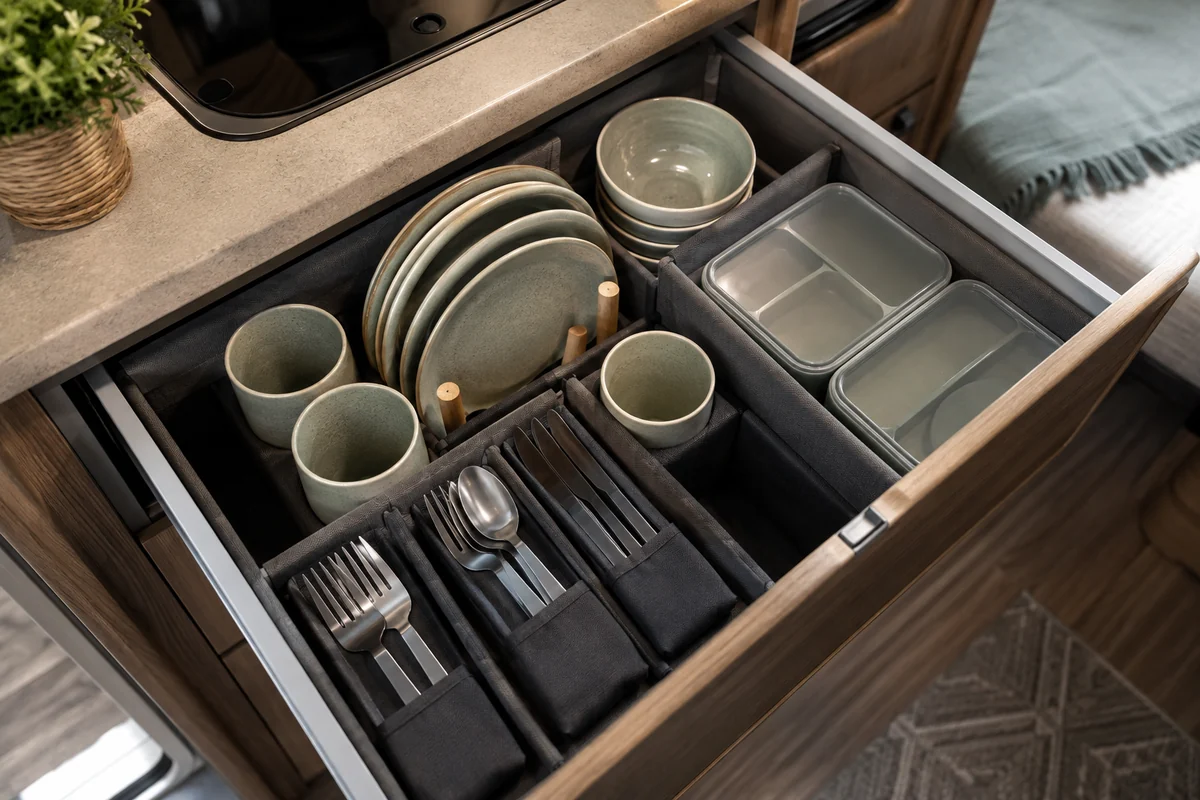
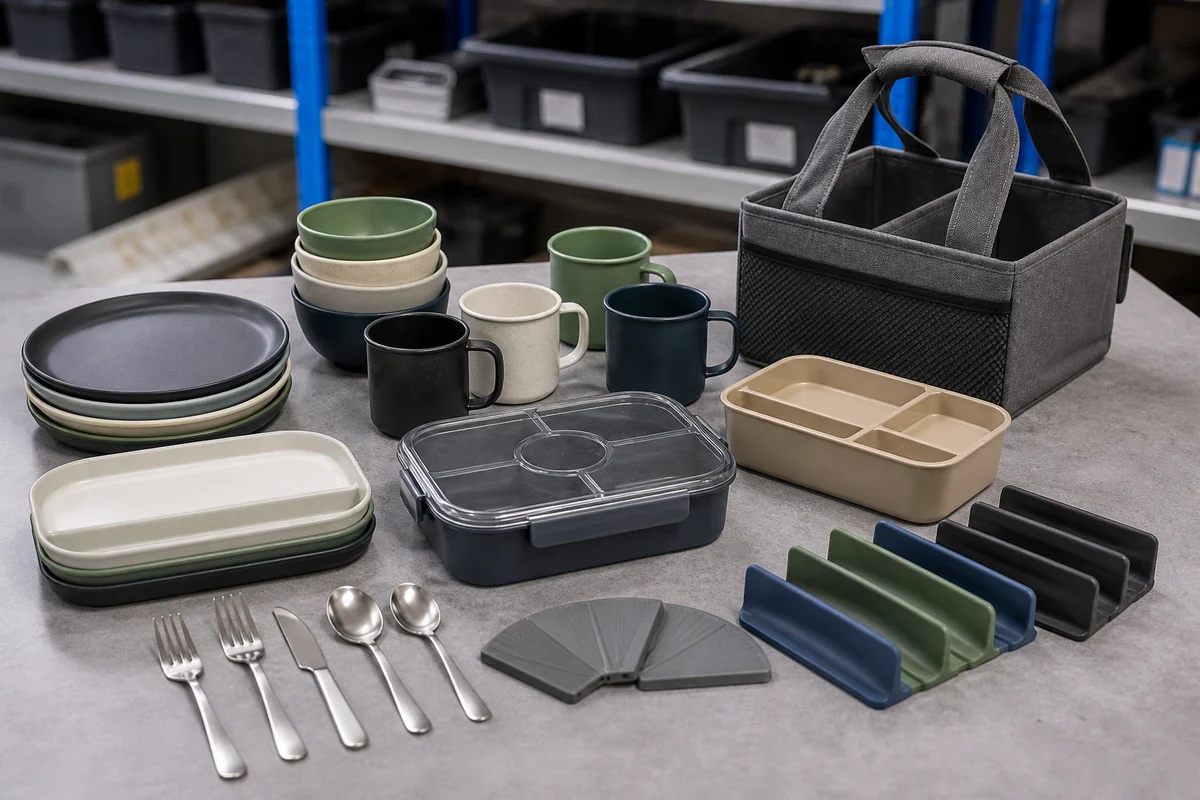
A disciplined component matrix lists every plate, bowl, cup, lunch box, utensil and storage element. It records quantity, function, material direction, revision, finish, color, logo zone and replacement code. This prevents a buyer from approving a hero image that does not match the final bill of materials.
Begin with a minimum viable set. For two users, that may mean two plates, two bowls, two cups and two cutlery groups, with a lunch box or serving piece added only when the buyer scenario supports it. For four users, do not simply double every part; confirm whether shared serving pieces, children’s components or beverage formats change the architecture.
Different materials can be combined, but each interface needs review. A hard metal cup nested inside a coated bowl can create abrasion. A flexible separator may reduce contact but complicate drying. A translucent lid may help identify contents but must have its own food-contact and care evidence.
Compare material directions for RV and caravan programs
Stainless steel
Stainless steel can suit reusable programs that value impact resistance and a familiar premium appearance. Buyers still need the declared grade, surface finish, joining details and evidence for any coating or decoration. Thin parts can feel light but may flex or produce more noise; heavier parts can be stable but increase packed mass.
Titanium
Titanium is often considered for premium lightweight collections, but the grade, thickness, forming, finish and exact product construction must be verified. A titanium material label does not prove capacity, nesting compatibility, dishwasher suitability or direct-flame use. Neutral buyer education must remain separate from confirmed Naike Dinner availability for any specific configuration.
Polypropylene and copolyesters
Polypropylene can support light, colorful, quieter sets and molded organization features. Copolyesters may be selected when transparency is important. Resin identity, additives, colorants, wall design, intended temperature and final food-contact evidence must match the supplied article; buyers should not transfer claims between different grades or shapes.
Silicone and soft components
Silicone can support lids, sleeves, separators and selected collapsible forms, but formulation, cure, reinforcement and cleaning behavior matter. Soft components can trap water or retain food at folds if geometry is poorly designed. Verify the finished assembly and make removal or care instructions clear.
Plant-fiber composites
Plant-fiber composites can create a warm, low-noise dining feel, but they are formulations rather than raw agricultural fiber. Confirm polymer matrix, fiber system, pigments, repeated-use conditions and destination-market evidence. Do not infer compostability, dishwasher performance or microwave suitability from natural-looking texture.
Weight should be allocated, not guessed
Total packed weight matters in mobile spaces, but “lightweight” has no useful meaning without a complete component list. Weigh the actual set with lids, cutlery, separators and carry storage. A light plate can be offset by a heavy lunch box or bulky organizer, and an ultralight set can still be inefficient if it consumes excessive cabinet volume.
Allocate a mass budget by function. Identify pieces that benefit from stiffness, pieces that can be thinner, and accessories that are optional. The related guide Camping Dinnerware Weight Guide for Product Buyers explains why buyers should compare complete systems rather than isolated samples.
Weight also influences handling. Very light plates may move on small outdoor tables, while a stable base or non-slip feature can improve use. Any stability claim should be assessed with the intended geometry and surface rather than inferred from mass alone.
Transit noise, abrasion and retention
Rattle is a frequent quality perception issue in moving vehicles. The solution is not always a thick bag; it can be controlled nesting, soft separators, shaped dividers, elastic retention or a cabinet insert. The selected method should allow ventilation and cleaning instead of permanently trapping moisture around food-contact articles.
Review contact points with the vehicle stationary and under representative movement. Look at rims, foot rings, handles, lid clips and decorated surfaces. If two components touch, decide whether that contact is acceptable, whether a separator is required and how the consumer will restore the same packing order.
Packaging for shipping is separate from storage inside the caravan. Transit cartons protect a retail unit through distribution, while the consumer carry system controls the set after purchase. Both should be approved, and neither should be represented by a decorative image without a physical packing trial.
Cleaning, drainage and repeated-use reality
RV users may wash by hand in a small sink, use a compact dishwasher or clean at a campsite facility. Select shapes that can be reached, rinsed and dried without hidden cavities. Deep foot rings, hollow handles and complex folds may retain water and should be evaluated in the intended cleaning workflow.
A dishwasher claim must be tied to the exact finished article, machine conditions, detergent, rack position and cycle scope. The current guide Can Camping Dinnerware Go in the Dishwasher? provides a condition-based approval framework. It does not declare every material or mixed set machine-washable.
Separate fabric carry storage from washable dinnerware instructions. A pouch may require spot cleaning or complete drying before repacking. The consumer pack should explain which pieces can be machine washed, which need disassembly and which must be kept away from direct heat.
Food-contact evidence must follow every component
In the United States, the FDA explains that food-contact substances are considered for their intended conditions of use. Buyers can use the official Food Contact Substances information to frame authorization and evidence questions. A general material name or supplier brochure is not a finished-set approval.
For European Union markets, Regulation (EC) No 1935/2004 provides the general food-contact framework. The European Commission’s food-contact materials overview explains the framework and links to material-specific measures. The buyer file must still identify the exact product, composition, intended use and supporting records.
A mixed-material set may need several evidence paths. Plates, cup bodies, seals, coatings, prints and lunch-box lids should be mapped to their declarations and test scope. Ask whether the evidence covers the supplied color and decoration, and record who reviews a change to the material, supplier or process.
Merchandising the set without overclaiming
Good RV tableware packaging shows what is included, how the set stores and which pieces are replaceable. Use accurate component photography and a simple pack-out diagram only when it reflects the approved sample. Do not show a lid, utensil or carry bag that is absent from the final bill of materials.
Care statements must be readable before purchase. If a plate is top-rack only, a lid is hand-wash only or a pouch must air dry, explain the differences. Avoid broad claims such as unbreakable, non-toxic or universally food grade unless the wording and evidence have been reviewed for the exact market and construction.
Product names can be natural and user-focused. Commercial terms such as wholesale or supplier belong primarily in SEO metadata and procurement sections when relevant; they should not crowd the visible H1. The page should help a buyer understand the product before it tries to rank for every purchasing phrase.
Applicable RV and caravan scenarios
Compact camper vans
Two-person sets benefit from shallow nesting, multipurpose bowls and a storage module that can be lifted out as one unit. Avoid excessive component counts. Confirm that handles, lids and cutlery do not consume the space saved by the plates.
Family caravans
Color coding, divided lunch boxes and replacement components can reduce confusion. Children’s pieces may require different proportions and risk review. The published family car camping dinnerware guide offers a broader scenario framework that can be adapted to caravans.
Rental fleets
Fleet buyers need countable parts, durable identification, uncomplicated care and easy replenishment. Define an inspection and retirement rule for damaged pieces. A premium finish that is difficult to replace may create more operational cost than value.
Premium motorhomes and glamping vehicles
These programs may prioritize coordinated finishes, quiet storage and table presentation. Approve appearance tolerances and separators together. Keep cookware education separate: dinnerware should not be placed on a burner or campfire without product-specific direct-heat evidence.

Limitations and procurement risks
Generated scenes cannot verify product availability, dimensions, grade, capacity, nesting or compliance. They can help buyers discuss a configuration, but every proposed component must be traced to an existing product record or treated as a development question. Compatibility to be confirmed by project sample and drawing.
Do not let nesting create hygiene problems. Components that lock too tightly can trap water, and a carry case packed before drying can develop odor. Validate ventilation, drainage and cleaning as carefully as the visual pack-out.
Do not assume one test report covers an assortment. A declaration for a plain metal bowl does not automatically cover a colored cup, plastic lid or printed lunch box. Evidence should map to each finished article and intended condition of use.
Do not invent a universal MOQ, price or lead time. These depend on component availability, customization, tooling, packaging, evidence and order structure. A responsible quotation identifies open decisions and the sample approval route before fixing commercial terms.
How to approve an RV set with a physical pilot
A useful pilot begins with the real storage envelope and a numbered component list. Place every item in the proposed drawer, cabinet or removable caddy, photograph the approved pack order and record where separators touch rims, handles, lids and decorated surfaces. Repeat the exercise after washing and complete drying because dimensions, friction and packing behavior can differ when components are warm or damp.
Run the pilot through representative daily routines rather than a showroom arrangement. Users should remove breakfast pieces without unloading the entire set, carry lunch components outside the vehicle and return clean, dry items to their assigned locations. Note which pieces are repeatedly misplaced, difficult to grip or inconvenient to clean; these observations can justify a component change before artwork and packaging are locked.
For rental and fleet programs, include an inventory handover. A staff member who did not design the set should be able to count pieces, identify damage and restore the pack using the supplied instructions. If the system depends on expert knowledge or an invisible order, it is unlikely to remain consistent in service.
Inspect noise and contact under controlled movement appropriate to the project. The purpose is not to invent a universal vehicle test but to reveal obvious free movement, hard contact and unstable stacks. Record the route or method, load state and observations, then decide whether geometry, sleeves, dividers or cabinet retention need revision.
Finally, reconcile the pilot with the selling page. The visible component count, colors, storage method and care statements must match the approved set. If a generated scene shows a useful idea that the physical sample does not support, change the marketing image rather than allowing the illustration to become an unsupported product promise.
B2B Buyer Checklist
| Check | Question | Why It Matters |
|---|---|---|
| Vehicle fit | Have we measured the usable drawer or cabinet around obstructions? | Prevents a complete set from failing at installation. |
| Component matrix | Does every item have a quantity, function and revision? | Keeps photography, BOM and quotation aligned. |
| Nesting | Does the physical sample stack without unsafe contact or trapped water? | Controls rattle, abrasion and hygiene. |
| Replacement | Can individual pieces be identified and reordered? | Extends fleet and consumer service life. |
| Care | Are washing limits stated separately for every component? | Reduces misuse and unsupported claims. |
| Evidence | Does each material, coating and decoration map to valid records? | Prevents document scope gaps. |
| Packaging | Have retail shipping and in-vehicle storage been tested separately? | They address different risks. |
| Change control | Who approves a new supplier, color, finish or geometry? | Protects the approved product identity. |
Procurement workflow for RV tableware brands
First, send the target vehicle class, user count, meal pattern, storage dimensions and destination markets. Second, define a component matrix and identify which pieces come from verified existing records and which require development. Third, assemble a complete sample for storage, handling, cleaning and presentation review.
Next, map food-contact and material evidence to each component. Approve colors, finishes, logo methods, care instructions and packaging on the same revision. Retain the signed component matrix, drawings, artwork and golden set so production inspection has a stable reference.
Finally, request a documented quotation that separates confirmed components from open tooling, evidence and compatibility questions. Use the Naike Dinner project review form to submit the brief. A complete request helps the team avoid unsupported assumptions and return a clearer sample path.
Buyer FAQs
1. What is the best material for RV camping tableware?
There is no universal best material. Select after defining storage, weight, noise, cleaning, meal and evidence needs. A mixed-material system can be appropriate when each component and interface is reviewed.
2. How many pieces should an RV set contain?
Start from users and meals rather than a promotional piece count. Include only components with a defined function, then decide whether lunch boxes, serving pieces or storage accessories add real value.
3. Are nesting sets always better for caravans?
No. Nesting can save volume but may create abrasion, trapped water or difficult access. Confirm the complete physical stack, separators and drying workflow.
4. Can one set include metal and plastic components?
Yes, potentially, but evidence, care instructions and contact interfaces must be assessed separately. Compatibility to be confirmed by project sample and drawing.
5. Should RV tableware be dishwasher safe?
Only when the exact finished items have condition-specific support for the intended machine, rack, detergent and cycle. Otherwise provide accurate hand-wash or limited-use instructions.
6. Can the carrying bag be washed with the dinnerware?
Do not assume so. Textile storage usually needs its own care instructions and complete drying before repacking. State component-specific care clearly.
7. How should brands control replacement pieces?
Assign component codes, revision identifiers and color standards, then keep approved samples. Replacement items should match function, fit, evidence and appearance rather than only the product name.
8. What information is needed for a quotation?
Provide vehicle type, user count, component list, storage dimensions, material direction, colors, logo artwork, packaging, target markets and evidence expectations. MOQ, price and lead time remain project-confirmed.
Build an RV Tableware Set Around the Real Storage Space
Share your cabinet measurements, user profile, component matrix, material direction, care expectations and destination markets. Naike Dinner can separate verified existing products from open development and compatibility questions before a sample or quotation is documented.