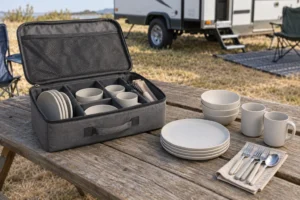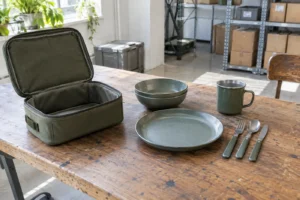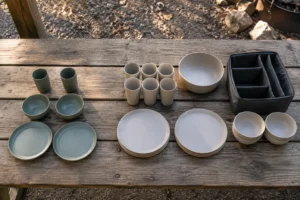
Make the parts modular when a buyer has a repeatable reason to change them without redesigning the whole set: user count, meal format, cleaning workflow, replacement demand or retail channel. Keep a stable core of eating pieces, then define optional modules around a documented physical and commercial interface. A piece is not a module merely because it can be removed from a bag.
This is a buyer decision about the architecture of a modular camping dinnerware set, not a claim that any pictured or linked set is already interchangeable. The output below is a core/add-on interface map that a product team can copy into its brief, drawings, sample review and bill of materials.
Start with the buyer’s change event
A fixed set is appropriate if its composition, user count and service pattern will not change. Modularity earns its complexity only when the brand needs to offer a smaller base kit and a documented add-on, replace a worn part without scrapping the set, or assemble several channel-specific bundles from a controlled component family.
Before choosing a connector or case, name the change event. “We might want options later” is too vague to justify extra tooling, identifiers, stock locations or assembly instructions. A useful brief says, for example, that the same two-place setting should accept a separate food-container option for an RV channel, while a rental operator needs individually replaceable cups.
The already-published component-list guide helps establish what belongs in a dining set. The two-person versus six-person analysis shows why user count does not simply multiply every shared component. This article adds the next decision: which boundaries should remain stable while a set changes.
Map the modular camping dinnerware set core and add-ons
Use the table as a working specification, not as a statement that particular components already fit. “Interface” includes physical fit, permitted food use, cleaning, assembly, identification and the information printed or shown to the buyer. Replace each open item with a drawing, sample result and owner before approving a retail bundle.
| Component or boundary | Default decision | What must stay fixed | What can vary | Release evidence |
|---|---|---|---|---|
| Plate and bowl per diner | Core | Place-setting count, rim/stack envelope and intended food use | Color or form only after fit and claim review | Revision-controlled drawings, fit samples and component-specific food-contact evidence |
| Cup per diner | Core, but replaceable | Count, packed location and permitted drink/temperature use | Handle or lid option if the case and use claim are separately validated | Pack-out trial, handling review and use-condition record |
| Cutlery unit | Core, individually serviceable | Required eating functions, safe edge storage and count check | Roll, sleeve or hard pocket after loaded-case review | Count sheet, packed-contact map and cleaning review |
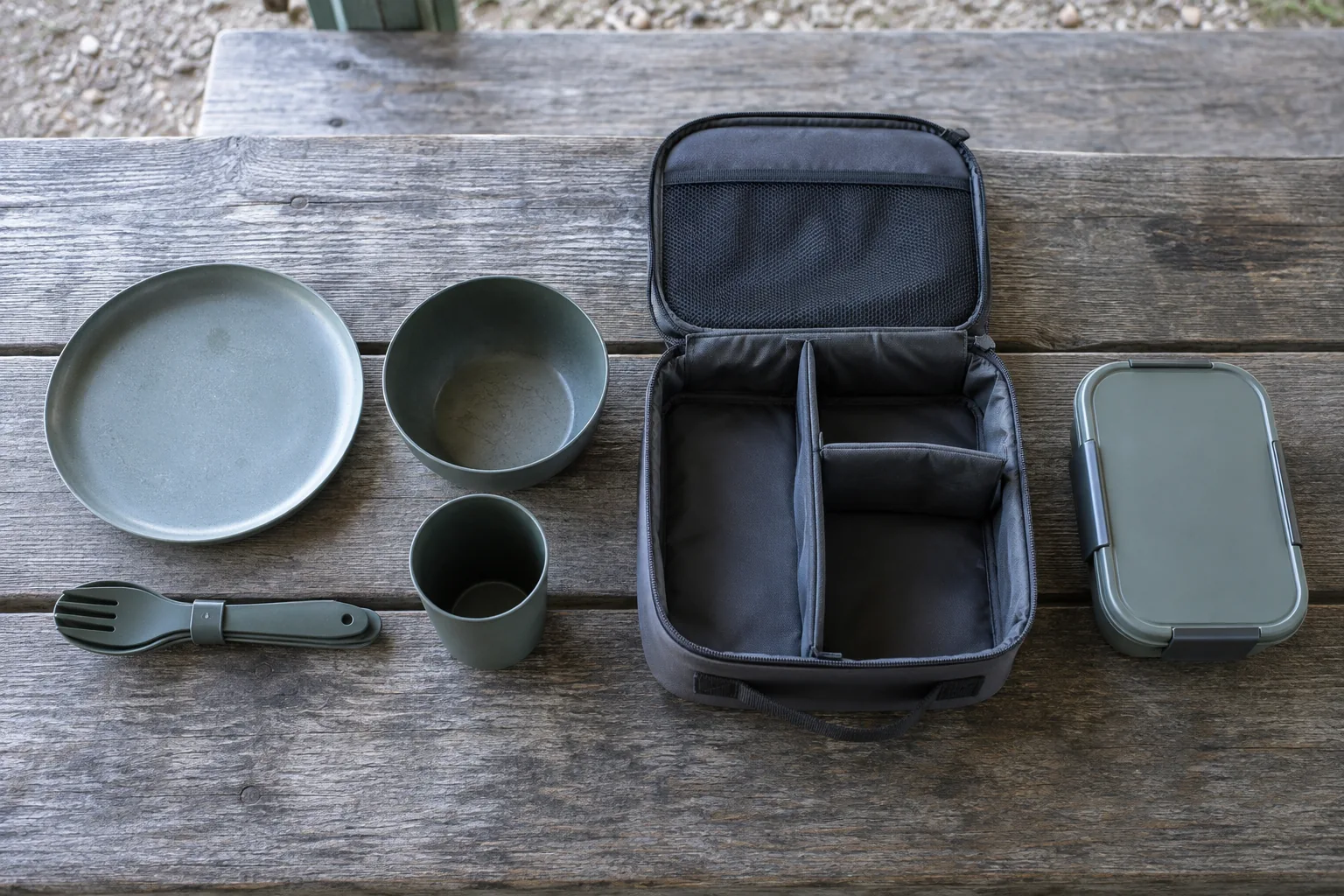
| Lunch container | Optional module | Whether it is included in the base SKU and where it is carried | Compartment pattern and closure only after sample review | Separate drawing, closure trial and food-use evidence |
| Serving piece | Optional for group formats | Clear distinction from individual place settings | Quantity by meal/channel, not automatically by diner count | Use-case matrix and signed component list |
| Carry case and dividers | Shared platform only if proven | External pack envelope, retention locations and cleaning access | Insert layout or accessory pocket after all packed variants are tested | Loaded-case drawing, pack-out video or observation and transport review |
| Retail identity | One controlled bundle per fixed composition | Published contents, artwork and channel identifier | Separate base and add-on listings with controlled revision history | BOM-to-label reconciliation and identifier decision |
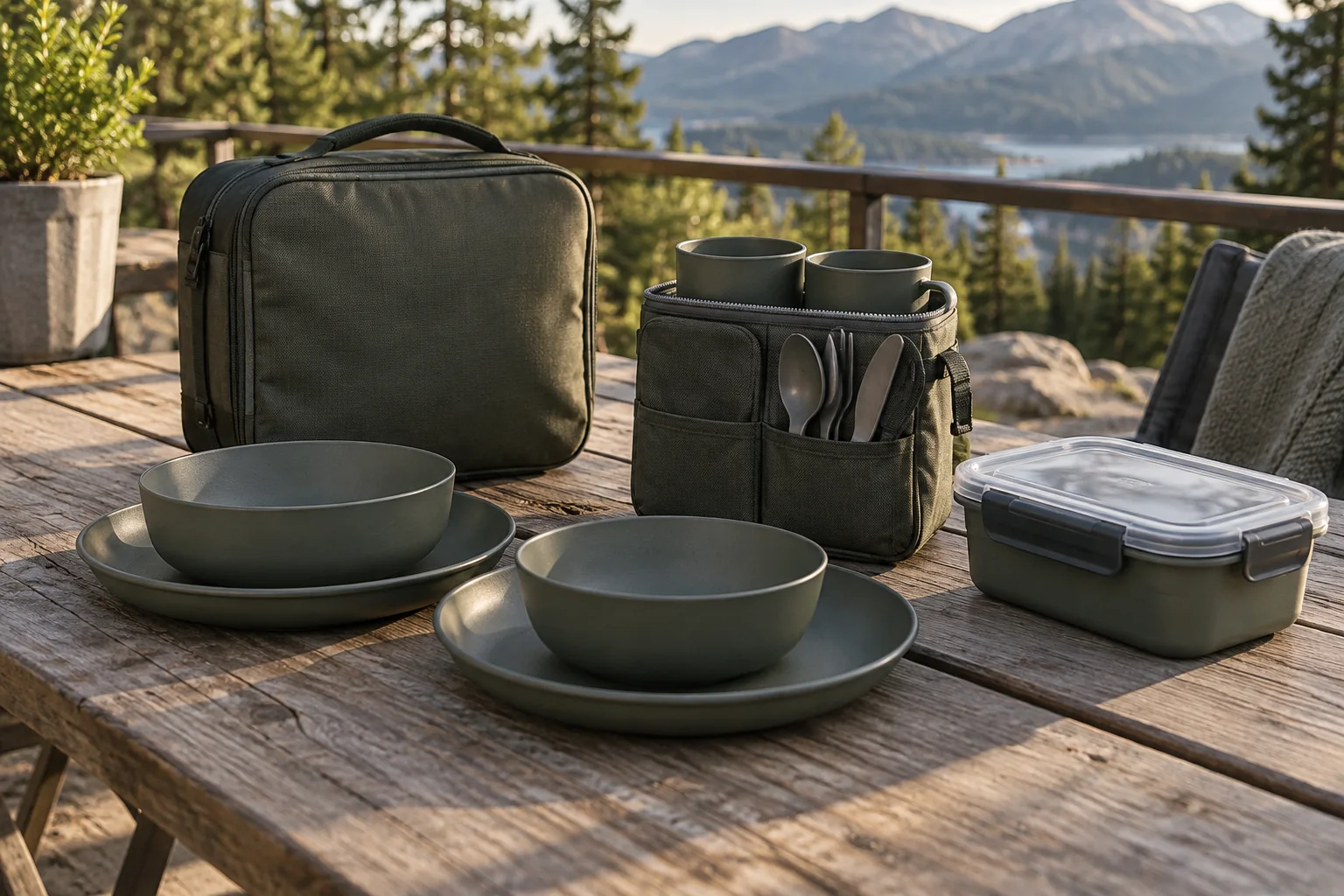
This matrix deliberately separates “removable” from “interchangeable.” A replacement bowl can be sold separately without fitting every historical case. Conversely, two bowls that appear identical in a photograph may differ in rim thickness, finish, material formulation or stack release; they need an interface check before a shared compatibility claim.
Define the physical interface before naming a module
For every proposed interchangeable part, the buyer should request a drawing with the outer envelope, contact points, nesting direction and clearance to the next piece. Record the component revision and the case or divider revision on the same sheet. A “universal” claim is not useful if it only describes one unconstrained prototype.
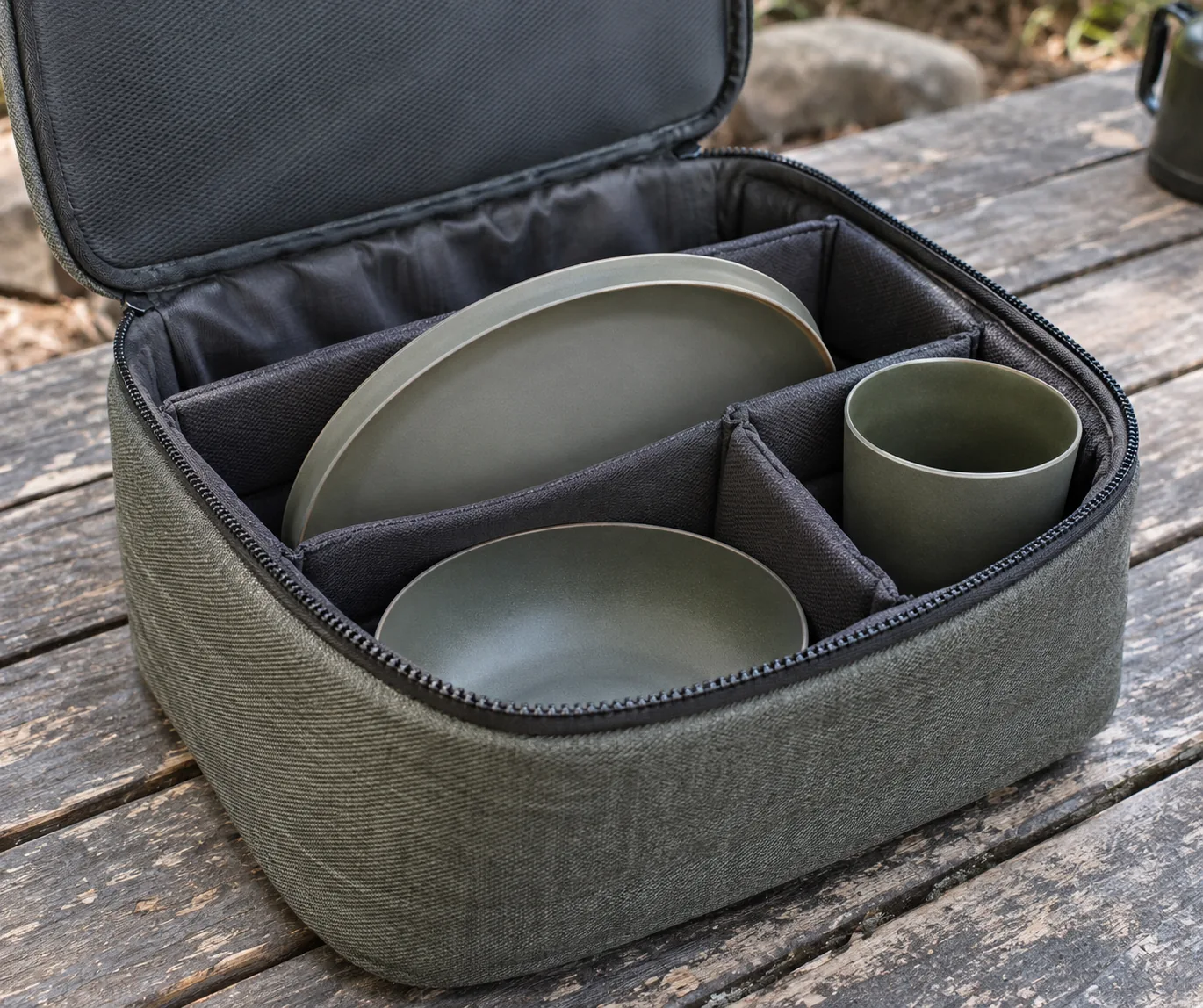
Check the loaded configuration, not just an empty case. Plate rims may touch a zipper path, cup handles can obstruct closure, and a lunch-box latch may face a compression point. The nesting-versus-stacking guide explains the distinct pack-out mechanisms; neither term proves that a new part fits an old assembly.
A practical sample review uses a fixed sequence: load every required piece, close the case without force, carry it in its intended orientation, reopen it, and inspect contact marks and access. Repeat with each proposed add-on and with the least forgiving combination. Record observations and open issues; do not convert a clean-looking photo into a pass result.
Treat food-use evidence as component-specific
Modularity can increase the number of finished articles and materials in one marketed set. The EU’s Framework Regulation (EC) No 1935/2004 covers materials and articles intended to contact food and includes traceability duties. In the United States, the FDA explains that regulatory status depends on the substances in a food-contact material and their authorized use; a base-set statement cannot simply be copied to an added container.
Use the FDA’s food types and conditions-of-use tables to frame the questions about intended food and temperature exposure, then request evidence for the actual finished component, formulation and use. Do not infer microwave, dishwasher, boiling-water, direct-flame or leakproof suitability from the word “camping,” from a shared color, or from these concept images.
The approval file should show each component’s material and finish, food-contact surface, intended food/temperature/cleaning conditions, supporting documents and revision. If a module changes pigment, lid material, coating or adhesive, flag the evidence scope for reassessment. This is buyer guidance, not a representation that Naike Dinner has produced or tested every illustrated material.
Make the commercial interface as explicit as the physical one
If the set is offered as a fixed retail assortment, the component list is part of the trade item. GS1’s predefined-assortment rule says that adding, changing or replacing a trade item in a fixed bundle requires a new GTIN. A buyer should decide identifiers with its channel and GS1 rules; the existence of a removable component does not permit silent substitution in a published bundle.
Use separate columns for the base set, optional add-on, spare part and channel bundle. Record whether each is a sellable SKU, what exact contents a buyer receives, and which artwork and instructions match it. If a retailer orders “the two-person set,” the purchase order, carton marking, web listing and packing station must refer to the same revision.
Modularity can reduce stranded stock when a frequently lost cup is replaceable, but it can also create an assortment that is expensive to count and easy to mispack. Do not promise a cost saving without a buyer-entered model for forecast, component price, assembly labor, packaging, returns and spare-part demand. The component weight-budget guide can help assess whether an add-on makes the packed set unacceptable for a particular channel.
Where modularity is useful—and where it is not
Rental fleets and replacement programs
A fleet operator may value a separately identifiable cup or utensil more than a decorative add-on. The decision hinges on how quickly staff can count, clean and replenish the item after return. Ask whether the replacement part maintains the same pack location and whether older cases remain compatible; do not assume this from a matching product name.
Retail base kit plus optional meal container
A retailer may prefer a compact base kit and a separate lunch-container add-on, particularly when not every shopper wants food storage. This avoids forcing an unused part into every carton, but it introduces a second identifier, shelf explanation and after-sale compatibility question. Approve the base and add-on as separate, explicit configurations.
Group kits with shared serving pieces
Individual dining pieces often scale with diners; serving tools and carry space may not. A group module should therefore be defined by meal operation and transport, rather than a simple “four more pieces” arithmetic rule. Test the fully loaded case and make the count visible on the packing instruction.
A one-off promotional gift with no replenishment, no channel variation and a simple fixed composition may not need modularity. A carefully specified fixed set can be easier to quote, inspect and explain. Choose the simplest architecture that solves the actual buying problem.
Failure modes to close before the RFQ
The most common specification gap is calling a component “compatible” without identifying the revisions on both sides of the interface. A second is allowing a packaging photo to show an optional item as though it were included. A third is reusing a food-contact or cleaning claim after changing a finished component.
Watch for a case that closes only when packed in one exact order, a divider that does not stay in place after washing, or a lid that contacts an eating surface during transport. These are questions for a project test plan, not performance facts about any existing Naike Dinner SKU. Where the assembly includes both dinnerware and cookware, give them separate use instructions; do not put a plate on a burner unless the exact item is verified for that use.
B2B buyer checklist
Use these seven checks as a release gate for the proposed modular camping dinnerware set. A blank evidence cell means the decision is still open; it is not permission to imply that fit, food use or bundle identity has already been approved.
| Check | Question | Why It Matters |
|---|---|---|
| Change event | Which customer, channel or service need changes the component mix? | Prevents options that add stock complexity without buyer value. |
| Core list | What exactly is always inside the base set? | Creates one unambiguous quote, listing and count standard. |
| Interface revision | Which drawing revisions define fit, retention and stack direction? | Makes compatibility testable and future changes traceable. |
| Loaded-case test | Has every intended configuration been packed, carried and reopened? | Exposes closure, contact and access problems before launch. |
| Use evidence | Does each finished food-contact part have evidence for its intended use? | A set-level claim cannot substitute for component scope. |
| Trade identity | Does every fixed bundle have a controlled contents list and identifier decision? | Prevents silent substitutions and mismatched channel data. |
| Service | Can a missing part be identified and reordered without replacing the set? | Tests whether modularity improves ownership in practice. |
Procurement FAQs
1. Is every removable piece a module?
No. Treat it as a module only when its function, interface, revision, packing location and commercial status are defined. Removability alone does not establish interchangeability or a replacement program.
2. Should the carry case be the common platform?
Only if the case accepts every approved configuration without forced closure, harmful contact or confusing pack-out. Test the actual loaded variants; a common external bag with different internal inserts may still require separate controlled revisions.
3. Can one food-contact report cover every color and add-on?
Do not assume so. Match the evidence to the finished part, its formulation, decoration and intended conditions of use, then ask a qualified compliance reviewer to assess the precise scope for the target market.
4. Does an optional lunch box belong in the base count?
Only if the buyer intentionally includes it in the base SKU and all listings, labels, drawings and quotes agree. Otherwise identify it as a separate option and document how it is carried or sold.
5. Will modularity lower landed cost?
Not automatically. Enter real component, case, labor, packaging, freight and after-sale assumptions into a comparison. An add-on strategy can reduce unused pieces while raising pick-and-pack complexity.
6. What should be requested before a sample?
Request a versioned component matrix, case and interface drawings, target use conditions, proposed configurations, artwork ownership and the open-issue list. State which compatibility and claims need sample or document confirmation.
Turn the map into a quotable project brief
Send your intended user count, channels, base component list, optional modules, target packed envelope, material preferences and required use conditions. Ask for a written response that separates verified existing options from proposed development and lists every fit or evidence item still open. Request a component and interface review before treating a concept as a saleable set.
If you already have plates, bowls, cups or a carry case, include their drawings and sample revision with the request. The next deliverable is not a generic “modular” claim; it is a dated, revision-controlled fit and assortment decision. Contact Naike Dinner with the project brief for a scoped response.