
The best material for camping dinnerware is the one that meets the actual user, meal, transport and cleaning conditions with verified finished-product evidence. Titanium can lead for carried weight, stainless steel for familiar fleet value, aluminum for lightweight formed systems, and polymer or plant-fiber composites for quiet, colorful eating pieces. No material wins every camping scenario.
Best Material for Camping Dinnerware: Start with the Job
A family driving to a campsite, a solo hiker carrying every gram, an outdoor retailer building a gift set and a camp operator washing hundreds of pieces do not have the same “best.” The product must solve a meal system, not win an abstract material contest. Begin by listing who carries it, what it holds, how it is cleaned and what failure creates a return or safety concern.
Keep dinnerware separate from cookware in that list. Plates, bowls, cups and eating utensils are not automatically designed for a burner, campfire or direct flame, even when made from metal. If a set contains a cooking pot, specify and validate that component independently rather than extending its heat claim to every nested piece.
This guide evaluates six practical material families: titanium, stainless steel, aluminum, conventional food-contact polymers, plant-fiber/polymer composites and enamel-coated steel. It does not claim that Naike Dinner manufactures or supplies every material discussed. Titanium, stainless steel, aluminum and enamel are included as neutral buyer education; Naike Dinner’s relevant verified website scope centers on reusable wheat-straw composite tableware and project review.
| Material family | Strongest starting scenario | Main buyer advantage | Primary validation risk |
|---|---|---|---|
| Titanium | Weight-sensitive premium backpacking | Low complete-set mass can support a technical proposition | Grade, thin-wall construction, comfort and premium cost must be verified |
| Stainless steel | Family, rental and fleet programs | Familiar metallic feel and broad commercial positioning | Grade, finish, edge quality, dents and corrosion-relevant use conditions |
| Aluminum | Lightweight formed sets with controlled finish | Low mass and efficient forming potential | Alloy, temper, surface treatment, abrasion and food-contact release evidence |
| Conventional polymer | Family, children’s, RV and colorful retail ranges | Quiet handling, color flexibility and low perceived coldness | Resin identity, additives, heat limits, staining and destination-market status |
| Plant-fiber/polymer composite | Branded reusable eating and serving sets | Natural visual texture with molded shape and color options | Exact formulation, truthful claims, food-contact evidence and use limits |
| Enamel-coated steel | Heritage-style car camping and gifting | Distinctive visual language and rigid feel | Coating chips, edge coverage, impact response and release evidence |
Decision Gate 1: Is Minimum Carried Weight the Main Promise?
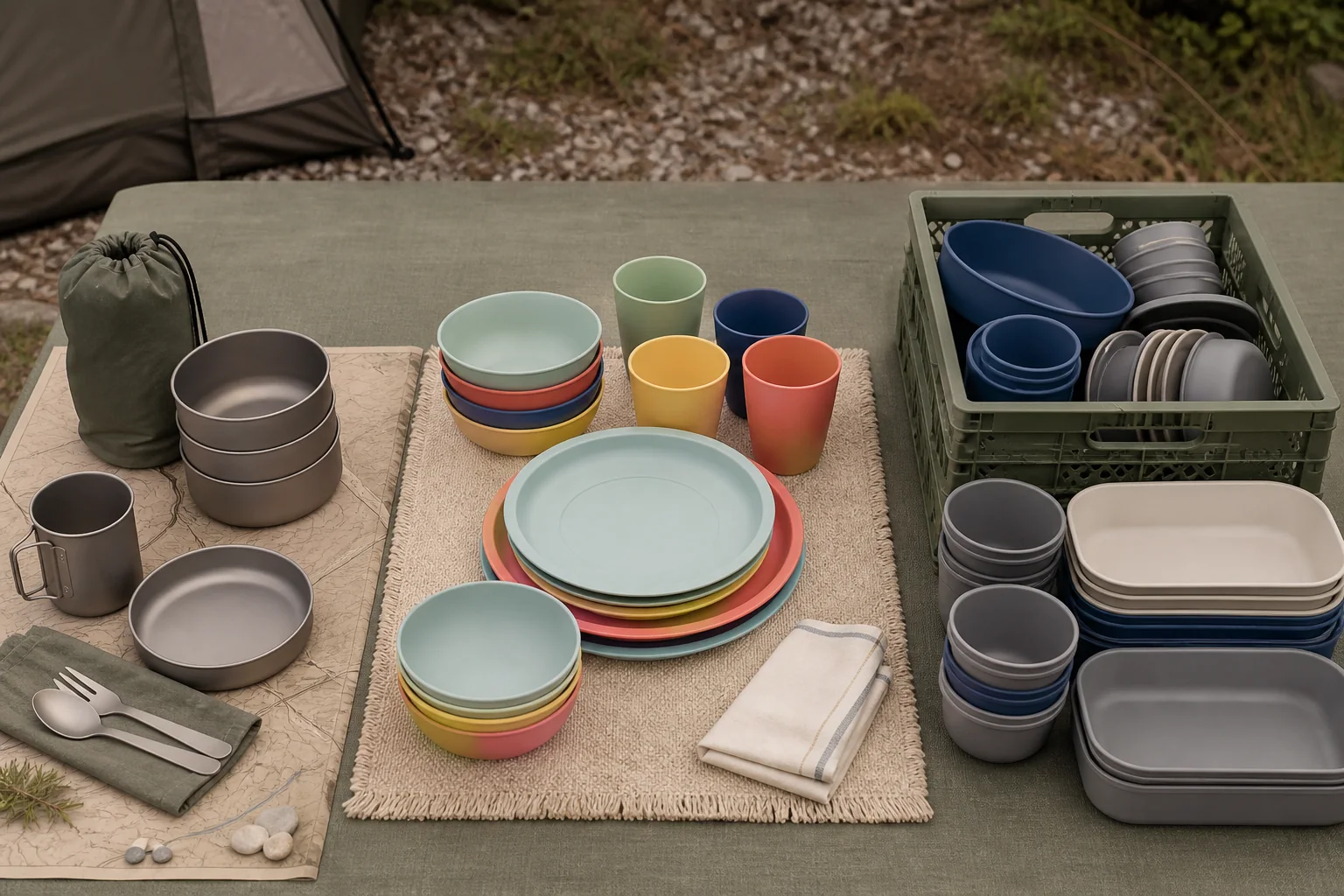
If the customer carries the entire system for hours, measure the complete packed set rather than repeating a density story. Include every plate, bowl, cup, utensil, lid, pouch, strap and separator. A light plate paired with a heavy pouch or redundant accessories may not deliver a meaningful system advantage.
Titanium often enters the shortlist for premium backpacking because designers can pursue low mass, but geometry, thickness, forming and rim design determine the actual product. Aluminum can also support low-weight designs, while thin polymers or composites may be competitive for eating pieces that do not require metal. Do not rank them without measured production-intent samples.
The buyer should state a target and tolerance for every component and for the assembled pack. Record whether the e-commerce number is net dinnerware weight or the packed system weight. The related titanium versus stainless-steel camping tableware comparison explains why grade and construction must stay visible behind the headline mass.
Decision Gate 2: What Kind of Failure Matters Most?
“Durable” can mean resisting a dent, avoiding a brittle fracture, retaining a smooth food-contact surface, surviving a drop, preserving a coating or remaining usable after repeated cleaning. Materials fail differently, and finished construction can reverse assumptions. Define the unacceptable outcome before selecting a laboratory or field protocol.
Metal pieces may deform or develop sharp damage at edges and joints. Polymer products may scratch, warp, stain or crack depending on resin, formulation, section thickness and exposure. Enamel-coated products combine a metal substrate with a glass-like surface, so coating chips and exposed edges require specific inspection language.
Use the same sample conditioning, drop orientations, surface, load direction and acceptance criteria across the shortlisted products. Record both function and appearance after the test. A bowl that still holds food but rocks on a table may fail a family-retail brief; cosmetic marks that are acceptable to a backcountry user may be unacceptable in a premium gift range.
Decision Gate 3: Which Foods, Temperatures and Contact Times Apply?
Food-contact suitability is always tied to intended and foreseeable conditions. Acidic soup, oily meals, hot beverages, cold snacks and extended storage can require different evidence. The buyer should specify food type, fill temperature, maximum contact time, repeated-use pattern and cleaning before requesting a report.
For European programs, Regulation (EC) No 1935/2004 establishes the general principle that food-contact materials should not transfer constituents in quantities that endanger health, unacceptably change food composition or deteriorate organoleptic characteristics under normal or foreseeable use. That general framework does not make every article made from a named material compliant.
For U.S. review, FDA distinguishes a food-contact material from the finished food-contact article and treats authorizations in relation to intended use and conditions. The agency’s food ingredient and packaging terms are useful for preventing a resin or substance authorization from being misrepresented as blanket approval of an entire finished camping set.
Material, colorant, coating, adhesive, printing and processing aids must be addressed as relevant. Ask the supplier to connect each declaration or test report to the exact SKU, formulation, finish and revision. Do not transfer evidence from a plain cup to a printed bowl or from one alloy/finish combination to another without a documented technical rationale.
Decision Gate 4: Does the Material Match the Cleaning System?
Trail users may rinse with limited water and air-dry. Families may use detergent and a sponge. Camps, rental fleets or hospitality programs may use commercial washing processes. The best material must tolerate the real chemistry, temperature, mechanical action and drying conditions without relying on care instructions the user will not follow.
Inspect folded rims, embossed logos, utensil slots, handle joints, textured surfaces and nested contact zones. These locations can retain food or moisture even when the broad surface looks clean. A smooth simple shape may outperform a technically impressive material assembled with inaccessible joints.
Do not infer dishwasher suitability from “stainless,” “titanium,” “PP” or “wheat straw.” Test the finished article under defined cycles when the claim matters, including changes in shape, surface, odor, color, joints and usability. Care labeling should reflect the verified conditions rather than a generic material reputation.
Material Profile: Titanium for Premium Weight-Led Systems
Titanium is most persuasive when reduced carried mass is a measurable customer benefit and the channel supports premium positioning. Buyers should name the grade, finished weight, wall construction, surface, rim and any handle attachment. A raw-material standard or mill certificate is useful identity evidence but does not replace finished-article food-contact and performance review.
Thin metal can transfer heat sensation quickly and may feel less comfortable with very hot contents. Handle geometry, wall thickness and user contact time matter. A titanium-colored surface also does not prove titanium composition, so grade traceability and incoming material controls must connect to the finished SKU.
Choose titanium when the complete system demonstrates a worthwhile advantage after all accessories are included. Avoid it when the brief is driven mainly by low retail price, color variety or quiet family-table handling. Naike Dinner does not claim titanium manufacturing or supply capability in this educational comparison.
Material Profile: Stainless Steel for Familiar Operational Value
Stainless steel often deserves first review for family sets, camps, rentals and broad retail programs where familiar feel, replacement planning and price architecture matter more than minimum mass. Specify a named grade, thickness, finish, rim construction and joint method. “Food-grade stainless” is not a complete purchase specification.
The EDQM’s official food-contact materials overview records the second edition of its metals and alloys guide and the role of metal release assessment. Use that framework to ask product-specific questions, not to claim that every stainless article is equivalent. Grade, environment, surface condition and care can affect corrosion and release behavior.
Choose stainless steel when a measured sample fits the weight budget and the operator values rigid, familiar equipment. Validate deformation, edge safety, surface wear, nesting noise and realistic wet storage. A replacement code for every component can be more valuable to a fleet buyer than a broad lifetime claim.
Material Profile: Aluminum for Lightweight Formed Products
Aluminum and aluminum alloys can support lightweight formed dinnerware, but the alloy, temper, thickness and surface system must be explicit. ASTM’s B209/B209M sheet and plate specification shows the range of alloys, tempers and finishes covered at raw-material level. It does not certify a finished plate, coating or destination-market claim.
Buyers should examine dents, rim integrity, abrasion, discoloration and any anodized or coated surface after intended foods and cleaning. If the visual finish contributes to the retail promise, define color and acceptable wear using a controlled sample. Investigate changes wherever forming, joining or decoration can expose a different surface condition.
Choose aluminum when low mass and formability support a clear program and the supplier can document the complete finished construction. Avoid treating “aircraft aluminum” as a sufficient grade, safety or durability claim. Marketing language should never outrun the material record and finished-product evidence.
Material Profile: Conventional Polymers for Quiet Colorful Sets
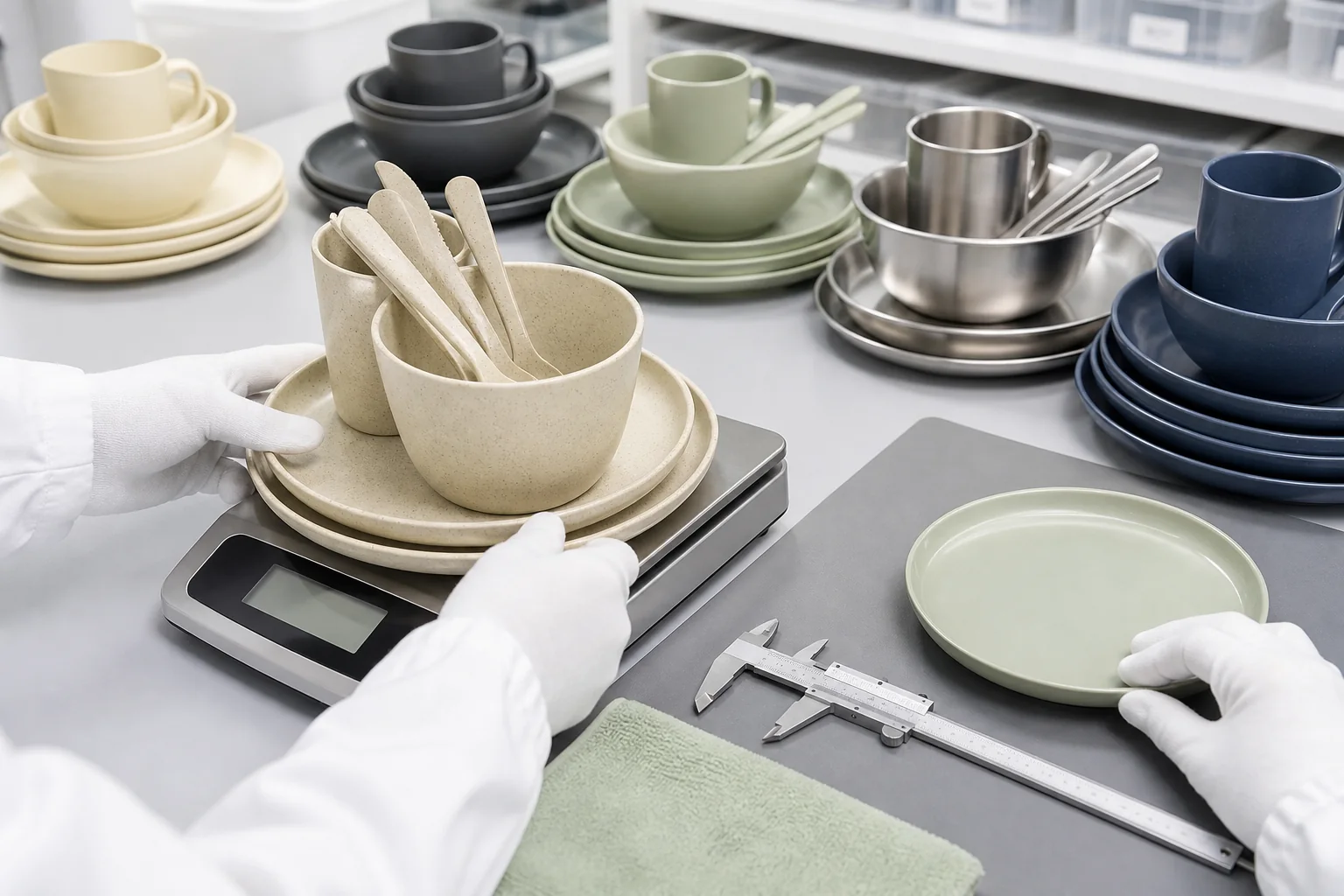
Food-contact polymers can suit family camping, RV storage, children’s sets and colorful retail collections because they are often quiet, less cold to touch and easy to mold into stable shapes. The exact resin, formulation, colorants and additives matter. Buyers should reject generic “plastic” descriptions and request traceable composition and destination-market status.
FDA emphasizes that authorizations are linked to a substance, intended use and conditions of use. Its inventory of food-contact substances listed in 21 CFR directs users to consult the cited regulation for the allowed uses and conditions. This is a useful reminder that a base polymer listing is not a universal statement about a colored, printed or assembled finished article.
Choose a conventional polymer when color, quiet handling, molded features and accessible positioning dominate. Validate heat deformation, staining, odor, scratching, repeated cleaning and any lid fit. Keep the dinnerware/cookware boundary unambiguous: a polymer plate or cup should not be used on direct heat unless the exact product has verified instructions for that purpose.
Material Profile: Plant-Fiber Composites for Branded Reusable Dinnerware
Plant-fiber/polymer composites can create a natural speckled appearance while retaining moldability, color options and reusable dinnerware function. “Wheat straw” describes a plant-derived fraction, not the complete material. The buyer needs the full material declaration, polymer identity, additives, colorants and intended-use limits.
Naike Dinner’s relevant scope is reusable wheat-straw composite plates, bowls, cups, trays and utensils for eating and serving applications. These products must not be described as metal cookware or as suitable for campfire, stove burner or direct flame without product-specific verified evidence. Review how wheat-straw composite material is defined before writing a buyer specification.
Choose this family when a branded reusable eating set benefits from quiet handling, molded form and a natural visual story. Validate the specific formulation, finished-product food-contact documentation, staining, warpage, impact, odor, color consistency and cleaning instructions. Avoid vague biodegradability or compostability claims unless the exact finished product and disposal route are supported.
Turn a material preference into a testable brief
Send Naike Dinner the camper, meal types, component list, target market, cleaning method, branding and evidence requirements. We can organize a material-neutral dinnerware brief and review relevant wheat-straw composite options without inventing metal or aluminum supply capability.
Request a specification reviewMaterial Profile: Enamel-Coated Steel for Heritage Positioning
Enamel-coated steel can create a recognizable heritage camping look with a rigid feel and strong color identity. It is a system of substrate, enamel surface, edge coverage and decoration rather than a single homogeneous material. Chips, cracks, exposed areas and impact response therefore belong in the acceptance standard.
Inspect the drinking rim, utensil contact zones, base and any decorated surface after drops and cleaning. Define acceptable pinholes, color variation, edge coverage and visible marks with qualified technical input. Food-contact evidence should address the finished construction and intended market, not only the underlying steel.
Choose enamel when visual heritage and gifting value justify the specific impact and coating controls. It may be less suitable where frequent drops, aggressive stacking or minimum mass dominate. Keep replacement planning practical because one chipped component should not force disposal of an otherwise usable multi-person set.
Use a Weighted Scorecard Instead of a Universal Ranking
A weighted scorecard forces the team to state what “best” means for this program. Assign each criterion a percentage before reviewing samples, then score every production-intent option using the same evidence. The numbers do not replace judgment; they reveal when a team is quietly changing priorities to favor a preferred material.
| Criterion | Example weight: backpacking | Example weight: family retail | Required evidence |
|---|---|---|---|
| Complete packed weight | 30% | 10% | Measured components, accessories and packed system |
| Defined durability failures | 15% | 20% | Conditioned drop/load/cleaning results and retained samples |
| Food-contact support | 20% | 20% | SKU-, formulation-, finish- and use-specific documentation |
| Cleaning and care fit | 10% | 15% | Realistic repeat-use cleaning assessment |
| User comfort and noise | 10% | 15% | Grip, rim, stability, nesting and handling review |
| Brand and finish | 5% | 10% | Controlled color/finish sample and decoration specification |
| Landed commercial scope | 10% | 10% | Like-for-like quotation including testing, packing and replacements |
These weights are examples, not Naike Dinner performance data or a universal model. A rental fleet might raise cleaning, replacement and deformation while reducing premium finish. An RV brand might raise cabinet fit, nesting noise and stable bases. Document the chosen weights and approval owner before supplier quotations arrive.
Normalize commercial scope before comparing price. One quote may include a pouch, retail carton, inspection, testing and replacement components while another excludes them. Record tooling, decoration, evidence and packaging as separate line items where possible; do not assume the cheapest component quote creates the lowest landed program risk.

Run a Production-Sample Challenge Before Choosing
Request production-intent samples for every shortlisted material and lock each sample to a component specification. Measure mass, dimensions, base stability, rim and edge quality, nesting, rattle and pack fit. Photograph only to supplement the written record; a photo cannot define thickness, grade or acceptance tolerance.
Condition the samples with intended foods, fill temperatures, contact times and cleaning. Then repeat the defined drop, load, abrasion or deformation checks. Record the order of operations because a clean new product and a repeatedly washed product may respond differently.
Review decoration and claims at the same time. Verify material wording, care instructions, dishwasher language, weight boundary and cookware exclusions across the insert, carton and online listing. If the design changes after approval, determine whether the evidence, testing and sample approval must be repeated.
The custom tableware sample-approval process offers a practical framework for controlled references, drawings, colors and packaging. Adapt the workflow to the selected material and qualified supplier instead of transferring wheat-straw-specific assumptions to metal products.
B2B Buyer Checklist for Camping Dinnerware Materials
| Check | Question | Why It Matters |
|---|---|---|
| User | Who carries, uses, cleans and replaces the set? | Defines what “best” means operationally. |
| Function | Is each component dinnerware, drinkware, utensil or verified cookware? | Prevents unsupported direct-heat claims. |
| Identity | What exact alloy, resin, composite formulation, coating and color system is quoted? | Replaces vague material labels with traceable inputs. |
| Weight | What are component and complete packed mass tolerances? | Tests the real portability proposition. |
| Failure | Which dent, crack, chip, warp, stain or edge condition causes rejection? | Turns durability into inspectable criteria. |
| Food use | Which foods, temperatures, times and repeat-use cycles apply? | Sets the scope for compliance and performance evidence. |
| Cleaning | Does the finished product tolerate the intended detergent, tools and cycles? | Connects care claims to actual use. |
| Documentation | Can every report and declaration be linked to the exact SKU and revision? | Prevents evidence transfer between unlike products. |
| Pack-out | Are nesting, rattle, scuffing, pouch fit and component counting controlled? | Protects user experience and logistics. |
| Change control | Which material, finish, design or supplier changes trigger reapproval? | Keeps later production aligned with the approved evidence. |
Buyer FAQs About the Best Camping Dinnerware Material
1. What is the lightest material for camping dinnerware?
Titanium and aluminum often enter weight-sensitive shortlists, but finished mass depends on dimensions, thickness, reinforcement and accessories. Some molded dinnerware can also be competitive. Compare measured complete sets rather than selecting from density or material reputation alone.
2. What material is best for family camping?
Stainless steel, suitable food-contact polymers and plant-fiber composites commonly deserve review because family programs may value familiar use, quiet handling, color, stable shapes and accessible positioning. The result depends on cleaning, heat limits, drop behavior, food-contact evidence and pack design.
3. Is metal always safer than polymer camping dinnerware?
No. Safety and compliance depend on the exact composition, finished construction, intended food contact, conditions of use and destination market. A named metal grade or authorized polymer substance is useful context but does not automatically approve an entire colored, coated or assembled product.
4. Can camping dinnerware go directly on a campfire?
Only when the exact component is designed, verified and instructed as cookware for that heat source. Dinnerware is not automatically cookware, even when it is metal. Wheat-straw composite and conventional polymer plates must never receive an open-flame claim without product-specific verified evidence.
5. Is wheat-straw composite suitable for camping dinnerware?
It can suit reusable eating and serving sets when the exact formulation, food-contact evidence, temperature limits, cleaning and mechanical performance match the project. It should not be represented as direct-flame cookware, and environmental claims must be limited to evidence for the finished product.
6. Which evidence should be compared before purchase?
Compare traceable material identity, finished-product specifications, market-relevant food-contact documentation, intended-use conditions, controlled sample records, performance protocols, inspection criteria, care instructions and packaging. Confirm that every document names or codes the actual commercial SKU and revision.
The Best Answer Is a Controlled Sample, Not a Material Slogan
The best material for camping dinnerware changes with the user. Titanium may lead a premium ultralight system; stainless may lead a family or fleet set; aluminum may fit a controlled lightweight construction; polymers and plant-fiber composites may lead quiet, colorful reusable eating ranges; enamel may lead heritage gifting. Each is a starting hypothesis.
A defensible purchase decision names the function, failure criteria, foods, temperatures, cleaning, destination market, complete pack and commercial scope. It then challenges every shortlisted finished product under the same conditions. That process is slower than choosing a material slogan, but it produces a specification that suppliers, inspectors and buyers can all understand.
Challenge your preferred material with real project conditions
Send the user scenario, meals, components, weight target, cleaning method, target market, branding and required evidence. Naike Dinner can prepare a documented sample-review brief and assess relevant wheat-straw composite dinnerware options while keeping metal, cookware and unsupported claims outside the quotation.
Request the sample challengeSend your material brief
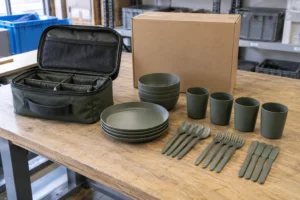
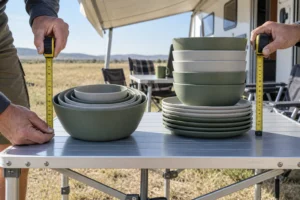
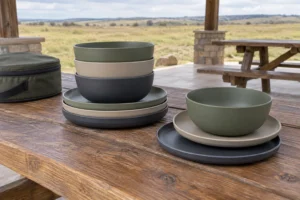
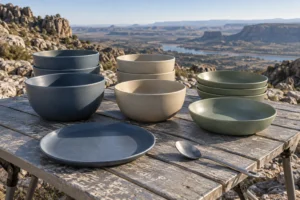
Three-way shortlist
PP vs Titanium vs Stainless Steel for Camping Programs
| Buyer priority | Food-grade PP | Titanium | Stainless steel |
|---|---|---|---|
| Typical positioning | Scalable family and retail sets | Premium ultralight assortment | Durable RV, glamping and repeated-use programs |
| Critical specification | Resin, heat conditions, wall thickness and drop performance | Grade, thickness, finished weight and construction | Steel grade, thickness, finish, joints and corrosion scope |
| Customization route | Molded color, logo, packaging and tooling | Finish, laser logo, nesting and pouch | Brushed/polished/coated finish, laser logo and storage |
Compare the dedicated PP, titanium and stainless steel sourcing pages before selecting samples.