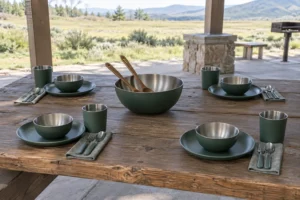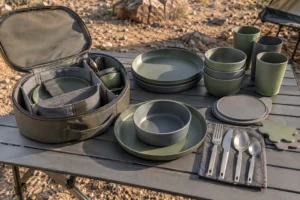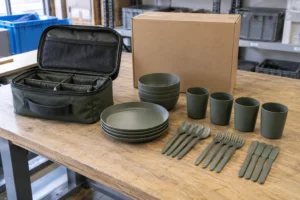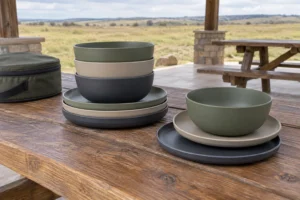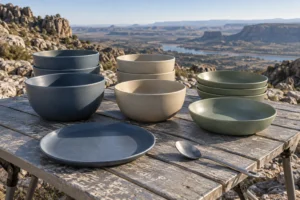
The best camping dinnerware for family car camping is a coordinated, reusable set sized for every family member, easy to clean at a developed campsite, stable on picnic tables, and simple to count and repack. Buyers should prioritize verified food-contact materials, practical plate and bowl geometry, child-appropriate handling, visible color allocation, replaceable components, and a storage plan that keeps dinnerware separate from raw-food tools and cookware.
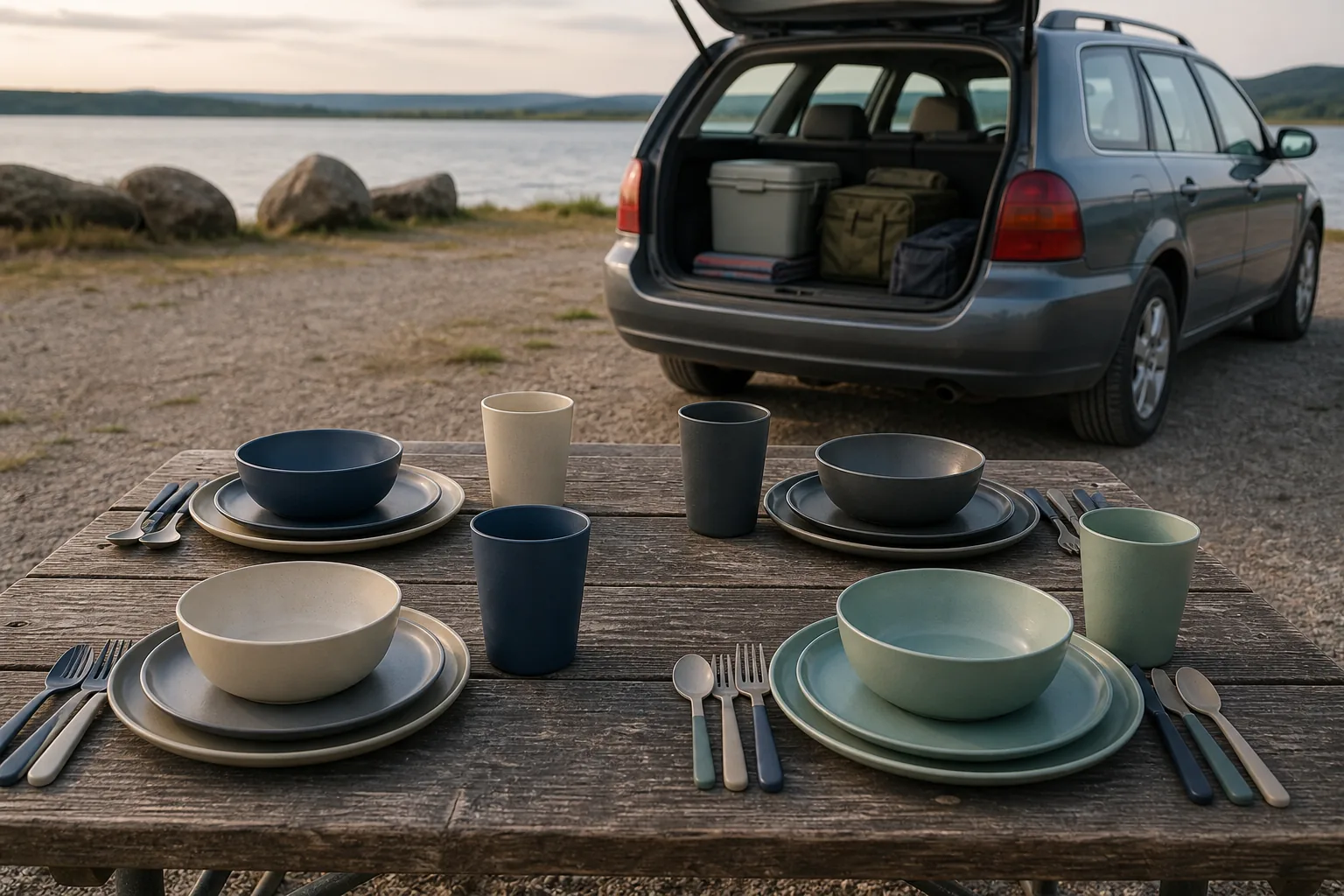
Why family car camping needs a different dinnerware brief
Family car camping is usually based around a vehicle-accessible pitch, cooler, folding table and organized storage rather than a lightweight pack. That operating reality favors a durable, countable dinnerware system with clearly separated personal and serving pieces over ultralight components chosen only for low mass. The brief should cover handling from meal preparation through washing, drying and repacking.
A family assortment also serves people with different hand sizes, meal portions and responsibilities. Adults may need flat plates and deeper bowls for shared meals, while younger users may benefit from lighter pieces, lower rims and clear color identification. Those decisions should be treated as product requirements, not decorative styling.
For a B2B buyer, the design problem extends beyond the campsite. The set must pack into a vehicle without rattling, display clearly at retail, survive repeated sorting, and communicate which components are dinnerware rather than cookware. A successful specification connects the user journey from shelf or carton to meal, washing, drying and repacking.
Best camping dinnerware decision table for a family set
| Component | Recommended family role | Buyer decision | Evidence or sample check |
|---|---|---|---|
| Flat plate | Main meals, sandwiches and dry foods | Diameter, rim height, stability and portion fit | Drawing, measured sample and loaded table test |
| Deep bowl | Breakfast, soup, pasta and shared sides | Capacity, base width, nesting and spoon access | Measured fill, tilt test and nesting review |
| Cup or tumbler | Cold or product-approved warm beverages | Capacity, grip, stackability and user identification | Sample handling and intended-use documentation |
| Fork, spoon and optional knife | Individual eating set | Age positioning, handle comfort and retention | Physical sample, component list and pack-out test |
| Shared serving pieces | Separates food service from personal utensils | Number, length, color and storage location | Menu simulation and contamination-control review |
| Storage box or pouch | Counting, transport and clean/used separation | Internal layout, drainage, drying and closure | Full-set pack-out mock-up and vehicle test |
This table is a starting architecture, not a universal SKU. A two-adult family eating simple breakfasts needs a different mix from a family of five preparing multi-course meals, so the buyer should define menu and user count before setting a headline piece total. Compatibility between separately sourced components must be confirmed by the complete project sample and drawing.
Use data and evidence instead of material shortcuts
Material names alone do not prove that an article is suitable for a target market or use. The U.S. FDA explains that food-contact substances are evaluated for their intended conditions and that migration and toxicological information can be relevant to authorization. Buyers should therefore request evidence for the finished article and declared use rather than accepting a generic phrase such as “food grade.”
For European projects, Regulation (EC) No 1935/2004 requires food-contact materials to be made so that, under normal or foreseeable conditions, they do not transfer constituents at levels that endanger health, unacceptably change food composition or deteriorate food characteristics. It also requires traceability and non-misleading presentation. The practical procurement lesson is that evidence must match the material, color, construction, food types, contact time, temperature and repeated-use conditions of the ordered SKU.
Car-camping menus can include acidic sauces, oily foods, hot servings, dairy, snacks and cold drinks during the same trip. Ask the supplier to identify intended food types and conditions of use for plates, bowls and cups separately. A statement that covers a room-temperature dry-food plate may not automatically support a bowl used for hot, oily food.
Separate dinnerware evidence from cookware evidence
Family sets are often photographed near a camp stove, which can create a dangerous assumption. Plates, bowls, cups and cutlery should not be placed on a burner, campfire or other direct heat source unless the exact product is designed and verified for that condition. A metal appearance, handle or nesting shape is not proof that an article is cookware.
Keep the purchasing documents distinct. Dinnerware specifications should define food contact, serving temperatures, cleaning and transport, while cookware documents should address heating method, thermal performance, handles and flame or stove conditions. If a kit contains both, label and test every component by its real role.
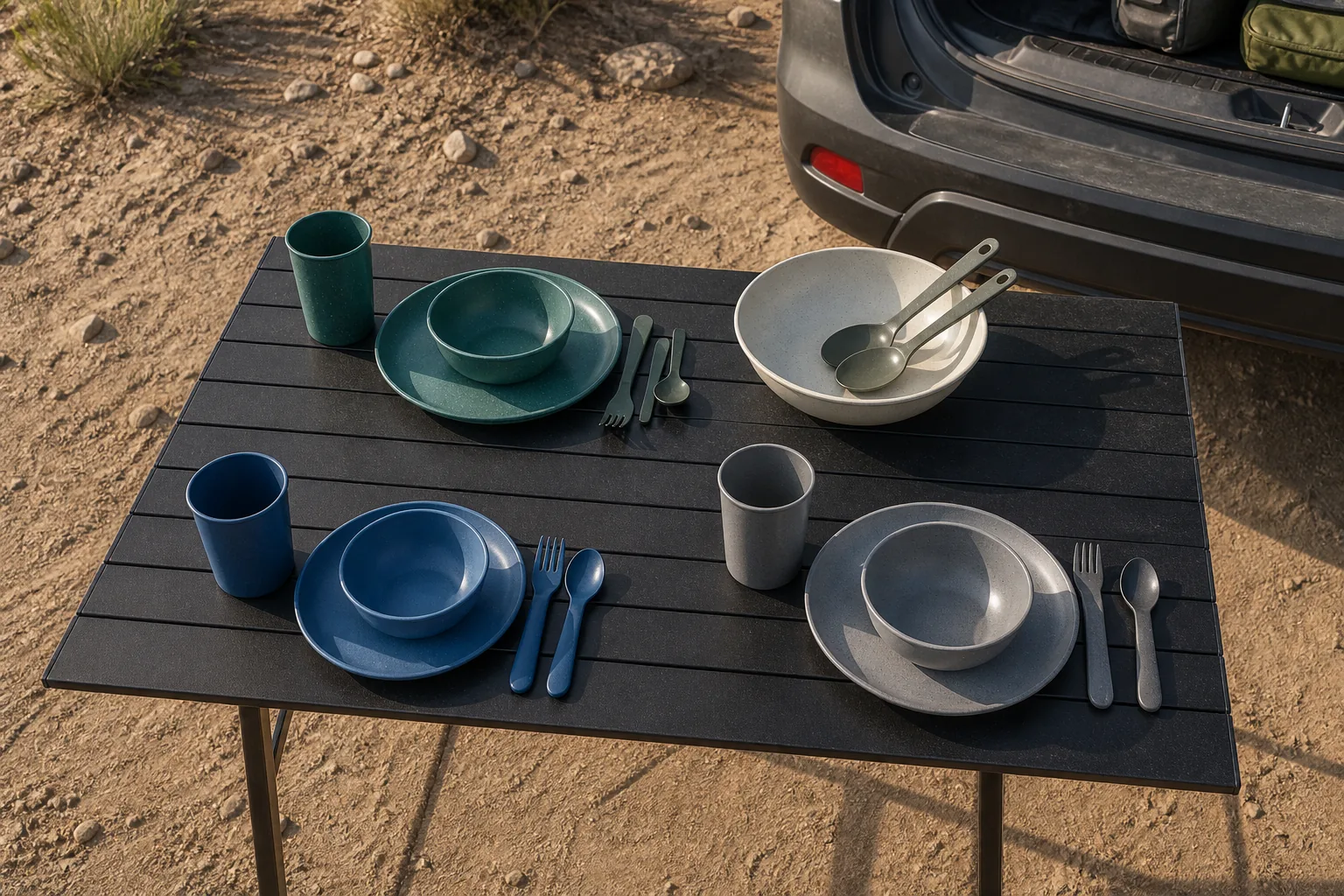
Compare the main material directions
| Material direction | Family car-camping strengths | Limitations to verify | Best purchasing use |
|---|---|---|---|
| Stainless steel | Robust feel, long service potential and familiar metal appearance | Weight, heat transfer, noise, denting, alloy and finish evidence | Durability-led adult or mixed-user assortments |
| Enamel-coated steel | Classic visual language and coordinated colors | Chipping, edge coverage, coating system and impact handling | Retail programs where appearance and care communication are strong |
| PP or verified plastic system | Low mass, quiet handling, color allocation and shape flexibility | Food-contact scope, temperature conditions, staining, warpage and care | Family, kids and high-color modular programs |
| Silicone components | Flexible packing and soft-touch features in suitable designs | Stability, odor, dust attraction, formulation evidence and support structure | Selected bowls or accessories after product-specific review |
| Plant-fiber composite | Distinct surface appearance and brand storytelling potential | Polymer matrix, fiber ratio claims, heat/care limits and environmental wording | Verified reusable dinnerware programs with controlled claims |
| Aluminum or anodized aluminum | Low mass and technical outdoor appearance | Surface system, denting, acidic foods, intended use and care evidence | Weight-conscious adult assortments where specifications are documented |
No material wins every column. Car camping allows buyers to choose a slightly heavier plate if stability, quieter handling or a better washing experience matters more than carried weight. A mixed-material set can work, but each component needs its own declaration, care instruction and evidence file.
For Naike Dinner, the live product record is strongest in reusable plant-fiber composite and related tableware categories; this article does not claim that every material in the comparison is currently supplied. Buyers can use the comparison to define a brief, then request confirmation of real product availability and documentation before sampling.
Build the assortment around real family scenarios
Weekend campground family
A two-night family trip usually benefits from one complete personal setting per user, two shared serving utensils and a storage solution that makes missing pieces obvious. Bowls should support breakfast and evening meals without requiring multiple specialty shapes. Color allocation can help children return each piece to the correct place while also simplifying inventory at pack-up.
The buyer should simulate the whole menu with production-intent samples. Check whether the flat plate holds the largest meal, the bowl remains stable on a picnic table, cups fit available holders, and utensils are comfortable for each intended age group. A beautiful nested stack is not enough if pieces are difficult to separate with wet hands.
Large family or shared group pitch
For four to six users, component counting becomes a quality feature. Use a clear bill of materials, visible color or icon allocation, and a storage layout that reveals a missing plate or utensil before departure. Shared serving pieces should look different from personal eating utensils to reduce accidental cross-use.
Larger sets also magnify stacking problems. Small differences in rim diameter or wall taper can create wobble, surface rubbing and excess carton height. Evaluate the complete stack after transport vibration and repeated washing, not only when the samples are new.
Families with young children
Age positioning must be explicit. Consider grip, mass, edge shape, base stability, portion size and the way a cup behaves when placed near the table edge. Avoid unsupported claims such as “child safe” unless the product and market evidence support the exact statement.
Bright colors can improve allocation but do not replace supervision or a sound specification. If the set uses several pigments or decorations, confirm that the evidence covers each relevant variant or document the grouping rationale. Packaging should state care and intended-use limitations clearly for adults.
Retail buyers should also examine how children identify their own pieces without relying on small printed labels that may wear away. A coordinated color system, distinct cup silhouette or clearly separated storage position can improve allocation, but every variation must remain within the approved material and decoration scope. Confirm that the complete set is still easy for an adult to count, wash and repack after the visual differentiation is added.
Caravan and RV families
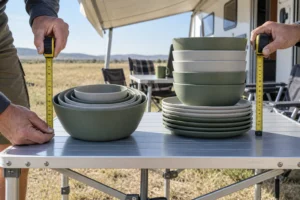
RV storage rewards compact nesting, controlled rattling and easy retrieval. Measure the available cabinet or crate, including handles and lids, before choosing components. Add separators only if the full system has been checked for moisture retention, abrasion and pack-out labor.
Because RV users may have access to water and indoor storage, they can prioritize a more comfortable daily-use form. However, do not assume that every campsite provides safe washing facilities. The set still needs a plan for clean water, temporary dirty-piece containment and complete drying.
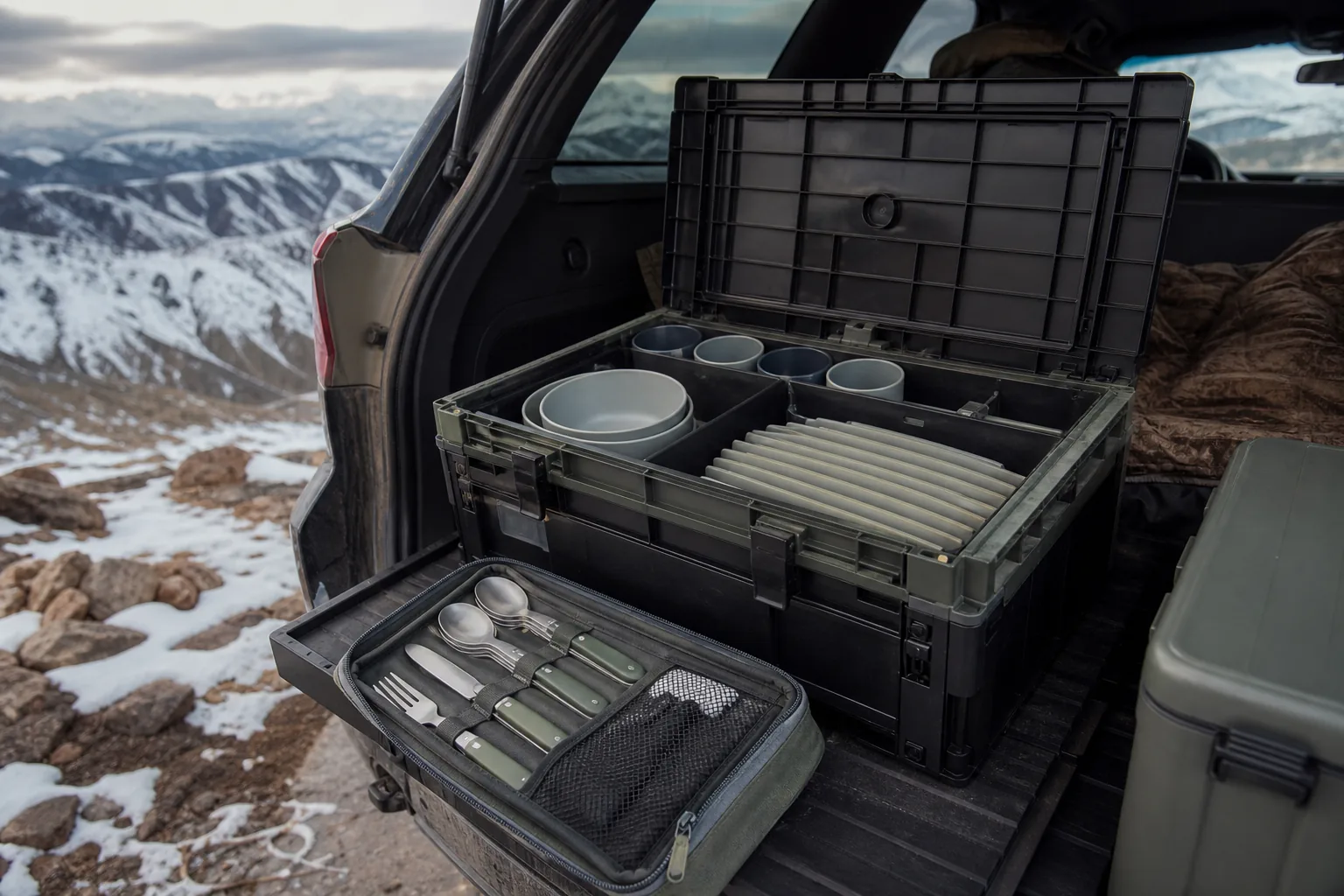
Measure the storage system with the vehicle loaded for an actual trip. Soft bags, coolers and bedding can reduce access or press against the dinnerware box, while vibration may cause utensils to migrate between compartments. A pack-out approval should record the intended orientation, closure clearance and retrieval sequence so the commercial sample reflects how families really use it.
Cleaning and food separation are part of the product system
The USDA advises campers to plan equipment, keep raw foods separate, use clean platters and utensils, and bring clean water when a campsite lacks it. These recommendations affect dinnerware architecture. Buyers should distinguish personal eating pieces, shared serving tools and any utensils used with raw ingredients through shape, color or dedicated storage.
A wash system needs more than a decorative pouch. The product brief should state whether the dinnerware is hand-washed or dishwasher-cleaned at home, which detergent and tools are allowed, and how pieces dry before storage. Deep recesses, tight nesting and fabric sleeves can trap water if the user packs too quickly.
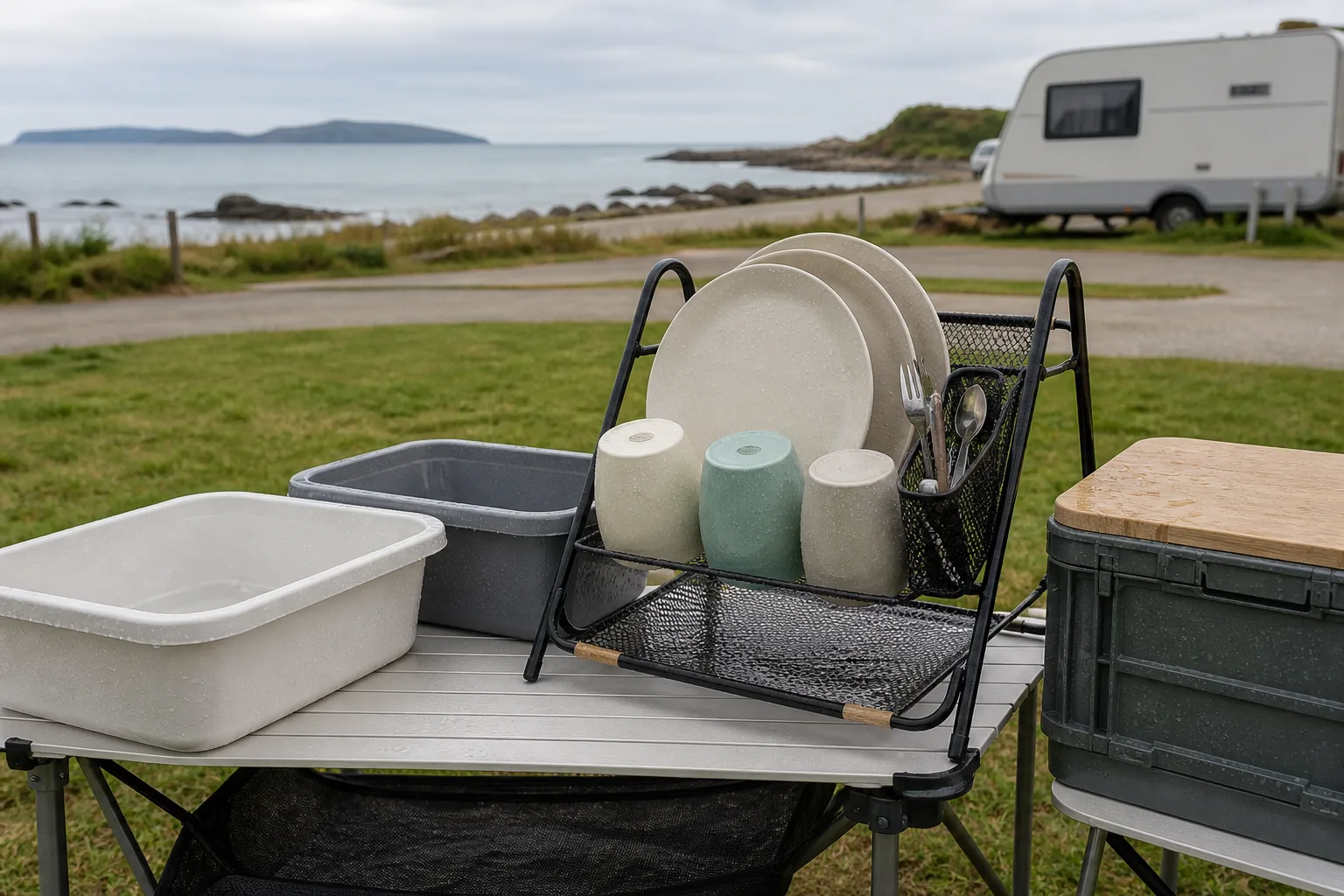
For developed campgrounds, a mesh rack and two-basin process may be practical where local rules permit. In more limited sites, the family may need to carry used pieces home in a sealed, washable container. Marketing copy should never encourage disposal of food scraps or wash water in ways that conflict with campground rules.
Limitations and purchasing risks
The first risk is buying by piece count. A “24-piece set” can still omit a useful bowl, include unnecessary knives or provide no shared serving tools. Require a line-by-line component schedule that states quantity, dimensions, material, color, function and replacement code.
The second risk is unverified nesting. Components from separate catalogs may appear compatible in photographs but collide at rims, wedge together or waste storage volume. Use the exact phrase “Compatibility to be confirmed by project sample and drawing” until the complete physical assembly passes review.
The third risk is mixing food-contact claims. One declaration cannot be assumed to cover several materials, colors, lids and decorations without a documented scope. Match reports and declarations to the final bill of materials and destination market, then control later substitutions.
The fourth risk is overclaiming environmental performance. Reusable, plant-fiber, recyclable, biodegradable and compostable describe different concepts and may depend on formulation and local systems. Use only claims supported for the exact article and market; avoid turning a visible fiber texture into a disposal promise.
The fifth risk is neglecting replacement. Family sets lose forks, cups and lids. A buyer should decide whether components have stable item codes, whether colors remain available, and whether replacements can be supplied without buying a complete set. If that commercial capability is not verified, mark it for project confirmation.
The sixth risk is confusing visual concepts with product evidence. Every generated image in this article is labeled as an illustration. Product decisions must rely on real samples, drawings, declarations, test evidence and approved packaging—not on the number or appearance of pieces in an editorial scene.
A step-by-step procurement workflow
Start with a family-use brief. Record the number and age range of users, trip length, typical meals, vehicle type, storage space, campsite facilities, cleaning method, target market and retail channel. This prevents the supplier from proposing a generic set that looks complete but fails the intended routine.
Next, choose the base architecture. Decide whether each user receives a plate, bowl, cup, fork and spoon, then list shared and optional pieces separately. Assign every component a function and avoid duplicates unless a spare is intentional.
Third, define construction and use conditions. For every article, state material direction, dimensions, mass target, food types, serving temperature, cleaning method and any decoration. Mark cookware separately and prohibit direct-flame use for dinnerware unless specific evidence exists.
Fourth, request a controlled sample set. The sample should represent the proposed colors and material systems, not a mix of unrelated showroom pieces. Test meal fit, grip, stability, stacking, separation, washing, drying, vehicle storage and family allocation.
Fifth, build the evidence matrix. Link each market claim to the relevant declaration, test report or supplier record. Check that model names, colors, drawings and dates correspond to the production-intent articles and keep a documented rationale for any grouped variants.
Sixth, approve packaging with the complete set. Confirm nesting order, separators, utensil retention, carton strength, count verification, care instructions and product boundary. Perform a transport trial and inspect for rub marks, trapped moisture, chips, dents or deformation.
Finally, define production inspection and change control. Inspection should cover dimensions, mass, appearance, sharp edges, stability, component count, color allocation, nesting and packaging. Require written approval before changes to material, pigment, finish, supplier, tooling, decoration, packaging or manufacturing location.
B2B buyer checklist
| Check | Question | Why It Matters |
|---|---|---|
| User allocation | Does every family member have the correct plate, bowl, cup and utensils? | Prevents incomplete or inflated piece-count offers. |
| Meal fit | Do the shapes support the actual camping menu? | Connects geometry to real use rather than catalog appearance. |
| Material scope | Is each substrate, pigment, coating and decoration declared? | Defines the evidence and change-control boundary. |
| Food contact | Do documents match the market, food, time and temperature? | A generic certificate may not cover the ordered use. |
| Child use | Are grip, mass, stability and age positioning reviewed? | Reduces unsupported safety language and poor ergonomics. |
| Nesting | Has the complete set passed stack, separation and abrasion checks? | Photographs cannot prove component compatibility. |
| Cleaning | Are detergent, water, drying and storage instructions validated? | Reduces trapped moisture, damage and confusing care claims. |
| Replacement | Can lost components be identified and sourced by item code? | Improves the usefulness of a reusable family program. |
| Packaging | Does the final pack reveal missing pieces and protect surfaces? | Supports counting, transport and retail presentation. |
| Change control | Which changes require buyer approval and renewed evidence? | Protects sample and compliance validity. |
Frequently asked buyer questions
1. How many pieces should a family car-camping set contain?
Count functions rather than chasing a headline number. A practical starting point is one plate, one bowl, one cup and essential utensils per user, plus only the shared serving and storage pieces required by the menu. Confirm the final list through a component schedule and full-set sample.
2. Is lightweight dinnerware always better for car camping?
No. Vehicle access reduces the need to minimize every gram. A slightly heavier article may provide better table stability or handling, but buyers should compare complete packed mass, storage volume, user comfort and durability rather than selecting by one metric.
3. Can adult and kids components use different materials?
They can be evaluated as a mixed system, but each material, color and construction needs the appropriate declaration and evidence. Review how the pieces nest, wash and pack together, and avoid claiming identical performance simply because the colors coordinate.
4. Are plant-fiber composite plates suitable for every camping meal?
Suitability depends on the polymer matrix, finished article, food type, temperature, contact duration and validated care instructions. Do not infer heat resistance, microwave use, dishwasher use, compostability or direct-flame suitability from visible fiber content.
5. Should the set include cookware?
Only if the purchasing program intentionally includes separately specified cookware. Plates, bowls and cups remain dinnerware unless the exact articles have product-specific heating evidence. Use clear labeling and storage positions so families do not put dinnerware on a stove or fire.
6. What should a buyer send for an accurate quotation?
Provide the family size, age positioning, target market, material direction, complete component list, dimensions, colors, logo, packaging, storage space, food and temperature conditions, cleaning method, evidence requirements and sample priorities. Ask the supplier to identify every field that remains to be confirmed.
Procurement recommendation
The best camping dinnerware for family car camping is a verified system that makes meals, washing and pack-up easier for a defined group. Choose the architecture before the styling, match evidence to every finished component, and approve the complete set in the real vehicle-and-campsite workflow.
Naike Dinner can review a family-set brief around verified available components and identify where samples, drawings or documentation are still needed. Explore the published Camping Dinnerware Sets, Camping Plates and Outdoor Tableware hubs, then use the project contact page to request a documented review.
Need a family car-camping set review?
Send the number and ages of users, menu, destination market, material direction, component list, vehicle storage limits, colors, logo, cleaning method and packaging target. We will separate verified options from fields that still require a sample, drawing or test scope.
Request a component and evidence reviewBuild a car-camping dinnerware brief your supplier can verify
Share your family allocation, intended foods, storage dimensions and market requirements. Ask for real samples and a documented quotation rather than a generic piece-count offer.
Request samples and a documented quotationRead the anodized aluminum guidePrimary references: 21 CFR 177.1520 on olefin polymers; FDA food-contact substances information; and Regulation (EC) No 1935/2004.