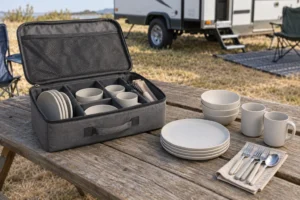
Set a camping dinnerware weight budget for the complete packed set first, then allocate it by component role and measure every approved sample. Include plates, bowls, cups, utensils, food containers, lids, separators, carrier and retail packaging in separate columns. An attractive lightweight plate does not make a lightweight program if its protective case or duplicate components consume the allowance.
Define which weight the buyer is trying to control
A camping dinnerware weight budget is useful only when its boundary is written down. A shopper carrying the set from a car to a picnic table cares about the loaded carrier; a backpacking customer cares about every item that goes into the pack; a retailer and freight buyer may also need the fully packaged sales unit and master carton. Treat those as different measurements rather than using the smallest number in marketing and the largest number in logistics.
Start with a named configuration and revision. State the user count, every individual place setting, shared serving items, optional food containers, cleaning accessories, protective pieces and the carrier. Our component-list worksheet helps establish the inventory, but the project’s own bill of materials must decide what is included, optional or excluded.
Use three mass fields in the approval record: unpacked product components, complete loaded carry system, and retail-packaged unit. The difference between the first two is the bag, dividers, straps and any retained protection; the difference between the second and third is packaging and inserts. Write the exclusions beside the figure so a product team cannot accidentally compare an unpacked sample with a competitor’s packed retail unit.
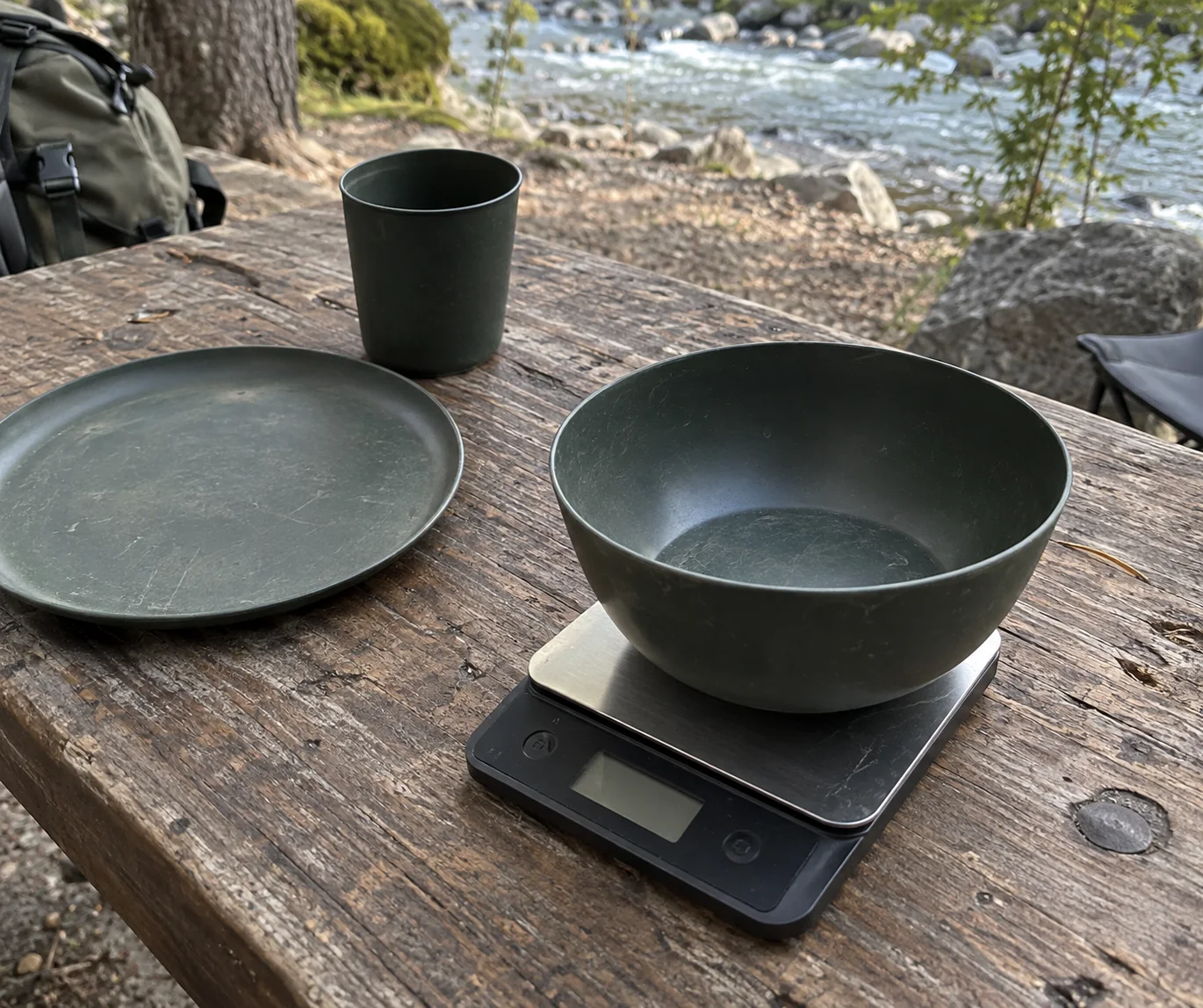
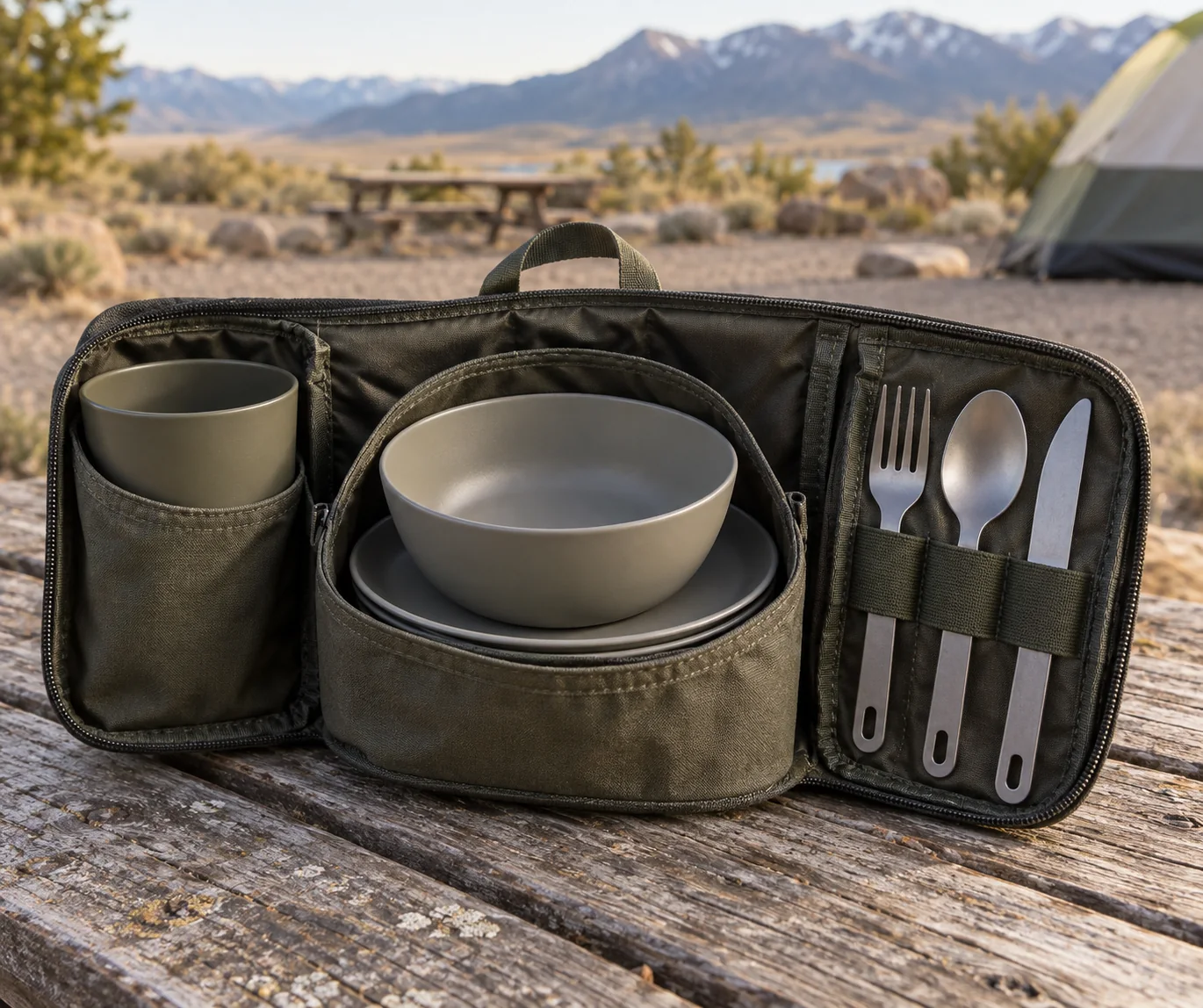
The images on this page are conceptual buyer guidance, not a verified Naike Dinner SKU, test or material declaration. No appearance, scale display or pictured assortment establishes a measured weight, stock availability or manufacturing capability. Dinnerware is for serving and eating under verified use conditions; it is not cookware, and nothing shown is represented as suitable for a burner, stove, oven or direct flame.
Use scoped measurement and food-contact evidence
For a defensible weight comparison, specify the scale, its resolution, the way it is zeroed and the state of the sample. The 2026 NIST Handbook 44 is a primary reference on specifications and tolerances for weighing and measuring devices in regulated contexts. It does not certify a camping dinnerware sample, but it underscores why a reported mass should come from a defined measurement procedure rather than from a rendering, catalog estimate or unrecorded kitchen scale reading.
Weigh clean, dry components and record whether removable lids, gaskets, sleeves, protective films and accessories are present. Take more than one reading when a small component approaches the scale’s display resolution; if the readings vary, report the observed range and investigate before rounding to a marketing number. A buyer does not need laboratory theater here, but does need repeatability and a traceable sample revision.
Weight is only one constraint. For an EU-bound set, Regulation (EC) No 1935/2004 provides the general framework for food-contact materials. For a U.S. program, the FDA’s food types and conditions-of-use tables show why intended food and temperature matter. Neither source supplies a pass result for a pictured concept; a lighter material substitution still needs finished-component, market-specific evidence.
Australia and New Zealand buyers can use FSANZ food-packaging guidance to frame their food-contact review. Do not let a weight target drive an undocumented change in contact surface, pigment, coating, gasket or use claim. Put the evidence requirement in the same change register as the mass calculation, so the lightest prototype is not quietly treated as the approved final set.
A component weight-budget worksheet buyers can use
The table is a working template, not a claim that any listed part has a particular mass. Enter the buyer’s maximum total mass, assign an allowance to each role, and then replace every blank with readings from a named sample revision. Keep an allowance for the carrier and protective system before trying to optimize plates and bowls; those non-food-contact pieces can determine the packed total.
| Component group | Count and revision to define | Allocated allowance | Measured sample mass | Decision if over allowance |
|---|---|---|---|---|
| Individual plates | Plate count, rim and base drawing | Buyer enters target for all plates | Measure each sample, then sum | Review profile, count and nesting before material change |
| Individual bowls | Depth, rim and base revision | Buyer enters target for all bowls | Include any separate lids | Check meal role and spill control before thinning |
| Cups or mugs | Capacity, handle and wall design | Buyer enters target for all cups | Measure cup and any sleeve separately | Check grip, temperature claim and packed envelope |
| Knife, fork and spoon groups | Piece count, handle length and storage | Buyer enters target for all utensils | Count every retained tool | Review missing or duplicate roles before lightening |
| Food containers | Body, lid, divider and seal revisions | Buyer enters target for all containers | Measure body and closure separately | Confirm whether container is essential or optional |
| Shared serving pieces | Serving role and replacement plan | Buyer enters shared allowance | Measure the selected sample | Remove only if the use scenario still works |
| Carrier and retention | Bag, case, panels, straps and separators | Buyer reserves an allowance early | Weigh empty and fully loaded | Revisit protection and access, not just fabric thickness |
| Retail packaging | Box, sleeve, insert and instructions | Separate retail-unit allowance | Weigh after pack-out approval | Compare channel need and damage risk |
Use the equations component subtotal = sum of every approved physical part, loaded-carry mass = component subtotal + carrier and retention, and retail-unit mass = loaded-carry mass + retail packaging. Record units consistently and do not mix grams with ounces in one column without a controlled conversion. If an item serves several roles, count it once physically but list each role in the notes so a later deletion is deliberate.
Reserve a separate contingency line for pending design changes; do not bury it in an unexplained “other” amount. The contingency is a planning buffer, not measured product mass. Once a final sample is approved, replace the estimate with the measured part and revise the total. Preserve the old worksheet so the buyer can see whether the mass changed because a component was added, its geometry changed, or the carrier was redesigned.
Allocate mass by function before selecting a material
A percentage split can make an early budget visible, but it must remain a buyer assumption until the component matrix is fixed. Rather than prescribing a universal split, ask which pieces are repeated for every person and which are shared. A small per-person saving can multiply across a family set, while a single heavy shared case may dominate a one-person set; the arithmetic changes with the configuration.
Identify “protected functions” that should not be thinned merely to meet the number. A plate must remain usable for the intended meal, a bowl must be stable and cleanable, a cup must match the beverage and handling case, and a food container must close and wash as specified. A narrower rim or shorter utensil can save mass on a drawing while causing a failure in grip, food retention or user acceptance. Ask the sample reviewer to record those trade-offs in the same row as the reading.
Separate material choice from form choice. Two candidates made from the same material can have different wall sections, rims, bases, handles and closures. Conversely, two candidates with similar measured mass may differ in food-contact evidence, packing compatibility or expected cleaning workflow. The comparison should therefore name both material and geometry, with no claim of equivalence until the finished samples are reviewed.
Where a buyer wants metal for a particular role and polymer or a plant-fiber composite elsewhere, define the intended use of each contact surface first. The mixed-material set decision guide explains why a lighter-looking configuration can create extra interface and document control. This article does not assume Naike Dinner produces each candidate material, process or geometry; proposed capabilities require verification in live company records and a project review.
Measure a complete sample, not disconnected prototypes
Have one reviewer lay out all numbered parts, then another compare the physical count with the bill of materials. Weigh each part on the defined scale, noting whether it is dry, empty and at normal room conditions. Record the scale identifier and display increment; if the reading is unstable, do not force a precise-looking number into a spreadsheet. Reweigh and escalate the uncertainty.
Next assemble the set exactly as it would be carried. Any anti-rattle sleeve, spare lid, utensil retainer or packing spacer must be present. Our rattle diagnostic shows why retention pieces cannot be treated as invisible accessories: they may be essential for transport and therefore belong in the loaded mass and bill of materials.
Compare the sum of part readings with a direct reading of the complete closed set. A mismatch can signal a missing component, a forgotten sleeve or an accounting error; do not dismiss it merely because it is small. Photograph the layout with the numbered physical pieces and store that image alongside the worksheet, but avoid using a staged image as evidence of a numerical result.
Weigh the retail package only after the protective design is settled. A cardboard insert, molded tray or extra wrap can change the sale-unit mass and pack-out. If the buyer needs shipping comparisons, use the master-carton configuration and logistics data from the actual pack design, not an extrapolation from one bare plate. Weight and packed volume should be evaluated together: a lighter but bulkier set may fail the intended shelf, bag or carton envelope.
Apply the budget to the actual sales and use channel
For backpacking, the carried set and pack envelope are central. Ask whether a food container is truly needed and whether a shared serving piece is justified, but do not delete an item that the cooking-and-eating workflow depends on. Keep the stove and cookware inventory outside the dinnerware number unless the buyer explicitly defines an integrated system, and never infer flame suitability from a metal appearance.
For car camping, RV and caravan programs, storage location, handling and clean-up can matter more than the absolute lowest mass. A slightly heavier protected carrier may reduce loose parts or make repacking more repeatable, but that is a buyer hypothesis to test, not a performance claim. Record the vehicle drawer, tote or shelf envelope as a separate acceptance criterion, so the team does not chase a low weight while losing accessibility.
For family retail sets, count per-person components before comparing total mass. An item advertised for four users may have four plates but one shared bowl, or it may include several food containers; those are different configurations. The weight budget should describe the exact component allocation and whether the total includes the carry bag, which lets the merchandising team compare like with like and reduces misleading “lightweight” labels.
For rental, catering or event use, replacement and cleaning can outweigh a minimal initial mass. Track which individual parts are likely to go missing, how the set is counted at return, and whether a carrier helps staff inspect it quickly. Do not turn a lower number into an unsupported durability claim. If the commercial model values faster counting or easier replacement, quantify that operational requirement separately from the component mass.
Where weight-saving proposals commonly fail
Removing material from a bowl base may help the spreadsheet but can change stability on uneven outdoor tables. Thinning a plate rim can alter grip or the way plates stack under load. Shortening utensils can improve packing while making them awkward to use with deeper bowls or food containers. Each proposed reduction should have a function it must preserve and an observation to check on a revised sample.
Removing the bag is another deceptively simple saving. It may shift the burden to an uncounted customer pouch, create loose utensils or require a larger retail insert. Conversely, adding a rigid case solely to make a set look premium can make the loaded system less suitable for a weight-sensitive channel. Compare the complete system for the intended distribution and use, not isolated product photographs.
Be cautious with multifunction claims. A lid that also serves as a plate may reduce physical piece count, but the buyer must confirm that the food-contact surface, grip, cleaning sequence and simultaneous-use needs still work. One item cannot perform two roles at the same time for different users. Document the meal sequence before calling a dual-purpose design a weight saving.
A lightweight claim based on a prototype can become obsolete after a colorant, decoration, gasket, thicker wall, revised handle or different package is approved. Put a change trigger into the specification: any new material, geometry or component count requires a new mass reading, pack-out check and evidence review. If a supplier proposes an alternative, the buyer should receive a revised worksheet and sample rather than a verbal assurance that it remains “about the same.”
Specify a repeatable sample approval sequence
First approve the component matrix and three mass boundaries. Second weigh individual parts under the agreed procedure. Third inspect each critical function at the proposed reduced design, including plate handling, bowl stability, cup grip, utensil use, closure behavior and cleaning access. Fourth load the exact carrier and repeat the total reading. Fifth compare the retail-packaged unit if that number will be used in commerce or logistics.
Store photographs of the numbered layout, a dated measurement sheet, the scale description, drawings or sample identifiers, and a list of any open items. A single total without a part-by-part record cannot explain later drift. Have a buyer, technical reviewer and merchandising owner each sign the criteria relevant to their role; this is a proposed governance practice, not a claim that any specific factory already follows it.
When comparing two development candidates, hold user count and component roles constant. Put both candidates in the same worksheet, including their carriers and protective pieces. If one lacks a lunch box or cup sleeve, mark the difference explicitly instead of attributing the entire mass reduction to its material. Then test both against the same intended food, handling, cleaning and packed-envelope conditions.
Do not publish exact mass, “ultralight” or weight-saving percentages until the final approved sample is measured and the claim boundary is stated. An early target can guide design, but it is not a factual product specification. Likewise, an image-generated scale is never measurement evidence and must not appear in a test report. This distinction protects the buyer’s catalog, the supplier’s quotation and the end user’s expectations.
Connect the mass budget to packaging and replenishment
A weight budget may be optimized for the user but lost in packaging. Specify whether the soft carrier is also the consumer package or sits inside a retail carton. Separate a removable marketing sleeve from a transport-protective insert in the worksheet. If a channel needs a mailer or a hanging display pack, compare each approved packaging variant rather than using one universal sales-unit weight.
Replacement pieces create a second calculation. A buyer may want spare cups or utensils sold separately, but those should not silently enter the core set total. Keep the base configuration, optional extension and service inventory in separate rows. That separation helps procurement ask for like-for-like quotations and lets operations forecast replenishment without inflating the advertised core assortment.
Pack volume and mass interact, but they are not interchangeable. A rigid case can occupy stable shelf space while adding weight; a soft pouch can compress but may need protection for fragile components. Record the maximum closed dimensions and the measured loaded mass from the same sample revision. If the carrier changes, update both fields and revisit any carton plan that used the old envelope.
For freight planning, do not extrapolate a carton number from the consumer unit alone. The master carton has its own box, dividers, count and sometimes protective layers. Ask the logistics owner to record a real packed-carton measurement and actual packing quantity when those are available. This article offers a decision method, not a freight quote or a declared shipping weight.

Turn the budget into an approve-or-revise decision
Build a decision sheet with one row per component and columns for target allowance, measured mass, variance, functional observation, food-contact evidence status, packed location and owner. Mark a row “open” when either the reading or the use-condition evidence is missing. A total under target does not close a row that fails basic handling or has an unverified contact surface.
Agree the trade-off hierarchy before the supplier revises anything. One program may protect a stable bowl and shorten a non-critical carrier strap; another may preserve fast one-handed access and accept a heavier pouch. The hierarchy belongs to the buyer’s channel and use case, not a generic claim that one material is always lighter or better. Record who can approve a change to that hierarchy.
When a measured total exceeds the target, investigate in this order: confirm the count, check missing or duplicate accessories, identify the heaviest repeated component groups, and test whether a geometry or packing revision preserves function. Change material only after the food-contact, cleaning and market consequences are scoped. A proposed substitution is a new candidate until its sample and evidence are reviewed; do not overwrite the approved row.
The final approval should contain both the measured complete-set mass and the configuration description that makes the number meaningful. Write whether the carrier and packaging are included, the sample revision, date, method and tolerance or observed variation. That record supports a truthful listing, a controlled RFQ and later change management without pretending that a planning worksheet is a certification.
B2B Buyer Checklist
| Check | Question | Why It Matters |
|---|---|---|
| Configuration boundary | Which exact pieces and quantities are included? | Different counts make quoted totals incomparable. |
| Mass definition | Is the reported figure components-only, loaded-carry or retail-unit? | Each serves a different buyer decision. |
| Scale procedure | Which scale, increment, tare and sample state were used? | Repeatable readings need a defined method. |
| Functional constraint | What must still work after a mass reduction? | Lower mass is not useful if the eating system fails. |
| Food-contact scope | What finished materials, colors and use conditions need evidence? | A lighter substitution can change compliance work. |
| Carrier and protection | Are every sleeve, divider and closure counted? | These often determine real packed mass. |
| Packaging variant | Does the chosen channel add an insert, sleeve or carton? | Sale-unit and shipping comparisons need the final pack. |
| Revision control | Who reweighs and reapproves after a drawing or material change? | Old claims should not survive a changed sample. |
Buyer FAQs
1. What is the first number to set?
Choose the maximum mass for the complete system the intended buyer actually carries, then state what it includes. Do not set an unpacked plate target and assume it represents the final set. Keep separate fields for component subtotal and retail-packaged mass so future teams cannot swap definitions.
2. Should every component receive the same percentage reduction?
No. Allocate by function, repetition and risk. A plate used by every person may deserve a different optimization effort from a shared container or one carrier, while a stability or food-contact constraint may make a nominal saving unacceptable. Use measured candidate samples rather than an equal percentage rule.
3. Can a lighter material automatically replace a heavier one?
No. Specify food and temperature conditions, geometry, cleaning, target market and the finished-contact surface. A substitution can affect stiffness, nesting, grip, decoration and evidence requirements. Treat it as a new candidate until the relevant checks and documents are reviewed.
4. Are lids, sleeves and inserts part of the weight budget?
Yes when they ship or travel with the approved configuration. Record them separately so their contribution is visible. A component that appears small in a photograph can multiply across several place settings, while protective parts can be essential to keep a packed set usable.
5. How should a buyer compare two competing quotations?
Request an identical component matrix, sample revision, measurement boundary and packaging description from each party. If one quotation excludes a carry case or divided box, normalize the scope before comparing totals. Ask for the measured part-by-part sheet, not only a rounded catalog figure.
6. When is the weight ready for a public product claim?
Only after the final configuration, carrier and relevant packaging are approved and measured under a recorded method. State whether the claim refers to the bare components or loaded carry set. Recheck after any revision that can change mass; do not rely on a concept picture or an earlier prototype.
7. Does a lower packed mass prove better outdoor performance?
No. It is one result under one configuration. Handling, cleaning, durability, fit, food-contact suitability and channel needs require their own evidence and review. The buyer should approve the trade-off that suits the intended use rather than assuming the lowest number wins.
Request a measured component review
Send your user count, component matrix, intended foods and temperatures, cleaning method, target markets, required carrier envelope, optional modules and three mass boundaries. Include existing drawings or samples if available, and specify which roles cannot be compromised. Request a specification and sample review that separates verified existing capability from new geometry or material proposals requiring feasibility work.
For a documented quotation, also send the retail packaging channel, artwork needs, evidence expectations and approval method. Ask the response to identify open measurements, unresolved compatibility and any required revision before treating a concept as an offer. Share the weight-budget worksheet and project brief; MOQ, price, lead time, availability and tooling scope are not asserted on this page.