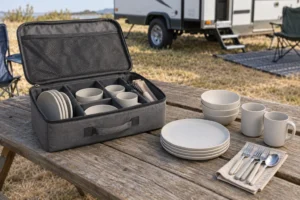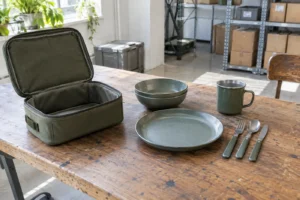
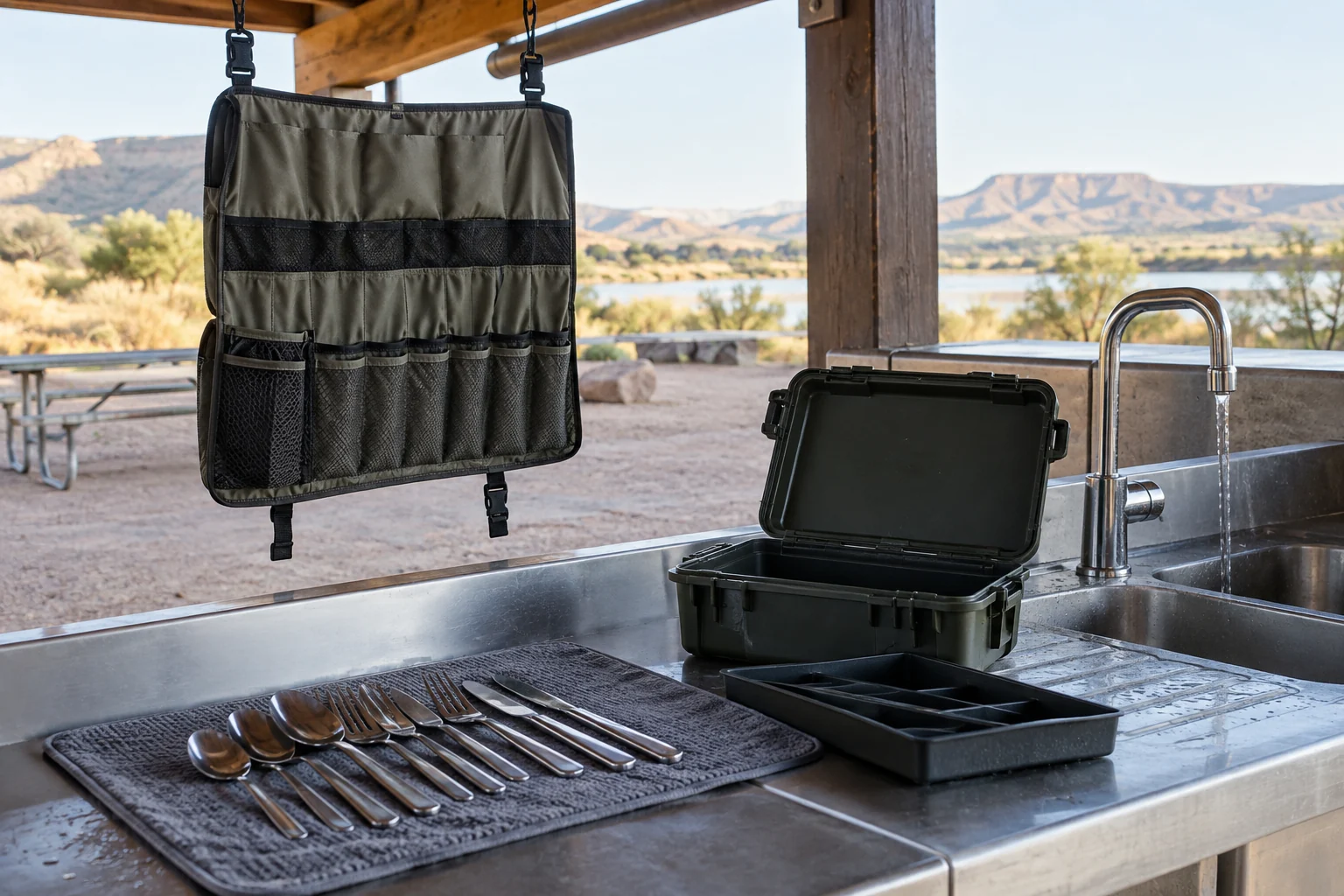
A cutlery roll works better when buyers prioritize low weight, flexible packing and quick visual access. A hard case works better when count control, crush protection and separation from damp or dirty gear matter more. The correct choice is not universal: approve it against the utensil matrix, cleaning workflow, pack envelope and the failure costs of your sales channel.
Start with the purchasing decision, not the accessory
The camping cutlery roll vs hard case decision looks minor beside plates, bowls and cups, yet it affects whether a finished set is complete, easy to repack and credible at retail inspection. Storage is an interface between loose utensils and the rest of the kit. If that interface is poorly defined, the buyer inherits rattling, missing pieces, trapped moisture, damaged finishes or a pack that no longer closes.
Procurement teams should therefore specify the storage system as a controlled subassembly. The approval record should identify the number and type of utensils, occupied envelope, closure, retention method, cleaning limits, expected user sequence and how the storage unit fits the outer bag or case. A photograph alone cannot prove those points.
This guide treats rolls and cases as formats, not as verified Naike Dinner capabilities for every material or construction shown. Materials, dimensions, compliance evidence, tooling feasibility and compatibility must be confirmed for the individual project. Dinnerware storage also does not establish that any component is suitable for a burner, stove or open flame.
Define the utensil matrix before comparing storage
A storage comparison is meaningful only after the buyer freezes a utensil matrix. Record the user count and the quantity of knives, forks, spoons, teaspoons, chopsticks, serving utensils and optional tools. Distinguish eating utensils from preparation tools because sharp or heavy tools may require separate retention and protection.
For example, a four-person set might require four forks, four spoons and four table knives, while another channel expects four sporks and no knives. Those are different storage problems even if both are described as a “12-piece camping cutlery set.” Count individual pieces, not marketing labels, and identify any utensil that must be isolated from food-contact surfaces.
Before final approval, reconcile the utensil matrix with the wider camping dinnerware component matrix. This prevents a common handoff error in which the cutlery drawing, packaging bill of materials and product-page configuration show different counts.
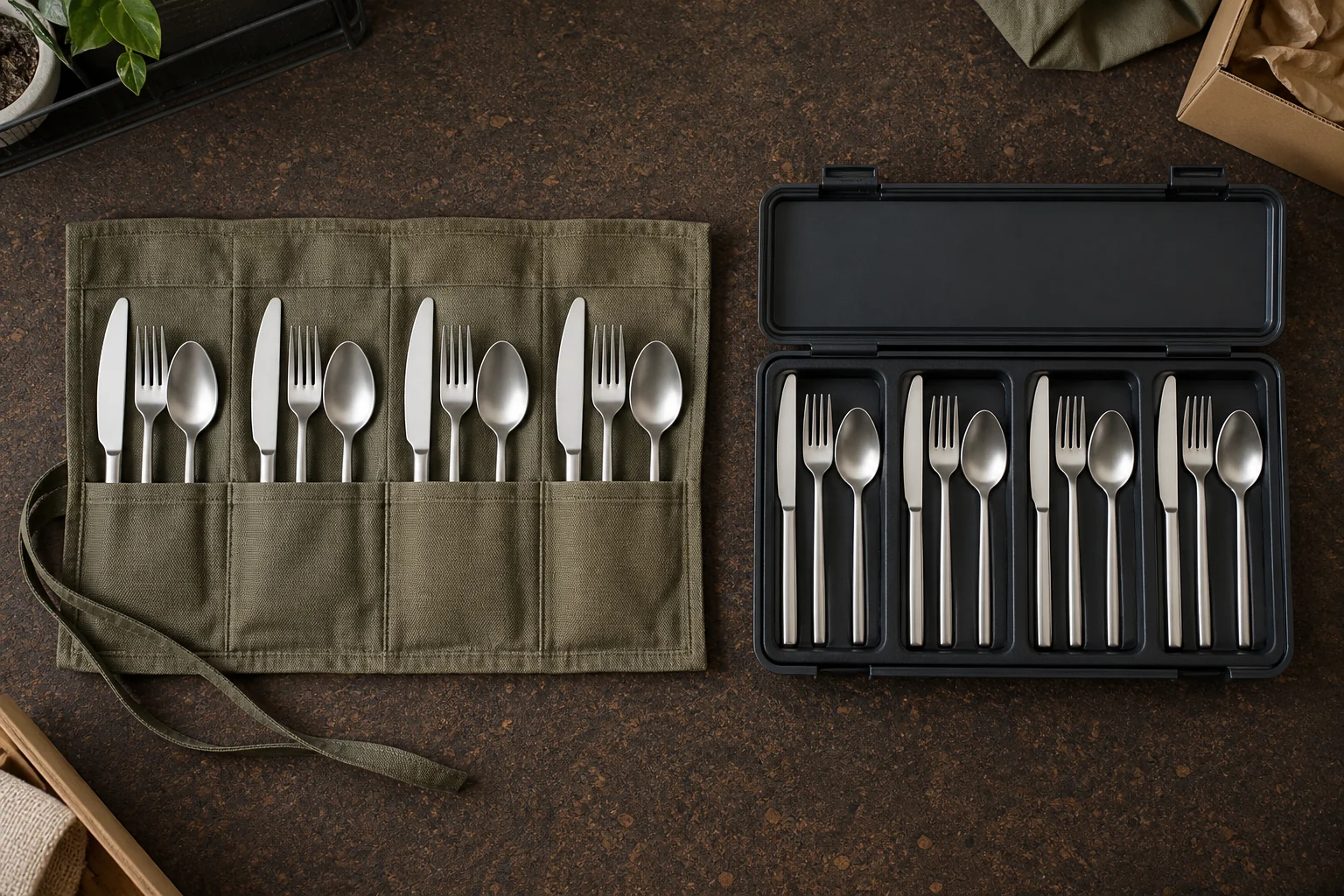
Camping cutlery roll vs hard case decision table
| Decision factor | Cutlery roll | Hard case | Buyer evidence to request |
|---|---|---|---|
| Pack shape | Conforms around nearby items and compresses when partly filled | Keeps a fixed outer envelope | Closed dimensions, loaded photos and pack-fit trial |
| Count visibility | Individual pockets can make omissions visible when fully opened | Molded or divided positions can make omissions obvious | Numbered component matrix and loaded sample |
| Crush protection | Limited; depends on fabric, padding and surrounding products | Generally stronger when shell and hinges are correctly designed | Project-specific compression and drop plan |
| Moisture behavior | Textile may absorb or retain water but can be opened broadly for drying | Non-porous shell may wipe clean, yet a closed case can trap moisture | Cleaning instructions, drainage concept and dry-close rule |
| Rattle control | Pockets and wrap tension can separate pieces | Requires fitted features, dividers or compliant retainers | Loaded handling and transport-rattle check |
| Weight sensitivity | Often suited to weight-sensitive configurations | Shell, hinge and latch add parts and mass | Verified unit weight from approved sample |
| Artwork area | Patch, woven label or print may be possible after material review | Shell surface may support molded, printed or applied branding | Artwork drawing and durability expectation |
| Replacement logic | May be treated as a soft accessory | May require matched shell parts or latch components | Spare-part and packaging policy |
The table is a screening tool, not a declaration that one construction always performs better. A poorly tensioned roll can lose utensils, and a weak hard case can open or crack. Buyers should translate each general tendency into a project test with an agreed sample, loading condition and acceptance record.
Count control: where each format succeeds or fails
A roll can provide excellent count control when each utensil has a clearly visible sleeve and the opening sequence exposes every position. Empty sleeves become obvious during packing. However, oversized pockets can conceal two stacked utensils, and a narrow roll may encourage users to return pieces to the wrong position.
A hard case can use shaped nests, channels or dividers to make the intended configuration legible. This is useful for rental, guided-tour, educational and institutional channels where staff must verify sets quickly. The limitation is that a fitted insert becomes less flexible when the buyer changes utensil geometry or adds another piece.
Ask the supplier to present the storage unit empty, correctly loaded and incorrectly loaded. Review whether a missing spoon can be seen without removing other components and whether the closure still engages if a utensil is misplaced. The answer should be demonstrated on a project sample rather than asserted in copy.
Pack efficiency is more than volume
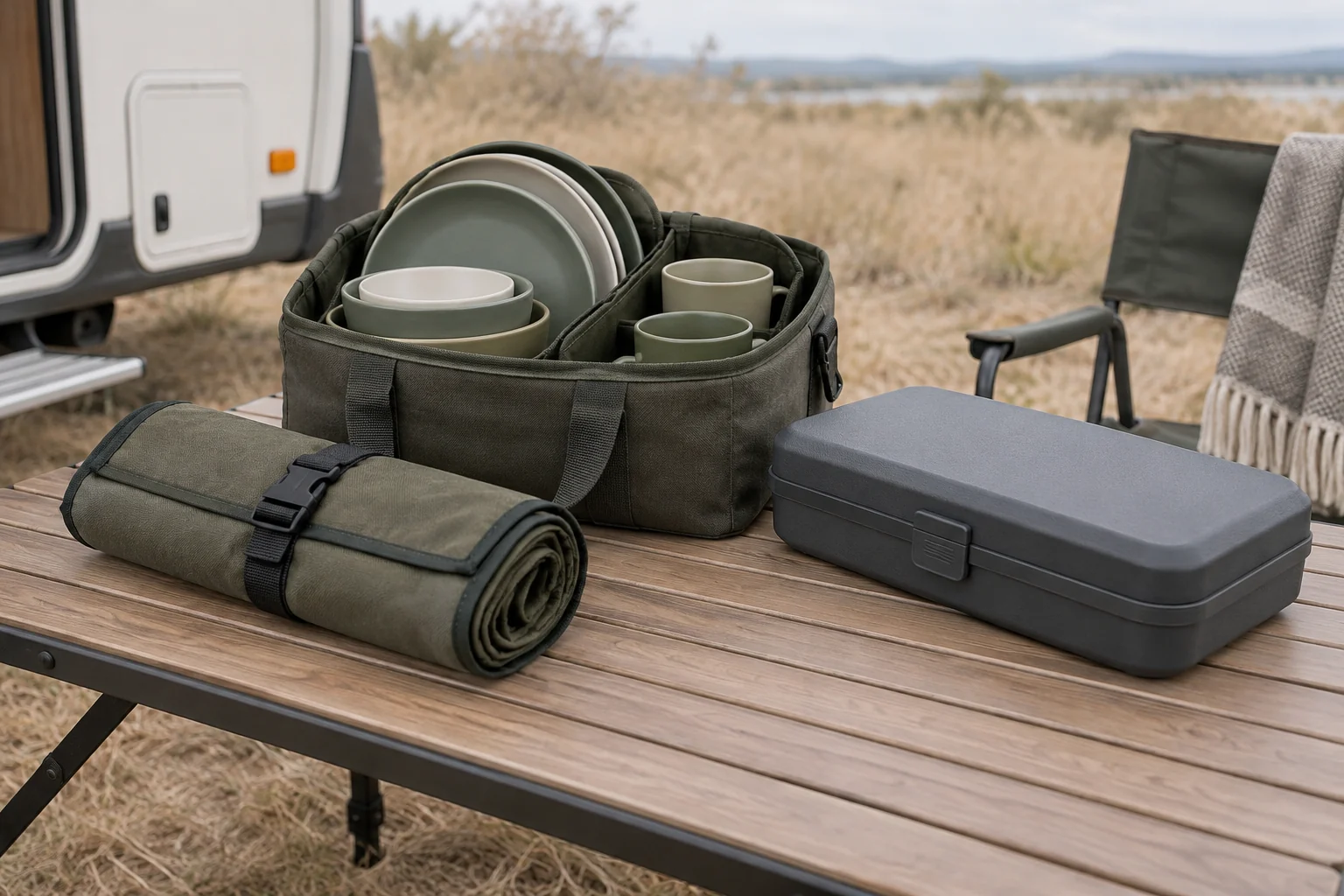
Flexible storage may occupy less theoretical volume, but it can create unpredictable thickness where handles overlap. Rigid storage consumes a fixed volume, yet its predictable geometry can simplify carton layouts and nesting studies. The relevant measure is the loaded system inside the real dinnerware set, not the storage item measured by itself.
Use the method in the camping tableware pack-volume guide to record maximum closed length, width and height. Then place the loaded roll or case in the intended pack position and note interferences with plate rims, bowl feet, cup handles, lunch-box latches and zipper paths. A few millimetres of interference can prevent repeatable closure even when the calculated volume appears acceptable.
Also record the extraction path. A compact hard case buried under nested bowls may be efficient in the carton but awkward at camp. A roll attached to an outer-panel loop may be easier to reach but could shift the balance of a carry bag. Procurement approval should consider packing, transport and use as one sequence.
Rattle, abrasion and finish protection
Metal utensils moving against one another can create noise and visible contact marks. A roll separates pieces naturally when each sleeve is correctly sized, while the wrapping layer can add restraint. If the roll is too loose, however, handles may slide and heads may contact each other at the open end.
A rigid case controls the outer shape but does not automatically prevent internal movement. The design may need ribs, channels, a compliant pad or individual retainers, all of which must be compatible with cleaning and the utensil finish. Buyers comparing formats should use the dinnerware rattle-control checklist and listen for movement in the complete packed set.
Do not accept a silent hand-carried sample as proof of transport performance. Define the packed orientation, closure condition and representative handling sequence. Inspect both the utensil contact points and the storage interior after the agreed trial, documenting scratches, displaced pieces and closure changes.
Cleaning and moisture management
Neither format should be closed around wet or food-soiled utensils. Textile rolls may retain water in seams, binding and layered pockets. Hard cases may appear dry on the outside while trapping moisture in corners, under inserts or around hinge features.
The FDA Food Code is a model code rather than a product approval certificate, but its emphasis on cleaning and contamination control helps buyers frame operating instructions. For European projects, food-contact compliance responsibilities should be reviewed against the European Commission food-contact materials legislation overview. Australian buyers can consult Food Standards Australia New Zealand guidance on food packaging when scoping materials and evidence.
These sources do not certify a storage roll or case. The buyer still needs product-specific material declarations, intended-use statements and any agreed testing. Storage components that do not directly contact food can nevertheless transfer dirt or moisture to utensils, so the cleaning workflow should cover the complete system.
Closure and retention are system-critical details
A roll may use ties, webbing straps, buckles, hook-and-loop material or a zippered outer layer. A hard case may use snap fits, sliding locks, hinges or separate fasteners. Each option changes the number of components, the cleaning surface, user force and the consequences of partial closure.
Ask whether the storage unit gives clear tactile or visual confirmation that it is closed. Then test it with the maximum approved utensil count and with one deliberately misplaced utensil. A closure that appears engaged but releases during handling is more serious than one that visibly refuses to close.
For child-oriented or family products, assess pinch points, detachable small parts and sharp utensil access through the project’s safety review. Do not infer suitability from rounded colours or lifestyle photography. The intended age group, supervision statement and applicable market requirements must be written into the specification.
Channel scenarios that change the answer
Outdoor retail and branded kits
A roll can communicate compactness and lets a shopper see the utensil assortment when opened. A hard case can present a more defined product silhouette and may protect decorative surfaces in distribution. Retail buyers should also consider shelf display, hangtag or sleeve requirements and whether the storage unit supports honest on-pack count claims.
Rental, tour and institutional programs
Fast inventory checks and repeatable repacking may favor a clearly divided hard case or a roll with one pocket per item. The better format is the one staff can audit accurately under real turnaround conditions. Request a timed repacking trial, cleaning instructions and a method for identifying missing pieces.
Vehicle camping and family picnics
Weight may be less important than organized access, yet the storage unit must share space with lunch boxes and dinnerware. A fixed case can stack predictably in a vehicle bin, while a roll may fit narrow side spaces. The buyer should evaluate access when the set is fully loaded rather than arranged for a photograph.
Backpacking and compact individual sets
A textile sleeve or minimalist roll may be appropriate when every gram and cubic centimetre matters. A bulky case may be difficult to justify unless it protects a specific utensil or performs another verified function. Keep cookware and dinnerware claims separate: storage near a cooking kit does not prove heat or flame suitability.
Limitations and commercial risks
Material names alone do not predict service life. Fabric density, coating, thread, seam construction, shell thickness, hinge geometry, latch design and actual loading all affect performance. Without controlled samples and drawings, claims such as durable, waterproof, odor-resistant or dishwasher-safe should not be approved.
Customization can also create hidden compatibility problems. A thicker logo patch may impede rolling; a new utensil handle may no longer fit a molded channel; a colour coating may increase abrasion sensitivity; and added packaging can change the final pack envelope. Every change should trigger an affected-feature review rather than relying on the previous sample approval.
Finally, avoid turning the storage unit into an unsupported sustainability claim. Reusability depends on actual durability, cleaning and continued use, while recyclability depends on material combinations and local systems. Request scoped evidence and use precise language appropriate to the target market.
Build a sample approval record
The approval record should include a dated component matrix, storage drawing, loaded and empty photographs, confirmed materials, artwork version and outer-pack position. Record who checked the count and which sample was used. If the approved sample changes, create a revision rather than overwriting the earlier record.
Run a dry pack-fit check first, followed by the agreed handling, cleaning and drying sequence. Inspect closures, sleeves, channels, utensil finishes and neighboring dinnerware. Record observations rather than converting a limited trial into a universal performance claim.
When comparing quotations, normalize what each offer includes. A lower quoted storage price may exclude a fitted insert, label, inner protection or assembly labor, while a higher price may include features the buyer did not request. Require suppliers to state exclusions and assumptions in writing.
Run a practical line-side packing trial
A storage format can work in a design review and still create assembly problems. Reproduce the planned packing station with the approved utensils, roll or case, dinnerware, outer carrier and packaging. Ask an operator who has not seen the concept to follow the draft work instruction, then record every hesitation, rework step and opportunity to miss a component.
For a roll, watch whether utensils are inserted in a consistent direction, whether adjacent pockets are easy to distinguish and whether the closure tension depends on operator judgment. For a hard case, watch whether shaped positions accept a reversed utensil, whether an insert lifts during loading and whether the latch can close over a misplaced handle. These observations help procurement distinguish a drawing-complete design from a production-ready sequence.
Count time should be measured separately from wrapping or closing time. A faster closure is not useful if the operator must remove every piece to verify quantity. Conversely, highly visible pockets may take longer to load but reduce the risk of shipping an incomplete set. Buyers should decide which failure cost matters most for the channel.
Separate verification, validation and ongoing inspection
Verification asks whether the supplied storage unit matches the approved drawing and component matrix. Validation asks whether the complete set works for the intended users and environment. Ongoing inspection checks whether later production continues to match the approved standard. Combining these activities into one vague “quality check” makes responsibility difficult to audit.
Dimensional inspection may verify the closed envelope, pocket positions or case features, but it does not validate ease of drying or count visibility. A user trial may reveal an awkward closure, but it does not replace material identification or food-contact evidence. Build an evidence map that assigns each requirement to the appropriate document, measurement, sample observation or market review.
For ongoing inspection, define a small set of observable characteristics: correct utensil count, correct pocket or cavity assignment, secure closure, no visible damage, approved artwork and clean packaging. More complex performance checks can be scheduled according to project risk. The frequency and acceptance criteria should be agreed rather than invented after a problem occurs.
Compare quotations on an equivalent basis
Ask every potential supplier to quote against the same revision of the component matrix and storage specification. The response should distinguish storage material, closures, labels, inserts, assembly, individual protection and outer packaging. It should also identify assumptions that are not included in the quoted scope, without relying on a generic product photograph.
A roll quotation may vary because of fabric width, pocket construction, binding, printing and hardware. A case quotation may vary because of shell process, hinge and latch architecture, inserts, surface treatment and tooling. Procurement teams should not request or compare unsupported prices before those scope variables are defined.
Use a deviation column in the quotation comparison. If one offer proposes a shared compartment instead of individual retention, or a different closure than the brief, record the change and its effect on tests, packing and claims. The lowest number is not comparable when the delivered system solves a different problem.
Control changes after the golden sample
The approved or “golden” sample should be linked to a drawing revision, artwork file, material description and loaded configuration. Store photographs of the empty and loaded system, including closure and contact points. A sample without this documentary link is difficult to use when a later shipment or redesign must be investigated.
Changes to utensil handle thickness, decorative coating, roll lining, pocket width, case insert or latch can affect fit even when the external appearance looks similar. Require a written change notice that identifies affected requirements and repeat checks. Do not allow a new colour or marketing refresh to bypass pack-fit and contact review.
If the buyer wants one storage unit to support multiple assortments, approve each assortment explicitly. A configuration that closes with twelve slim utensils may fail with eight pieces that have wider handles. Compatibility is a relationship between specified components, not a permanent property of the container.
B2B Buyer Checklist
| Check | Question | Why It Matters |
|---|---|---|
| Utensil matrix | Are every utensil type and quantity frozen by user count? | Prevents count and packaging conflicts. |
| Loaded envelope | What are the maximum closed dimensions with the approved contents? | Controls fit in the dinnerware carrier and carton. |
| Retention | Can missing or misplaced pieces be detected before closure? | Reduces incomplete-set and field-loss risk. |
| Moisture | How are seams, recesses and inserts opened for drying? | Prevents damp storage and contamination pathways. |
| Surface contact | Which utensil and dinnerware surfaces can rub in transit? | Identifies noise and finish-damage risks. |
| Change control | Which checks repeat after an artwork, utensil or material revision? | Keeps approvals valid after customization. |
| Evidence | Which declarations, instructions and test reports are required for the target market? | Separates verified evidence from marketing language. |
Sequential buyer FAQs
1. Is a cutlery roll always lighter than a hard case?
No. A simple textile roll often uses less material than a rigid case, but padding, hardware and layered construction can change the result. Compare verified weights from loaded project samples, not assumptions based on format names.
2. Which format makes missing utensils easier to see?
Either can work. One pocket or shaped position per item makes omissions visible, whereas shared compartments can hide them. Approve the count-check method with the actual utensil matrix.
3. Can a hard case be closed around wet cutlery?
It should not be treated as a solution for wet storage. Even a wipeable shell can trap moisture around recesses and hinges. Define a clean-and-dry-before-closing instruction for the complete system.
4. Does a roll prevent rattling?
Only if pocket dimensions, separation and wrap tension control movement. Test the loaded roll inside the final set because neighboring plates or lunch boxes can create additional contact noise.
5. Can one storage design support several utensil configurations?
A flexible roll may tolerate variations, while a fitted case may require revised inserts or channels. Compatibility to be confirmed by project sample and drawing.
6. What should be supplied for a quotation?
Provide user count, utensil matrix and drawings, target storage envelope, preferred format, cleaning method, branding, packaging, target markets, evidence needs and expected approval tests. This gives suppliers a common basis for a written comparison.
Request a storage-system sample review
Send Naike Dinner your utensil matrix, target pack envelope, channel, cleaning workflow, artwork and market requirements. We can use those inputs to discuss a project-specific component and storage review without inventing dimensions, certifications, MOQ, price or lead time. Request a cutlery storage specification review, then use the returned sample and drawing to validate every compatibility claim.
If you are still deciding between formats, include both alternatives in one brief and identify the commercial risk you want to reduce: missing pieces, pack volume, surface damage, cleaning time or display presentation. Ask for a written comparison and sample plan tied to those buyer priorities.