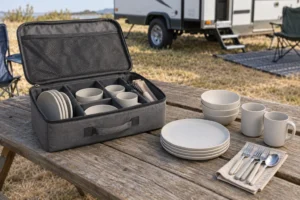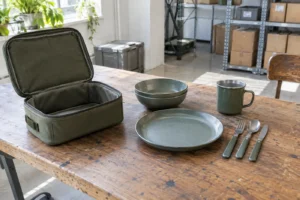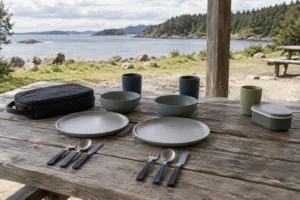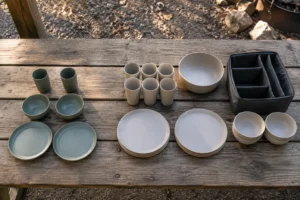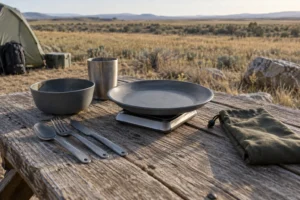
Build the core around components every intended user needs for the defined meal, then move occasion-specific pieces into separately identified options. A camping dinnerware core set should make the standard place setting, user count and pack-out unambiguous; it should not absorb a lunch box, serving bowl or extra cup just because these can fit in the case. Approve each addition against a documented buyer scenario and its incremental burden.
The deliverable here is a base-versus-option assortment worksheet. It is a decision tool for product and merchandising teams, not a claim that any illustrated combination is a tested or available Naike Dinner SKU. Enter your own user research, samples, costs and channel rules before turning the worksheet into a listing.
Define the meal and the user before counting pieces
Start with one sentence that can be observed in use: for example, “two adults eat a prepared cold lunch at a serviced campsite and carry the set back in one case.” That sentence says more about the useful core than a target piece count. It specifies users, eating occasion and pack-out, while leaving unanswered claims such as heat resistance or leakproof transport out of scope.
Write down the meals the base set must support, how many people eat at the same time, and what the buyer already owns. A plate may be essential for one meal pattern and redundant for a bowl-only travel range. One cup per user may be expected by a retail buyer, while a rental operator may issue drinkware separately for hygiene or replenishment reasons. Do not universalize any of these choices.
The published component-list guide gives a broad inventory of possible dining pieces. The two-person versus six-person comparison explains why shared pieces do not simply multiply with user count. Here the question is narrower: which pieces are compulsory in one clearly defined base listing, and which need their own optional purchase path?
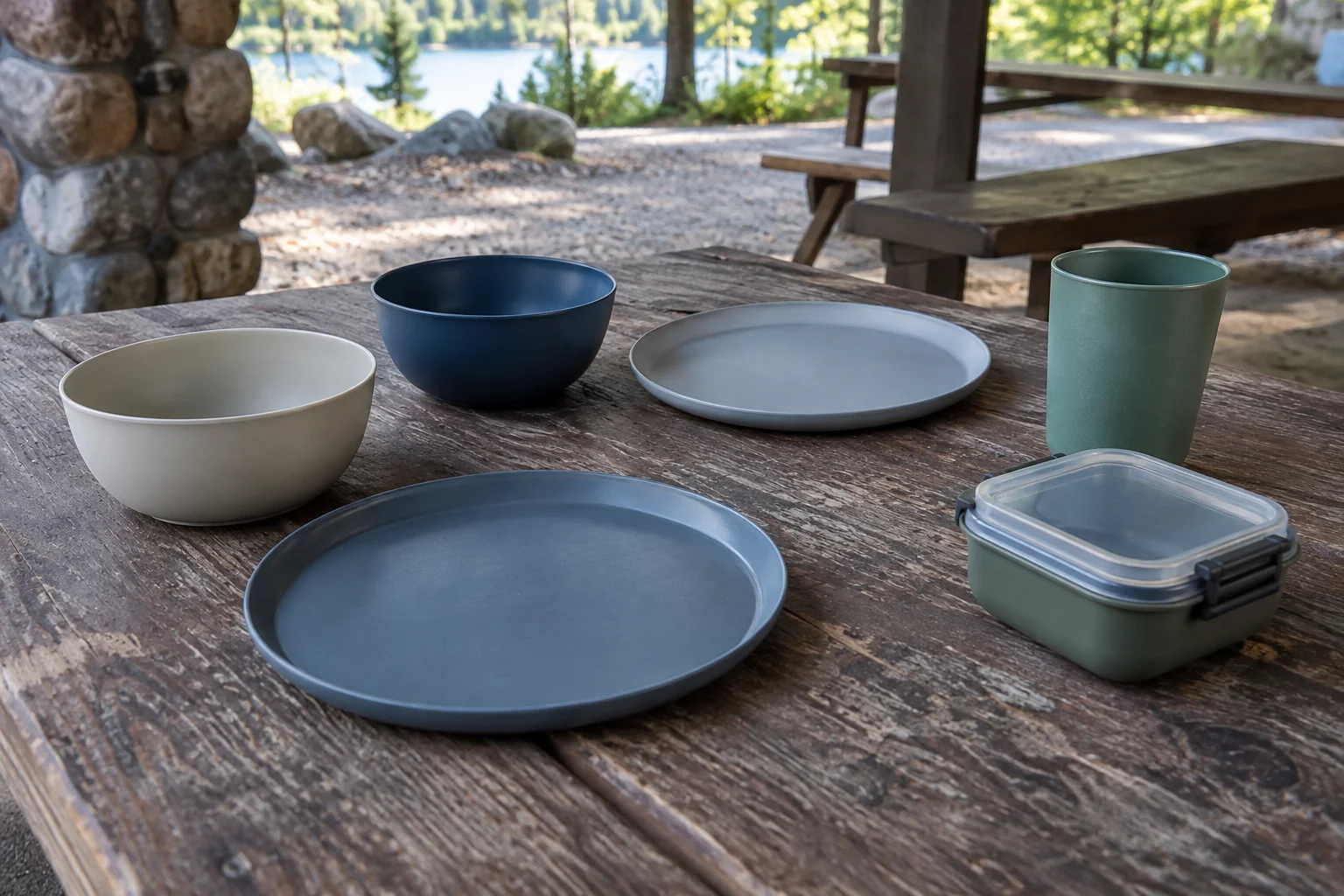
Copy the base-versus-option assortment worksheet
Use one row per component and one column per selling format. Mark a piece “base” only when omitting it would break the defined meal or promised contents for most buyers of that exact listing. If a piece serves a different meal, user count, channel or replacement event, give it a separate option or spare-part decision. “It fits” and “it increases the piece count” are not inclusion criteria.
| Component or decision | Base-set test | When to offer separately | Buyer evidence to record | Worksheet entry |
|---|---|---|---|---|
| Plate per diner | Required by the stated meal and user count? | Bowl-only meal range or alternative plate shape | Meal map, sample handling and exact count | Base / option / exclude; quantity |
| Bowl per diner | Needed alongside the plate, or only for a different menu? | Soup or breakfast extension not in the base promise | Meal map, stack envelope and cleaning review | Base / option / exclude; quantity |
| Cup per diner | Included by the channel’s standard place setting? | Drinkware sold separately or a different handle/lid format | Use-condition brief and packed-position sample | Base / option / exclude; quantity |
| Knife, fork and spoon | Which eating functions are needed for the meal? | Specialized utensil or individually replaceable spare | Utensil-function matrix and count check | Base functions; spare pathway |
| Lunch container | Is transport of prepared food part of the core promise? | Only some channels need divided food storage | Closure, cleaning, packed-contact and food-use review | Separate module or explicit base inclusion |
| Serving bowl or shared piece | Does the defined group meal require it? | Family, picnic or catering extension | Group meal plan and nonduplicated function | Shared option; quantity by occasion |
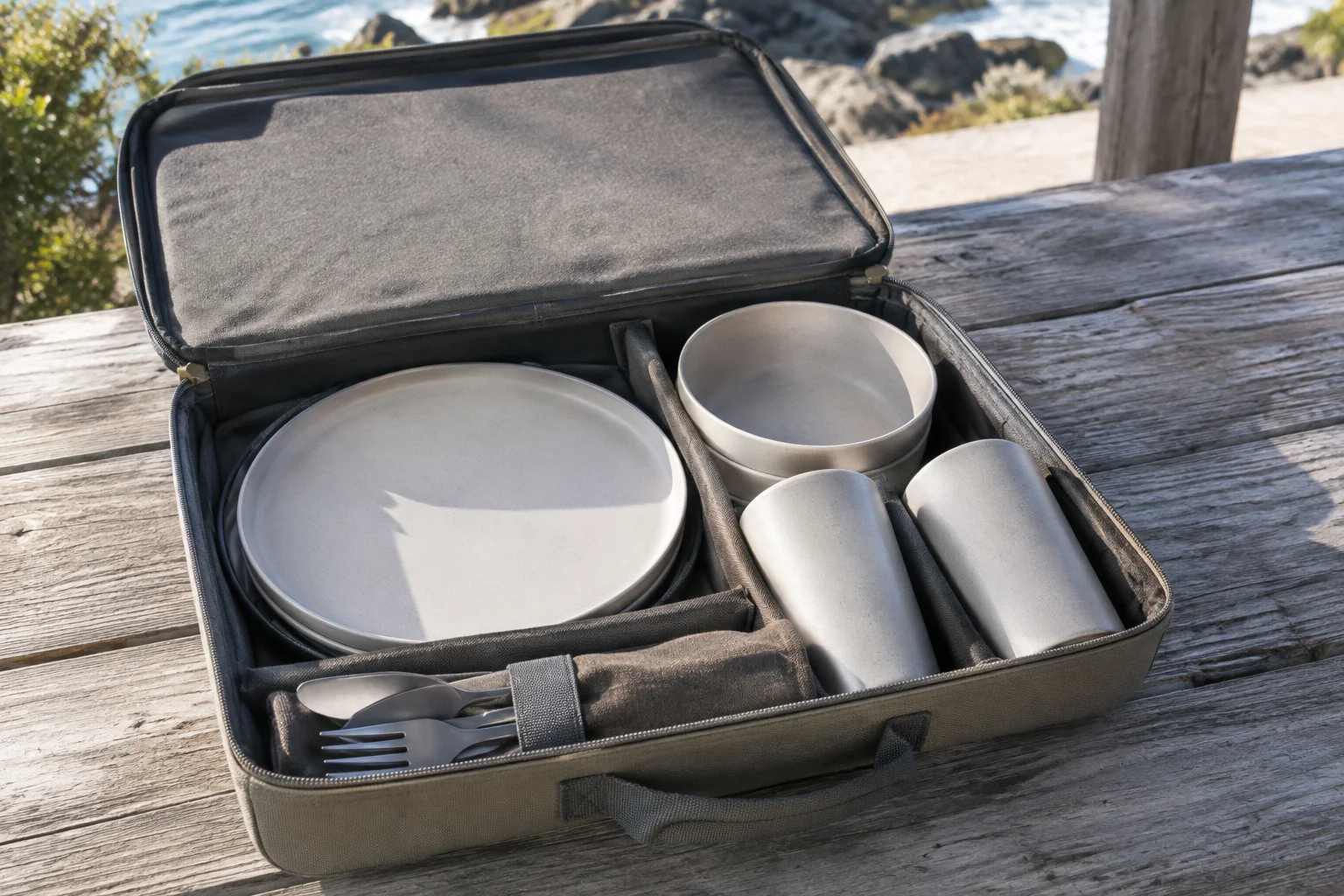
| Carry case | Does the promise include organized portable storage? | Case-free refill or replacement format | Loaded-case drawing and pack-out observation | Base case / separate case / no case |
| Listing and pack identity | Does every shipped base unit have the same contents? | Optional bundle or replacement SKU | BOM, artwork, identifier and carton check | One controlled composition per identifier |
Leave the last column blank until the team has sample and channel evidence. A useful worksheet also records the owner, revision, open question and approval date for each row. It is acceptable to retain an “unresolved” decision; it is not acceptable to turn an unresolved option into a finished specification or to imply that a proposed kit is already validated.
The result is a deliberately smaller promise, not necessarily a cheaper product. Buyers should compare all-in value for their own channel, including case packing, labeling, assembly, handling, returns and replacement demand. Without those buyer-entered inputs, claims that removing a piece reduces total cost or improves conversion are speculative.
Use scenarios to separate the core from a genuine option
Two-person campsite meal
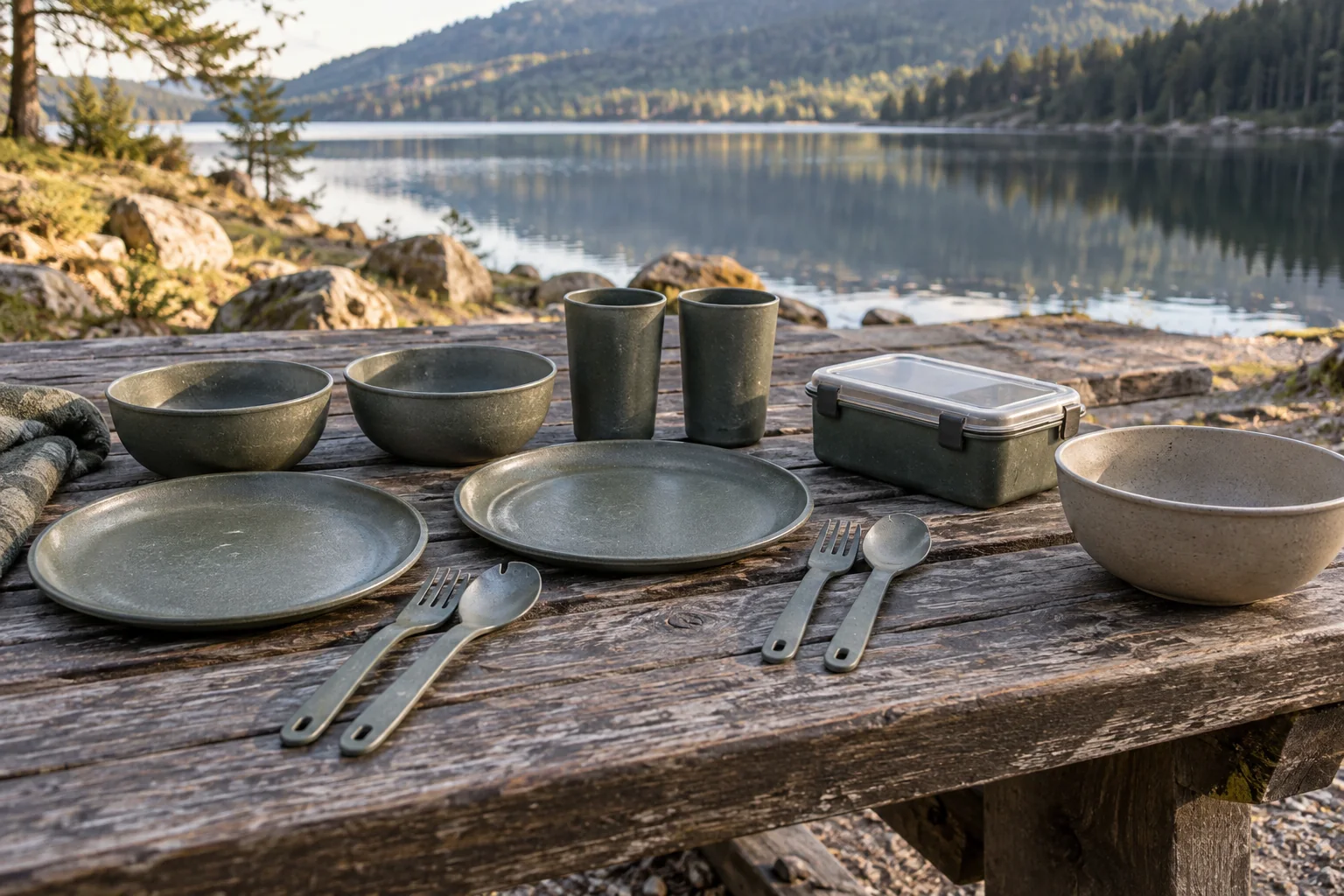
Suppose the defined use is a two-person seated lunch at a serviced campsite. A buyer might test two plates, two bowls, two cups and two utensil sets as a candidate core, then keep a divided lunch container separate because some customers prepare food on-site. This is an illustrative worksheet choice, not a verified Naike product configuration. The team must still decide whether both plate and bowl are genuinely needed for the menu, whether utensils are sold with the base, and whether the case has a credible packed arrangement.
Ask a small group of intended users to pack and unpack the candidate set using only the proposed contents and instructions. Record which pieces are used, left untouched, substituted with owned gear or missed. Treat one observation as a question generator rather than a market-wide demand estimate. If a piece repeatedly sits unused for this precise occasion, test it as an option; do not silently delete it from a listing already promised to buyers.
Retail shelf assortment
A retail brand may want a clear entry set and a visible upgrade bundle. Keep the base listing stable, then define any larger assortment as a separate fixed composition with its own bill of materials, artwork and channel identifier. GS1’s GTIN Management Standard addresses changes to predefined assortments; replacing or adding a trade item in a fixed bundle can require a new GTIN. The buyer should apply the standard to the exact trade item and market rather than assume an optional component can be slipped into an existing package.
Display the optional item as a genuine separate selection, not as a vague “may include” statement in the base description. A purchaser should know the precise component count and whether the add-on ships in the same outer pack. If an option changes case fit, weight, artwork or shelf dimensions, review those consequences before merchandising it as a simple upgrade.
Rental and replacement program
A rental operator may regard individually replaceable cups and utensils as more important than a broad retail bundle. The base issued set can remain compact, while spares have their own count, storage and replenishment rules. This decision is driven by the operator’s observed loss and cleaning workflow, not by an assumed universal piece count. The earlier modular-interface guide explains how to control physical and commercial compatibility if several formats share a component family.
Separate a spare from an option in the worksheet. A spare restores the stated contents after damage or loss; an option adds a distinct function or occasion. Confusing the two causes poor demand forecasts and can let a replacement part drift away from the base product’s revision and food-contact evidence.
Keep food-use claims tied to the pieces actually sold
A lean base does not remove the need to review every included food-contact article. The EU Framework Regulation (EC) No 1935/2004 establishes general rules for food-contact materials and articles, including traceability. For US distribution, the FDA explains that regulatory status depends on the substances and authorized uses of the relevant food-contact material. Evidence for one plate cannot be copied automatically to a separately sold container or decorated cup.
Record the intended food, temperature, duration and cleaning conditions for each final component. The FDA’s food-type and conditions-of-use guidance helps frame the US review, but it is not a substitute for a finished-item evidence file. “Camping” does not mean stove, burner, campfire, microwave, dishwasher or leakproof suitability. Dinnerware and carry components must not be described as cookware without product-specific proof.
The option strategy can complicate claims. If the base has one material and an add-on has a different lid, pigment, adhesive or finish, do not use one blanket dishwasher or food-contact sentence for the combined marketing image. Match each statement to the final material, design revision and intended use. Confirm any supplier capability, sample availability or customization route with current company records before making it a commercial promise.
Check the cost of choice at the packing station
Every option introduces a possible picking and packing error. Prepare a base bill of materials with one exact count per component, then a distinct option BOM with its own identifier and pack location. A packer should not need to infer whether the lunch container was ordered by reading a lifestyle image. The customer-facing product title, quotation, order line, pick list, carton label and delivered contents must agree.
Run a blind pack-out trial with someone who did not design the set. Give the person only the release-stage work instruction and a mixed pool of base and option pieces. Observe missing items, unclear visual distinctions, awkward case positions and places where the optional piece contacts food surfaces or prevents closure. Record the issues; no illustrative photo can replace that trial.
The nesting and stacking comparison is relevant when an option changes the pack envelope. A serving bowl that fits loosely on a table may not fit within a case intended for individual place settings. Weight and packed size are also buyer-specific; use the component weight-budget method rather than asserting that a slimmer base automatically becomes lightweight.
When a larger fixed bundle is the better decision
Do not force an option model onto a channel that needs one predictable kit. A school field program, a rental fleet or a gift pack may prefer a complete, fixed issue list and one replenishment path. If nearly every buyer adds the same piece, splitting it out can make checkout, labeling and receiving more difficult without improving relevance. The test is the actual order pattern and service workflow, not a blanket rule that “fewer pieces are better.”
Conversely, an overfull base can obscure what the buyer is paying for and create unused inventory. Watch for items added only to reach a round piece count or to match a competitor’s headline. A 20-piece label is not a meal plan. Review the output by function: individual eating, drink service, shared serving, transport, storage and replacement. If a component has no named function in the target scenario, challenge its inclusion.
Do not assume existing parts form a safe new set. Compatibility to be confirmed by project sample and drawing. If combining products changes contact points, cleaning access or evidence scope, resolve those issues before launch. The worksheet is therefore a gate to sampling and approval, not an authorization to publish a new finished product claim.
B2B Buyer Checklist
| Check | Question | Why It Matters |
|---|---|---|
| Meal promise | What exact meal and user count does the base serve? | Prevents decorative or unused pieces from becoming compulsory. |
| Component function | What job does each plate, bowl, cup, utensil and shared piece perform? | Exposes duplication and missing eating functions. |
| Option trigger | Which channel or occasion justifies each optional item? | Creates a defensible add-on rather than an arbitrary extra. |
| Pack-out | Have base and option combinations been loaded and closed as physical samples? | Prevents unverified fit and transport assumptions. |
| Food-use scope | Is finished-component evidence matched to material, finish and use conditions? | Avoids carrying claims from one item to another. |
| Identity | Do the BOM, listing, identifier, artwork and carton state identical contents? | Controls fixed assortments and fulfillment errors. |
| Spare versus option | Is this an added function or a replacement for a lost part? | Keeps forecasts and revisions intelligible. |
| Commercial model | Are cost, returns, assembly and demand inputs real rather than assumed? | Prevents unsupported savings claims. |
Procurement FAQs
Is there a standard number of pieces in a camping dinnerware core set?
No universal number answers this procurement question. State the users, meals and included functions first, then count the pieces required by that promise. A headline count can include utensils, lids, case or serving parts in different ways, so compare itemized contents rather than totals alone.
Should a lunch box always be optional?
No. If transporting prepared food is central to the listing, it may belong in the base. If only a subset of customers need it, a separate option is usually clearer. Either route requires a specific component drawing, food-use scope, case-fit check and unambiguous BOM.
Can one case serve the base and upgraded versions?
Only after reviewing both loaded arrangements with project samples and drawings. The optional piece may change clearance, retention, closure or packed-contact risks. A case that holds the base cannot be assumed to hold the upgrade safely.
Does removing an unused piece automatically reduce the price?
No. The result depends on component cost, case design, packaging, picking labor, order quantity and channel economics. Request a line-item quotation for the controlled base and for each option, then compare the total delivered and service costs using buyer-supplied inputs.
Can the same compliance statement cover the base and every add-on?
Not without matching evidence for each final food-contact article and its actual use. A new lid, finish or material can alter the review scope. Keep the claims and supporting documents tied to the exact revision and intended market.
When should an option become a new fixed bundle?
When the channel requires a stable published composition or order evidence shows a repeatable combination. Give the bundle its own controlled BOM, pack instruction, artwork and appropriate trade-item identification. Do not change a fixed bundle silently while retaining an inaccurate listing.
Approve a small base with an explicit option path
Before requesting a sample or written quotation, send the intended meal, user count, target markets, base-versus-option worksheet, component sketches, proposed case envelope, permitted use conditions and required artwork/pack format. Ask the supplier to identify which points are verified existing capability, which need a drawing or sample, and which are still open. Request a component and assortment review with those documents rather than asking for a generic “camping set.”
The release decision should be a signed, revision-controlled composition: exact base contents, exact optional contents, separate spare rules, evidence scope and pack-out method. If any row remains unresolved, keep the claim open. For a written quotation or sample brief, contact Naike Dinner with the completed worksheet; availability, tooling route, material, dimensions, quantities, pricing and timing must be confirmed for the project.