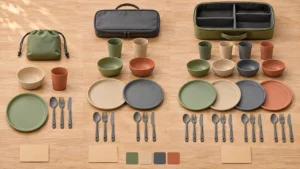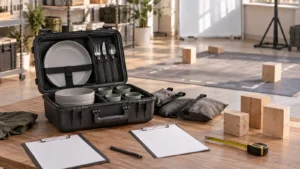
Direct answer: A useful camping set cost breakdown separates four quote buckets: food-contact components, carry case, decoration, and packaging. Record quantity, included operations, approval evidence, and commercial basis for each bucket. Do not divide one total price by piece count until both suppliers confirm the same BOM, decoration coverage, pack-out and Incoterm.
A low total can hide a missing carry case, one-color artwork on only one part, or a plain bulk carton where the buyer expected a retail box. This worksheet is designed for buyers to enter supplier values; it does not state Naike prices, MOQ, lead time, capacity or material performance.
Decision path
- Freeze the comparison unit.
- Assign every quoted item to one cost bucket.
- Expose scope and evidence gaps.
- Reconcile packaging and commercial terms.
- Release only a comparable quotation.
1. Freeze the comparison unit before requesting prices
Treat the camping set cost breakdown as a comparison control: it is useful only when every supplier is pricing the same revision, quantity basis and commercial boundary.
Start with one named configuration and one saleable unit. A “four-person set” is not precise enough. The line should identify the count of plates, bowls, cups, forks, spoons and knives; whether a lunch container is included; the carry-case construction; and the packaging level. If one supplier quotes 24 loose pieces and another quotes a packed retail unit, their totals answer different questions.
Use the same project brief across suppliers. The custom camping dinnerware brief helps define the buyer inputs, while the BOM revision control guide keeps the cost request tied to the approved component list.
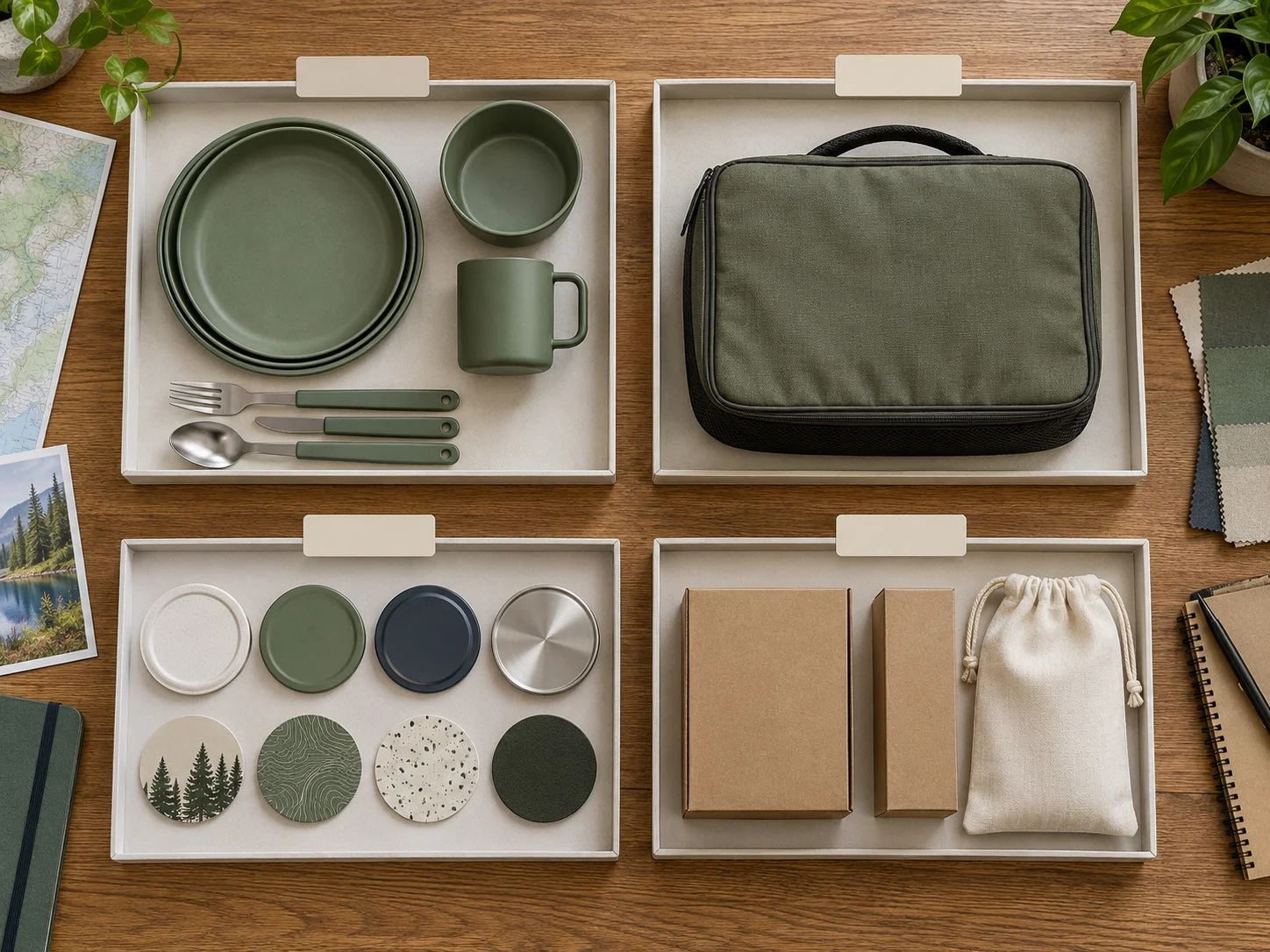
2. Copy this four-bucket camping set cost breakdown
Enter the supplier’s currency and price basis exactly as quoted. “Open” means the supplier has not supplied enough information; it does not mean zero cost.
| Cost bucket | Buyer-defined line items | Supplier value | Scope evidence to request | Approval owner |
|---|---|---|---|---|
| A. Components | Each plate, bowl, cup, utensil, container, lid or divider by quantity and revision | Currency, unit basis and extension entered by buyer | BOM/drawing revision, material declaration scope, finish/color reference | Product + quality |
| B. Carry case | Shell, lining, tray, loops, zipper, handle, label and assembly | Separate line or confirmed inclusion | Case drawing, loaded-fit sample, component-retention acceptance | Product + packaging |
| C. Decoration | Artwork by component, color count, process, position, setup and approval sample | Per position/process plus any setup basis | Artwork release, color target, decorated-sample approval, evidence boundary | Brand + compliance |
| D. Packaging | Protective wrap, insert, retail box or mailer, instructions, labels and master carton | Per saleable unit and per shipment pack | Dieline, pack-out instruction, carton configuration, shipping marks | Packaging + logistics |
| Commercial basis | Incoterm, named place, currency, tax/duty boundary, validity and payment assumptions | Recorded outside product subtotal | Quotation header and revision/date | Purchasing + finance |
3. What belongs in the component bucket?
In the camping set cost breakdown, this bucket should follow the approved BOM rather than a loose count of visible pieces.
List physical food-contact parts separately even when the supplier presents one set price. The purpose is not to force cost disclosure the supplier cannot provide. It is to identify what the total includes, what may change when the BOM changes, and which parts need evidence. A replacement spoon, revised lid or different cup should not silently change the comparison basis.
For a new mold or modified geometry, record tooling or development evaluation outside recurring unit cost until ownership, cavity plan, approval stages and amortization treatment are agreed. The existing-component versus new-mold matrix helps define that boundary.
4. Keep the carry case separate from the dinnerware
A case is a product system, not a free accessory. Ask whether the quote includes the outer shell, lining, molded or sewn retention, zipper, handle, labels, assembly and loaded inspection. A rigid tray and an elastic-loop organizer may hold the same components but create different development and pack-out work. Compatibility to be confirmed by project sample and drawing.
If the case is buyer-supplied or quoted by another vendor, mark it as buyer-supplied and still record the fit interface, delivery point and responsibility for final pack-out. Zero in the supplier’s column is valid only when the exclusion is explicit.
5. Decoration cost follows positions, processes and approvals

Separate decoration by substrate and location: plate, cup, utensil handle, case patch, insert and retail pack may use different processes and approval evidence. Record artwork size, color target, position, print or marking process, setup assumption, sample approval and permitted claims. Do not assume a test report for an undecorated component covers a final decorated version.
6. Packaging has several levels
The camping set cost breakdown should keep retail presentation, protective inserts, shipping carton and labeling scope visible instead of hiding them inside one packaging line.

Separate primary protection, retail presentation, channel shipping and transport packaging. A plain carry case inside a master carton is not equivalent to a shelf box with insert and instructions, and neither is automatically equivalent to an e-commerce mailer. Record the approved pack-out, carton quantity and measurement basis before using freight calculations.
The retail box versus mailer matrix supports channel selection, while the pack-volume worksheet helps reconcile dimensions after a physical pack is approved.
7. Reconcile commercial terms outside the product subtotal
Record the Incoterm rule and named place precisely. The ICC Incoterms rules define delivery, cost and risk responsibilities; they do not define the product BOM. Classification also affects landed-cost work, so use the World Customs Organization Harmonized System overview and the destination authority rather than copying a supplier code without review. The WTO customs valuation overview explains the international valuation framework. These sources do not replace destination-specific advice.
8. Cost-scope approval record
| Release question | Pass condition | Owner / record |
|---|---|---|
| Is the BOM identical across quotes? | Same revision, quantities and optional parts | Product / BOM comparison |
| Is the case scope explicit? | Construction and retention included or excluded by line | Packaging / case drawing |
| Is decoration defined by position? | Process, color, size, substrate and approval route recorded | Brand + compliance / artwork release |
| Is packaging channel-specific? | Protection, retail/mail-order pack and master carton separated | Packaging / pack-out sheet |
| Are commercial terms comparable? | Currency, Incoterm, named place, validity and exclusions aligned | Purchasing / quotation log |
| Are open items visible? | No blank cell is interpreted as included or free | Project owner / open-issue log |
Buyer checklist
Use this checklist to approve the camping set cost breakdown before two supplier quotations are compared.
| Send to supplier | Ask supplier to return | Approve internally |
|---|---|---|
| One BOM revision, set quantity, target market and channel pack | Four-bucket inclusion/exclusion table and quotation revision | Comparable scope and acceptable open risks |
| Case envelope, component drawings and artwork map | Fit assumptions, decoration positions and packaging proposal | Sample and evidence plan by affected component |
| Incoterm request, named place, currency and destination | Commercial basis, validity and buyer-supplied items | Finance/logistics comparison basis |
FAQ
Should a supplier reveal its internal cost?
No. The worksheet can record inclusion, exclusion and change-sensitive scope without requiring confidential factory costing. Use the level of separation both parties agree for quotation control.
Can one unit price cover all four buckets?
Yes, if the quotation also states exactly what that unit price includes. Keep the four-bucket scope record even when the commercial offer remains a single total.
Where should tooling or development fees go?
Record them as separate project costs until ownership, approval milestones and any amortization basis are confirmed. Do not bury an unconfirmed tooling assumption in recurring unit cost.
Can packaging cost be finalized before samples?
Only provisionally. Final compatibility, insert geometry, case closure and carton measurements should be confirmed with the project sample and approved pack-out.
Request a scope-controlled quotation review
Send the target BOM, case concept, decoration map, packaging channel, destination and commercial basis. Naike can review the camping set cost breakdown and identify which project values remain to be confirmed.
Request a quotation-scope review · Send drawings and artwork · Discuss packaging scope
Reviewed . Evidence scope: buyer decision method and cited primary guidance; all supplier values remain project-specific.