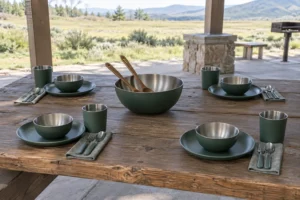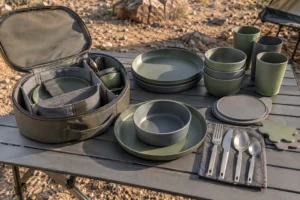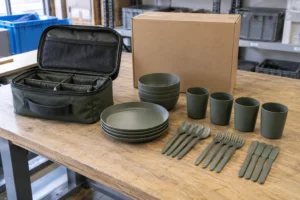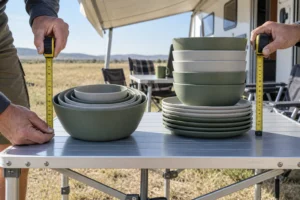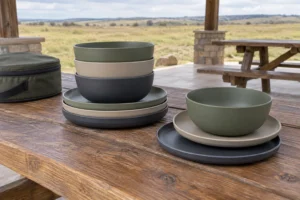
Direct answer: Define camping dinnerware set components by mapping every user and meal to an individual eating vessel, drink vessel and utensil group, then add only the shared serving, food-storage and packing items the program actually needs. Record quantities, interfaces, material conditions, cleaning assumptions and approval ownership in one component matrix before asking suppliers to quote.
A component list is not a decorative count of pieces. It is the controlled bill of contents that tells a buyer what must be present, what may be substituted, what must nest together and what evidence is needed before a set can be approved. If that list is vague, two quotations described as a “24-piece camping set” can represent very different user capacity, packed volume and commercial risk.
This guide gives sourcing teams a practical way to create a camping set component matrix. The output can be attached to a request for quotation, sample request or internal range review, so design, sourcing, quality, packaging and sales teams judge the same configuration.
Start with the use case, not the advertised piece count
The useful first question is not “How many pieces can we put in the set?” It is “Who eats what, where, and how will the items be cleaned and carried?” User count establishes the minimum number of individual place settings, while meal style determines whether each person needs a plate, bowl, cup, lunch box, or a smaller combination.
A four-person breakfast-and-dinner program is not automatically four times a solo kit. A family may share serving containers, while a school, rental or guided-tour program may require every participant to have clearly separated pieces. Retail packaging may also treat the carry case as one component, whereas an operational checklist may treat internal dividers and removable utensil sleeves as controlled subassemblies.
Define the counting rule at the top of the matrix. State whether lids count separately, whether a fork-knife-spoon group is one utensil set or three pieces, and whether the bag, strap and organizer are commercial pieces. This prevents marketing counts from being confused with the engineering or quality-control bill of contents.
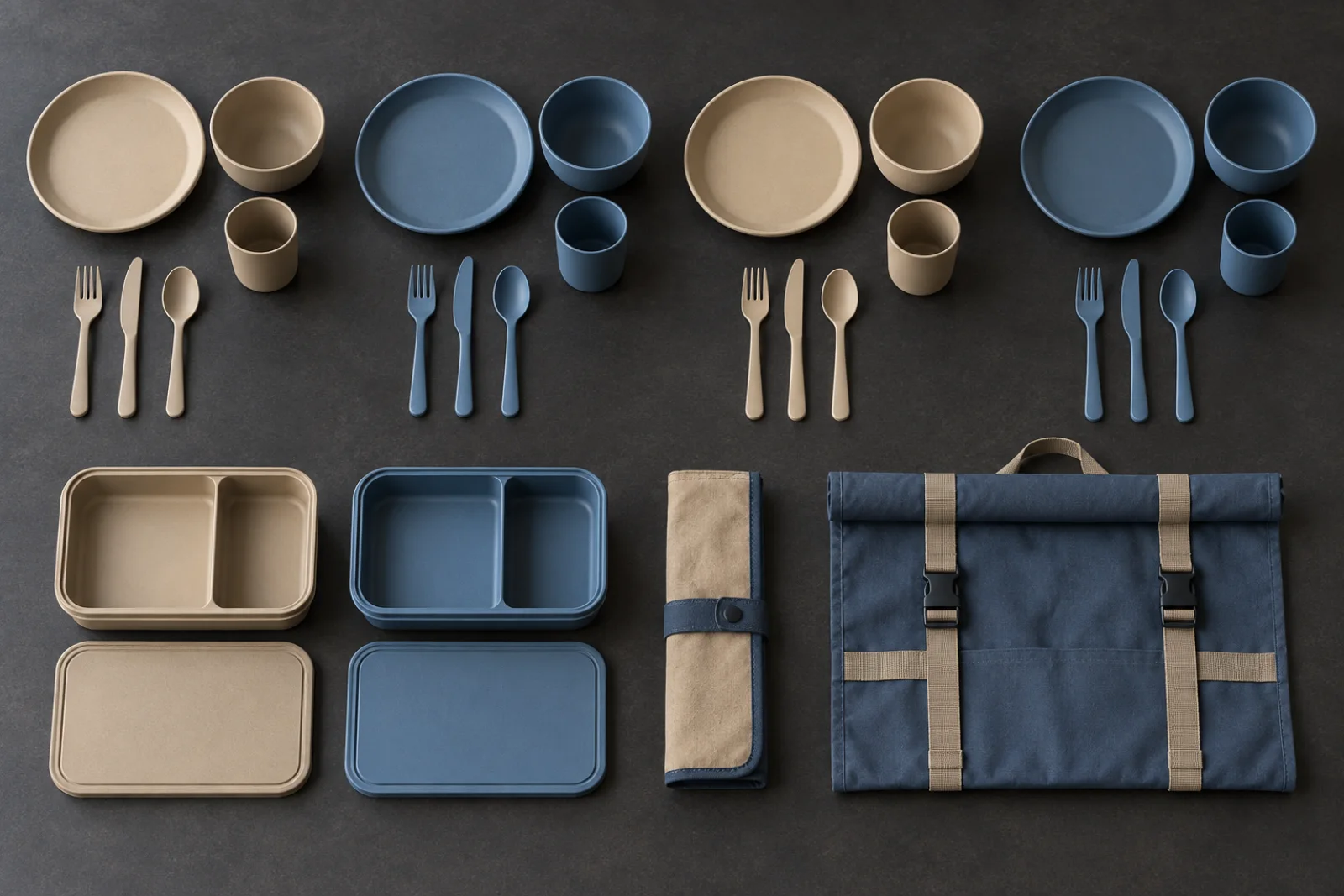
The component matrix buyers can actually use
The table below is a starting framework, not a universal set specification. Replace each example decision with the needs of the channel, destination market and intended user group. Quantities should be confirmed through a meal simulation and packing trial rather than copied from a competitor’s piece count.
| Component family | Decision to record | Typical matrix question | Approval evidence |
|---|---|---|---|
| Primary eating vessel | Plate, bowl, divided plate or lunch box by meal | Can one form handle the intended foods without spills or awkward portions? | Sample meal review and approved drawing |
| Drink vessel | Cup count, handle style, lid need and nesting role | Does the cup pack securely and suit the intended beverage conditions? | Use-condition statement and packing trial |
| Eating utensils | Fork, knife, spoon, spork, chopsticks or market-specific group | Which foods and user groups must the utensil set support? | Approved component list and handling review |
| Shared service | Serving bowl, platter, ladle or shared food container | Is a shared item operationally necessary or merely increasing the count? | Meal workflow observation |
| Food storage | Lunch box, divided box, lid and closure arrangement | Is storage part of the promise, and is leak resistance claimed or not? | Project-specific test method and claim approval |
| Organization | Utensil sleeve, separator, retention strap or nesting insert | What prevents movement, abrasion or missing parts in transit? | Packed-set inspection and drop-test plan |
| Carry system | Pouch, rigid case, roll-top bag, handle or shoulder strap | Who carries the set and how is it stored between trips? | Packing drawing, user trial and packaging review |
| Documentation | Instructions, use limits, cleaning guidance and traceability fields | Which statements are required for the market and substantiated for the product? | Approved artwork and evidence file |
The matrix should identify an owner for each decision. Product management can own the user promise, engineering can own interfaces and drawings, quality can own acceptance criteria, regulatory specialists can own evidence scope, and packaging teams can own the packed configuration. When responsibility is unclear, a component can be approved visually while its lid fit, cleaning limitation or pack position remains unresolved.
Separate individual, shared and packing components
Individual place-setting components
Individual components are issued to each user during a meal. They usually include an eating vessel, a drink vessel and the utensils required for the planned foods. A buyer should specify quantity per user rather than only total quantity, because that exposes whether a set advertised for four people actually contains four complete place settings.
Consider user accessibility as well as count. Children may need different proportions and edge geometry; institutional buyers may value visual assignment or replacement simplicity; premium retail programs may prioritize consistent surface treatment. These are design inputs, not claims that every material or shape is automatically suitable.
Shared meal components
Shared components support serving, preparation after cooking, condiment distribution or food storage. They should not be added merely to raise a commercial piece count. Each shared item should have a named meal task and an identified relationship to the individual pieces.
Keep cookware outside the dinnerware matrix unless the program explicitly includes it and verifies separate use conditions. A bowl used to eat soup is not a cooking pot, and a dinner plate should never be described as safe for a burner, stove or campfire without product-specific evidence. This boundary protects both buyer expectations and product instructions.
Packing and organization components
Packing components turn loose tableware into a repeatable set. A bag, divider, sleeve or strap must have a purpose: controlling movement, separating food-contact surfaces from soiled items, making missing pieces visible, or fitting a known shelf and transport condition. Record whether these are replaceable components and whether they contact food-contact surfaces.
Do not assume that nesting alone prevents damage. A packed trial should examine rim contact, utensil movement, lid pressure, textile abrasion and the way users repack damp items. The matrix can include a “pack position” column and a simple photo or drawing reference for each component, provided the reference is accurate and version-controlled.
Translate meals into component requirements
Create a meal map before choosing shapes. List the meals the product is expected to support, the likely food forms and the service method. A breakfast with cereal and a hot drink creates different vessel needs from grilled food with shared salads, and a packed lunch creates different closure and storage questions from a campsite dinner.
For each meal, mark the minimum viable place setting and any optional enhancement. The minimum list supports the core promise; optional modules can become channel-specific versions without silently changing the base set. This is particularly useful when a brand wants a compact outdoor set for specialty retail and a larger family version for club, promotional or rental channels.
| Meal or activity | Minimum individual role | Possible shared role | Decision risk |
|---|---|---|---|
| Breakfast | Bowl or plate, cup, spoon or selected utensil group | Shared dry-food or fruit container | Adding both plate and bowl without evidence that both are used |
| Packed lunch | Lunch box or eating vessel, drink vessel, utensil group | Condiment container if genuinely required | Implying leak resistance without a defined claim and test |
| Camp dinner | Plate or bowl selected for the menu, cup, utensils | Serving bowl or platter after cooking | Blurring dinnerware with direct-flame cookware |
| Family picnic | Complete place setting per intended user | Food boxes and serving pieces | Too many shared parts for the carry and cleaning workflow |
| Guided group | Clearly assignable, countable place setting | Controlled service pieces | Missing-part detection and replacement not defined |
Build quantity logic that survives quotation comparison
Use a simple equation: individual quantity equals intended users multiplied by units per user; shared quantity is added by meal workflow; packing quantity is added by the chosen organization concept. Then state the counting convention. A four-user set with one plate, one bowl, one cup and three separate utensils per person already contains twenty-four individual pieces before any food boxes or bag are counted.
That arithmetic explains why piece count alone is a weak comparison tool. One “24-piece” offer may mean four complete six-piece settings, while another may count lids, small condiment pieces or packaging accessories. Ask every supplier to return the same matrix with proposed part numbers, quantities and deviations instead of comparing headline counts.
Use a deviation column with only three permitted states: conforms, proposed alternative, or not included. A proposed alternative should identify why it is offered and what dependent decisions change. If a cup geometry changes, for example, the nesting stack, bag height and packed mass may also change.
Specify interfaces, not just objects
The highest-risk failures often occur between components. A lid belongs to a particular body; a bowl nests within a defined plate profile; utensils fit a sleeve of known length; and the assembled stack fits a bag with a specific retention method. Treat each relationship as an interface that requires approval.
Add an “interface” field to the matrix. It can record lid-to-box, bowl-to-plate, cup-to-bowl, utensil-to-sleeve and stack-to-case relationships. Compatibility must be confirmed by project sample and drawing, especially when components are sourced from different molds or combined into a new set.
Mixed-component programs need tolerance review. Nominal dimensions do not prove that parts will nest consistently across production variation, nor do attractive concept images prove closure or retention. An approved golden sample, controlled drawings and a representative packed-set trial provide a more reliable basis for acceptance.
Use conditions determine material and evidence fields
A component matrix should not use a single generic material statement for the entire set unless every component genuinely shares the same formulation and conditions of use. Record the material declaration for each component family, including lids, seals, handles, coatings, printed decoration and textile organizers where relevant.
For U.S. projects, the FDA explains that the regulatory status of food-contact material components depends on their identity and intended use, and its conditions-of-use framework distinguishes factors such as food type, temperature and contact time. Buyers can use the FDA’s guidance on determining regulatory status of food-contact material components and the agency’s food types and conditions of use to frame evidence requests without claiming that a generic material name proves compliance.
For EU programs, Regulation (EC) No 1935/2004 establishes the general framework for materials intended to contact food. The relevant evidence package still depends on the material, component, intended contact and applicable specific measures. Record the destination market and intended use next to the evidence request, rather than asking for a certificate with no defined scope.
Cleaning and outdoor use also affect the component list. The USDA’s food-safety guidance for hiking and camping emphasizes safe handling, temperature control and clean practices; it does not make a particular dinnerware component sanitary by itself. Buyers should define how used pieces are separated, washed, dried and repacked in the intended scenario.
Scenario checks expose missing or unnecessary parts
Four-person RV and campground program
An RV-oriented family set may prioritize complete place settings, compact cupboard storage and a bag that organizes components during transport. Shared food boxes can be useful when the program includes packed meals or leftovers, but their role should be stated. If the buyer expects the set to move between vehicle and picnic table, handle position and packed stability matter as much as visual assortment.

Run a table-layout exercise with the intended meal. Check whether four users can reach shared items without crowding, whether empty components occupy unnecessary space, and whether the bag can remain nearby without becoming a cleanliness risk. Record resulting component changes in the matrix rather than relying on meeting notes.
Two-person hiking-base or car-camping program
A two-person program often benefits from fewer forms and clearer nesting. It may use one bowl and one plate per person, or select a single versatile eating vessel if the actual meals support that decision. The right answer depends on menu, cleaning method, pack target and buyer positioning, not a universal minimalist rule.

For compact programs, ask whether every added lid, divider and utensil earns its packed space. At the same time, avoid deleting a component that prevents cross-contact, supports the intended food, or enables an important market expectation. The matrix makes that tradeoff visible and reviewable.
Rental, education and guided-group programs
Operational buyers may care more about counting, replacement and cleaning than retail presentation. The matrix should identify individually replaceable components, visual differentiation rules, inspection points and the method for detecting an incomplete returned kit. A complicated nesting system can look efficient but slow down turnaround if staff cannot inspect it quickly.
Do not assume that a residential cleaning claim applies to field operations. Define the actual cleaning equipment, chemicals, water conditions and cycle expectations, then request evidence appropriate to those conditions. If the evidence is not yet available, mark the decision open rather than converting an assumption into marketing copy.
Limitations and commercial risks to record
A component matrix controls what has been decided; it does not prove performance. It cannot replace material declarations, migration or other applicable testing, mechanical checks, artwork approval, packaging validation or product-specific instructions. It also cannot establish flame suitability for dinnerware or validate compatibility from photographs.
Watch for count inflation. Counting every lid, strap, insert and utensil as a headline piece may be mathematically defensible under one convention but misleading to a buyer expecting complete place settings. Use a dual count where necessary: operational component count and customer-facing piece count, both with transparent definitions.
Another risk is uncontrolled substitution. If a quotation allows “similar bowl” or “standard cup” without defining the approved geometry and interface, a later replacement can alter stack height, bag fit or user experience. Require written approval for component, material, color, surface and construction changes that affect the approved matrix.
Over-specification is also costly. A matrix filled with arbitrary dimensions, colors or test methods can prevent suppliers from proposing workable configurations. Separate fixed requirements, target preferences and supplier-proposed solutions, and state which decisions will be confirmed after sample review.
Procurement workflow: from brief to approved matrix
- Define users and meals. State user count, meal types, food forms, beverage needs, cleaning method, carry mode, sales channel and destination market.
- Create the minimum place setting. Choose the individual eating vessel, drink vessel and utensil group needed by one user.
- Add shared items by task. Name the serving or storage action supported by every shared component.
- Design the packing system. Assign a packed position, retention method and repacking sequence to each component.
- Record interfaces and evidence. Link nesting, lids, sleeves and cases to drawings, samples, use conditions and approval owners.
- Issue one matrix to all bidders. Require part-level quantities, proposed alternatives and exclusions in the same format.
- Review a representative set. Conduct meal, cleaning and packing trials before approving the commercial configuration.
- Freeze the approved revision. Align the matrix, drawings, artwork, inspection criteria and quotation revision.
Buyers building a family configuration can compare this process with our published guide on how to build a four-person camping dinnerware set. For capacity choices, see one-person versus four-person camping sets. If the format decision is still open, begin with camping mess kit versus dinnerware set.
B2B Buyer Checklist
| Check | Question | Why It Matters |
|---|---|---|
| User and meal scope | Are intended users, meals, foods, beverages and service method written down? | Prevents a piece count from replacing the actual use requirement. |
| Counting convention | Are lids, utensils, organizers and bags counted consistently? | Makes quotations and retail claims comparable. |
| Individual completeness | Does every intended user receive a complete required place setting? | Exposes incomplete “multi-person” configurations. |
| Shared-piece purpose | Does every shared item have a named meal or storage task? | Reduces unnecessary count, cost and packed volume. |
| Interface control | Are lid fit, nesting, utensil storage and case retention linked to samples and drawings? | Controls failures between otherwise acceptable components. |
| Material scope | Is each component family tied to intended contact conditions and destination market? | A material name alone does not define regulatory suitability. |
| Cleaning workflow | Can users or operators wash, dry, inspect and repack the complete set? | Field usability depends on the whole workflow. |
| Deviation control | Must proposed alternatives and later substitutions receive written approval? | Protects the approved stack, pack and customer promise. |
| Commercial alignment | Do matrix, quotation, artwork and inspection plan use the same revision? | Prevents mismatched approvals at order release. |
Frequently Asked Questions
1. What are the essential camping dinnerware set components?
The essential list is the minimum place setting required by the defined users and meals: usually an eating vessel, a drink vessel and appropriate utensils per person. Shared service, food-storage and packing components should be added only when their tasks are documented. There is no universal component count that fits every program.
2. Should lids count as separate pieces?
They may count separately in a commercial piece total, but the counting convention must be explicit. In the procurement matrix, link every lid to its body and control the pair as an interface. Consider reporting both the total physical piece count and the number of complete functional components.
3. How many components should a four-person set contain?
Calculate the count from the selected per-person place setting, then add justified shared and packing items. Four people with a plate, bowl, cup, fork, knife and spoon create twenty-four individual pieces before food boxes or a case. Another valid program may use fewer or different forms because its meals and positioning differ.
4. Can components made from different materials be combined?
They can be proposed as a mixed-material set, but each component and interface needs its own intended-use, evidence and compatibility review. Do not infer that one declaration covers every polymer, metal, coating, seal, print or textile. Compatibility should be confirmed by project sample and drawing.
5. How should buyers compare two quotations with the same piece count?
Send both suppliers the same component matrix and require part-level quantities, materials, proposed alternatives, packing roles and exclusions. Compare complete place settings and functional roles rather than headline count. Also compare what is still “to be confirmed” and who owns each approval.
6. Is a lunch box automatically part of a camping dinnerware set?
No. Include it when packed meals, food separation or leftover storage is part of the program. Define any closure or leak-related claim and its verification method rather than assuming a lidded box is leakproof. If it has no documented task, it may add unnecessary volume.
7. When is the component list ready to freeze?
Freeze it after representative samples have passed the agreed meal, handling, cleaning and packing reviews, interfaces match controlled drawings, evidence requests are resolved or formally tracked, and commercial documents use the same revision. A concept image or preliminary quotation is not sufficient approval.
Request a component-matrix and sample review
Send Naike Dinner your intended user count, meals, required place-setting pieces, shared functions, storage concept, destination market, cleaning assumptions, artwork needs and target pack constraints. We can review the brief against available product information, identify decisions that require samples or drawings, and prepare a documented quotation basis without inventing missing specifications.
Request a camping dinnerware set component review and attach your current matrix if one exists. For a new program, use the same Contact Naike Dinner form to request samples, a specification review or a written quotation based on confirmed project requirements.