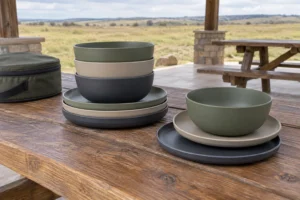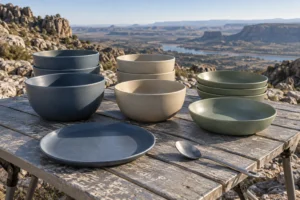
Choose a camping mess kit when one user needs a compact, self-contained eating system; choose a camping dinnerware set when several users need coordinated place settings, shared serving pieces, and controlled replacement parts. The right format depends on user allocation, meal plan, packing method, cleaning workflow, retail promise, and whether cookware is included or deliberately kept separate.
For a buyer, “camping mess kit vs dinnerware set” is not a debate about which label sounds more outdoors-oriented. It is a product-architecture decision that changes the bill of materials, packed footprint, instructions, imagery, quality checks, replacement strategy, and the promise printed on the retail package.
This guide produces a format decision matrix rather than a generic definition. Use it before requesting quotations so every supplier is pricing the same user count, component scope, material boundary, carry solution, and evidence requirement.
Start with the operating difference
A mess kit is normally organized around one person or one compact eating task. Its parts often nest into one another, fit in a small pouch, or combine eating and storage functions so the user can carry fewer separate objects.
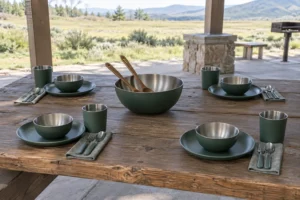
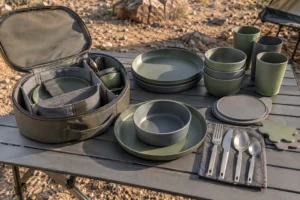
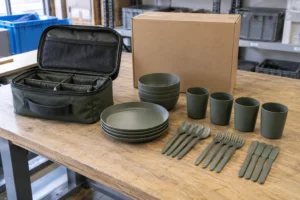
A camping dinnerware set is organized around a serving system. It may allocate one plate, bowl, cup, and cutlery group to each user, then add shared bowls, food containers, or a carry case that controls the complete group.
Neither term proves that cookware is included. A pot or pan designed for a stove, burner, or fire is cookware; a plate, bowl, cup, lunch box, and eating utensil are dinnerware or food-contact accessories. Buyers should state this boundary explicitly because a marketing image showing a metal bowl near a stove can otherwise create an unsupported direct-heat expectation.
The format must follow the meal plan
The U.S. Department of Agriculture advises outdoor users to plan what they will eat, how they will prepare it, and what equipment they will need. That sequence is valuable for product development: define meals and users first, then select components, instead of beginning with a target piece count.
The National Park Service also distinguishes camp-stove or fire cooking from food storage and eating arrangements. A buyer can use that operational separation to decide whether the project needs an eating-only system, a food-container system, or a separately validated cookware module.
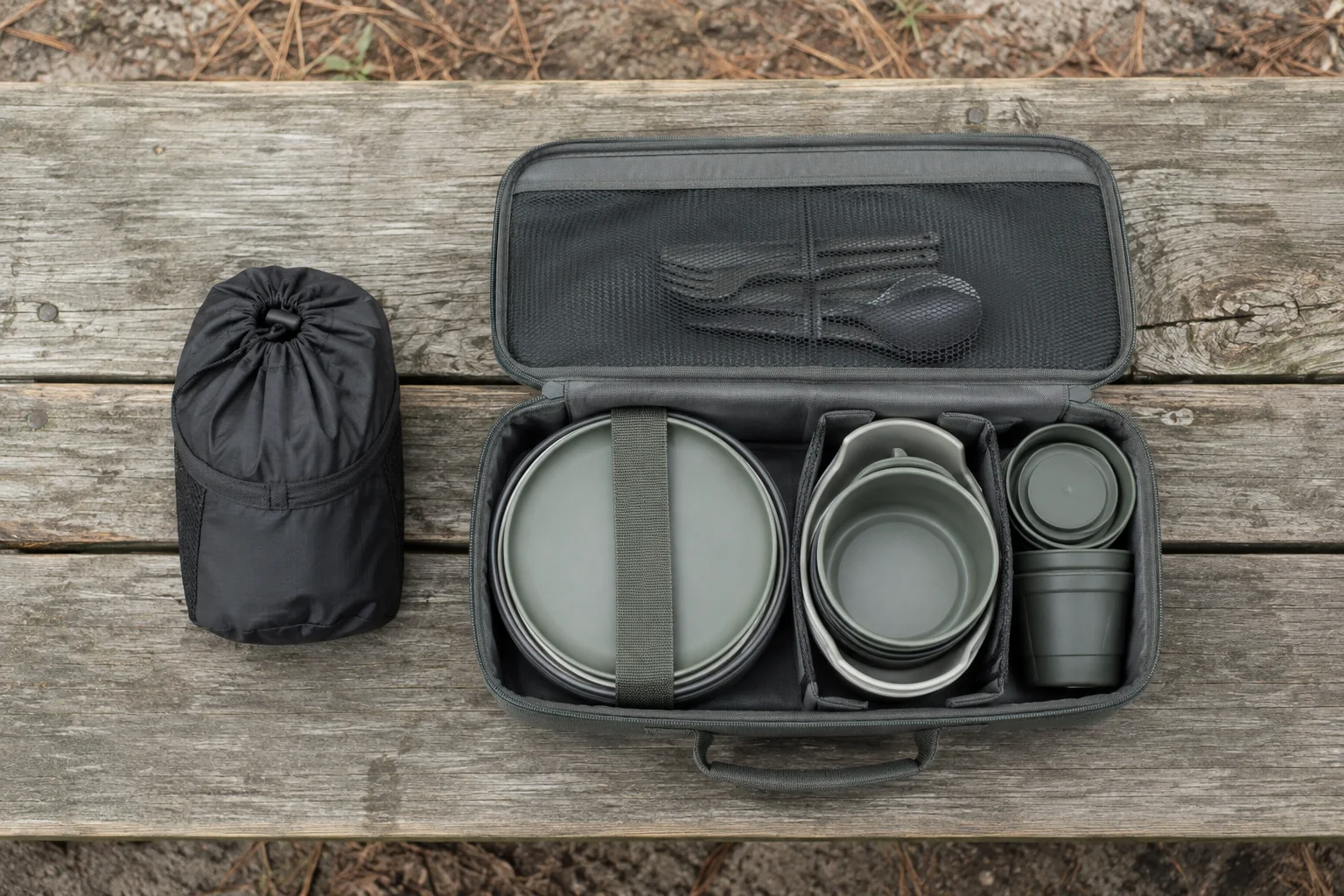
Camping mess kit vs dinnerware set decision table
| Decision factor | Personal mess kit | Camping dinnerware set | Buyer implication |
|---|---|---|---|
| Primary user model | Usually one allocated user | Two or more coordinated users | State user count before piece count |
| Core architecture | Compact, nested, self-contained | Repeated place settings plus optional shared pieces | Create a component matrix by user |
| Typical components | Bowl or plate, cup, utensil, compact pouch | Plates, bowls, cups, cutlery groups, carry case | Do not assume a universal configuration |
| Cookware | May be marketed with it, but not inherent | Usually separate from dinnerware | Validate direct-heat items independently |
| Packing priority | Minimum personal footprint | Controlled group organization | Measure packed system, not loose parts |
| Cleaning workflow | One user cleans one allocation | Parts are pooled, sorted, and reassigned | Use identity, color, or cavity controls if needed |
| Replacement model | Replace the kit or a limited core item | Replace high-loss components by family | Define spare-piece policy before launch |
| Retail communication | Mobility and personal completeness | Capacity, coordination, and hosting | Package claims must match the component list |
The table is a starting framework, not a product specification. A two-person kit can still be compact, and a one-person set can contain several pieces; the controlling question is whether the system is allocated to an individual or designed as a coordinated serving program.
Build a user-to-component allocation before choosing a name
Write every component in rows and every intended user in columns. Mark whether an item is individual, shared, optional, replacement-critical, or outside scope. This simple matrix exposes hidden assumptions earlier than a mood board or a supplier quotation.
For a personal mess kit, the matrix may contain one eating vessel, one drinking vessel, one utensil group, and one storage element. For a dinnerware set, the matrix should repeat place-setting pieces consistently and then distinguish shared serving components from individual food containers.
A practical allocation example
| Component family | Personal format | Four-user format | Approval question |
|---|---|---|---|
| Eating vessel | One bowl, plate, or dual-purpose vessel | Four plates and/or four bowls | Which meals must each vessel hold? |
| Drinkware | One cup if required | Four identifiable cups | Must cups nest, stack, or fit bottle pockets? |
| Cutlery | One compact utensil or group | Four controlled utensil groups | How are clean and used utensils separated? |
| Food container | Optional individual box | Individual boxes or one shared container | Is storage part of the promise or a separate module? |
| Carry solution | Small pouch or nested closure | Case, bag, tray, or divided organizer | Can users count and repack every part? |
| Cookware | Explicitly included or excluded | Normally a separately specified module | Is any item intended for direct heat? |
If a buyer cannot complete this table, the project is not ready for a reliable quotation. Suppliers may fill the gaps differently, producing prices that appear comparable but represent different component scopes.
Naike Dinner buyers can also review the published explanation of what a camping mess kit is and the detailed guide to mess kit component selection. Those pages provide definition context; this article focuses on choosing the commercial format.
Evaluate packing as a system, not as a photograph
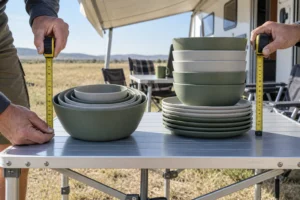
A compact-looking image does not prove an efficient packed system. Buyers need the closed external dimensions, total packed weight, component count, packing order, retention method, clearance between parts, and an explanation of how wet or used pieces are handled.
Mess kits usually prioritize a short packing sequence and minimum personal footprint. Dinnerware sets prioritize counting, separation, component protection, access order, and making sure several users can find their place settings without emptying the entire bag.
Request a packing demonstration using the intended component count, not a case photographed with missing pieces. The demonstration should show unpacking, normal use, repacking, closure, carrying, and whether parts rattle or rub under movement.
Measure three states
Record the system when fully packed, when opened for access, and when dirty components return after use. A case can be efficient in the first state but awkward in the second, while a deeply nested personal kit can trap moisture or food residue in the third.
For a group set, count-control matters. A shaped tray, labeled cavity map outside the food-contact area, controlled color grouping, or consistent stacking order may make missing parts visible before the campsite is packed away.
Choose the personal mess-kit format for the right scenario

A personal mess kit fits programs for solo hiking, individual issue, emergency kits, compact travel, scout allocation, or any offer where every user carries and controls their own eating equipment. It is especially useful when the customer values a single packed unit more than a coordinated table presentation.
The format also supports straightforward accountability. One user receives one unit, and a missing cup or utensil is associated with that unit rather than with a pooled group inventory.
Its limitations are equally important. Deep nesting can make parts harder to dry, a dual-purpose bowl may not serve every menu, and very compact utensils may reduce eating comfort. A personal kit can also be mistakenly treated as cookware if metallic nested vessels are shown near heat, so usage instructions and imagery must state the intended boundary.
Choose the dinnerware-set format for coordinated service

A dinnerware set fits family car camping, RV programs, glamping, outdoor catering, campsite rental, group education, and retail bundles that promise a defined number of place settings. Buyers can coordinate shapes and colors while selecting different vessels for soup, grilled food, snacks, drinks, and shared sides.
The group format makes merchandising clearer when the package honestly states user count and component allocation. It also lets a brand build good-better-best versions by changing shared accessories, case construction, or component materials without confusing the core place setting.
The risk is uncontrolled piece inflation. Adding another serving bowl, lid, tool, or accessory may improve the front-of-box number while increasing volume, assembly work, inspection points, loss risk, and customer confusion. Every piece should have a meal or workflow reason.
Food-contact evidence follows components and intended use
Format names do not establish food-contact suitability. The U.S. FDA describes conditions of use by food type, temperature, and handling conditions; a buyer should connect the final material, pigments, decorations, adhesives, and food-contact surfaces to the intended foods and temperatures.
The FDA also explains that regulatory status must be determined for the components of a food-contact material and their intended use. For a multi-component set, this means evidence should identify which report or declaration covers which plate, bowl, cup, lid, seal, lunch box, or utensil rather than treating one document as proof for every part.
For EU programs, the general food-contact framework requires materials not to transfer constituents in quantities that could endanger health or unacceptably change food. Relevant plastic components may also fall within the specific plastics framework, so the evidence file must match the actual material and final use conditions.
These rules do not decide between a mess kit and a dinnerware set. They determine what evidence is needed after the format, materials, food types, temperatures, and repeated-use instructions are defined.
Cleaning workflow can decide the format
The USDA outdoor food-safety guidance recommends planning cleaning and hand hygiene as part of the trip equipment. For product buyers, this means the dinnerware format must be evaluated with the expected water access, detergent, drying space, and separation of raw-food and ready-to-eat contact items.
A personal kit minimizes the number of surfaces but may create tight nested gaps. A group set increases surface count and sorting work, yet can provide wider openings, separate clean and used zones, and visible allocation if the carry system is designed accordingly.
Do not publish “dishwasher safe” or similar cleaning claims for the whole set because one component passed or because a material is commonly associated with that use. Confirm the final component, decoration, construction, and declared cycle conditions through appropriate evidence.
Retail and replenishment consequences
A personal mess kit can be sold as one controlled unit with a concise component list. A dinnerware set needs clearer front-of-pack user count, a complete bill of contents, an image that does not hide repeated pieces, and an explanation of optional or shared items.
For rental fleets, camps, or institutional buyers, a group set may benefit from replacement availability for high-loss cups, utensils, and lids. A personal kit may be simpler to issue, inspect, and replace as a unit, but replacing an entire kit for one missing spoon may increase waste and operating cost.
Ask how the supplier will identify components across drawings, samples, packaging, inspection records, and replacement orders. A family name alone is insufficient; each controlled part should have a stable reference even when the consumer sees only the set name.
Limitations and risks buyers should surface early
First, the market uses “mess kit” inconsistently. Some listings include cookware, some contain only eating vessels, and others use the term for any portable tableware bundle. Define your own scope in the RFQ rather than relying on the category label.
Second, visual nesting can conceal contact and tolerance problems. Rims may bind, decorated surfaces may rub, lids may deform under compression, and cutlery can mark adjacent parts. Compatibility to be confirmed by project sample and drawing.
Third, mixed materials multiply evidence and instruction requirements. Metal, rigid polymer, elastomer seals, textile bags, coatings, pigments, and printed decorations cannot be covered by an unsupported universal claim.
Fourth, generated concept images and reference configurations are not product evidence. They can help communicate architecture, but final availability, dimensions, materials, compatibility, tooling, packaging, and performance must be verified against company records, drawings, and approved samples.
Write the RFQ so suppliers cannot price different formats
Begin the RFQ with an unambiguous format statement: personal eating kit, coordinated group dinnerware set, or dinnerware set with a separately controlled cookware module. Follow it with a numbered component list in which every row includes quantity per set, quantity per user, material direction, food-contact role, decoration area, color relationship, and whether the component is required or optional.
Add a packing section that requests the complete closed configuration, the order in which parts enter the case, the method used to retain utensils and lids, and the way users can identify a missing component. If a supplier proposes a different architecture to meet the packed-volume objective, require a revised component matrix and drawing instead of accepting an unexplained substitution.
Define evidence as a deliverable rather than a general promise. Ask the supplier to map each material declaration, food-contact report, drawing revision, and instruction claim to the affected component IDs, final colors, decoration, and intended conditions of use. A report for an uncolored plaque, an earlier material grade, or a different component geometry should not be treated as automatic coverage for the finished set.
Finally, separate requested facts from target values. User count, destination market, and required components are buyer requirements; packed size, weight, color, tooling route, MOQ, lead time, and packaging may remain project variables until drawings, material records, and quotations are reviewed. Marking these fields “to be confirmed” is more useful than forcing an early number that later becomes a misleading commitment.
This RFQ structure also makes commercial comparison faster. When every bidder returns the same matrix, the buyer can identify differences in component scope, tooling assumptions, evidence responsibility, packing labor, sample stages, and replacement support without relying on a single total price.
B2B Buyer Checklist
| Check | Question | Why It Matters |
|---|---|---|
| User allocation | Is the system personal, shared, or a mix of both? | Determines repeated pieces and accountability |
| Meal coverage | Which real meals must the vessels serve? | Prevents decorative or redundant components |
| Cookware boundary | Is any item intended for direct heat? | Separates dinnerware claims from cookware validation |
| Component matrix | Is every piece individual, shared, optional, or spare? | Makes quotations comparable |
| Packed system | Are closed size, weight, order, retention, and rattle reviewed? | Tests actual portability rather than appearance |
| Cleaning | How are parts washed, dried, and separated after use? | Reveals gaps hidden by tight nesting |
| Evidence | Does each component match its material and intended-use file? | Prevents one report being overextended |
| Replacement | Which pieces are expected to be lost or damaged first? | Supports after-sales and fleet economics |
| Packaging | Does the package show the exact user count and contents? | Reduces buyer and consumer misunderstanding |
| Sample approval | Will the final packed set be tested as one system? | Catches tolerance, abrasion, closure, and counting issues |
Use the checklist with a component drawing and a packing sequence. For a group-format example, the published guide to designing a four-person camping dinnerware set explains how user allocation changes a practical component plan, while the one-person versus four-person comparison provides additional scale context.
Procurement recommendation
Select a personal mess kit if the buyer promise is “one user, one compact unit” and every included component supports that promise. Select a camping dinnerware set if the buyer promise is “a coordinated meal system for a defined group” and the carry, cleaning, counting, and replacement workflows support repeated place settings.
Before requesting price, send a one-page brief containing user count, meal types, required and optional components, cookware exclusions, material direction, intended food and temperature conditions, packed-size objective, carry method, cleaning expectation, destination markets, artwork zones, and required evidence. Ask every supplier to identify assumptions and unverified fields instead of silently completing them.
Naike Dinner can review a proposed component matrix against verified product records and help separate reference components from items requiring further project confirmation. Request a specification review with your user count, meal plan, target channels, and preferred carry format before asking for a documented quotation.
Buyer FAQs
1. Is a mess kit always for one person?
No. The term is used inconsistently, so some products serve two people or include shared parts. For procurement, define whether each component is allocated to one user or shared, then use the name that best communicates the finished architecture to your market.
2. Does a camping mess kit normally include cookware?
Not necessarily. Some commercial kits include a pot or pan, while others contain only a bowl, plate, cup, and utensils. State direct-heat components separately and require product-specific evidence rather than treating the word “mess kit” as a cookware claim.
3. Which format is better for family car camping?
A coordinated dinnerware set is often easier when a family needs repeated place settings, shared food, visible counting, and a single organized case. A set is not automatically better if it adds unused pieces or creates a difficult cleaning and repacking workflow.
4. Can a dinnerware set still be compact?
Yes, when plate and bowl profiles, cup geometry, cutlery length, lunch-box placement, and the carry case are engineered as one packed system. Compactness must be confirmed with the complete physical sample, not inferred from isolated component dimensions.
5. How should buyers compare quotations for the two formats?
Normalize user count, component quantities, material and decoration scope, carry solution, packaging, testing responsibility, sample stages, and replacement parts. A lower quotation may simply exclude components, evidence, or packing work included elsewhere.
6. Should a brand launch both formats?
Only when each has a clear user and channel role. A personal kit and a family dinnerware set can create a coherent range, but overlapping component promises, incompatible replacement parts, or unclear naming can produce unnecessary SKU complexity.
7. What should be approved before tooling or a production commitment?
Approve the component matrix, drawings, intended-use boundary, material declarations, artwork locations, nesting and retention logic, packed configuration, cleaning instructions, evidence plan, and change-control process. Unknown commercial and technical fields should remain marked for project confirmation.
Turn the format decision into a quotable brief
Send the intended users, meal types, component matrix, carry preference, destination markets, material direction, and evidence requirements. We will review what can be matched to verified records and identify every point that still needs drawing or sample confirmation.
Primary evidence used for this decision framework