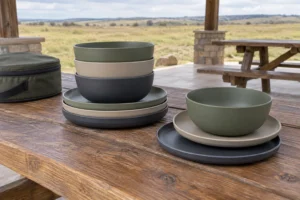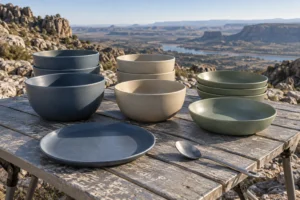
A one-person camping dinnerware set is optimized for individual carry, minimal duplication and compact nesting; a four-person set is optimized for simultaneous group service, coordinated storage and per-household value. Neither is inherently better. B2B buyers should compare complete functions, per-user allocation, packed mass and volume, cleaning capacity, replacement logic and verified material evidence before selecting or assembling a program.
This comparison covers dinnerware—plates, bowls, cups and eating utensils. Cookware, burners and fuel are separate unless a commercial kit deliberately includes and documents them. The conclusions are procurement guidance, not a declaration that every material or configuration shown is currently manufactured by Naike Dinner. Current supply scope, drawings, samples, evidence and commercial terms must be confirmed for each project.
One Person vs Four Person Camping Set: Decision Table
| Decision | One-person set | Four-person set | Buyer evidence |
|---|---|---|---|
| Primary use | Individual carry and personal issue | Family or group service | Written user scenario |
| Components | One complete place setting | Four agreed place settings plus justified shared items | Named bill of materials |
| Portability | Total mass and pack access | Mass per user and shared case efficiency | Conditioned packed sample |
| Cleaning | Small wash sequence | Higher sorting and drying load | Meal and cleaning trial |
| Replacement | Whole-kit replacement may be practical | Component replenishment is valuable | Part identification plan |
| Channel | Backpacking, travel, personal kits | Family camping, RV, rental and retail | Assortment and pack plan |
Start with the service model, not the piece count
A solo kit normally gives one user direct ownership of every eating item, while a four-person kit must decide which items are duplicated and which are shared. That distinction changes meal flow, hygiene, replacement and packing. Before comparing prices, write a service map showing who receives a plate, bowl, cup and utensils, plus any shared serving or storage pieces.
The one person vs four person camping set comparison becomes misleading when a four-person listing counts lids, pouches or repeated cutlery as equal to core eating vessels. Ask for a named bill of materials with quantities and revision references. Piece count is useful only after every item has a defined function.
Keep cookware outside the count unless the commercial kit intentionally includes it and reports it separately. Dinnerware is not automatically suitable for a burner, stove or campfire. Any direct-heat statement requires product-specific evidence for the exact item and construction.
Component allocation comparison
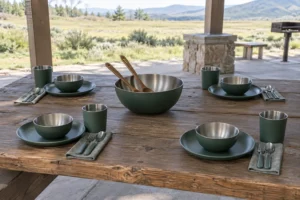
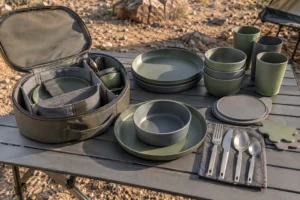
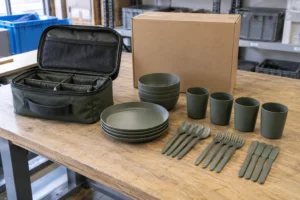
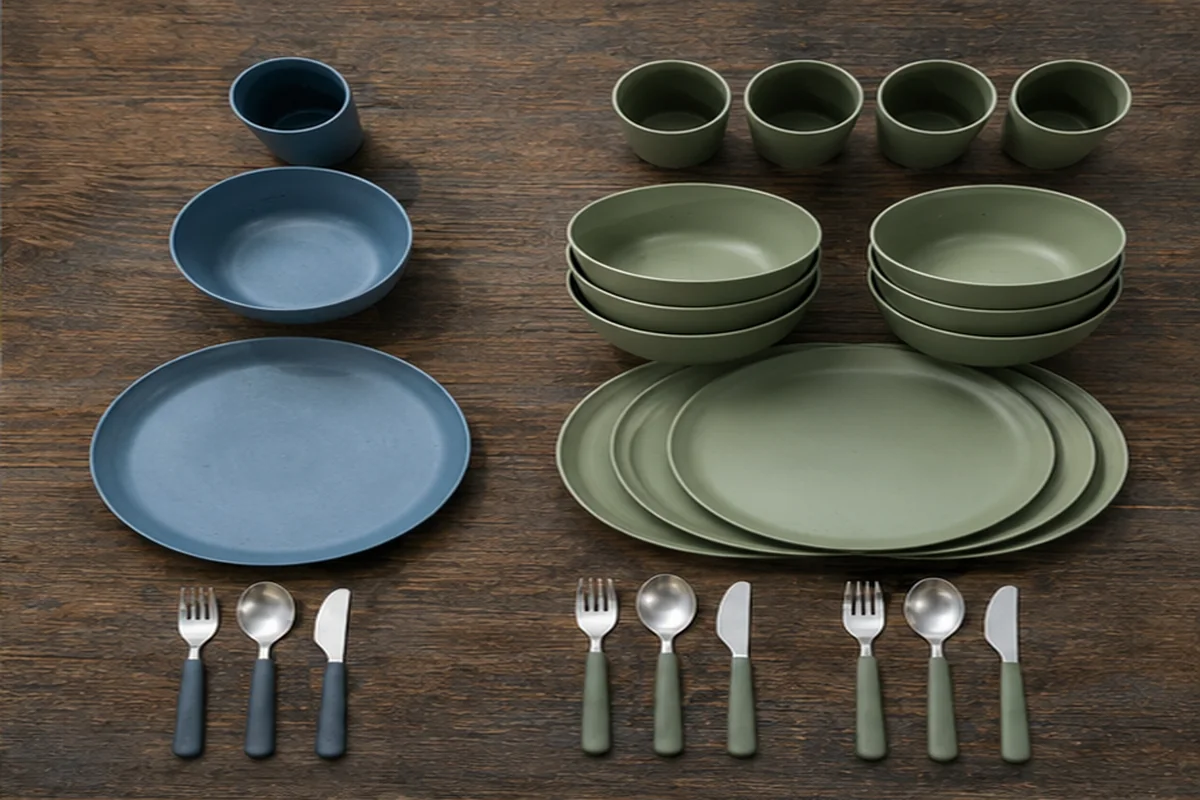
A one-person configuration can be intentionally minimal: one eating surface, one liquid vessel, one utensil solution and one storage method. A four-person configuration usually duplicates personal-contact pieces four times, then adds only those shared pieces justified by the meal plan. This avoids a heavy bundle that looks complete in photography but is awkward in real use.
For family programs, consider whether children need different sizes, grip geometry or color identification. Do not assume an adult plate can simply be relabeled for children. The user group, destination-market requirements and finished-item evidence must be reviewed for the actual configuration.
For rental fleets or organized camps, identical place settings can simplify counting and replacement. For premium retail, controlled color pairs may improve merchandising. These are buyer decisions, not universal rules; the approved bill of materials should capture the selected logic.
Portability, mass and packed volume
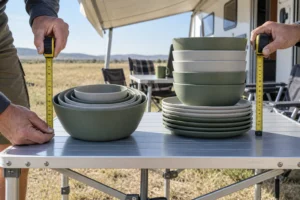
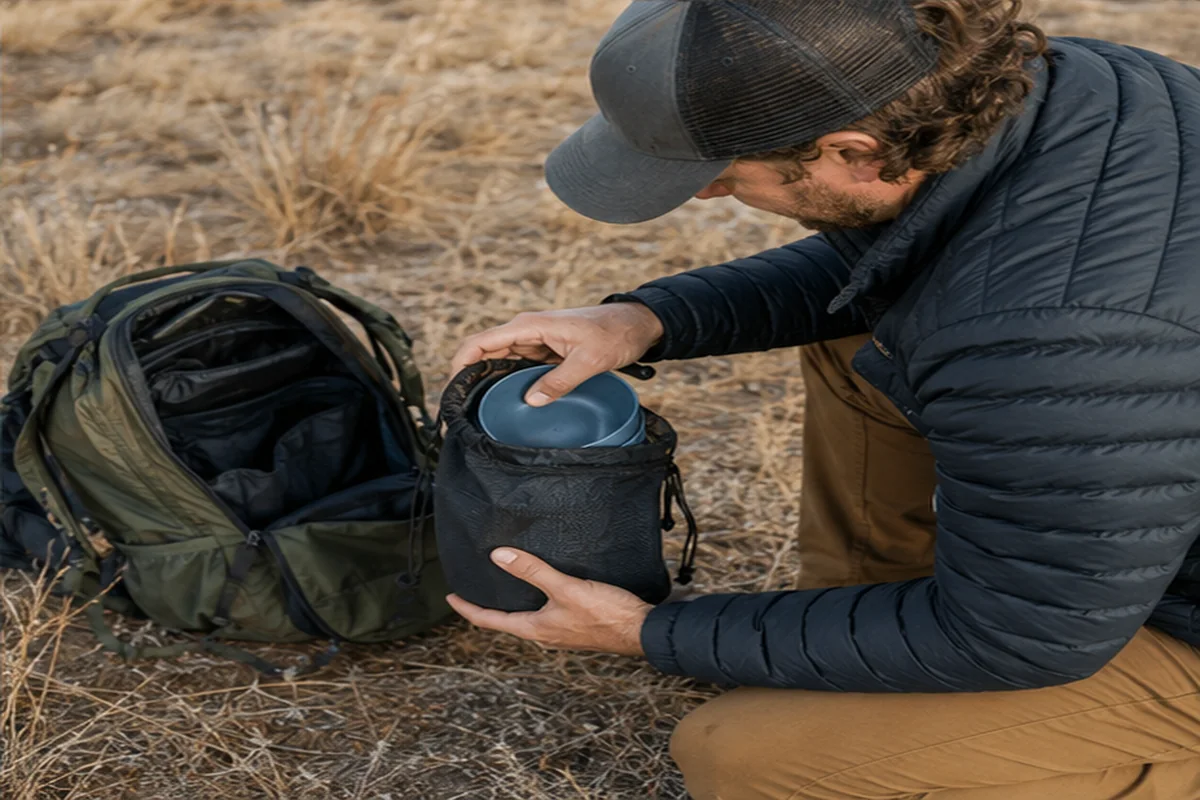
A solo traveler often carries every gram and cubic centimeter, so packed volume and access are critical. A four-person car-camping buyer may accept more mass for stable plates, full cups and organized storage. Compare total packed mass, mass per user, nested diameter, nested height and pouch or case dimensions under the same boundary.
Do not compare a bare solo bowl with a four-person set inside a rigid case. State whether storage and consumer packaging are included. The NIST SI mass reference supports consistent unit language, but it does not set a target for camping dinnerware.
A slightly heavier four-person set may pack more efficiently per user when pieces share one stable footprint. Conversely, four repeated cups may prevent efficient nesting. Approve a physical packed sample because nominal diameters and renderings cannot prove separation effort, rattle or closure.
Nesting and separation logic
Solo sets can use aggressive nesting, but a user must still remove each item with cold or wet hands. Four-person sets multiply the risk of jammed rims, surface abrasion and confusing component order. Review rim draft, foot rings, texture, decoration and any separator before approving the stack.
Compatibility to be confirmed by project sample and drawing. That sentence belongs in the brief whenever components come from different families or suppliers. Similar-looking parts can interfere after pigment, texture or tolerance changes.
A useful nesting trial records the order of pieces, complete stack height, packed orientation, separation method and condition after repeated cycles. The trial should not be presented as a universal durability test; it is project evidence for the sampled configuration.
Meal scenarios and user behavior
Solo hiking meals may be eaten directly from one deep vessel, but family meals often need simultaneous plates, bowls and cups. Menu assumptions therefore drive configuration. Soup, cereal, shared snacks and hot beverages impose different handling needs than sandwiches or dry meals.
A four-person program should test the moment when everyone is served, not just a styled table. Are there enough vessels at the same time? Can children identify their pieces? Does the carry case become a cluttered holding bin once wet items return? Scenario review reveals omissions that a component spreadsheet misses.
The family car-camping dinnerware guide gives additional buyer context. Use it as planning guidance while verifying every product-specific claim separately.

Cleaning and drying capacity
One user can usually manage a small wash sequence and inspect every surface. Four users create more food residue, wash water demand and drying area. A set design should support scraping, washing, rinsing and complete drying under the intended campsite routine.
Shared tubs or pouches should not trap moisture around nested pieces. Review drain paths, textured surfaces, deep foot rings and storage ventilation. Dishwasher suitability cannot be inferred from material name; it must be supported for the exact finished item and stated conditions.
For camps and rental fleets, count how many pieces can be cleaned and checked per cycle. A simpler four-person configuration may outperform a high-piece-count bundle if it reduces sorting errors and makes damage easier to see.
Durability and replacement strategy
A solo buyer may replace an entire low-piece-count kit after loss or damage. A four-person buyer benefits from replaceable components because one missing cup should not retire the whole assortment. Specify whether colors, dimensions and nesting interfaces will remain controlled for replenishment.
Mass is not proof of strength, and material name is not proof of service life. Review geometry, edge condition, wall distribution and relevant product-specific tests. Retain approved samples and acceptance criteria rather than relying on adjectives such as unbreakable or ultralight.
Replacement logic also affects packaging. Individual spares may need simple identification and protection, while a complete retail set needs a clear component list. Do not invent continuity commitments; ask what can be confirmed for the project.
Materials and food-contact evidence
Both solo and four-person sets may use stainless steel, aluminum, enamel, silicone, polypropylene, Tritan-type copolyester or plant-fiber composites, but the appropriate evidence depends on the exact construction and market. Neutral comparison does not mean Naike Dinner supplies every material. Current capability and documentation must be verified during project review.
For US polymer projects, consult applicable provisions such as 21 CFR Part 177. For EU projects, begin with Regulation (EC) No 1935/2004 and applicable material-specific measures. These primary sources provide regulatory context, not approval of a generic product.
Request declarations and test reports that identify the finished item, material, color, test conditions and responsible report holder. A report for one bowl cannot automatically cover a different plate, pigment or construction without a documented basis.
Retail, DTC and institutional fit
A compact solo set can suit adventure travel, promotional kits and direct-to-consumer add-ons where packability is easy to explain. A four-person set can suit car camping, RV programs, family retail and group issue. Channel fit depends on the buyer’s assortment, price architecture and after-sales plan, not on a universal winner.
Retail packaging should show the exact included pieces without hiding repeated low-value items. DTC pages need clear packed dimensions and care limits. Institutional buyers need issue, count-back, sanitation and replacement controls. One configuration rarely serves every channel equally well.
Consider building a family of related configurations around common components. That can support solo, pair and family offers while keeping visual identity consistent. Compatibility, supply continuity and packaging efficiency still require project confirmation.
Customization and new-set assembly
B2B buyers can create differentiated offers by combining verified plates, bowls, cups, cutlery and storage rather than treating the set as a fixed catalog object. Start with existing components that meet the brief, then identify gaps that might justify a modified component or new-mold feasibility discussion.
Color, logo and packaging should be controlled across the whole assortment. Approve physical color samples, artwork position and pack-out, and keep open values marked “To be confirmed for the project.” A concept image is not evidence that a mold, process or component is available.
For either side of the one person vs four person camping set decision, send the target market, user group, meal scenario and required functions before asking for a quotation. This allows the supplier to separate confirmed scope from engineering questions.
Risk review before purchase
The most common risk is comparing unlike bundles. Another is allowing a photography sample to define the order while the quotation uses a different bill of materials. Lock the component matrix, sample revision, color allocation, storage item and packaging boundary in writing.
Do not accept unsupported heat, dishwasher, drop, food-safe or environmental claims. Define intended use and request evidence appropriate to the finished item. If a specification or compatibility point is unknown, retain it as an open project question rather than filling the gap with generic industry language.
Check that form, carton and consumer copy use the same user count. Four place settings means four complete agreed place settings, not four vaguely related pieces. This simple control prevents a large class of listing and fulfillment errors.
How to choose between the two
Choose a solo set when individual carry, personal issue, compact storage and simple replacement dominate. Choose a four-person set when simultaneous family service, shared storage, coordinated merchandising and per-household value dominate. If both segments matter, design a controlled component platform with clearly separate pack-outs.
The one person vs four person camping set decision should be documented as a use-case choice, not a quality ranking. Either can be premium or basic depending on material, design, evidence and execution. The better configuration is the one that completes the buyer’s meal and channel task with fewer unverified assumptions.
Before approval, compare complete samples side by side. Run the intended meal, wash, dry, nest, carry and count-back sequence. Record unresolved issues and do not publish final claims until the relevant evidence is available.
Nine Commercial Checks for the Final Configuration
1. Verify the meaning of one place setting
Write a one-line definition for a complete place setting and apply it to both offers. If the solo set includes plate, bowl, cup and three utensils, the four-person comparison should either provide four equivalents or explain every shared substitution. This first check keeps the one person vs four person camping set analysis centered on actual user service rather than marketing arithmetic.
Ask the packaging artwork team to use the same definition. A component pictured on the carton but absent from the approved bill of materials creates a fulfillment risk. Conversely, a useful component hidden from the list weakens perceived value and can be missed during inspection.
2. Compare complete functional equivalents
Build a row for eating, drinking, cutlery, serving, storage and cleaning support. Mark each row as personal, shared or not included. When a deep plate replaces both a flat plate and bowl, validate it with the intended menu and users. Functional equivalence is a buyer decision supported by trials, not a shortcut inferred from shape.
The one person vs four person camping set comparison may reveal that two configurations need different vessels. That is acceptable when the channel and use scenario differ; the goal is transparent allocation rather than forced visual symmetry.
3. Inspect the complete nested assembly
Request assembled samples, not isolated showcase pieces. Check rim contact, surface scuffing, separation effort, rattle, strap position and case closure. Repeat the sequence after washing and drying because surface friction can change. Record the component order in photographs and a controlled pack-out sheet.
Browse the published Camping Dinnerware Sets range for current assortment context, but confirm every selected part by project sample and drawing. A category page cannot establish compatibility for a new mixed bundle.
4. Test realistic portion and beverage use
Nominal dimensions do not show whether a plate supports the intended meal or whether a cup is comfortable for the user. Trial typical portions, stable table placement and hand access. For a group set, serve four users at once and observe whether sharing creates delay or cross-use.
The one person vs four person camping set decision should also consider leftovers and storage. Do not imply that a dinnerware bowl is leakproof unless the exact bowl, lid and closure have verified evidence. Keep food storage claims separate from open serving-vessel use.
5. Model cleaning and drying
Count surfaces, crevices and pieces that must be washed after one meal. Estimate the drying area and decide whether wet components can be kept apart. For limited-water camping, a smaller piece count can help, but hygiene and complete user service remain the priority.
Review the live Camping Mess Kits category when considering broader kit architecture. Keep cookware and direct-flame pieces separately identified so care instructions and evidence are not mixed with dinnerware.
6. Establish weight and volume boundaries
Measure individual pieces, the complete reusable set and the consumer storage item. Record retail and shipping packaging separately. Compare mass per user only after confirming equal functions. A four-person case can share packaging efficiently, but it may be unsuitable for divided carrying among several hikers.
The one person vs four person camping set record should state the measurement unit, sample revision and inclusion boundary. Avoid presenting early estimates as final production values. Unknown or unverified values remain “To be confirmed for the project.”
7. Plan component-level quality inspection
A complete set can meet total mass while containing the wrong mix, so inspection must count and identify each component. Add dimensional, visual, fit, edge, artwork and packaging checks relevant to the approved construction. Link any performance test to a defined method and acceptance criterion.
For four-person programs, color allocation deserves its own inspection row. A family palette can use four identifiers or coordinated pairs, but the approved rule must be clear enough for production and packing teams to follow.
8. Define replacement and assortment continuity
Ask which components can be reordered and how revisions will be identified. A four-person kit has more opportunities for isolated loss; replacing one cup or fork can preserve the set. A solo kit may favor a compact complete replacement, but the commercial policy must match the channel and customer promise.
The one person vs four person camping set platform may share components across solo, pair and family pack-outs. That can simplify brand language and replenishment, subject to verified compatibility, supply scope and project agreements.
9. Lock claims and evidence before launch
Review every material, care, heat, safety and environmental statement against the exact finished items and destination market. Do not infer a claim from color, texture or a generated application image. Store the approved component matrix, drawings, artwork, finished-item reports, sample photos and change history in the project evidence file.
Use the published Camping Tableware Manufacturer Checklist to organize supplier review. For a side-by-side project discussion, send both candidate configurations and their open questions.
B2B Buyer Checklist
| Check | Question | Why It Matters |
|---|---|---|
| User allocation | Does every user receive every promised eating function? | Prevents misleading piece counts. |
| Boundary | Are storage and packaging included in mass and dimensions? | Makes quotations comparable. |
| Compatibility | Has the complete configuration been checked by sample and drawing? | Avoids jams and poor nesting. |
| Cleaning | Can all pieces be washed, dried and counted in the intended setting? | Protects real group use. |
| Evidence | Do reports identify the exact finished items and conditions? | Generic material claims are insufficient. |
| Replacement | Can a lost or damaged component be identified and replenished? | Reduces full-set retirement. |
| Artwork | Are color, logo and packaging approved on controlled samples? | Aligns production and marketing. |
Buyer FAQs
1. Is a four-person set simply four solo sets?
Not always. It may share storage or serving pieces, but every personal function must be explicit. Compare the named allocation, not the headline piece count.
2. Which configuration is lighter per person?
A four-person set may share storage efficiently, while a solo set may avoid group extras. Measure complete equivalent functions under the same boundary.
3. Should cups and cutlery be duplicated four times?
Usually when four simultaneous place settings are promised. Any shared solution should be stated and tested against the meal scenario.
4. Can cookware be included?
It can be sold in a broader kit, but report it separately and verify its direct-heat suitability. Dinnerware must not be represented as cookware without evidence.
5. Can different component families be combined?
Potentially. Compatibility to be confirmed by project sample and drawing, including nesting, finish, color and packaging.
6. How should a family set handle replacements?
Use stable component identification and an agreed replenishment policy. Do not assume future availability without a project commitment.
7. What information should an RFQ include?
Send market, user count, component matrix, material preference, packed limits, color, logo, packaging, evidence and sample requirements.
8. Can Naike Dinner review both configurations?
Yes, within verified current scope. Send both component matrices for a documented comparison.
Build the Right User-Count Configuration
Share the meal scenario, market, component allocation, carrying limit and packaging plan. We will separate confirmed options from compatibility, drawing and evidence questions before quotation.
Request a One-Person vs Four-Person Set Review