
How should outdoor tableware buyers respond to the participation frequency gap? Treat participation growth and lower outing frequency as separate signals. Segment the program by use frequency, access mode and household needs; define the minimum job each set must perform; then request samples and evidence against that requirement matrix. Do not convert a market statistic directly into a SKU forecast or performance claim.
This outdoor participation frequency gap tableware guide is a buyer decision model. It does not predict Naike Dinner sales, certify a product for a user group or assume that every casual participant wants the same configuration. The buyer must provide channel, market, price architecture, use case and demand inputs before a range or quotation can be reviewed.

What Does the Participation Frequency Gap Mean for a Buyer?
The Outdoor Industry Association 2026 Participation Trends summary reports an all-time high 183.2 million U.S. outdoor participants, while the average participant takes five fewer outings per year than in 2019. That is a public market observation. It does not establish the demand, replacement rate or acceptable specification for any tableware program.
The same report notes growth among older adults and children. Separately, the U.S. National Park Service publishes visitor-use statistics that buyers can use as another participation-context input, while the U.S. Bureau of Economic Analysis outdoor recreation statistics show the sector’s economic scale. Neither source substitutes for buyer-specific category data, use-case research or a product forecast.
| Evidence type | What it can support | What it cannot prove |
|---|---|---|
| Participation count | Whether the addressable outdoor audience is broadening | Units, price, component preference or purchase intent |
| Outing frequency | Whether ease of entry and low-friction use deserve buyer review | That a lighter, cheaper or simpler set will automatically sell |
| Age and household mix | Need for handling, readability and pack-out questions | Suitability for children, seniors or accessibility without testing |
| Vehicle-accessible camping growth | Reason to compare car-camping and carry-in programs | Required dimensions, loads, materials or appliance compatibility |
| Buyer sales and return data | Program-specific assortment and forecast decisions | Future demand unless assumptions and uncertainty are recorded |
How Should Buyers Segment Requirements Before Selecting a Set?
Build the requirement matrix before choosing materials, component counts or packaging. A frequent backpacker may prioritise controlled mass and volume. An occasional car camper may value an obvious pack-out, fewer loose parts and easier replacement. A family or campground program may need multiple user sizes, clear ownership rules and a simple receiving configuration. These are hypotheses to test, not universal truths.
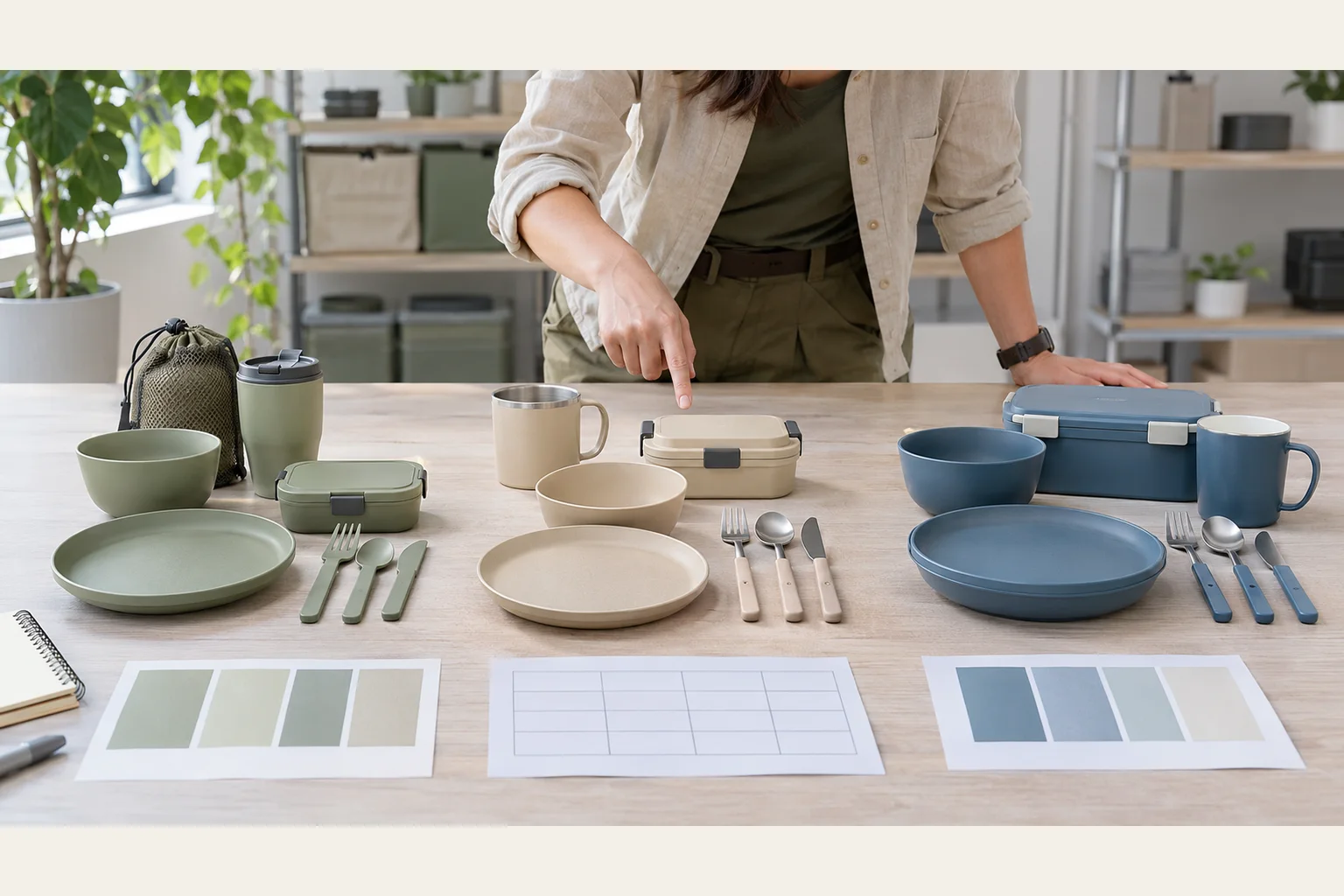
| Buyer-defined segment | Questions to specify | Evidence before approval | Typical inquiry handoff |
|---|---|---|---|
| Frequent technical user | Controlled mass, packed envelope, repeat cleaning, field replacement | Measured sample, component drawing and use-specific protocol | Specification and sample review |
| Casual vehicle-accessible user | Pack-out clarity, missing-part risk, carry distance, storage between trips | Pack sequence, closed-bag review and user trial plan | Configuration review |
| Multigenerational household | Grip, rim handling, component recognition and cleaning responsibility | Buyer-approved usability questions and representative sample review | Sample evaluation plan |
| Campground, rental or hospitality | Issue/return count, replacement codes, cleaning flow and ownership | Controlled BOM, service record and receiving workflow | Program RFQ |
| Retail gift or seasonal set | Shelf story, packaging space, claim boundaries and replenishment timing | Artwork, pack mock-up, compliance file and launch calendar | Packaging and quotation review |
For component fundamentals, use the existing camping set kitting verification guide. For a broader decision path, compare the camping tableware selection questions and the component-lot corrective action guide. Those pages provide inputs; this article controls how market evidence changes the buying brief.
Which Outdoor Participation Frequency Gap Requirements Reduce User Friction?
The outdoor participation frequency gap requirement matrix should remove unnecessary decision and packing friction without deleting controls that protect food-contact use, handling or transport. Ask which task causes abandonment: finding all components, understanding the pack sequence, carrying the set, cleaning it, drying the bag or storing it between infrequent trips.
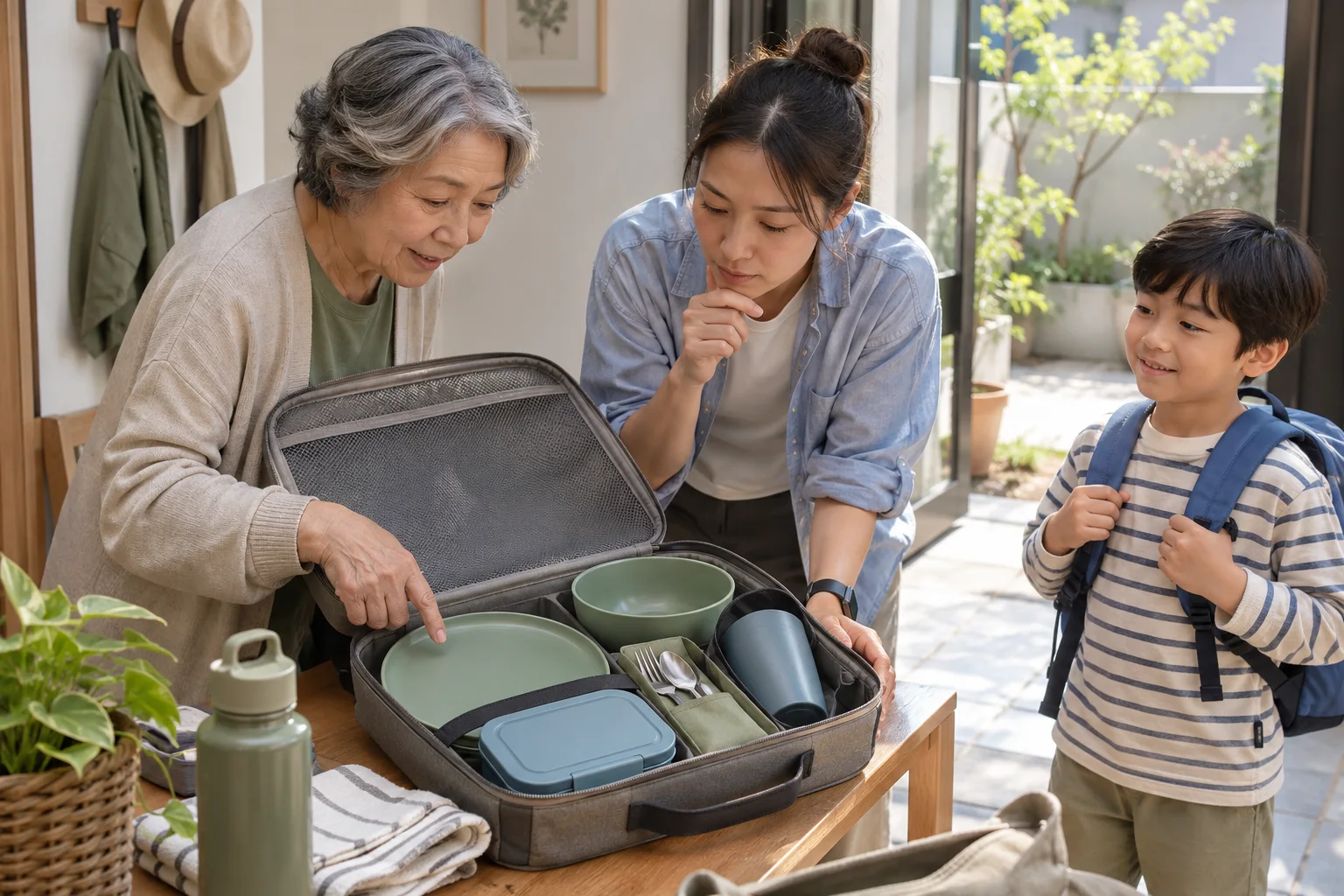
| Friction point | Buyer requirement to write | Sample question | Risk if assumed |
|---|---|---|---|
| Forgetting parts | Visible component map and count at pack-out | Can a user identify a missing item before closing? | Incomplete set reaches the trip or customer |
| Unclear nesting | One approved packing sequence and final envelope | Can the set close without force or rim contact? | Damage, bag strain or inconsistent presentation |
| Cleaning and drying | Component-level cleaning and drying instructions | Are moisture traps visible and accessible? | Odor, staining or closed-bag moisture |
| Too many variants | Decision rule for each component or size option | Which user job justifies the variant? | Stock complexity without buyer value |
| Overstated claims | Claim owner, evidence source and market scope | Is the claim supported for the exact material and use? | Compliance and trust exposure |
How Can an Outdoor Participation Frequency Gap Brief Avoid Overengineering?
An outdoor participation frequency gap brief should not confuse overengineering with high quality. Overengineering occurs when cost, complexity, mass or controls are added without a documented user job or risk reduction. Under-specification is the opposite failure: deleting necessary food-contact, handling, cleaning or packaging controls to reach a price point. Use a requirement-to-evidence record to hold the middle.
Decision rule: keep a feature only when the buyer names the user job, failure risk, acceptance evidence and commercial effect. If one of those fields is blank, mark the feature for clarification rather than quietly adding or removing it.
| Proposed feature | User job | Evidence requested | Decision |
|---|---|---|---|
| Extra service component | Buyer enters the distinct meal or user need | Range data or approved scenario | Keep, option or remove |
| Special carry structure | Buyer enters distance, orientation and handling route | Drawing, packed sample and acceptance plan | Develop or use simpler pack |
| Material or decoration option | Buyer enters market, use, appearance and compliance need | Component specification and evidence file | Approve only after evidence review |
| Claim on page or carton | Buyer enters the decision the claim should support | Claim approval matrix and source record | Approve, qualify or remove |
How Should Outdoor Participation Frequency Gap Signals Enter a Demand Model?
Do not multiply the national participation count by an assumed conversion rate and call it a forecast. The outdoor participation frequency gap is a scenario input, not a conversion rate. Start with the buyer’s reachable channel population, then record the adoption, units-per-order, inventory, season and replacement assumptions. Present a range rather than a false point estimate.
Buyer worksheet: program demand range = reachable buyers × buyer-entered adoption range × units per order, adjusted for opening inventory, replenishment and returns. Every value needs an owner, date and source. Public participation data may inform the scenario, but does not supply the conversion rate.
Before requesting a quotation, separate the commercial forecast from the engineering sample quantity. MOQ, price, tooling, capacity and lead time remain project-confirmed. The existing master-carton marking guide explains why configuration and packaging inputs matter before commercial values can be evaluated.
Buyer Checklist
Send
Target channel, market, user segments, use frequency, access mode, meal scenarios, component wish list, price architecture and forecast range.
Verify
Component jobs, handling and cleaning questions, food-contact evidence scope, pack sequence, storage, packaging, claims and replacement rules.
Approve
Requirement matrix, sample plan, evidence owners, exclusions, assortment logic, forecast assumptions and inquiry scope.

Frequently Asked Questions
Does lower outing frequency mean buyers should always choose a cheaper set?
No. Frequency is one input. The buyer must also define failure risk, expected life, cleaning, food-contact use, pack-out, channel and brand position. A lower price is not evidence of a better fit.
Should frequent and casual users receive different materials?
Not by default. First define intended use and acceptance evidence. Material selection requires verified component, market and food-contact information rather than a user label alone.
Can one set serve hikers, car campers and campground programs?
Possibly, but the shared configuration must pass each program’s required jobs and constraints. Otherwise use controlled variants instead of an unsupported universal claim.
What should be sent for a useful sample review?
Send the requirement matrix, controlled component list, intended use, target market, packaging and claims, plus the questions the sample must answer.
Does Naike Dinner claim that these market trends guarantee demand?
No. The cited sources describe public market observations. Demand, suitability, specification, MOQ, price and lead time remain project-specific.
Request a Participation-Gap Range Review
A useful outdoor participation frequency gap buying brief connects market evidence to buyer-controlled requirements, samples and commercial inputs.
Send the target channel, user segments, configuration, intended use, evidence questions and forecast assumptions. Naike Dinner can review the brief for a project discussion; materials, compatibility, compliance evidence, MOQ, price, tooling, capacity and lead time remain to be confirmed for the project.
Request a Range Brief ReviewSend a Sample PlanRequest a Program RFQ